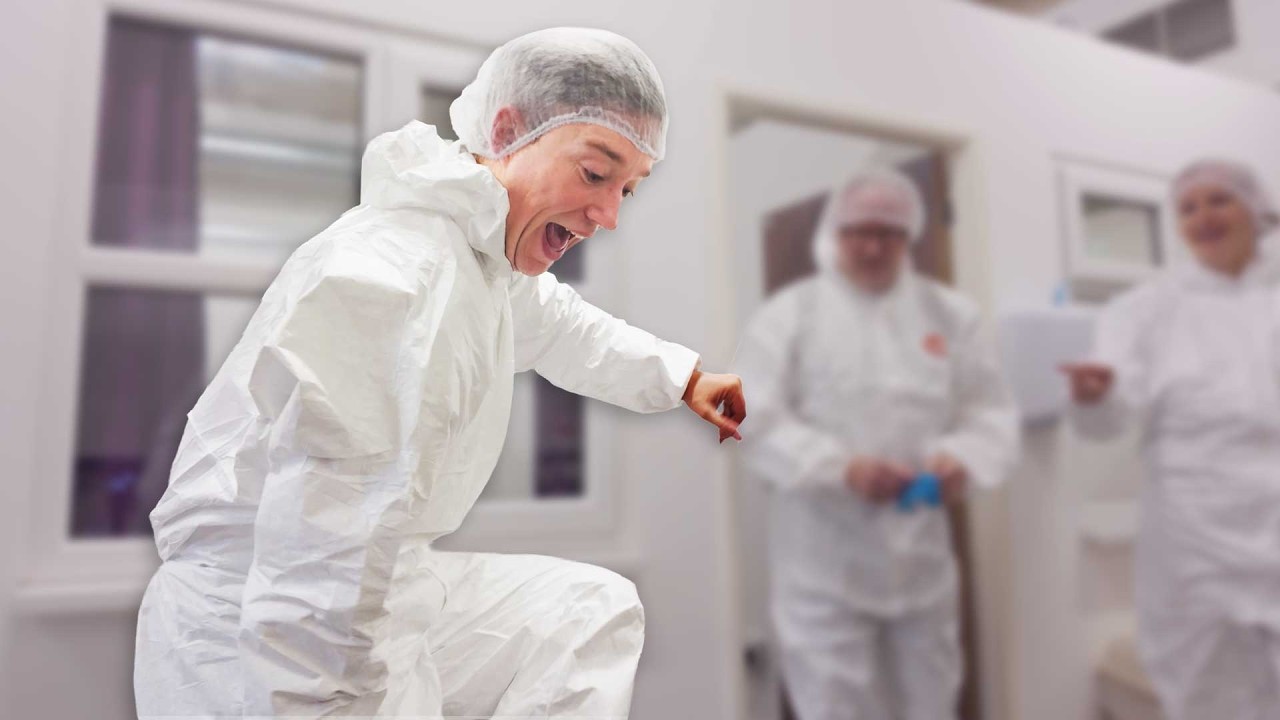
The next stop on my road trip was through the uncanny valley and out the other side metaphorically. Anyway, literally, I was going to Yorkshire. It's the largest historic county in England. Traditionally divided into three ridings, partly because of that and partly because I spent a good few years of my youth there and feel quite a bit of loyalty to it. Yorkshire is getting three episodes on the road trip, one for each riding. And we start in the west. I parked up at the collegiate campus of Sheffield Hallum University, home to the medical and healthcare students and to a very strange hospital ward. — This is NHS signage. — Yeah, it is actually. It's as close to the NHS spec that we physically could get. And you'll see as we walk on the ward how close we are. — Oh, this is a hospital. Every bit of my brain just went, "This is a hospital. " — It even smells like a hospital, which is really weird. — Right. That is Kay. She's a senior adult nursing lecturer at the university and she showed me around their simulated hospital ward that they use for teaching. I need to give you a bit of a heads up here. This is the less intense version of the video, which means a few things in the later parts are going to be blurred and desaturated. We're going to talk about life-changing injuries, surgeries, reproductive organs, and there's going to be a lot of blurred goo, but that's the limits of what YouTube's policies will allow. So, the more intense version is available on Nebula. Anyway, we start the tour with one of the more mundane parts of the hospital ward, the toilets. — My brain has just gone, this is a hospital. Like, we walk through that door and I'm no longer in a university campus. — So, we use this for stuff with physios, with student nurses, anything where we're moving patients around. Everything works. The emergency cord works a little too well. It actually linked to security. So, they actually think it's an emergency. So, we have to be mindful of that. We even have a slle. — Oh, a hospital slle is for safe disposal of bodily fluids, waste, and associated items. And theirs works. They have almost everything they need to run an actual hospital ward despite the fact they don't have any actual patients. — Obviously, fake urine and feces is used. — Of course, it is. — So, we need somewhere to dispose of things. — Okay. So, obvious question. Do you buy that from a supplier? Is there someone who — um we have a Sophie who makes all sorts of really wonderful things. — I should go talk to Sophie. Sophie is a technical specialist on the clinical simulation team and she has particular skills in mouage which is the art of creating realistic simulated injuries and illnesses. We'll see those in a moment. But I should make it clear you do a hell of a lot else besides — Yeah. which we can show. Yeah. As you look around you can tell the it's an actual ward — with patience. with patients. I Yes. Okay. I'm slightly weirded out by the people in the beds, but other than that, this is a perfect simulation of a hospital. — Can we have a look around? — Yes. So, we're going to go this way first. — All right. This way. You You've planned this all out. Thank you. — Cuz I want you to meet the first Sim. — Oh, — so this is Gwen. — I nearly said hi to Gwen. — So, we love Gwen. — Okay. — I think Gwen is one of the most pampered mannequins you will ever meet in your life. She's got a bean bag. She's got some toys. She's even got a health passport which is just on there. — Oh yeah. — So this is something that she would take into hospital with her. So it's how to, you know, properly care for her and things like that. So we tried to make it as real as possible. She has a little dragon here that's tucked under her. Gwen is actually based off a real person as well. um incredibly brave uh little girl that's gone through and had these scans and things like that um for Lifecast to actually be able to make. So, — wow. — My hesitation is not because of the uncanny valley. I did expect this to be a story about the uncanny valley where things like mannequins that aren't quite human enough freak out the brain. But no, I'm stuttering and panicking because on some level my brain has accepted this mannequin as human. Intellectually, I know this is a lump of plastic, but the simulation is so good. That looks like a sleeping kid to me. Oh, that is that feels like I'm holding a hand. A slightly cold hand perhaps, but that's within that's just someone who needs the heating turned up slightly. That's incredible. I feel uncomfortable doing that. Not because it's a mannequin, but because my brain is going, that's a human that I'm disturbing. — Yeah, it's really cool. If you notice as well, Gwen's eyebrow hairs. — She's got eyelashes — and in all individually done — I feel invasive with this camera. I know it's a mannequin. I keep That's every detail. — Sometimes with um Down syndrome, what she's got is a difficult airway as well. So, we can teach people how to manage difficult airway. So, it's not just on the outside, it's actually on the inside. — If you're trying to intubate or — Yeah. because this is based on an actual little girl. Yeah.
Segment 2 (05:00 - 10:00)
— So, she actually has the scars that uh So, — Oh, it's on this side. — Yeah. The little girl had an operation and she's got the scars. — This again I This feels invasive. I did a bit of research on the Gwen mannequin afterwards and turns out the original Gwen has an acting and casting agent. She was paid for her work. She and her family understood everything that was going on. People with Down syndrome tend to have worse health outcomes. So, training students on a mannequin like that is going to be helpful. — Not every patient can say yes and no. Um, not every patient will be perceived to be able to understand things. So, how you communicate is a huge thing. And the fact that Gwen doesn't speak makes it able to do those things with her. — How long does it take the students to kind of get acclimatized to this? Some students love it. Some students are completely freaked out by it. Um, we do like a briefing. Sophie does the briefing a lot explaining about each of the mannequins. — Okay. So, there are other mannequins here. — Yes. Lots and lots of different. — So, I'm going to let Sophie take over on these ones because I'm an adult. Do not deal with children. — I was going to say we we've kind of got a bit of a variety out for you. — How's my reaction to kids as well? So we've got a variety of ages from baby or toddler. I think he's more of toddler size. So again, we've got some sort of lifelike some of the kind of like what we say is ILS mannequins. — ILS. — So it's immediate life support, — right? — So it's um how to kind of deal with a emergency situation. So things like CPR and stuff. So that's kind of what we've got out at the moment. I do want to show you another one though. if you want to come over here. — Um, you saying about Gwen? — However, we do have little Aiah. — Sophie traded me my camera for the baby mannequin. — I mean, it's clear from the way I'm handling the mannequin that this is not something I'm comfortable with. — I mean, you tend to pass this around to students. — So, I'm terrible for doing this. I'm going to take baby off you cuz you look terrible. — Yeah. Absolutely. And I'm much nicer with this. Camera's great. — So what I tend to do with particularly this baby is randomly pass it to a student when they're on the ward because the moment you are a health care professional, doesn't matter what level you are, a child will be handed to you. Doesn't matter if you're a paramedic, uh a radiotherapy and oncologist, a nurse, even if you are not looking after that child, a child will be handed to you. So, I kind of do that to our students, which is a tiny bit mean, but it it's — You saw my reaction. I just have a freeze up like, "No one has taught me how to do this. — I'm terrible with children. " Um, but I know how to hold a baby just cuz I hand it out so frequently. — Yeah. — He freaks me out because I don't do children, but it works really well as a teaching aid for students. — Um, some of our students have got really attached to them. — They do. Yeah. go like, "Where's the baby? We need to put the baby down. " And I'm like, "It is a mannequin, but there we go. " — But he because he's um lifelike doesn't tend to do any screaming or crying, which is really handy. — Yeah. Really, that's not lifelike in my experience. — But we do have ones that are a little more loud. Yes. — Okay. So, now let's leave the children's side of the ward behind. Things are going to get a little bit more intense. No goo to be seen yet, but we are going to dive a bit further into the uncanny valley. My brain just went people. My brain completely out of the corner of my eye. Saw people in the hospital beds. — Yep. So, this is I call her Babs. She's amazing. We've got a few of her, haven't we? — Yeah. So, we've currently got two. She is one of our newer mannequins. So, she's a buriatric mannequin. — Yeah. The UK's National Health Service defines beriatric patients in a few different ways depending on context, but generally that's anyone whose weight or physical size means they're going to have limitations in their healthcare. For someone of average height, that's around 160 kilos or to use the British measurement 25 stone. — I don't want to dro you my dear — and I would not be able to show that anyway. — No, it's fine. Um but like realistic to touch and things like that if you think from I mean I don't know what I'm comparing but okay — she she's supposed to represent 26 stone isn't it she — uh round about. Yeah — about 26 stone obviously she doesn't weigh that but — the body shape — because you need to be able to pick up and lift the mannequin and move to a different bed. — Yeah. But the students — if for example they were learning something like personal care — right — so with someone like Babs because she's a beriatric patient there's more creases there's more folds there's more
Segment 3 (10:00 - 15:00)
opportunities for infection so if we are doing a bed bathing scenario they would have to wash every part of her — and so in that case it's not the right weight but every other detail is there — is the exact same um and we do mean every detail so from a bi biological point of view, — everything you would expect from a biatric patient. The other thing that Babs has got, which she said loves, but she and she does make it better — is she has a diabetic toe also. — Oh yeah, that is because of course the mannequins have to have things beyond what they're in hospital for because every patient is complex. Every patient has more than one thing even if that thing's minor. — Every patient that comes into a hospital environment doesn't come in with one thing. They come with so many different things. So Babs might have come in with breathing difficulties. She might have something like COVID, but um she's got a diabetic foot ulcer that she didn't realize because one of the things with diabetes is neuropathy. So they can't feel it, — right? — So we might be the first person to see that toe. — And so the student's job is to among other things to notice and log and realize that. And the chances are with the level of necrosis on that toe, she could lose it, — right? — Uh which is the fascinating thing that uh we've got someone like Sophie who is able to make that look, what's the best way of describing it? Gooey. — Grosser. And actually um we've all had stories as being a nurse where you've pulled the bed sheets back and the toes come off. — Oh — yes. Uh so and that's sadly not uncommon. Um, — right. — And we kind of want to show the real life grossness of nursing and healthcare in general because it's interesting. Um, it's not just for shock factor, — right? Heaven knows like someone on an actual ward is going to have much grosser seems like such a reductive term, but much more shocking stories than that. — Yeah, definitely. — Every week. It's very funny as well because students don't realize as lecturers, as staff, we are always listening. So if they say anything slightly derogatory, we can pull them up on it and go, "Okay, so patients hear everything. " — Yes, they do. — So with this, — I'm sorry, I don't know why I'd said yes, they do. As if I know that. I just — they really do. They hear everything. This obvious ward is very quiet. Normally, it's a very loud environment. Really really busy. — How many students would you have in here? We can have up to 25 to 30 students um on a full sim. — Yeah. And we have the delight. Do you want to press? — Oh, — why haven't we? — So, we have the bed alarms and stuff which so we will switch them on. Um as in patients are buzzing, the phone will be ringing, there'll be students doing and it gets very loud up here. — Uh which is quite authentic for an actual ward. Um, we also have like crash trolley um on both sides as well, which is what you would have if someone was to have a cardiac arrest. Yeah. — It's got everything you could possibly need in the event of a cardiac arrest as well. — And presumably at some point during a simulation, a mannequin might have a cardiac arrest. — Yeah, which is something that we're going to show you. This is — Oh, did that just blinked. Ah, now I said that. I didn't say he, she, they. I said that. So my brain Yeah, that blinking is enough to make me go, "Oh, no, not a human. " There's a there's different levels of realism. — Yeah. So all the mannequins you've met at the moment are all um simulating life ones, but this one actually does things. So if you notice, she is breathing. — She is the chest is going up and down. Now, is there actually a fan? Can I detect breathing if I — No. Okay. Um but what you can do is you can find a pulse — where you would do on a normal human being. — Got to remember how. — So if you put — two fingers just — just there — slightly down. — Also if you press too hard it will stop as well. Yeah. Which is natural. — Yeah. Of course. That's — so you can take an accurate pulse. — And what Sophie's got there is the controls. — Oh. So that's hooked up to the monitor there. It's showing correctly the heart rate, which is Yeah, that I'm not going to say I got it at 80, but it's about bit more than one a second. — Yeah. — And there's blinking. — She does actually make noises as well, so we can — Sorry. — Okay, I know you're used to this and like I don't normally put myself in a position where I have like a freakout reaction on camera. That was uncomfortable. That was halfway between a mannequin is screaming at me and a person is screaming at me. They can record scripts, have the mannequin speak and respond, or they can give the mannequin a heart attack.
Segment 4 (15:00 - 20:00)
— So, she's gone into — saturation signal low, eyes have shut and — and I will change. — Pulse rate is dropping — and there's no breathing. — There is no breathing. I would not have noticed a lack of breathing. — But you're not a healthare professional or training to be one. — That's probably for the best. — But that that's the interesting thing. It makes it so those little changes that seemed huge. — Yeah. — For you when this world's really busy and noisy. — Are you going to pick up on that? that there's eyes closed, no noise, no pulse? Not when there's three other beds beeping and someone's just handed me a baby. — Yeah. We can actually do more with these mannequins. We can catheterize some of them. Um, and we can actually fill some of their bladders with urine. We don't tend to do that too much because it's electrical. And um, — it's a bit of a panic sometimes. — Yeah. Um I know myself and several lecturers have spent a lot of uh a few times running into the office going I need a bag of foreskins because we are doing caization and we require that and they come in a little bag and you have to physically put them onto the genitalia. — Right. — I told you and you need a new one each time. — No, it's just cuz we remove them uh every now and then because obviously some people are circumcised, some people are not. So when you get to your mannequin and you're like, "Oh, actually I could really do with one that has a foreskin. " — Okay. — Because it adds a level of complexity for doing a categorization, — right? I'm really glad people are training for things like that. It's just it it's a thing that you'd never think of as a lay person. — No. And that's the one thing with all our Sims, with uh the tech team that we have, we're able to um ask for really random things. It's kind of normal. — Yeah, it really is. Sophie is one of several people on the clinical simulation technical team and that team gets some requests that really only make sense in this context. — You can literally say anything and it does not bother us at all. Um like I've had people coming in like, "Can we have some poo? " Yes, that's fine. Um yeah, any sort of question really. We're just like, "Yep, that's fine. We'll just uh walk in across campus with a urine is normal or if we require a particular smell. " So there's certain smells within healthcare which sounds very strange but if you smell that smell it means certain things. Yeah. — So there's something called melina which is um basically a bleed u but it's from um the bowel. So when someone uh basically passes feces it will be a different color and it will smell almost irony. — Right. Once you've smelt that, once you've seen that, you know that that's quite an emergency sort of situation. — That's not going to be in any textbook. You won't like the description is, but that's not going to help you have that realization. — It's that immersive thing. And this is why the ward's best when it's noisiest. It smells like hospital ward, — right? It has to. This is your heads up for where the goo starts. It's not much to begin with, and it's blurred and desaturated in this version. But if you have a weak stomach and a strong imagination, continue with care. We head over to see Chris, a mannequin built to represent a transgender patient who's been on testosterone on tea. And as far as the team here know, that's the only medical mannequin in the world that represents someone who's trans. The blurring you're about to see isn't because of the chest. It's because of the chest wound. They're based on someone that's been on tea for six years, — right? — So, if you notice, the nipples are quite engorged. That's quite common. Facial hair. So, we have actual facial hair, chest hair. — Y that's all individually done. Obviously, I know you're not going to be able to show this on YouTube, but Chris's genitals are exactly what they would be for someone that's on tea, — been on tea, cuz there are going to be changes there. — Yes. So, um we have engorged labia and an engorged clitoris hood. We did have plans to get another transgender mannequin, male to female. However, the company was taken over by a US company and they stopped making them. — This is really unfortunate. — Yeah. Sometimes they don't tell the students that Chris is trans because if Chris was a patient arriving to a hospital unconscious and alone, no one's going to tell the doctors then. — We've actually added a bit of mouage today. Shall I say Sophie has? — Oh, that's new today. — Yeah. Yes. — Right. So Sophie's done — I was going to say as top surgery scars go something's wrong there. — Yes, very much so. And the reason we've kind of done it like this is because when we talk about like gender affirming care, the wait list is so long that people are choosing to go abroad. — Oh yes. — Which adds a level of complexity um and an increased chance of infection. So this is representative if Chris had gone abroad or even in the UK and things went
Segment 5 (20:00 - 25:00)
wrong. The mannequin has regular top surgery scars as default. But the things that went wrong, additional redness, the wound, that was not part of the mannequin. That was Sophie's work that day. A one-off piece just for this video. And it's not just superficial. Oh. Oh, wow. That's — gory. — Yes. — Um, — I didn't expect that. I mean, of course, it's realistic. Of course, that's exactly what would happen. — What do you what are you using for that? Like what's — um So, that is actually uh Vaseline, petroleum jelly. — No kidding. — There was a quite an in-depth conversation last week about can we make it like look thicker? look a bit greener? That was happened between us two. um trying to figure out like I want it to be accurate and Sophie's incredible — and you've got the experience to know you'll have seen stuff like that in reality. — That's what we would call quite a sluffy wound. — Sluffy. Okay. — Sluffy. Um and would probably require a bit of packing. — Um because — as that drains out, there's going to be a cavity — more than likely. Well, I know there's a cavity cuz she made one, but there'll be a cavity that will require packing because when we're dealing with wounds, we heal from the inside out. We don't heal from the outside because that cavity still will be there. Yeah. — And it will work as close as you can make it to the real thing. — Yeah. Um, — it's so unbelievably accurate. Um, it's really cool. I got very excited. — I have to ask, may I? — Yeah. Okay. Um I — Wait, wait. Because we're health — Oh, yes. No, apologies. I mean, that will also mean I don't have to clean my hands much, but uh — yeah, — thank you. — If you want to give it a wipe as well, just in case — this feels extremely uncomfortable for me, but I imagine not as uncomfortable as a patient who hadn't had So, — may I? — Yeah. — I don't want to ruin your hard Oh, yeah. That's that is setting off a very slight not nausea reaction, but you know the reaction where your mouth um — Yeah. feels like just in case you might — throw up later. — Yeah. — Just a little bit of that reaction. All right. I'm going to put that in the waist bag. Thank you very much. — If you've ever seen a video of something gross and wondered why your mouth was watering, it's not because you're hungry. It's because your brain is thinking you might need to throw up soon. And that'll make it easier. So that's the ward. I said thank you to Kay and then Sophie took me over to another building to see two other mannequins. They checked that I was okay with seeing some blood and gore and then they told me very little else other than the simulation would begin when I pulled back the towel. I switched to my 360 camera and set up a few others because whatever was about to happen, it was going to happen very fast. Hi. — I'm Tom. Nice to meet you. Andre, — who's this? — Um, so this is our one of our trauma mannequins. — Okay, that's blood. — If you want to pull the towel back, — right, that's blood. Wait, are we Am I basically — Yeah. — Okay, I'm in the job. Okay, sure. — Okay, let's pull back. Oh my god. Okay, that's right. — What do I do? That's a bloody stump with the bones sticking out of it with active bleeding. I mean, blood is pumping out of there. We'll get a closeup later. I didn't have time in the moment because immediately I was handed a toric and told to stop the bleeding. — You want to get that to around. — Oh my god. Okay. Yeah. And then pull it nice and tight there. — Yeah. Thank you. Now, half of my brain knows that this is all fake, right? I'm on camera. I'm not going to say I was fully convinced, but there is something about seeing the blood and gore that startled me into believing it more than I otherwise would. Part of my brain was treating it like a nightmare where you're still in school and you haven't prepared for the test. Like I am in scrubs attending a patient on a floor that part of my brain has accepted is bleeding out and dying in front of me and someone is handing me a toric and I don't know how to do this. And then you want to twist. Twist that bit. — Twist that bit there. — Yeah. And then you want to tuck it in. — Like — I help you. Yeah. — I'm having a full on panic here. Okay. Yeah. I got that completely wrong because I — So that wants to go under the leg. — And then you want to twist that as — And it tucks in there — nice and tight. Yeah. And then that goes over the top. There we go. Stop the bleeding. — I was bad at that. The patient would
Segment 6 (25:00 - 28:00)
have died. I should learn first aid because if that had been a real emergency situation, I would probably have been much worse than that. The blood is theatrical blood, the same stuff used in stage productions. And as for where it was coming from, you see that blue towel conveniently covering a bit of the ground? What's going on behind there? Is that Is there someone pumping? — Yeah. — Right. Okay, sure. The technician didn't want to be on camera, but they're using one of those garden hand pump pressure sprayers to push the blood through. Anyway, we put a blaster bandage on the patient, which I was also incompetent at. — So, just be careful cuz there is a bone sticking out there. So, — yeah, there is — can be quite sharp. — That also stops the patient seeing their mangled leg if they wake up. — And then with the other bit of the leg, we want to put in a bag and take it to the hospital with the patient. — Okay. Do we have the other bit of the leg? — Uh, we don't. — Okay. That bleeding limb was made by Sophie for this video. The mannequin is just missing a lower leg. It's not bloody or gory by itself. The team now get to reuse that bleeding limb prosthetic in a load of other situations. That's an asset that they'll have for a while, but they wanted something shocking and I was shocked. So, last thing, let's do the close-up. So, yeah, that's without toric. That's incredibly disgusting. Um, I don't know if I can show that. Also, Jay, who handed me the Tori K, he's seen plenty of things like this for real. Could uh to the mystery technician behind the screen, who I know doesn't want to be on camera, could you start pumping again, please? Could you Oh my god. Is that a realistic amount of blood or is that low or high? Or — That is a realistic amount. That's a realistic amount of blood. Yeah. If we get there in time. — So that would be about I mean what there's eight points in a person. — Uh about six liters. — Six liters. Yeah. — So yeah, you're going to lose six liters very quickly even at that rate. I feel weird doing that, but that's — How realistic is that? Is that — That is very realistic. Okay. Yeah, that is as close to real that we can get it. — Wow. — So yeah, — the only thing I would say is that there's no smell. — So in real life, you would be able to smell the iron in the blood. Um, this you can't, but everything else looks real. — Thanks, folks. — You know what else is on Nebula? Not just the unblurred version of this episode, not just the next episode in this series, but also Nebula originals that you can't watch anywhere else, like Days from the channel Not just Bikes, which is about uh Well, Jay, why don't you TELL THEM? HI, TOM. — HI. Day Pass is a public transit travel show where I visit a different city every episode, see some interesting cultural and urbanist destinations while also riding as much public transit as possible. Right now, as this video goes out, Nebula annual subscriptions are 50% off. That's $30 for the year, which works out to just $2. 50 a month if you use the link on screen or in the description. And there's even 40% off a lifetime subscription. You can watch day pass right now. You can watch the goo from this episode right now. And as for the next episode, well, next time or right now on Nebula, I drive something nicknamed the floating coffin, get scared by a moth, and apologize to a seagull.