Genius Solution to Transform Barren Land into Fertile Garden
7:32

Genius Solution to Transform Barren Land into Fertile Garden

After Skool 28.04.2026 60 998 просмотров 3 780 лайков

Machine-readable: Markdown · JSON API · Site index

Поделиться Telegram VK Бот
Транскрипт Скачать .md
Анализ с AI
Описание видео
Want to restore the planet’s ecosystems and see your impact in monthly videos? Join Planet Wild and try the first month for free: https://planetwild.com/r/afterskool/join If you want to get to know them better first, check out their mission in Tanzania: https://planetwild.com/r/afterskool/m33 This episode features two simple solutions to transform degraded, deforested land into lush, fertile habitats. Across Africa, people are coming up with innovative, simple techniques to stimulate the ecosystem, reverse a vicious cycle of devastation and restore biodiversity. The first method is called Bunds, also known as "Earth Smiles", which are a simple, low-cost rainwater harvesting technique used for landscape restoration in arid and semi-arid regions. They consist of semi-circular (half-moon shaped) pits dug into the ground, with the excavated soil piled up to form a small embankment. The open side faces uphill, and the curved "smile" side faces downhill to catch and hold runoff water. The second method is called Farmer Managed Natural Regeneration (FMNR), which has managed to bring back an estimated 200 million to 240 million trees across Africa — without planting a single tree. How? By utilizing the underground forests that already exists. When a tree grows, its main shoot releases a hormone called auxin that suppresses the growth of other shoots and buds - to focus energy into one single strong trunk to create a tree. But when the tree is cut to a stump, it stops producing auxin even though the roots stay alive underground. As a result, dozens of shoots sprout at once, competing for resources making it look like a bush. Essentially this simple technique is about choosing one or two strong shoots and pruning away the rest so the chosen sprout can quickly become a tree again. This growth happens much quicker than planting a tree because the root system is already established. Big thanks to Planet Wild for collaborating on this video. It's an honor to contribute to an organization that is actually doing good...not just saying they're doing good. Subscribe to our monthly newsletter https://www.afterskool.net/ Support After Skool on Patreon https://www.patreon.com/AfterSkool to help us pick video topics and get early access to videos.
Оглавление (2 сегментов)

Segment 1 (00:00 - 05:00)

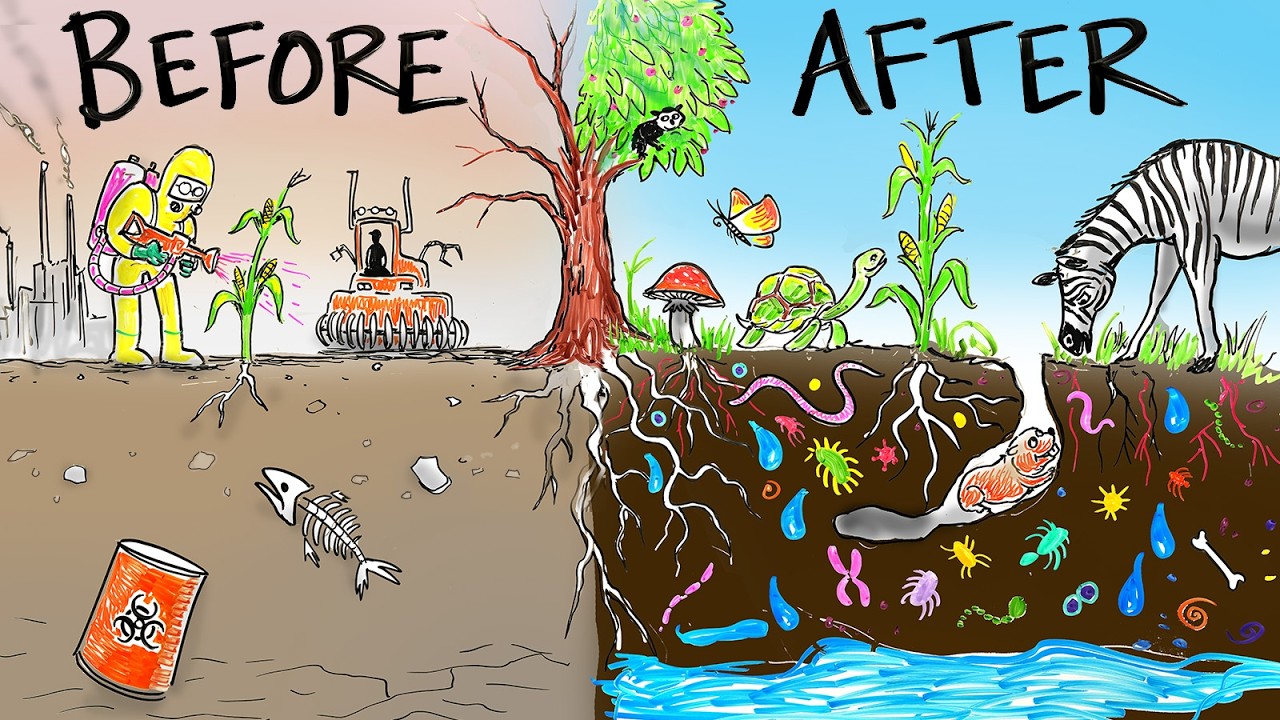
For the last 30 years, we have been bombarded  with the narrative that man-made climate change is   going to end civilization. The planet is getting  hotter, ice is melting rapidly, species are going   extinct, and cow farts are off the charts. It's  easy to become cynical about the future with a   neverending doom and gloom. But I'm here today  to present some good news about the environment.    What if I told you we could turn this into this?   And we can do it without advanced technology   or planting a single tree. It all starts by  understanding more about the ground beneath   our feet. Or more specifically, soil, one of the  planet's most important natural resources. Soil is   a living mix of minerals, plant material, water,  air, and billions of microorganisms that make life   on Earth possible. It grows our food, filters our  water, recycles our waste, and keeps the ecosystem   balanced. However, we take the soil for granted,  and how we have been using the land for the last   100 years has had lasting effects on the planet's  soil quality. Onethird of our soils are already   degraded, which means they are too damaged and  nutrient poor to be productive. This has happened   for a few reasons. As the planet gets warmer,  it can lead to something called desertification,   where once lush forest and fertile land is turned  into dry, arid desert. When this happens, the soil   is no longer able to absorb water. So instead of  soaking all the water up, large areas are washed   away, taking with it vegetation and all important  nutrients. Over time, the land gets drier and   harder to work with, which not only breaks  down the ecosystem, but also the communities   that need it most. These days, we use all kinds  of pesticides, fertilizer, and machines to grow   crops and feed livestock. But all these chemicals  in the ground kill many of the important microbes   needed to keep soil naturally healthy. What's  more, when the same crop is planted repeatedly,   called monoculture, it continuously extracts the  same nutrients from the soil over and over again,   leading to large imbalances and making  the soil even more useless over time.    All of this leaves us with a planet where soil  is nutrient poor and degraded. And when soil is   degraded, we all feel it. In rising food prices,  failing harvest, malnutrition, and in social,   political, and economic instability. But in some  of the most ravished places on Earth, resilient   people are finding a way to not only survive,  but thrive, turning barren wastelands into lush,   fertile gardens once again. In this episode,  I teamed up with Planet Wild to showcase two   genius solutions that are having a profound  impact. These are buns, also known as Earth   Smiles. And their job is simple. Collect enough  water to rewet the landscape. Buns are engineered   barriers built close to contours and slopes dug  to slow, catch, and store surface water runoff.    It may seem counterintuitive, but the drier soil  is, the worse it becomes at absorbing water. Just   look at these examples of water absorption between  these three states of soil. As you can see,   the moist, spongy soil drinks the water right  up, while the driest soil forms a hardened, waxy   shell that won't let the water in. So, even when  it rains, the water simply runs off. In Kenya,   the Messiah have found a simple way to make the  ground more absorbent by digging tens of thousands   of these buns. Each bund sparks a beautiful chain  reaction. As rain collects inside thousands of   slopes, it allows the dry soil to slowly soak  up water again. Seeds sprout and drive their   roots deep into the hardened earth, breaking it up  bit by bit and restoring its original sponginess.    Meanwhile, life can also return, providing  nutrients for above ground vegetation to spread,   which then protects the land from erosion  and provides shade that lowers the surface   temperature and increases humidity. After just a  couple of years, a barren landscape can transform   into something totally different. The second  method involves bringing back the trees. A   common reaction to deforestation is why don't we  just plant new trees? This makes sense logically,   but doesn't necessarily pan out in practice.   In 2019, Mr. Beast famously planted 20 million   trees to celebrate hitting 20 million subscribers.   Planting trees is a noble pursuit, but as of 2025,   only about 6% of the trees planted were still  alive in the areas where follow-up surveys were   done. A more successful and efficient technique  called farmermanaged natural regeneration FMNR has   managed to bring back an estimated 200 million to  240 million trees across Africa without planting   a single tree. How? By utilizing the underground  forest that already exists. Here's how it works.

Segment 2 (05:00 - 07:00)

When a tree grows, its main chute releases a  hormone called oxin that suppresses the growth   of other shoots and buds to focus energy into one  single strong trunk to create a tree. But when the   tree is cut to a stump, it stops producing  oxen even though the roots are still alive   underground. As a result, dozens of shoots sprout  at once, competing for resources, making it look   like a bush. Essentially, this simple technique  is about choosing one or two strong shoots and   pruning away the rest so the chosen sprout can  quickly become a tree again. This growth happens   much quicker than planting a tree because the root  system is already established. And as more trees   recover using this method, the more their shade  cools the ground and their roots hold the soil,   keeping it from being swept away. So, in essence,  these solutions are both about seeing what can   be done with the limited resources we have. Dry,  depleted soil leads to dry, depleted conditions,   which in turn makes the soil drier and even  more depleted. It's a vicious doom loop. The   late great philosopher comedian George Carlin  had a bit where he said, "The planet isn't going   anywhere. We are. " And this is absolutely true.   The planet doesn't need us to save it. We need   the planet to save ourselves. The best thing of  all, biodiversity can recover. Forest can regrow.    Animals can return if we let it. The mission  is to use simple reing techniques to break the   doom loop so nature can restore itself. And it's  astounding how fast that happens when we let it.    Solutions like these are low tech and are having  a real world impact in places that need it the   most. I am honored to have collabed on this video  with Planet Wild, a global community of people who   care deeply about the planet. They partner with  grassroot organizations doing vital work on the   ground like bringing back endangered species,  cleaning our oceans, and reggreening entire   landscapes. They also document all their  missions right here on YouTube, so you can   see exactly where contributions are going and the  impact they're having. So, please check out their   channel and consider joining their community  of over 20,000 members who are contributing   to making positive changes. Scan the QR code  or click the link in the description to join.    You can give whatever amount feels right to you  and you can cancel anytime when you use my link.    The first month is free so you can see the impact  for yourself. Thanks for watching. Stay curious.

Другие видео автора — After Skool

Ctrl+V

Экстракт Знаний в Telegram

Экстракты и дистилляты из лучших YouTube-каналов — сразу после публикации.

Подписаться

Дайджест Экстрактов

Лучшие методички за неделю — каждый понедельник