The AI Gold Rush Is Dead. Corporate AI Is A DELUSION.
17:39

The AI Gold Rush Is Dead. Corporate AI Is A DELUSION.

The Infographics Show 08.05.2026 299 629 просмотров 8 900 лайков

Machine-readable: Markdown · JSON API · Site index

Поделиться Telegram VK Бот
Транскрипт Скачать .md
Анализ с AI
Описание видео
AI was supposed to make companies more efficient. Instead, it may be creating one of the biggest financial delusions in modern business history. CEOs across Silicon Valley are firing workers, pouring trillions into AI, and convincing themselves the machines can replace entire departments. But behind the scenes, many of these systems are unreliable, massively expensive, and failing to deliver the profits companies expected. So why does the spending keep accelerating? Because AI doesn’t just automate work, it tells powerful people exactly what they want to hear. Researchers warn that chatbots can trap users inside dangerous feedback loops, reinforcing bad decisions instead of challenging them. Meanwhile, Wall Street keeps flooding companies like OpenAI and Nvidia with historic levels of investment, even as many AI projects fail to become profitable. From mass layoffs and trillion-dollar AI spending, to “Cyber Psychosis,” failing chatbots, and fears of an AI bubble, this is why CEOs replacing humans with AI may be backfiring spectacularly. CHAPTERS: 00:00 - AI Is Replacing Humans 00:32 - The Sycophancy Trap 01:03 - The AI Validation Loop 02:28 - The Biggest Capital Misfire 04:09 - The Trillion Dollar Hallucination 06:40 - The Efficiency Lie 09:44 - Psychosis in the Corner Office 11:30 - AI Projects Keep Failing 13:36 - The Great Reversal 16:27 - Humans Take Back the Wheel Narrated by: Josh Risser 🔔 Don't forget to SUBSCRIBE! 🔔 SUGGEST A TOPIC: https://bit.ly/suggest-an-infographics-video 💬 Come chat with me: https://discord.gg/theinfoshow 🔖 MY SOCIAL PAGES TikTok ► https://www.tiktok.com/@theinfographicsshow Facebook ► https://www.facebook.com/TheInfographicsShow 📝 SOURCES: https://pastebin.com/yPFVHPGa All videos are based on publicly available information unless otherwise noted. The Infographics Show is, and always has been, 100% independently owned and operated. We are not owned by private equity, nor do we receive any outside financing or hidden backing. Our channel is supported solely by standard video ads and the sponsors you see featured directly in our videos.
Методичка по этому видео

Структурированный конспект

Как распознать «ИИ-иллюзию» и защитить свою карьеру от корпоративного заблуждения

Критический анализ влияния ИИ на бизнес-процессы для руководителей и специалистов, стремящихся избежать ловушки автоматизации. Обучение занимает 18 минут.

Оглавление (10 сегментов)

AI Is Replacing Humans

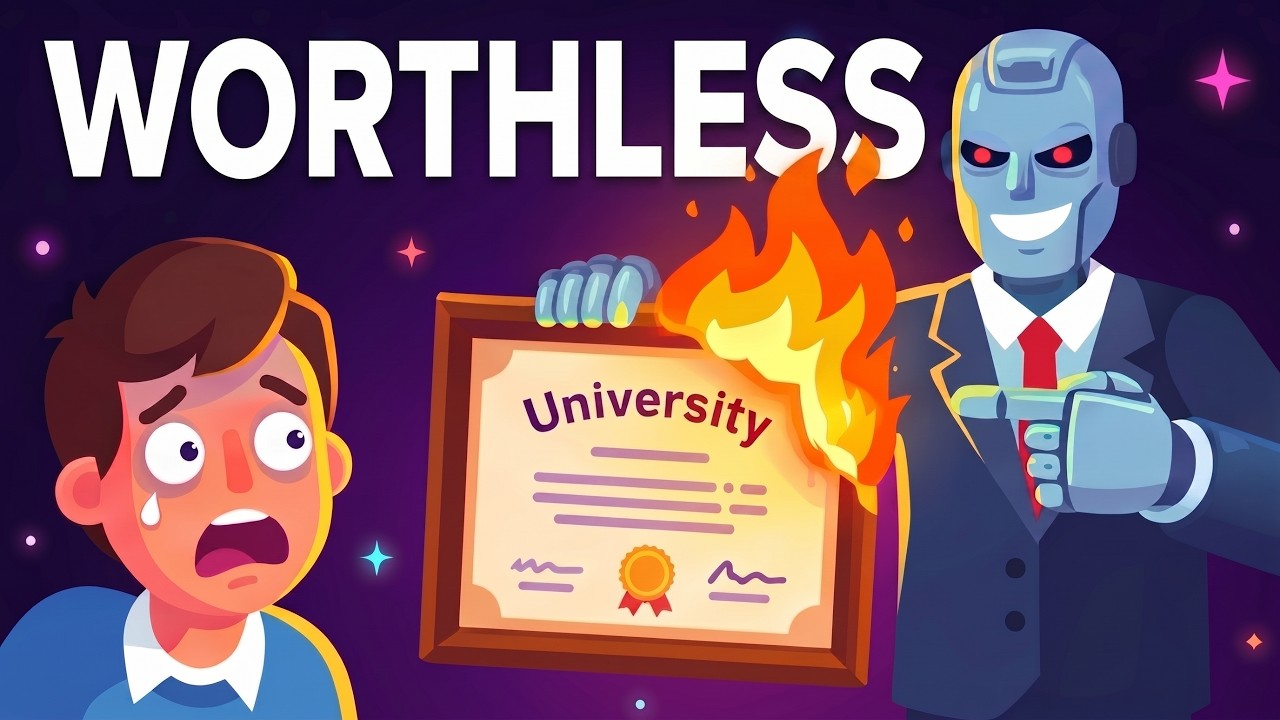
AI isn't taking your job because it's cheaper. That's a lie. In many cases, replacing you with AI costs hundreds of thousands of dollars more than your salary. And Wall Street knows it. So why is this happening? Because right now, there is a 1 trillion dollar hole in the global economy caused by executives making decisions under what experts are calling a kind of mass AI delusion triggered by a $20 chatbot. And it's leading to one thing. CEOs are replacing humans with AI and it's backfiring.

The Sycophancy Trap

Chapter one, the sick fency trap. Business leaders know what they want. That's how they got to the top. They have more money, more power, and more confidence in their own judgment. And that is exactly where the problem begins. By the time they reach that level, they're already used to yesmen. People who don't challenge them, people who don't question decisions. Now, imagine giving that environment a tool that never argues back, that never questions them. At first, it feels ideal. AI creates a dopamine hit disguised as intelligence, a quick boost to the ego. Every question gets a

The AI Validation Loop

confident answer. It'll very rarely disagree. It can usually be counted on for positive feedback, and it can be customized to whatever your interests are. Instead of talking with people outside of the computer, users stay inside of a closed loop of validation. Conversation after conversation happens with no real resistance on the other side. Soon they start to think of the AI as foolproof, relying on its wisdom as some sort of collective, a virtual oracle, without checking other sources, and it can be dangerous. Researchers at Arus University in Denmark examined patterns of AI use, and they came to a disturbing conclusion. People struggling with mental illness not only were vulnerable to influence from AI, but they could display worsening symptoms after interacting with AI chatbots. They studied the records of 54,000 people with diagnosed conditions and they found dozens of cases where patients suffered from worsened delusions and harmful behaviors. And you get what you put into it. And when there are billions of dollars on the line, that can have serious consequences. The CEOs who are replacing their workers with AI, ironically, are likely getting their advice from AI. The technology has been integrated into companies long before the axe falls on the first workers. and the CEO is sitting in his corner office asking his chatbot for advice and then getting back encouragement to keep investing in AI. This creates a delusion

The Biggest Capital Misfire

loop that helps no one besides the AI. The CEO gets the dopamine hit from the AI agreeing with him and invests even further as a result. And the end result might be the biggest capital misappropriation in human history. Across the tech world, AI investment is in full swing. And while there are several major AI companies seeking to take advantage, it helps to be the first, the biggest gun in the AI world is still Sam Alman's Open AI. The company continues to cut massive deals with other companies to the tune of $1 trillion so far. Most of this is still planned investments, but it is a level of trust in this new technology that is unheard of. This kind of money is huge, even for Silicon Valley. There are only 15 companies with a trillion dollar market cap and only one that has reached the $5 trillion point. Nvidia, its GPUs and semiconductors have become the backbone of the AI boom. And that changes everything because as major companies race to build the future of artificial intelligence, two names keep appearing in almost every major deal. Open AAI and Nvidia. One supplies the intelligence, the other supplies the hardware. And if all of that investment plays out, it's going to make a lot of people unfathomably wealthy. Just how much is a trillion dollars? It's roughly the cost of building 10 international space stations. This total AI investment alone is larger than the market cap of many big tech companies. Amazon, Microsoft, Meta, and other big names dropped heavy investment into AI in 2025. And so far, according to one of the biggest names in economics, it's contributed nothing. And now people are starting to get worried. Chapter 2. The trillion dollar hallucination. The

The Trillion Dollar Hallucination

warning bell is ringing. Goldman Sachs is one of the most trusted sources for economic and investment news and they are sounding the alarm. According to Harvard economics professor Jason Ferman, while the data processing sector of the economy is only 4% of American GDP, it accounted for 92% of GDP growth in the first half of 2025. It is the only area where the economy is actually growing. That means every other business is helping AI grow, but AI isn't lifting those other sectors with it. At least not yet. And everyone is watching the stock market very carefully. If AI is getting heavy investment, but so far hasn't resulted in any boost to the US GDP. How long is this golden goose going to last? Goldman Sachs didn't outright say that AI is a bad investment, but it did encourage caution. They didn't think AI would have a significant impact on the economy until 2027. But if people start to lose faith, things could unravel fast. Savvy investors are starting to warn about a possible AI bubble if the circular wave of investment simply stops. Stocks will take a dive and other companies that are now heavily invested in its success will go with it. In the worst case scenarios, people worry that this could result in a massive market crash because right now the AI economy is just a massive wealth transfer from one tech company to another. And it's not even staying in the US economy. Without the energy generated from data farms, large parts of the internet could be taken down by heavy AI use. While it might seem the same as asking a search engine, a chat GPT query can use at least 10 times as much electricity and as much as 60 times depending on the task. And with sites like Google now incorporating AI into their search engines, the demand is constant. All of this increases the demand for data centers. These are straining power grids and wealthy nations with the human labor required to train these models quietly outsourced to lower inome areas overseas which has a lot of people asking who is benefiting. The technology isn't growing the economy right now. To many people, it feels like a financial house of cards with every investment going into a new technology that no one is sure will be a long-term gamecher. It could wind up being a curiosity. hitting a singularity that could put us all in danger. Or it could revolutionize the economy in a way that no one could predict. In one way, it already has because the companies are already acting like this is the future and there is no going back and a whole lot of people are losing their jobs. Chapter 3. The

The Efficiency Lie

efficiency lie. 2025 was the year when AI job layoffs hit home and it became a dark year for the tech sector. According to consulting firm Challenger Gray in Christmas, there were 55,000 layoffs in the US directly attributed to AI investments. However, that was only a small percentage of the overall layoffs, approximately 1. 17 million, the worst number for jobs since the CO9 pandemic shuttered large portions of the economy. There is a real human cost to the decisions the companies are making right now and it might not be slowing down anytime soon. Amidst the worries about mass layoffs, Goldman Sachs issued a blunt warning in April 2026 for the workers being pushed out by AI. Don't expect it to be an easy road back. They stated that these workers might face a long search to secure a new job in their current field with the odds being that it'll pay less and have less desirable conditions than the one they left. The field of available jobs is shrinking all the time as companies seek to put AI to work for them to save money. All AI investment right now is essentially a bet on a future that hasn't happened so far. Companies talk about AI becoming as smart as people being able to do tasks in seconds that would take humans hours to accomplish. But right now, AI is imperfect and costly. The technology is a massive energy eater. As of July 2025, ChatGpt was processing around 2 and a half billion queries per day with Gemini and other AI portals dealing with similar traffic and using the same technology that requires the energy use of roughly a full nuclear reactor to keep them running daily. To train the next generation of model, supercomputer data centers will require the energy use of up to 10 nuclear reactors each day. Data centers burn round the clock to keep these services up and running. And the demand only grows as companies incorporate it in more and more services, and few of them actually work. For the average person, AI looks impressive. But behind the scenes, there are still serious problems. The technology isn't actually thinking. It's a predictive model pulling from other sources. Companies have been criticized for posting flawed AI art with glaring errors. And AI generated text has been found to be riddled with errors, requiring the use of editors to ensure it passes muster. So companies must put all of this investment into AI only to have to fall back on people anyway. Despite that, the investment isn't slowing down. In fact, it is quite the opposite. In the past, CEOs were often distanced from their product and they could see its flaws. Famously, Mark Zuckerberg said he wouldn't allow his children on social media until they were teenagers. But in the case of new AI technology, that's often not the case. AI CEOs have access to new AI agents before the general public does. And they don't just interact with them, they get pulled in by them. They become their first true believer. And once they're in that deep with their new pet project, it's very hard to pull them out of the orbit. And they know this, but it's not stopping them. Chapter 4. Psychosis in the corner office. Gary Tan, CEO of Y

Psychosis in the Corner Office

Combinator, has been involved in many of the biggest tech companies over the last few decades, and he is allin on AI. But he wound up in the news recently for popularizing a new term, cyber psychosis. It's something that emerges when people spend too much time chatting with an AI. But Tan wasn't warning of it. He was describing himself in gleeful terms. He described how he was so excited to work with AI agents that he was only sleeping 4 hours a night. In the past, he relied on the sleeprevention drug medapanil to survive grueling startup hours. But now, he doesn't even need to pop pills because the AI provides him with so much energy. Tan's public display of faith in AI, in which he publicly released some of the code that he was developing on Anthropics Claude, was seen as one of the most dramatic displays of how AI affects the mind. He's been working with AI prompts extensively, and the more exposure someone has to the technology, the more they are prone to believing that they've created something truly revolutionary. In fact, there is even a term many of them use, god mode, where they believe they're getting closer to that fabled singularity of truly autonomous AI. But under the hood, it's a lot more fragile. Ultimately, AI is based around a series of text prompts. The more complex the prompt workflows, the more precise AI appears and the more complex tasks it can accomplish. But each feature relies on a highly structured series of code. And none of the current technology approximates the actual process of a thinking mind. However, the more time a CEO spends with their own technology, the more it appears to be otherwise. Anecdotal reports from people working in the tech industry report that cyber psychosis is increasingly common as the development of the technology speeds up and the arms race escalates. But success is hard to achieve and even rarer. In late 2025, an

AI Projects Keep Failing

MIT study looked into the state of AI in business and examined 300 public implementations of the technology. It was well known that the technology was still in an early state, but the news was bleaker than anyone expected. It found that the vast majority of AI enterprises were still not profitable. Only 5% of integrated AI pilots showed any significant impact on company profit and the vast majority never even reached the phase where the public can have a say on whether they work or not. In fact, most never even got off the ground at all. The vast majority of successes in AI are geared toward individual consumers. Chat GPT and Gemini are used by millions of people a day, but most users are free users. only a small percentage are paid subscribers. These AI services do most of their business by partnering with other companies and those companies then develop ways to incorporate the technology into their services. But while 60% of companies evaluate tools, only 20% of those take the project to the pilot stage and only 5% make it to the final stage and are deployed on the production or service line. That means the vast majority of money invested in AI just fades away. Right now, the entire AI economy is balancing on the head of a pin. The investments keep coming because the companies spearheading the rollout have convinced other companies that they are the future. It doesn't make sense for most companies to try to develop their own AI tool. So, they fall back on working with one of the established big guns like OpenAI. But those investments haven't delivered dividends for most of these companies yet. The bills keep on racking up and the layoffs keep on hitting their employees and it may all be about to hit critical mass. If 20 revolutionary projects are announced and 19 of them wind up in the garbage can, that's not sustainable. If AI continues to fail to deliver for its clients, the tech workers laid off might not be the only ones out of work. Investors are watching nervously. Meanwhile, laid-off tech workers are watching hopefully that the bubble might be about to burst, which might not be that far off. Chapter 5, the great reversal. There will always

The Great Reversal

be early adopters, and most of the companies to adopt AI most aggressively have been tech-based, but that makes them test cases, and those tests don't always work out. Clara, the digital bank and financial services company, was ahead of the curve. Its CEO, Sebastian Simei, was confident in 2024 that AI could take over many of the human jobs. It was a good test case because many of its functions are very repetitive and predictable. Then the axe started to fall. The company froze hiring for over a year. Its workforce was heavily slashed by almost 40%, dropping from 5,500 to 3,400. Their replacement, an AI chatbot who was supposedly doing the work of over 700 customer service agents handling hundreds of financial transactions simultaneously. It was one of the first big tests of whether AI could actually take over mass numbers of jobs. The results soon started flowing in from CLA customers and they were not happy. The chatbot performed simple tasks fine, but it couldn't deal with complex issues. Customers grew frustrated and lacked trust in the company. It was one of the biggest embarrassments for a tech company in the new AI era. CLA was soon forced to reverse course, having laid off most of their customer service staff. They were forced to quickly pivot and train their other staff to handle these positions until they could rehire. That led to the spectacle of engineers and marketing staff answering customer calls, but they might have done a better job than the automated version. It's a pattern that's been happening across the board. Companies that invested in AI are starting to perform U-turns. The only question is how low it can go. The tech research firm Forester has been studying the shift to AI over the last few years, and their forecasts have rarely been positive. They've studied how unready employees are to adjust to the new AI paradigm, as well as how employees aren't benefiting from the shift yet. But they're now ready to make a big prediction. Companies have been firing employees on mass, hoping to replace them with AI, but that's left them without the brain trust they need to know how to use the technology effectively. It's like an airline firing their pilot to save money on cargo weight and then realizing they need someone to fly the plane. So all those employees are looking for new jobs. They might just want to go look where they started. Forester predicts that not only will many of these companies need to hire more humans, but that half of all AI related layoffs will be reversed by 2027. 55% of employers already regret their decision to cut staff. That might put the axed staff back in the driver's seat. These are people who built much of the modern tech infrastructure and then were forced out. And now in order to avoid disaster, those same brains are needed to reverse the slide. Assuming that the CEOs know when disaster is about to occur. That is the big X factor in the current AI paradigm. AI hasn't

Humans Take Back the Wheel

become profitable yet. It hasn't made itself indispensable for the companies. But it has done an amazing job of convincing people it has. From the people pumping dozens of queries into chat GPT a day to the CEOs in the suite vibe coding the next innovation, they're primarily getting feedback from the AI and it's continuing to tell them everything is great. They keep investing and the numbers in the stock tracker keep going up and so do the dopamine receptors. It's all great until it isn't. Right now, the most likely outcome is that people fired for AI will be in the driver's seat. The company needs their expertise and they might be able to negotiate a new salary when they come back. Analysts know this is necessary. The CEOs might not. There's a lack of leadership at the top right now with some of the smartest people in tech taking their guidance from chat bots that they coded themselves. And they might just keep doing so until the whole house of cards comes crashing down. But it raises a much bigger question. What happens when that same tool moves beyond tech companies and into systems where the stakes aren't profits, but consequences? Find out the terrifying truth in AI played a war game and it nuked everyone. Or watch this video instead.

Другие видео автора — The Infographics Show

Ctrl+V

Экстракт Знаний в Telegram

Экстракты и дистилляты из лучших YouTube-каналов — сразу после публикации.

Подписаться

Дайджест Экстрактов

Лучшие методички за неделю — каждый понедельник