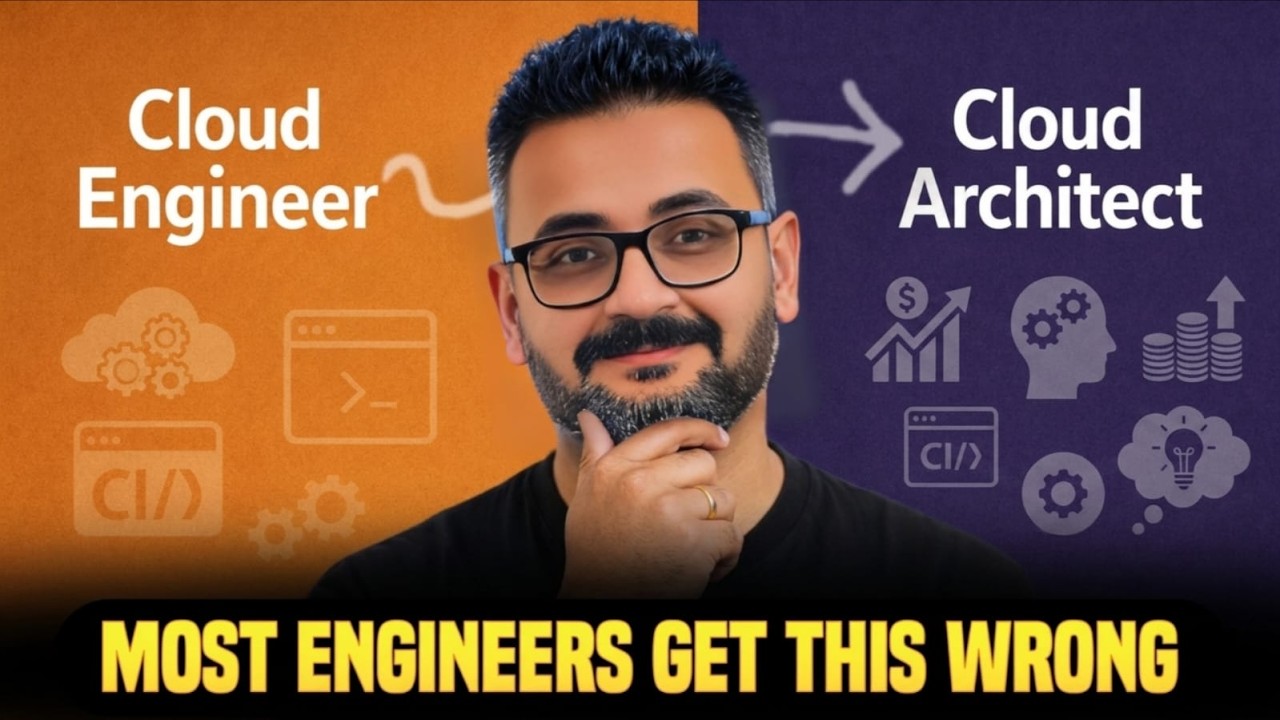
Cloud Architect vs AI Architect — is this switch right for you?
For the last 3 years, the AI Architect role has been rising fast.
LinkedIn is flooded with people changing their titles. Job portals
are listing AI Architect roles every day.
But if you come from a Cloud or Solutions Architect background
with 8–10 years of experience — should YOU make this move?
This is NOT a technical video. This is a career guidance video.
In this video I break down the real mindset shift, the key
differences, and the one hybrid approach that gives traditional
IT professionals the biggest salary advantage in 2026.
What you'll learn:
▶ The core mindset shift: Deterministic (Cloud) vs
Probabilistic (AI) — and why this changes everything
▶ Why Cloud Architect = Building Architect and
AI Architect = City Planner
▶ Role comparison: compute, data, monitoring, priorities
▶ Why "human in the loop" is critical in AI production
▶ 3 real business scenarios with honest India salary ranges
▶ Why the Hybrid Cloud + AI Architect is the biggest
career opportunity right now
▶ What to do if you come from a traditional IT background
──────────────────────────────────
🎁 FREE RESOURCES
──────────────────────────────────
→ AWS MASTER CHEAT SHEET - 163 AWS Services Explained in 1 Line - https://exly.live/q0TBeT
──────────────────────────────────
⏱ CHAPTERS
──────────────────────────────────
0:00 — Is the AI Architect switch right for you?
1:12 — What both roles have in common
1:45 — The biggest mindset shift: Deterministic vs Probabilistic
3:21 — Real example: why AI output varies (context engineering)
4:36 — The analogy: Building Architect vs City Planner
6:02 — Role comparison: compute, data, priorities
8:24 — Monitoring, human in the loop, and production risk
10:39 — 3 business scenarios + India salary ranges
13:12 — The Hybrid Cloud + AI Architect advantage
14:00 — What YOU should do next
──────────────────────────────────
💬 DROP A COMMENT
──────────────────────────────────
Should I cover vector databases, RAG, and model
versioning on this channel? Let me know below —
your engagement shapes what we build together!
#CloudArchitect #AIArchitect #AIMLCareer
#CareerSwitch #ITCareerIndia #CloudVsAI
#GenerativeAI #ITkFunde #TechCareer2026
Оглавление (10 сегментов)
Is the AI Architect switch right for you?
Friends from the last 3 years, AI architect role has been coming up the charts. Wherever you see, you see Naukri, you see on LinkedIn, you are seeing people changing their titles to AI architect. There are jobs which are coming up on your job portals which are very specific to AI architect roles. And we are all thinking, if you are a cloud architect or a solution architect in 8 to 10 years experience or even slightly more or slightly less, you must be curious as to is this for me? Whatever I have been doing, can I use those skills and move towards this career? Now, this is not an answer to be given very, very quickly. So, we have to think from the mindset perspective, then think uh understand some basic differences between these roles, and then at the end we will talk about an approach which will give you the best advantage if you are coming from a traditional IT uh background. And trust me, that advantage will make a huge difference because that is the biggest package gaining opportunity for everyone. So, I will try to demystify this to you in this particular video. This is not a technical video. This is a career guidance video. So, if you are here to deploy some AI models, sorry, it is not for you. But if you are someone who's curious enough to understand how this role is shaping up in the industry, then please sit back, relax, and in few minutes we'll understand how. Let's get started. So, as an architect, the first
What both roles have in common
thing which you do is to design solutions, build solutions. And it could be in any area. You could be an application architect, you could be a data security architect. So, we have talked about what is the architect mindset in a separate video, but I'm assuming that you know good enough about the architect role regardless of where it fits. So, in that sense, AI architect and cloud architect are very similar because here you're deploying and building and designing cloud solutions, here you are doing the same for AI solutions. But what is the key difference? The key difference The key shift is understanding this
The biggest mindset shift: Deterministic vs Probabilistic
difference between D versus P. So, almost everything which you do on cloud as an architect or as an engineer for that matter is deterministic in nature, okay? Deterministic in nature. So, you give an input and then you expect a certain output, and 99% of the times it does come that way, okay? That is what you have been used to. So, it is very predictable in that sense. If you have put a load balancer, and if you have configured it to go to three different places, it will places. If you have set up auto scaling on EC2 instance to generate three different replicas or instances, okay? It will generate it. It will create it if the load increases. So, it is like that. When it comes to being an AI architect, you have to understand the core philosophy that anything we do in AI is probabilistic in nature, okay? So, probabilistic means that you can plan your input, you can also build your model, that model can infer knowledge, it could also talk to different tools, okay? APIs, and then this could be your LLM model, for example, okay? All this you can do, but even then you can't 100% predict the outcome. It is always probabilistic in nature, okay? And that's where as an architect, you have to create solutions or design or build solutions which caters to this probability, which is kind of naturally aligned to manage any kind of output, okay? And this is the greatest power, but sometimes biggest weakness is for building AI solutions, that you cannot 100% predict what it is exactly doing, okay? So, this is the mindset shift
Real example: why AI output varies (context engineering)
basically. So, here a lot of things are very, very deterministic and predictable, but here it varies. There could be n number of factors. If you just go to cloud, for example, okay? I will just give you a recent thing which I was doing. The model itself is so, so different. So, one coding activity or one challenge which I was trying to do with one model, and then when I was switching to another model, you know, the output was completely different. In fact, the other model had to tell me that I'm not able to process this, and then I told it that Mr. Sonnet 4. 6, Opus 4. 5 is doing it very nice. Would you like to learn? Then I made Sonnet 4. 6 learn from Opus 4. 5, okay? This is how different it could be. I'm just giving you an example, but I'm just telling you that it could vary at so many different places. The context engineering Okay, this is a very important word, guys. Maybe I'll make a video on this also. This is booming now. So, now it's no more about prompt engineering. Those days are done. Prompt does not hold that level of value now. If you just ask any LLM, it will create a very good prompt for you. Context is very important. What context you're giving. So, context engineering will be a very important new role getting built. So, when we are worried about layoffs and roles getting replaced, it's getting evolved. So
The analogy: Building Architect vs City Planner
context engineers will come in and start building those contexts around these models. But yeah, this is for some other video. So, this is the main difference, okay? Now, let's understand it through another analogy, which is like So, cloud architect is like your builder who's building your apartment, okay? It is very, very concrete, very concrete. They exactly know how many floors, what is the square feet, how many flats in one floor, when would be the possession. Everything is very, very planned. But when it comes to this area, AI architect, it could be like a city planner. Now, unless you are blessed to be in city like Chandigarh I've been to Chandigarh, very beautiful city. Unless you are in a city which is very planned right from the beginning, the city planning does not work that way, okay? City evolves. So, today you're building the city and the township considering the current factors. But what if there are new people set of people coming into that particular city as part of migration for new job opportunities? You know, it will move, it will shift. New roads need to be created. If there is a congestion, then you have to build a reroute the traffic. All kinds of things can come while planning the city. So, it could evolve very, very organically, you know, as we go forward. So, always imagine that whenever you're building AI solutions, you're actually building a city. You don't know where it will go. You can control certain parameters, but not everything, okay? So, the output is largely out of your control. So, yeah, that's the basic understanding. And now, let's go into the details of these roles and how it varies and what are the salary packages we are talking as far as
Role comparison: compute, data, priorities
India is concerned. So, friends, let's quickly understand some left and right differences. This is not exhaustive, but just a rider for you to explore further. And after this, we'll also take three different business scenarios where we will have three different roles in this area with three different salary packages, okay? Let's start. So, basically from cloud architect perspective, the focus is mostly on cloud infrastructure design. No matter how much you say that you are doing this and that, ultimately you are in the infrastructure space more or less. Whereas here, as an architect, you are not building infrastructure, you're building AI ecosystem, end-to-end ecosystem. You need to know everything around AI. What is rag, how to deploy LLM models, how to tune it, how to use inference. It is completely different thing, but at the same time, we will come to what you need to know from this side, okay? From compute perspective, EC2, containers, Kubernetes. Here, it is GPU clusters, inference servers. There are multiple things, but I'm just giving you some hints like what you need as AI architects from the compute perspective. And it could be that some of the infrastructure you would be using from here as well, okay? So, that's completely fine. From data side, mostly we will be building storage and data flows, and then basically data lake also, that's fine. But here it is more about feature and context engineering and data and machine learning ML pipelines from the data side. As an architect, you need to be focusing more on this. For example, if there is some data coming on the S3 storage, okay? That would pretty much be uh taken care by either your cloud architect or your data engineering team. So, you don't need to know that where the raw files are. Again, this is very, very subjective. So, don't quote me on this, but I'm just telling that if you are in this particular field in a core way, then it might be that you would be not touching the raw landing zone, okay? As a cloud architect, what are your main priorities? Priorities are up time, the cost you are incurring for a particular design on cloud, security, obviously, and performance. Wherein here, the whole focus is around model accuracy, okay? How accurate is your model? Drift. Drift is very important concept like you have to continuously see if your model is drifting away from your intended output because sometimes it does happen. Then again, the latency, how quick or slow your model is. And hallucinations, we all know that the models tend to hallucinate, and they start giving you wrong answers. So, we have to keep a check on it, and that's where your focus would be primarily. From monitoring perspective, you would
Monitoring, human in the loop, and production risk
have you have different tools in AWS, you have CloudWatch, and in Azure also, you have monitoring. Everywhere you have monitoring and observability. But in here, I think MLflow model monitoring would be more focused. Whenever there is an issue on the cloud, uh you will get an alert like server is down, or you would be triggering some alerts. But in this particular role, if your model is wrong, then generally it is completely silent. It won't tell you that I'm wrong. You have to look at the output and decide. And that's why this concept is very important. No matter how advanced we become, this will always be there, which is human in loop, okay? So, whatever the model will generate, whatever your design will bring as an output, there has to be a human after that who should be watching it and making those calls that whether how accurate it is, is it good to go into production, okay? Because deploying AI solutions on production are still something which is slightly riskier because you don't know what might happen. So, you have to keep your check and balances. So, yeah, these are some basic, not exhaustive, but basic differences. If you want to go into detail of how the AI architecture looks on cloud, then tell me, I will do it, but only if I get enough likes, shares, subscribe on this particular video. Also, if you're interested on your generative AI career roadmap, then I have created that blueprint. You can check that as well from the in the description below. One more thing. Last time when I made uh videos on ChatGPT or model contracts protocol, it did not got that much attention. And again, I don't want to bore you with stuff which you don't want to get from me on this channel. So, do give your reactions, your dislikes as well, okay? Completely fine, but I get to know what you See, my thing is, I'm sorry, I'm digressing a bit, but my thing is, whatever I'm interested in and what I think is the future, I try to bring here, okay? It might not be interesting to you, it might be boring, but 5 to 10 minutes, guys, you just scroll for hours. Give it long-form content, still valid, right? Give some time, I think it might add value to you. No pressure, but again, a request that, please, it takes time for building these videos and bring it in front of you. I'm not an expert in everything, but I do my research and I try to bring it to you so that it helps you. So, anyways, let's go back to these three different scenarios of three different business or companies where three kinds of roles could exist, okay?
3 business scenarios + India salary ranges
Let's do that. So, let's talk real business scenarios. At number one, we have a large Indian bank which is planning a migration from on-prem legacy systems as a part of a digital transformation on cloud, and you're doing that cloud migration, building VPCs, cloud landing zone, and you're migrating 200 plus workload, and your priority is compliance and security. This is a pure cloud architect kind of a role, okay? So, the market right now, and the these numbers are just average numbers, okay? So, you could be lower than this, and you could be higher on this, depending on your specific scenario, but this is the range I have got over the internet, and it will continue to change, so don't get fixated on this. This is like a rough indicator, okay? This is pure cloud, okay? Pure cloud. But, what about the other one? What about this one? So, this if we say that okay, this is pure cloud, then something like this is pure AI, because here you're building enterprise AI co-pilot, okay? And it is a 100% AI product line. So, it is a co-pilot which you're building. You already have the back-end infrastructure, everything ready, you're just building on top of it, and you are the AI architect, so you would be working on things like vector databases, rags, GPU scaling, model versioning, and then your approach would be to have AI first architecture. So, this is a pure AI architect role, okay? Pure AI. And the salary range here also is somewhere in this range. And by the way, this is Indian numbers. Globally, if you're watching from some other country, it will vary, but this is just indicative, okay? And then we come to scenario B, which is this one, which is of a fintech. Now, this is very interesting, guys, and this is where my focus is, because this gives best of both the worlds. So, it is a hybrid kind of a role, and here, for example, you're building a real-time fraud detection application, and then you're building those ML pipelines, you're refining your feature stores. You're also at the same time building your AWS infra, managing performance, latency, and on top of it, you also have a hybrid cloud infrastructure where you still connect to something over the VPC or over AWS infra structure or Azure infrastructure to on-prem data center, okay? So, you are using some things from the cloud architect domain, but also doing something on in the AI domain. If you come from this world, you can't directly go to this world. You have to somewhere start from here, find a middle ground. And in fact, in companies also, companies are also not moving directly here from here to here. They also are exploring. So, they need people who have knowledge of cloud infrastructure, on-prem, and then AI. So, this kind of a hybrid cloud plus AI role, cloud plus AI architect or AI architect with cloud architect background would be in huge
The Hybrid Cloud + AI Architect advantage
demand. And I am anticipating, and this is just based on my assumption, also some research, that this role will surpass these two, at least for near future, okay? And the range could be from anywhere from 35 to 55 lakhs and even more, because you have to understand that if you are bringing best of both the worlds, then you're potentially replacing two people in one shot, okay? You don't need a dedicated cloud architect or AI architect. If you can do this, and trust me, guys, during your interview, if you are 70% here and 30% here, even that is acceptable, because even companies are like this, they're 70% here and planning to go 30% here. So, why they would expect you to be 100% and unless they are a very niche product company, which is very high-end, already doing a lot of stuff in AI. So
What YOU should do next
this is my analysis that if you come from a traditional IT cloud background, then this should be your approach, and I hope this helps you plan your next steps. And trust me, even if you don't want to pursue this career, having knowledge about these things, vector databases, what is rag, how an agentic AI workflow works, is always going to be very useful for you, because sooner or later, all this will merge into one role, okay? And these lines are blurring very fast. So, this is my question to you, and you have to answer it in the comment. Do you want me to open up these topics to you? Slowly, in basic manner, how we do it on this channel. Start understanding what is vector databases, retrieval augment generation, model versioning, because this is also good for me, because even I will learn while teaching you, right? So, we can together learn this. But, if you guys say, "No, no, we just want to learn networking and infra and all that kind of stuff which we are very good at. " That's also good. We are doing it anyways, but I'm telling you that we have to expand our boundaries, we have to leave our comfort zone as cloud architects, cloud engineers, and start going into these zones, even without zero expectation. We are not asking anyone to hire us, but what if we know this already? So, that is what I am interested towards, and I want you also to have a think on it, but this is your channel, and you decide what you want to learn. So, if I do not get enough traction, like, subscribe, share on this video, I would automatically understand that you're not interested, and then possibly I will do things which are more relevant to you or more interesting to you. But, having said that, in the meantime, I'll keep exploring, bringing these things which excites me, okay? So, I hope it was a useful video. Let me know in the comment what you would want to learn next, and as always, keep learning, keep growing, and keep sharing. Bye for now.