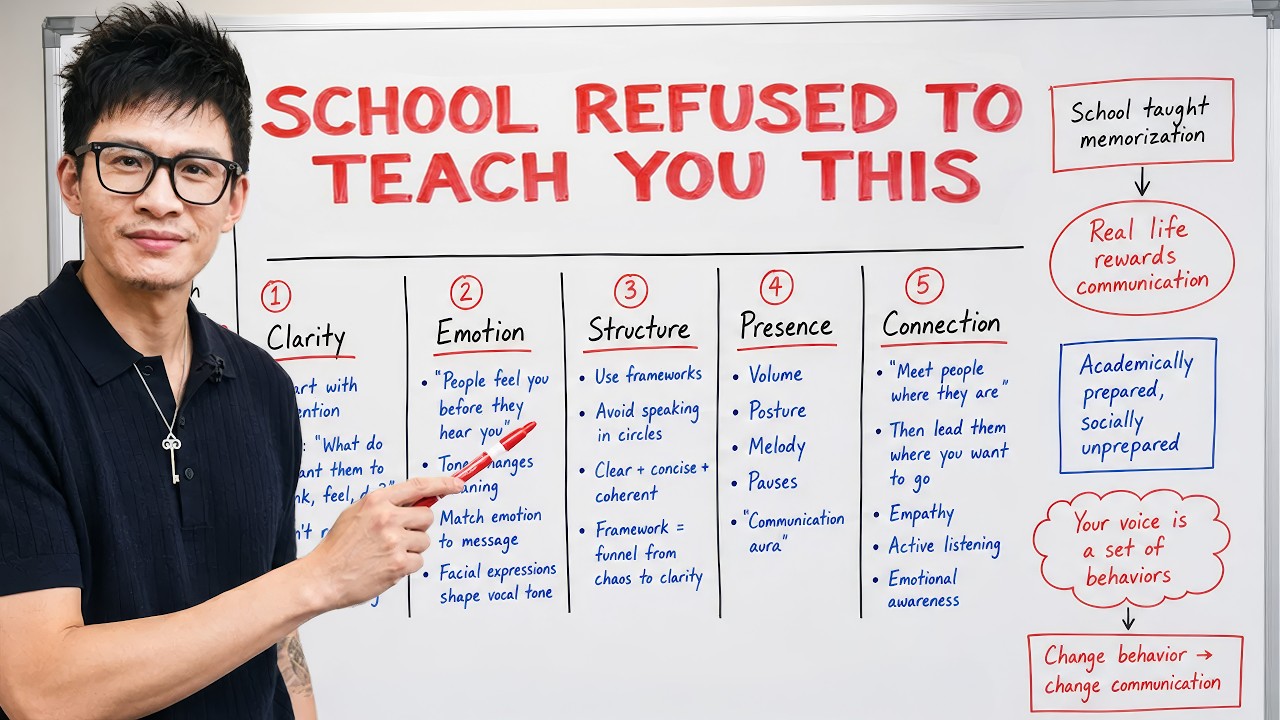
At some point in your life all eyes will be on YOU. Here's the blueprint on exactly how to approach it.
FREE 7 Step Rehearsal Process ➡ https://free.vinhgiang.com/aeoy-7-step-rehearsal-process
TIMESTAMPS:
0:00 - Intro
0:48 - STAGE 1: Before The Moment
11:00 - STAGE 2: Owning The Moment
16:42 - STAGE 3: Beyond The Moment
=== About Vinh Giang ===
Vinh Giang is an internationally acclaimed keynote speaker, communication skills expert, and magician. He blends his unique talents to captivate audiences and deliver powerful lessons on the art of influence, persuasion, and effective communication. His mission is to empower individuals and leaders to communicate with clarity, confidence, and impact, enabling them to unlock new levels of success in both their personal and professional lives.
=== Follow me on social media ===
IG: https://www.instagram.com/askvinh/
X: https://X.com/askvinh
TT: https://www.tiktok.com/@askvinh
FB: https://www.facebook.com/askvinh/
Оглавление (4 сегментов)
Intro
At some point in your career, all eyes are going to be on you. It might be on a stage in front of 500 people. It might be in a boardroom in front of just 10. Or it might be in front of five very important clients. And when that opportunity arises, if you learn how to shine, this will completely change the way they perceive you and your capabilities. This is where career advancement lives. And this moment, it's coming for you whether or not you are prepared. My name is Vin and over the last 15 years I've climbed the mountain that is professional speaking. Thousands of stages, millions of people. And today I'm distilling every framework, every mistake, every lesson into a complete system. Before the moment, owning the moment, and then beyond the moment. You don't need to be speaking on big stages for these lessons to apply to you. Stage
STAGE 1: Before The Moment
number one, all of your fears and anxieties around public speaking, it's all fixed in the prep work before the moment. And if you watch only the first section of this video and practice it, I guarantee you it's going to solve 80% of the problems you experience in that moment. Most people just wing it when it comes to presentations. And they wonder why they get nervous. It's because you're winging it. Years ago, before I ever began my career as a keynote speaker, I took theater classes to help me improve my stage presence. And there was a rule that I learned from the world of theater that blew my mind. For every 1 minute you spend on stage, you rehearse for 2 hours. Let that sink in for a second. For every 1 minute you're rehearsing for 2 hours, you're probably thinking, Vin, that's overkill. Yeah, that's exactly what I thought, too. But then I realized, ah, this is what it takes to be world class. So, it made me think, and I want you to think about this, too. Most people in life, they're not going to do the work. Most people just do the bare minimum. And I decided, I'm not going to do the bare minimum as I've been doing up until that point in my life. What if I started to do the bare maximum? What if I went all the way? What if I chose to be world class instead of just average and just being okay? So, I did the crazy. I learned my speech inside out. I mastered my vocal delivery. And I perfected every single beat and every single movement of my talk. And I dedicated myself to this for months. And you know what happened? It paid off. When I delivered that presentation, I freaking crushed it. All thanks to the rehearsal that I'd put in. And do you know what that unlocked? Momentum. Every single speech that I did led to more opportunities, bigger audiences, bigger and better companies. Microsoft, American Express, and I've recently done a gig for one of my favorite gaming companies, Blizzard. They sent me one of my favorite characters, Sana Windrunner, who was a high elf who then became a banshee of the undead. So cool. Now, I know what you're already thinking. You're thinking to yourself, "Vin, I just want to get better at running my weekly team meetings. " Look, you don't have to be extreme like me. The level of rehearsal you do is dependent on the stakes of the presentation. If you've got a 10-minute weekly standup at work, maybe rehearse it between one to three times, and that might be enough. But if you know that the leaders of your organization are going to be in that meeting as well, maybe rehearse it at least 10 times. But then a 10-minute pitch to a group of investors that could lead to hundreds and thousands of dollars of investment for your business. Yeah, I'd be rehearsing that at least a hundred times. So, let me tell you how to rehearse. I personally do a sevenst step rehearsal technique as a professional speaker, but this might be overkill for most people. So, I recommend at least doing the first two steps. Step number one, do between 5 to 10 table reads. Print out your script and then read it out loud from start to finish. Not in your head, out loud. Here's where most people go wrong already. They read it quietly while pacing back and forth and they've rehearsed that movement into their presentation. The way you rehearse is actually the way you end up presenting. This is why you see so many people when they're on stage and they're speaking, they walk back and forth, non-stop. Here's the fix. read with the same energy while you're rehearsing in your room, while you're doing the table read, with the same energy, same volume, and same pace as you would, as if you're reading in front of a live audience. And if that's how you rehearse, that's how you're going to present and deliver on the day. Higher levels of energy and effort during rehearsal leads to higher levels of retention. You remember things more when you rehearse like this. And lower levels of energy and effort during rehearsal leads to lower levels of retention. That's why when you read things in your head, you don't end up remembering any of it just by you doing step one. That already puts you ahead of most people. But if you want to take things to a whole another level, let's learn step two, which is called improv rehearsal. What I mean by this is that you can still have your script in front of you, but you're going to try to deliver the speech without looking at the notes. Inevitably though, at some point, you're going to forget where you're up to. what you're going to say next. And when that happens, don't go to your notes straight away. Just pause for as long as you need. Take a big deep breath and do everything you can to try to remember. After at least 10 seconds, if nothing comes, then look at your notes. The 10 seconds of trying to remember is the whole point. Because when you strain yourself to remember and then the thought finally arrives, whether from your own head or from the page when you check the notes, that struggle is what burns the material into your mind and your brain. Another reason why I get you to pause for 10 seconds while trying to remember is now you're also rehearsing in what to do when you forget where you are. Most people when they forget, they start to panic. They start to hyperventilate. They freak out. They flare on their arms and then they themselves. The reason I'm getting you to pause for that extended period of time while you're remembering is because now you're practicing a new behavior when you forget where you're at. Now, instead of panicking in those moments, you just end up pausing. And because your mind and your body is more relaxed, you are in a state that's more likely now to remember where you're up to. If you think that's enough for you, great. Take it and use it. But if you want to be world class, if you want to do what most people don't do, and if you want to be crazy like me, if you want to learn the sevenstep rehearsal process for your next presentation that has the opportunity to potentially change the trajectory of your career, then I recorded a sevenstep rehearsal process video just for you. Just click the link that you can see inside the description below or you can scan the QR code that is on screen right now and it will take you to that free training. If you want to be prepared for the next opportunity that's coming your way and I guarantee you there's an opportunity that's coming your way, then learn how to rehearse. Learn how to be prepared. Now, you may be fully rehearsed, but the moment you set foot on stage, nervousness and anxiety kicks in. So, what do you do about that? In those few moments before you step on stage and speak, when you see the faces of all the people you're about to speak to, and you feel the attention that's starting to come your way, all at once, your mind starts to smile. Your heart starts to kick in and race. You go into overdrive, your breathing becomes shallow, your palms start to get shaky and sweaty, and you think to yourself, "What if I suddenly go blank? What if I forget my lines? What if I mess this up in front of everybody? What will they think of me? " Even after 15 years of doing this, I still get nervous before every single keynote and presentation that I need to give. It hasn't gone away. But what has changed is that now I have a system to manage it. And it works on three levels. Psychological, physiological, emotional. And you need to hit all three. Firstly, psychological. And this one is the most important one. The reason why you get nervous is because you're only thinking about yourself. What if I forget? What if they judge me? What if I look stupid? It's me, me, me. It's all about you, isn't it? And when your attention is pointed inward, the nerves take over because all you can see is everything that could go wrong for you. So instead of being self-conscious, learn to become audience conscious. Before I walk on stage now, I always think to myself, even if just one person in this audience improves their communication skills, this is going to create a ripple effect in their life, their family, their friends, their workplace, the people they serve, I need to make sure I stay focused on helping them unlock their voice so they can unlock their potential. Today's not about you, Vin. Today's about all the faces you can see as you look out into the audience. And the second I shift my attention outward instead of inward, I feel this massive weight that just falls off my shoulders because I'm no longer thinking about me and focused on me. It's about how can I best serve the people that are listening to me in front of me right now. Once your psychology is dialed in, you then have to focus on calming your body, your physiology. The reason your body shakes and your voice trembles in these moments is because your brain thinks you're about to wrestle a giant two-headed dragon, which floods your system with adrenaline, and then as a result of that, blood goes to your hands and your arms and they go to your legs. So, you can either now fight or run away. But in reality, you're just talking to people. It doesn't have to be that scary. So, what I like to do before a big presentation, and I do this every single time, is before I go out into the spotlight, when I feel my adrenaline starting to pump in my body, I dump it all out. Not by taking a poo. But in all seriousness, I do get rid of all of that, the adrenaline all backstage. And the way I do it is by doing push-ups, by doing star jumps, by skipping. And I know I might look like an idiot while I do this, but I don't care because the alternative is walking out on stage with all of that adrenaline still stuck in my body. And then the second thing I do is I do Wimhof breathing. Make sure you look it up if you don't know what this is. And just a few rounds of Wimhof breathing will calm my nervous system, slow down my heart rate, and reset my mind and body. Now, once I've dialed in my psychology, physiology, the last thing I do is I fill my mind and body with good emotions. And here's something I learned from one of my friends, Mel Robbins. She's an incredible human. When I was growing my speaking career in the US, she said something to me that I have never forgotten. Vin, nerves and excitement are the exact same physical state in your body. The only difference is how your brain reacts to it. And she's right. Think about this for a moment. When you're excited, when you're nervous, it's the same symptoms. Your heart rate goes up, your palms get sweaty, your chest gets tight, and your body can't tell the difference. The only difference is the label you put on it. So relabel it instead of saying to myself, "Vin, why are you so nervous? " I say to myself, "Oh, Vin, this is the feelings of excitement. You're getting excited. " One more trick that I do before I step out into the spotlight is I watch funny videos, which puts me in a playful mood just before I greet the audience. To recap, shift your focus outward, burn off the adrenaline, manage it, reframe the feelings, do those three things before every presentation, and
STAGE 2: Owning The Moment
watch those nerves start to vanish away. No, no, Craig. No, no, no. Don't make me vanish, Craig. No, not me vanish. The nerves vanish. Damn you, Craig. Well, I guess we just got to do the rest of the video like this then. Well, then let's do it. Fine. So, now you're in the moment. You've done the prep. You've got the nerves under control, and you're about to open your mouth and say your first words. This is the critical part of any speech or presentation. Craig, can we seriously bring back now? This is ridiculous, man. Oh, thank goodness I'm back. If only you could do that for your dad, Craig. Back to what I was saying. This is how most people open a presentation. They get up in front of the room. They stand behind a lectern like it's a shield. They sound overly formal and then they get straight into the content. And almost immediately, you can feel the audience disconnecting in real time. It doesn't matter if the content of your presentation is gold. If you lose them in the first 30 seconds, you're going to spend the next 30 minutes trying to salvage their attention back. And spoiler alert, most of the time you won't be able to get their attention back. So, here's the rule I live by when I'm opening my presentations. Start with connection, not content. Every single time I do a keynote, I open with a short personal story. I don't open with research. statistics. I open by telling the people a little bit about me. Specifically, an origin story that has shaped me because storytelling deepens the connection with the people around you. And it also humanizes you. I've been able now to relate to them. And as a result of that, they'll be more invested in what I have to say in my speech because we're now mates. So by starting with connection, you now build a bridge between you and the audience, which makes the transfer of content back and forth much easier. And this principle doesn't just apply to keynotes. I mean, let me give you an example with a job interview situation. Instead of answering the question, tell me a little bit about yourself with descriptive words like integrity, intelligent, and the classic, "My biggest weakness is that I'm a perfectionist. " Instead, do what I do in my keynotes. Tell them a short origin story about yourself. And here's a pro tip. If you can link that story to the reason why you applied for the job, if you want to learn how to do that, click this video here and check that out. Because once you do that, oh, this is going to build connection with the interviewer right from the get- go. And to be honest, what is this going to do? Well, it's going to put the rest of the interview on easy mode. Why? You already know the answer. Because of connection. But how do you deliver value now in a way that keeps people engaged once you're connected? Well, it's what I call the 33 3331 formula. And I'll tell you about that formula in just a moment. But first, let me ask you this. I want you to think about the most boring presentation you've ever been to. The kind that you just sit in and then scroll through your phone the entire time. Then I want you to think about the other type of presentation, the one where you forgot you even had a phone, where you locked your attention on stage for a full hour and only felt like 5 minutes. What was the difference? It wasn't that the boring one had worse content. The boring presenter only did one thing. They just informed you. Whereas the great presenter, they taught you something. They made you laugh and they made you feel like anything was possible. When I was building my professional speaking career, because I had a background in professional magic, I went full entertainment mode and I used to do 100% magic and loosely link things into lessons that I'd learned during entrepreneurship. And although it was entertaining, I remember hearing the feedback from the organizer saying it felt like it was just the magic show. So then I took on that feedback and I was really buttth hurt by that. And then I went pure education mode. the very next presentation. All I did was educate the audience and then I ended up putting them to sleep. It wasn't until I started asking every single event organizer that booked me this single question. I asked them, "What do you want your audience to take away from my presentation and then I started hearing them all say the exact same thing. " Vin, we want them to learn something pragmatic and useful. feel inspired and we want them to have fun. 33% should be education. 33% should be inspiration and then the other 33% should be made up of entertainment. What does this mean? Well, it means when I'm writing my speech, I make sure there's an even balance between those three ingredients. I don't go too heavy on the entertainment. I don't go all rah inspiration and out content because it will make the audience actually Sorry, I just got a bit of Did I make you yawn? Because if I actually made you yawn, you have to comment below and let me know because yawns are ridiculously contagious. So don't do that to your audiences. Make sure you include all of the three ingredients. And did you notice I was still missing 1% for those of you who are good at math? The last 1% is your X factor. It's the thing that makes you unique. And for me, it was my ability to storytell. bring audience members on stage and perform magic. It was my ability to use my voice, my stage presence. I learned all of those skills from performing as a magician. Yours might be that you know how to make Excel spreadsheets fun using memes. And this is the lens that I want you to look through in everything that you do. I mean, if you've made it up until this part of the video, have you realized that I'm not only here to educate you, that I'm here to make you laugh, and I'm also here to try to inspire you to be a better communicator. Notice how I'm using the very ingredients that I just spoke about. And as a result, this video is way more engaging. Right? Stage
STAGE 3: Beyond The Moment
three, beyond the moment. Most people think the work ends the second you walk off stage. No, that's actually where most of the important work begins. Because after 15 years of doing this, I've noticed there are only two ways people tend to feel when they walk off the stage or out of a meeting. Either they're convinced they absolutely killed it, or they want the ground to swallow them whole. And in both cases, they're usually wrong about how it actually went. I remember early in my career, I walked off stage for a gig I did for a group of dentists in Sydney, and I was convinced that I'd smashed it. The event organizer shook my hand as I walked off stage, smiled at me warmly, and said to me, "Wow, man, that was one of the best talks I've ever seen. " And I was thinking, "Oh my goodness, really? I thought I did a terrible job. " And that made me feel amazing. So, I decided to stay for the rest of the conference, mostly so that, you know, other people could tell me how amazing I was. But then that didn't happen. The only person that said I was amazing was the event organizer. I remember thinking, "Well, that's a bit weird. " And as I sat in on the next speaker's session, I remember sitting there thinking to myself, "Wow, this speaker is really monotone. The delivery is flat. There's ums and everywhere. This is so bad. I can see the audience checking out and being on their phones. " And I just thought to myself, "Oh man, sucks to be that presenter. " And then I see him walk off stage and I see him about to greet the event organizer and I'm thinking to myself, "Oh, this is going to be so awkward. I wonder what she's going to say. " I see them shake hands and I literally hear her say, "Oh my god, that was an amazing presentation. You did a great job. " — Yep. She said to that guy the exact same thing she said to me. Which means what? Which means I was bad just like that guy was bad. The point I'm trying to make here is that people are never going to tell you the real story about how you communicate. They don't have the heart to hurt your feelings. And even if they wanted to help you out, they don't know what specific feedback to give you anyway. So, it's easier for them to say, "Oh, you were amazing. You did great. " So, if the people around you are never going to tell you what you really need to hear, you have to find a way to be able to see it for yourself. That's what self-awareness is all about. The way you build it is extremely straightforward. Even though doing it takes a bit of courage. You film yourself every single time, everywhere where you want to see improvement. Every keynote, every team meeting, every pitch, every Zoom call that you can reasonably get away with recording. And then here comes the painful part. You sit down and you force yourself to watch the whole thing back from start to finish. I'll warn you right now, you're going to cringe. You're going to sweat. You're going to hate the process. You're going to notice things about the way you speak and the way you carry yourself that make you want to fling your laptop across the room. When I first started wanting to improve my keynotes, I did this very thing, but I took it to a whole another level. I remember duct taping two GoPros together, one facing me and one facing the audience, and I'd set them up in front of every single stage that I was speaking on. That way, I could see my delivery and the audience's reaction in real time, side by side, minuteby minute. So when I watch the footage back, I had both those clips in front of me. And then I'd obsess over the footage for days after every gig. What was I doing when they went to their phones? disengaged? What was I doing well? What was I doing when when I completely lost the audience's attention? What were those specific things? I started to learn what no teacher, no coach, no audience member had ever been able to teach me. I finally had a mirror, a real one, a real mirror that I could look into. And eventually, it turned into a whole system I now teach my students. And I call it record and review. And it is the single biggest reason my speaking career went where it did. Now look, you don't need to duct tape two GoPros together. You don't need a keynote. stage. You just need the phone that's in your pocket right now. But here's the catch with record and review. I wanted footage of myself on stage so I could start reviewing it, building self-awareness of me on stage so I could start getting better. But then I fell into this trap. I wasn't getting any gigs yet. So then as a result, I can't record anything. So I had no recordings to review. I wasn't reviewing anything. And then as a result, I wasn't improving my stage awareness. And I got stuck in this rut until I started to come to the conclusion, I don't need an audience. I can set up my own stage. So, I built a stage in my backyard. Yep. This photo you're looking at right now is literally my backyard. I got a projector screen. I got a PA system. I hooked up a microphone. And I did my first keynote to my dogs. And during that period of my life, I was really good at excuses. I remember thinking to myself, "Damn it. I need some public speaking experience where I'm speaking in front of other humans. I can't keep speaking to my dogs. " Only for me to realize again, I'm waiting for someone to come save me. Someone to come give me an opportunity. And I finally just decided, damn it, Vin, stop waiting for a door to appear. Build the damn door. So I went out into the city, got a busking permit from my local council, and I started just talking in the city, spoke in front of random people. I didn't care as they were walking by. That was me getting a rep in with public speaking to human beings. Now, there's a really important lesson here, and if you didn't quite grasp it, let me make it really clear. Don't spend your whole life waiting for the things you want. Don't spend all this time learning how to get really good at excuses as to why you can't achieve this and that. Instead, learn carpentry. Learn how to build the damn door. Create your own opportunities in this life. After I learned how to build the doors of opportunity, I was now able to walk through them and build self-awareness. I was able to build self-awareness in my backyard speaking to my dogs. I was now able to go out into public and speak in the city awkwardly in front of strangers. And with this self-awareness now, I started to get better and better. I started getting booked first for small events, lunch sessions, and then universities, and then for conferences with rooms full of 500 people, then a,000 people, then 2,000 people, then 5,000, then 10,000, and even more. And I don't just speak on these stages. I've learned to crush them. So, that's the complete system. This moment is coming for you. Sooner or later in your career, you're going to be asked to stand up and speak in a room where people who are going to decide your future are watching. When that moment arrives, most people run from it. They dodge the invitation. They hand that opportunity to somebody else and they spend the next few years of their life wondering why they never quite got where they hoped. Speaking in front of a room is one of the fastest ways for you to become visible inside an organization. When you can educate, inspire, and entertain the people listening to you, the leaders above you start seeing you as the person ready for what's next. Careers move in those very few minutes when you're standing in front of the room and everyone else is sitting down. So, do the work. If this video has helped you out, leave a like and subscribe. It does make a real difference to how many people YouTube shows this video to. And if you want to go deeper on the sevenst step rehearsal technique that I mentioned earlier in the video, click the link in the description or scan the QR code that's on screen right