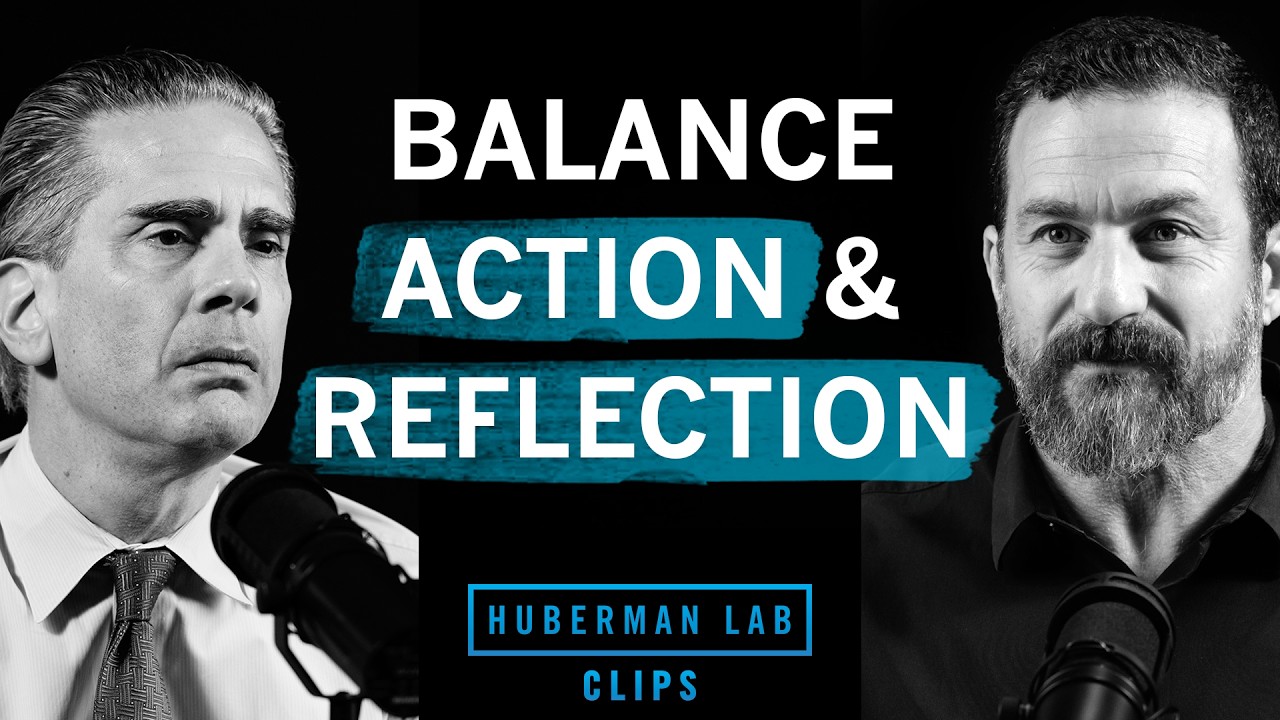
How to Balance Action & Reflection | Dr. Paul Conti & Andrew Huberman
9:33

How to Balance Action & Reflection | Dr. Paul Conti & Andrew Huberman

Huberman Lab Clips 09.05.2026 2 788 просмотров 97 лайков

Machine-readable: Markdown · JSON API · Site index

Поделиться Telegram VK Бот
Транскрипт Скачать .md
Анализ с AI
Описание видео
Dr. Paul Conti and Dr. Andrew Huberman discuss the optimal balance between self-reflection and action, highlighting how externalizing thoughts through speech or writing recruits specialized brain processes to help individuals overcome unproductive mental loops and improve mental clarity. Dr. Paul Conti, MD, is a board-certified psychiatrist and an expert in how to improve mental health and increase your sense of agency and wellbeing. Dr. Andrew Huberman is a tenured professor of neurobiology and ophthalmology at Stanford University School of Medicine and host of the Huberman Lab podcast. Watch the full episode: https://youtu.be/cWCs7dxrt-A?si=_zLHk6TkMtHA7f2B Show notes: https://go.hubermanlab.com/ignr1Bk *Timestamps* 00:00 Balancing Action & Reflection 02:34 Spectrum of Introspection 04:50 Happiness & Generative Drive 07:24 External vs Internal Processing #HubermanLab Disclaimer & Disclosures: https://www.hubermanlab.com/disclaimer
Оглавление (4 сегментов)

Balancing Action & Reflection

when you have a patient that is not depressed, is um maybe is struggling, right? Um so no clinical issue that needs dealing with first, how much do you encourage them to explore the self through doing versus thinking about their thinking? It depends very much on who is that person, right? And where do they need to face to sort of break new ground of self? And you, you know, you mentioned that most people would find the idea of just being with themselves to be anxietyprovoking. And I think that that's unfortunate. I think that comes from a lack of leadership in the mental health field and then the stigma of mental health and our fears, those blackbox fears that we don't understand. So we're afraid of what we don't understand. What we don't understand is ourselves. — So then the idea of being with ourselves becomes very anxietyprovoking. And I think that's not good. I think there are ways that we can go about being with ourselves that we don't have to be afraid of and say if I do that, it's interesting what I'm going to find. Right? And the reflection and the thoughts and the ideas, the learning that comes from it is going to guide me towards the best balance for me. Right? So there are some people who are very assertive, right? And they want to have high levels of doing in the world, but they still need some reflection. Right? There are other people who are going to be very reflective and they're going to be doing less one. We need to understand what profile works for one person. It's not one exact place, but we kind of have a profile of reflection and of doing. And if we are wellbalanced where we're asserting ourselves in the world at levels that work for us and we're finding pleasure and gratification in ways that are healthy, now we're finding balance. If there's too much doing and not enough reflection, not a lot of good will come from that, right? We we'll find that there's diminishing returns. We feel unsatisfied, right? Because we're doing too much and we're maybe taking less pleasure in what we're doing. But if we're doing too little, then, you know, we can feel idle and there can be a sense of learned helplessness. So, it's finding what is the optimal range for a person to be asserting themselves in the world and then finding gratification in what they're doing. And if that's going well, we'll see it there. there's a happy balanced person and if not we'll be able to figure it out of what is going on in that person is there an issue somewhere say in the unconscious mind right are they asserting more and too much and reflecting too little right so by looking at the person and going through these steps we can figure out what serves that person best and how might they adjust from where they are now to get there

Spectrum of Introspection

— is it true that there are just some people who just don't really think about their thinking very much they just like do stuff. I mean, I've had friends say that like I don't I'm not I don't want to speak for me. I I'll speak for them. They they'll say that they don't think about their thinking. They just get up in the morning and they brush their teeth and they use the bathroom and they go about their day and they they're not very introspective. They're not — um they're not called to think about their thinking. — And in some cases, these are people who are extremely busy. So maybe that's one reason. But in some cases there are people who just, you know, for whatever reason that the mirror doesn't pop up in their cortex. It it's they're busy doing and observing and they seem functional. Are they missing out on a on something fundamental or is that maybe even the goal? I asked this from a very selfish perspective because growing up I thought how cool would that be to just like go through life, just do stuff, not think about stuff from the past too much, — not reflect too much, just like get stuff done. And I and I'm a get it done kind of person, but I think like most people, I also forced to think about my thinking from time to time. — When you say forced, what then forces you? — Oh, sorry. It just spontaneously happens. I reflect like and the reflections usually I'll try and generalize these cuz it's this is not about me. The reflections generally come from — like is that something I should explore? Like is that a problem? Is the way I'm thinking about or doing that a problem or is the way that they're thinking about and doing something a problem? This usm thing is it — is kind of what it boils down to. And it's either positive or negative. I confess I don't really sit around a lot and think about all the things going right. I should I have a gratitude practice. — I generally don't sit around and think like oh like the walls are up and the ceiling's intact and I'm fed and I'm healthy and of course until something bad happens and then — we start doing we do our inventory. Right. — Right. — But yeah, I just kind of wonder whether or not there's a spectrum of of reflexive self-exloration. People have different reflective capacity and interest. So

Happiness & Generative Drive

have different reflective interest. So there are people who have more and that could serve them well to be more self-aware but also people may have less reflective capacity but be more naturally generative and then they're just moving forward. So the question is even though we have different um natural levels of reflective inclination, right? Are we happy? Are our lives going well? If life is going well and that person is, you know, they're healthy, they have good mental health and secure relationships and life is going well and they're not reflecting very much like that sounds good. How I would characterize that is they're living through the generative drive, right? They're being productive contributo people in the world. They're making the world better. They're learning. They're growing. So, they're making themselves better. And they're just moving forward. That's a great way to be. For most of us in order to get there, we do have to be reflective and some of what will happen is it will come to us. You said you're not kind of planning maybe to sit down and be reflective, but then it comes to you, hey, I should think of this possibility at hand and what are other people thinking and if how's that impacting what I'm thinking? So, you become reflective because your brain is leading you there, right? Because it's saying, "Hey, we need to we do need to stop and think about things. That's how we're going to make better decisions. " So our brains will lead us to reflection. But if we're moving so fast or we're defended against it, right? Then we're not reflective and that's not good for us. And that's how you could see, for example, someone who's always busy. So they don't have time to reflect. But the the big question is, is that person happy? Right? If that person is not happy and they're complaining and they feel like they're working and never getting anything out of it or never getting any reward, then it's not good that they're not reflective, right? They're blocking themselves from something that they need. There are spectrums that apply differently to different people and we all reside on different parts of the spectrum whether it's reflective capacity or it's assertion or it's pleasure but in terms of what we're doing and whether it's healthy for us is it's different for we're each and all unique so we have to stop and look at ourselves like hey how's this going for me right how am I functioning and is it working for me right is it am I pausing and thinking enough maybe the answer is yes no maybe I'm not sure but if I'm not happy, let me go back and revisit that question. So this curiosity of self can lead us to, oh, how am I built to function? Am I functioning in a way that really works for me? If not, why not? What change might I bring? And here again, we're using the ability to understand and to go through a process to make our lives better.

External vs Internal Processing

I realize these aren't clinical terms, but someone recently said uh about themselves that they are an external processor. They need to talk things through in order to understand what's going on for them and make decisions and that implies that some people are internal processors. Is that true? Do you see that in your practice that some people do best by like thinking, sitting and thinking, walking and thinking, driving and thinking, kind of working things through, and other people actually work it out by talking either to you or to um to their friends or family, — some trusted person. Is that really are those two probably not completely separate, but at least semi separate bins of people? — I don't know that they're separate bins of people. I I think that the ability to think and to be objective in our thinking differs among people. What happens often is we get stuck in our own minds. So then we're thinking but we're not thinking productively, right? Because we get stuck in our own loops. And when we take the thought process outside of us, so if we write the words down or if we say the words, we say the words to another person, then we're bringing different brain processes online, different error checking processes online. So some of us can do more of this inside and say, hey, you know, I've been thinking about this for a while and nothing's different or nothing's going better. Like is there a different way? Is there a way I could think about it that's new or that's different? Right? Sometimes we can do that, but a lot of times we just get stuck inside of ourselves and we have to bring different brain processes online. Like making words and putting those words out there in writing or in speech is different. It holds the brain more accountable. That's why sometimes we'll just say something out loud or we'll say something to someone else and say, "Oh, I figured that out. " Or, "Thanks for helping me figure it out. " And you might realize all you did was listen, right? Because just by being there, the other person is forming words. You know, we do more due diligence inside of ourselves that way.

Другие видео автора — Huberman Lab Clips

Ctrl+V

Экстракт Знаний в Telegram

Экстракты и дистилляты из лучших YouTube-каналов — сразу после публикации.

Подписаться

Дайджест Экстрактов

Лучшие методички за неделю — каждый понедельник