Google Meridian | Controls, Mediators and Treatments
7:09

Google Meridian | Controls, Mediators and Treatments

Google Analytics 01.04.2026 1 026 просмотров 17 лайков

Machine-readable: Markdown · JSON API · Site index

Поделиться Telegram VK Бот
Транскрипт Скачать .md
Анализ с AI
Описание видео
Explore the causal logic driving Meridian's insights. This video unpacks the Directed Acyclic Graph (DAG) framework, detailing how to correctly classify variables into treatments (paid, organic, and non-media), confounding controls, and predictor controls—and why you must strictly avoid mediators to ensure unbiased causal estimates. Learn more: https://developers.google.com/meridian/docs/advanced-modeling/control-variables #GoogleMeridian #MarketingMixModeling #CausalInference #DataScience

Оглавление (2 сегментов)

Segment 1 (00:00 - 05:00)

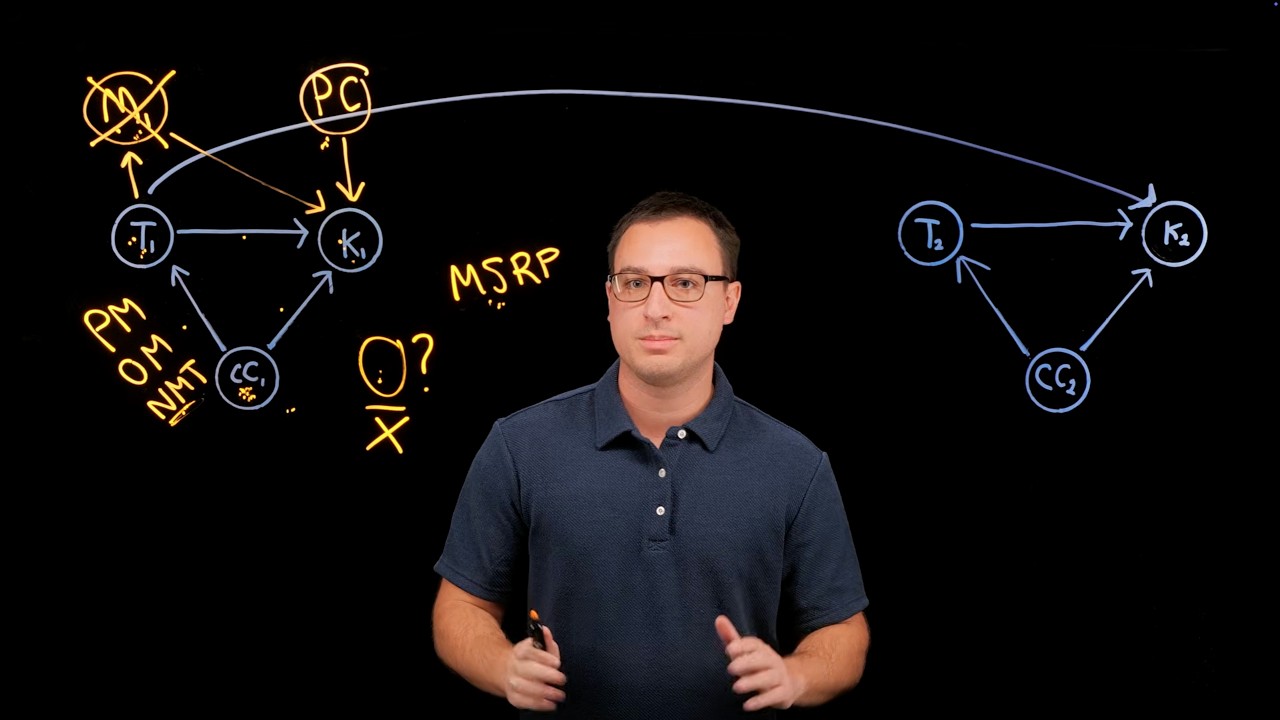
— Hi, I'm Alex. Causal inference is key in marketing mix models like Meridian. To understand how Meridian isolates the causal impact of your marketing, we need to look at under the hood at the causal logic driving the model. In causal inference, we use a specific diagram like this one to map out relationships. It's called a directed acyclic graph or DAG. Let's walk through the specific DAG assumed in Meridian. We have nodes, these circles, and we have arrows. The nodes represent groupings of variables at specific time periods. T1 represents all of your treatment variables at time one. This includes paid media, organic media, and non-media treatments. K1 is our target KPI at time one. It is just a single target metric like revenue. CC1 represents the set of confounding controls at time one. We have a similar set of nodes over here for time two. The arrows represent potential causal effects. For instance, an arrow from T1 to K2 allows for the possibility that treatments in the past affect the KPI in the future. This is the lagged effect we often talk about in MMM. Now, look at this confounder node. Notice that has a causal effect on both the treatment variables and the KPI. This is what we call a confounding control or simply a confounder. In an ideal world, every confounder would be passed to Meridian as a control variable to debias the causal inference of the treatment variables. But in reality, we prioritize the major confounders. As an example of a confounder, think about a competitor launching a promotion. That promotion hurts your sales and thus has a causal effect on your KPI. Let's say in response to the promotion, you increased ad spend. Thus, the competitor's promotion also has a causal effect on the treatment variable. Because it drives both your KPI and your treatment, it is a confounder and should be included in the model. Next, we have predictor controls. These affect the KPI, but they don't affect your marketing decisions. Including strong predictors as controls is beneficial for the model, though the objective should not be maximizing predictive accuracy. While these variables don't debias the causal estimate, powerful predictors reduce the variance, yielding tighter and more precise ROI estimates. If the competitor's promotion had no effect on your marketing strategy, then competitor's promotion would be a predictor instead of a confounder. We also have mediator controls or simply mediators. These are variables that sit in between the treatment and the KPI. An example of a mediator might be a website visit. You run an ad, which drives people to your website, which then drives sales. You must exclude mediators like website visits from your controls. Here's the intuition. Regression models like Meridian estimate the effect of a variable while holding all else constant. If you hold website visits constant, essentially fixing it to a set number, you're forbidding the ad from getting any credit for changing the website traffic. You block the causal path. A common question we hear is, is this variable a control or a non-media treatment? Non-media treatments are treatments like price changes or promotions. A good rule of thumb is intervenability. If the variable is not intervenable, it's a strong sign that it should be a control variable. Take the weather. You can't intervene on decide to make it sunny to boost sales. Therefore, the weather should be a control variable.

Segment 2 (05:00 - 07:00)

If you had instead considered weather a treatment variable, you would need to include its important confounders. The set of confounders for a variable that's not intervenable is often very large and is not readily available. Now, take a price change. You decide to change the price. It's an intervention. Therefore, it makes sense to consider it a non-media treatment. Meridian produces causal estimates for treatment variables such as a contribution percentage or an ROI estimate, but it doesn't produce causal estimates for controls. This is because the DAG is set up for causal inference for the treatments, but not the controls. Some analysts may be tempted to label weather as a non-media treatment. You may say, "I can't control the weather, but I want to see its contribution percentage anyway. " We advise against this. To calculate a contribution, the model needs to compare what happened against a zero or baseline state. For a TV ad, the baseline is clear, zero impressions. But for temperature, what is the baseline? Is it 0°? Is it the historical average? Because the baseline is arbitrary, the concept of weather's contribution isn't well defined. But for price change, we often do have a meaningful baseline. For example, the standard shelf price or MSRP. Because that reference point exists for price, the incremental contribution of a price drop relative to its baseline is meaningful. By correctly sorting your variables and strictly avoiding mediators, you ensure that Meridian isn't just fitting a line to data, but accurately estimating the causal ROI of your marketing. —

Другие видео автора — Google Analytics

Ctrl+V

Экстракт Знаний в Telegram

Экстракты и дистилляты из лучших YouTube-каналов — сразу после публикации.

Подписаться

Дайджест Экстрактов

Лучшие методички за неделю — каждый понедельник