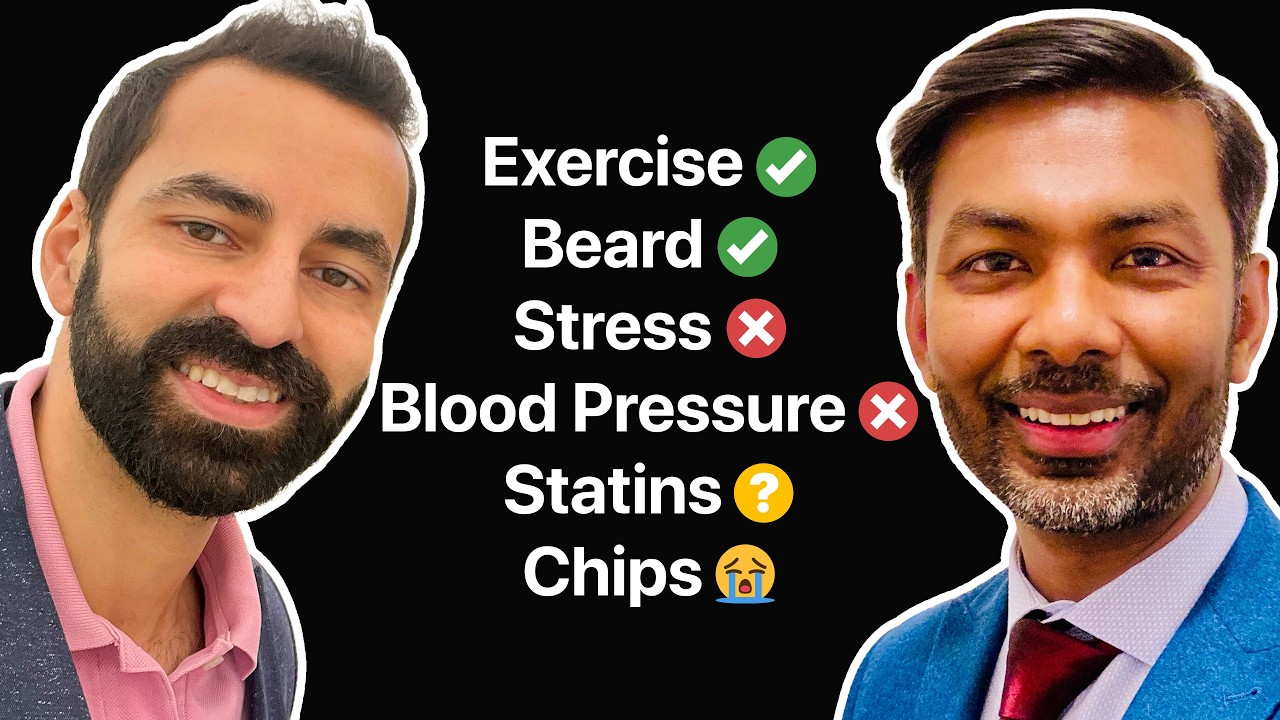
A conversation with my friend and cardiology colleague, Dr Heeraj Bulluck MBBS PhD, who has written a book called 'Heart Reset 40', which is an attempt to review the highest yield, evidence-based advice for maintaining cardiovascular and overall health.
Heeraj and I don't agree on some of the minutiae, which is normal! And indeed that's why I was happy to invite him onto the channel, but the big things that are most important for preventing the development of heart disease are universally agreed and supported by high quality evidence. This is intended for a general audience, anyone who is interested in protecting their cardiovascular system, but especially for those north of their mid-30s. It is a simple overview of the most important factors, as opposed to getting too into the weeds with certain topics, which may be interesting but can distract from the big picture.
You can buy Heeraj's book here: https://www.amazon.co.uk/Heart-Reset-40-Cardiologists-Science-Backed/dp/1919392505. This video is not sponsored!
Watch all my videos without any adverts, plus exclusive ad-free content hundreds of other creators only on Nebula: https://go.nebula.tv/medlifecrisis
All my videos, including this one, are uploaded to Nebula before YouTube. I do not ask anyone to support me on Patreon but if do wish to help me continue making videos, please consider signing up to Nebula via my link – it helps me AND you get the best deal in streaming.
00:00 Intro
03:47 Interview start
06:06 What is Heart RESET
08:40 What is special about midlife
10:40 Basics of heart disease
14:30 Blood pressure
20:05 Cholesterol
27:20 Cholesterol-lowering therapy
32:05 Diet for dummies
33:55 Pre-diabetes and diabetes
38:22 Booze
42:20 Stress and passive exercise
45:00 Resistance vs cardio
49:00 Genetic risk of heart disease
51:30 Subscriber quickfire questions
-----------------
More Medlife Crisis:
Sign up for my free newsletter: https://medlife.substack.com/
Support me on Nebula: http://go.nebula.tv/medlifecrisis
https://www.youtube.com/medlifecrisis
https://www.youtube.com/channel/UCXFgI0Lgrwc_fY2ttqQ9Yhg
https://www.instagram.com/medcrisis
https://open.spotify.com/show/1axFhN3Bu3Yzs0LvbLPlq1?si=04208921407c461b
https://bsky.app/profile/medcrisis.bsky.social
Оглавление (15 сегментов)
Intro
Hello everybody. Today I'm doing something slightly different for the channel. Now, I've often joked that the videos I make are clinically useless. Maybe there's some interesting trivia. There's probably some lousy jokes, but actionable advice, I'm not always so sure. So, when a very clever friend of mine uh fairly unexpectedly actually told me that he's written a book about heart health, and I knew I'd be meeting him at a conference fairly soon, I thought it would be the perfect opportunity to record an interview. And I think this conversation will be of interest to anyone uh keen on knowing how to maintain a healthy heart and cardiovascular system. But it's probably of most interest to those in their 30s, 40s and above. Uh specifically focusing on midlife as a crucial time in your life to invest in your future health. And while good habits are important at any age, it's really around 40 that the risk starts to more significantly edge up. a landmark that I passed a few years ago. It's not a naval gazing 4-hour discussion about some unproven and niche or expensive product or supplement which will at best give you a tiny minuscule return on investment. No, this is simple stuff, straightforward advice based on the best available data with the highest yield outcomes. So, who is the friend I'm talking to? Well, Dr. Hi Bulock is a fellow interventional cardiologist like me. But unfortunately for me that's where our resume similarities end because Hiraj is a bit of a genius. He's originally from the beautiful island of Maitius in the Indian Ocean which had uh I don't believe had a established medical school when he finished school. So he won a scholarship to learn medicine in Beijing. Now something you may not know about people from Maitius is they pretty much all speak about four languages. French, English, Creole, Bhjpuri. So, learning Mandarin in a year was clearly just a walk in the park for Hiaj. And by the way, he subsequently went on to learn Italian to woo his wife and Spanish because, you know, why the hell not. Now, I replaced HiJ as a PhD fellow researching heart attacks using MRI scanning. And not a day goes by without me sympathizing with our poor PhD supervisor who must have had the worst case of whiplash in history when the quality of fellow deteriorated so sharply overnight. Apologies. Um he works at the second busiest cardiac center in the UK where he is head of interventional research. It's widely published in the field. So I won't keep you much longer uh from our conversation which I hope you will find uh interesting and useful. It was recorded in my hotel room at the London Hilton Metropole. This video is not sponsored, but and if anybody from Hilton is watching, I'm very willing to accept a free hotel stay, preferably somewhere tropical. And um I have to apologize as well because it is me. So even though uh in spite of being on YouTube for something like seven years, I am still a complete amateur. Somehow the camera on me failed for part of the recording. So, I'll use some very high-end AIdriven CGI to digitally replace my face where necessary. You probably won't even notice because, you know, truly amazing the stuff AI can achieve these days. But the camera on Hirage, uh, which is the main one, worked throughout. Or if you're listening to this as a podcast, as all new midlife crisis videos are now available simultaneously as podcasts, at least the long ones, then well, this whole paragraph is irrelevant and you're probably feeling quite proud of yourself, aren't you? All right, here is my chat with Dr. Hiroj Bulock on his book Heart Reset 40. Hi, thanks so much
Interview start
for joining me. We're busy with a annual conference of cardiologists. I thought this was a great opportunity to have a bit of a chat. So my friend Hiroj has written this book and um it's called Heart Reset 40. So what does that mean? — Yeah, thanks Roin. Thanks for organizing this. It's a pleasure to have a chat with you about the book. What does it mean? So probably the idea is um myself being my 40s and having treated heart attacks for a few years now like you would agree with me that we are seeing more and more patients presenting younger and some of us younger than us myself being 47. — So we try very hard to treat them in the lab and then advise them all the strict things afterwards. But then it started to feel a bit wrong like swimming against the tide when disease has already formed. So that made me think I should optimize my heart health. And along the way I thought actually there's nothing out there that put everything in one place that's practical and hence that's the idea to put it in a book and share it with my peers and with everybody else out there. — And there's a bit of personal background here that kind of motivated you as well. — Yeah. That's correct. So I lost my father when he was in his 30s at the time. We don't know the exact cause but that's also at the back of my mind for me to be more aware of you know our heart health what's going on inside even if you don't have symptoms — and that's also part of the motivation. — So this is for general public this for anybody to pick up this book or is it aimed at sort of a specific demographic? — Yes that's a good question. So it's called heart reset 40. But the idea is it's for anyone in the mid30s, 40s, 50s and beyond who are in their midlife. They feel fine overall but something is not quite right. — Probably the energy levels is dipping, their sleep is a bit lighter, stress levels are a bit more and probably the parameters in terms of blood test, blood pressure or borderline. So this is aimed at them when they don't have a lot of symptoms. they feel fine but actually deep diving into the book make them being aware of what can be done now to change things from happening in the future.
What is Heart RESET
future. — And the reset in the title this is a framework that you've coined before we dive into each topic and sort of explore the nitty-gritty. What what is the reset? — Yeah. So I think the idea was not to make it as a rigid program that you had to abide by religiously. So it's more a framework um that's flexible okay you know to stick to a program you need ideal conditions but life is not always ideal you know you get busy you get ill um you drop off the program and whereas reset the framework is more about you can jump it at any time small habits that compounds and probably we'll dive in what it al it's as you know the R is for routines — eating sleeping All the stress could be included in that as well. Exercise and then eventually tracking. — So the idea is it's a framework that you can use to guide you but not to religiously abide by and you can jump in and out anytime you want. Yeah, that's what I I liked a lot that, you know, in contrast to a lot of very prescriptive stuff, as I'm sure um anyone who's seen my stuff before would know, I get very frustrated with a lot of the influencers out there and advice that's very highprofile, which is often extremely not only prescriptive, but sort of spuriously detailed, like you need to have 0. 6% 6% of the you know all these very exact numbers and it feels rigid and what I liked about this is you said you're not following a program it's more just sort of a guide framework to make these changes and uh try and avoid developing cardiovascular disease and what why should anyone be in interested in cardiovascular disease in particular why not why aren't we talking about cancer and things like that — yeah that's a good So probably first of all the biggest killer worldwide is cardiovascular disease. Um but although this focuses on heart health but it by optimizing your heart health you're also optimizing your general health. A lot of the the tips and tricks not only improve your heart health but overall health as well. So you will have other additional benefits. It's not although the focus is hard but you would eventually benefit overall in terms of stroke prevention and overall health. — Yeah. And it's all about preventing it, but probably delaying things from happening as long as you can. And
What is special about midlife
— you know, you mentioned obviously 40 is in the title. You mentioned it's kind of 30s, 40s, 50s and beyond. Why is midlife uh and I've got a vested interest here as my channel is called midlife crisis and I am in midlife myself. Um why is that a important time? So yeah, so midlife to me for some people may feel like it's the decade of decline, but actually I'm trying to position it as the decade of opportunity. — So that's the time when you know there's shifts in hormones. For example, in men, your testosterone gradually starts to dip. In women, they start to have your estrogen start to dip. So these hormonal changes start happen in midlife and that ends up leading to increased fat around your waist. So increase in visceral fat, increase in insulin resistance and that leads to downstream effects with your lipids and blood pressure and things. So now it this decade probably is the decade of opportunity because even small habits small changes which we will talk later in this decade will reap the maximum potential benefit compared to the same habit you do 10 or 20 years later. So hence focusing on this particular decade the same thing you might be doing in your 30s may not impact you as much as it does now. — When does cardiovascular disease start? — Yeah. So that's a topic you know quite a hot topic. So, we tend not to realize it, but there's been studies out there looking at autopsies of young adults involving road traffic accidents. And actually, surprisingly, a lot of them in their 20s start having signs of fatty streaks in their vessel. These are microscopic, but they're the start of plaques starting to develop in your 20s, — and this gradually builds up in your 30s and 40s — without you realizing it because it doesn't give you any symptoms. Yeah. — So that starts quite at a young age for most people. — So just tell us a little bit about that
Basics of heart disease
plaque development because we use the term lesions plaque and all these things but I think to the general public they're not familiar with these phrases that we tend to use. So you know I often find when I'm explaining to patients some of the analogies we use are a little bit limited. You know because we talk about clogged pipes and things like that but actually it's not really that simple. It's not a case of just 50% is double the risk of 0% and 80% is you know it's not a linear progression like that and the characteristic of these plaques these depositions um can affect the risk. So tell us a little bit about what you mean when you say that we see development of fatty streaks or plaques like that. Yeah, that's a very interesting question and actually one of your uh or a group of your subscribers asked the question, can we unclog a clogged artery? So probably that would answer that question as well. So I think over time in our lifetimes as you said it's not a binary thing. So gradually there are insults that causes damage to the lining of our arteries of the inner lining. So be it high blood pressure, glucose being high etc. Or so what happens is these your your fat particles in which are the atherogenic one the harmful ones which carries cholesterol predominantly LDL which is the so those fat particles penetrate the lining and some of them will come out but most of them get trapped. So when they get trapped your immune system goes into action try to engulf it and inflammation happens but eventually those develop into what we call streak. So there's small deposits of plaque within the lining of the artery. So it becomes part of the your vessel lining. It's not sludge inside the vessel. So with time this plaque what we call plaque this deposit of lipids will mature will expand you will develop a fibrotic cap like a layer on top and some of that can become hardened or calcified. — So yeah it's a gradual process it happens over time there are different stages and the issue is not about delaying or preventing or regressing plaque. It's more about stabilizing it, delay the progression and reduce the inflammation. So it's a bit like in the book I mentioned, a zit that gets inflamed and if it ruptures that's when your body tries to repair it and then that's when heart attack or stroke happens. The idea is to pacify those scars or layers of of thickening that happens with within the vessel to prevent inflammation and eventual plaque rupture that leads to the cascade of events downstream. — So to kind of drill down on that question that you highlighted which is um yeah a lot of people were voting for that one but I'm frequently asked this question about can you unblock arteries. So what you're saying is it's not so much about unblocking them, it's about making them more quiescent, lower risk. — Yeah. Although there has been some studies like more than 20 years ago now showing if you do if you on a low-fat plant-based diet and strict lifestyle changes, there might be a little bit of plaque regression, — but overall the idea is yeah, it's not too you can't really regress it cause that's build up in your artery. Um it's about as you say make them pacify them and stabilize them so that they don't cause downstream problems. — So let's do a little whistle stop tour of risk factors and that's kind of how you structured the chapters. Um and this is very something very familiar to all doctors because there are sort of
Blood pressure
several questions we ask to look at cardiovascular risk. Um, so why don't we start with one I think that perhaps gets a little bit overlooked in the popular media which is blood pressure. I think we'll certainly talk about cholesterol which is absolutely something that deserves attention but I see much less discussion in online circles about BP. So give us a little crash course in blood pressure and sort of how that affects health. — Yeah. So probably in the book I mentioned blood pressure refers to the pressure your artery feels. So with each contraction it's the pressure your arteries will feel and over time the constant pressure rising is a bit like your arteries being hammered each time with each heartbeat and it's as I call it a silent hammer. So over time this silent hammer with your blood pressure creeping up it's not a binary overall although we label it as hypertension borderline or not but it's a linear uh direction so over time your artery will suffer some damage to the linings as we described and as I called it's a silent killer so there is no symptoms there is your arteries have been put under stress if it's been high over time without you realizing it and that would lead to the downstream effect of you know your um apo B and your LDL cholesterol entering the linings and causing hardening of the arteries etc. So most of the time we don't have any symptoms until it's quite advanced and that's why I mentioned in the book it's quite important to know what is your blood pressure. So you have the systolic blood pressure and the diastolic So the systolic is the pressure when the heart contracts and exerts it in the vessel. Diastolic is more when the valve is closed. The the artery is under resting conditions and the pressure that it exerts against the wall. So knowing those numbers ideally nowadays we say we should a optimal is less than 120 over 80 — and knowing that number you know at home getting a blood pressure cuff is a good investment. — Yeah. I mean they're pretty cheap these days. you can buy them quite easily. So when should people start checking the blood pressure? — So probably in midlife I would say. So uh I don't think we should get overly um obsessed with the numbers in our 20s or 30s unless there's a strong family history or ethnicity and things like that. So I would say in your 40s a good time in the NHS as you know we have a health check at some point in men in the 40s, women in the 50s. So you would have an idea then but also it's a good time to buy a blood pressure cuff and check it at home probably to start with once a month but if it is more than the number I mentioned 120 or 80 maybe it's worth checking it twice a day for a week get an average if it's normal range then you just once every six months or you don't need to be too strict about it or obsessed about it but getting an idea what's happening and when life circumstances change or more stressed it's worthwhile checking what's happening as well. — And I mean I I don't want to say this for each of the risk factors we go through cuz the advice is pretty much the same like the things that address each of these is the same but um perhaps if we start now and we just kind of refer back to it but what are the things aside obviously from pharmacological intervention that can bring your blood pressure down? — Probably one of the underrated activity is walking. So you know walking bris walking specifically for if you walk bris walk for 20 minutes a day that's a very good activity even part of your you know we call it the nonex exercise activity thermogenesis. So even taking the stairs or parking a bit further away at the supermarket or at work. So walking moving every day even if it's just walking and if you can do bris walking even better that has a big impact on blood pressure especially if you start early. — Yeah. And then there are things about in terms of what we eat being cautious about ultrarocessed food which is rich in salt or sodium contents. — So being mindful of what's going on our plate and how much sodium we're having or salt overall because probably at home most of the salt we eat is a minority of what enters our diet compared to the processed food we have which is the bulk of the source of sodium. So that would be the second thing. The third thing would be make sure we sleep adequately. So a minimum of seven hours uh and also good quality sleep. So especially in our midlife weight starts to creep up. Some people starts to snore. If they develop you know sleep apnnea as we call it you know they have times overnight when your breathing is affected your oxygen level dips. That's a cause of hypertension as well. So that's something to be mindful. — Um and lastly is managing your stress. So um we don't really realize it but probably stress we can't really eliminate stress from our life probably but we can find ways to cope with it better for our body to respond to it better in terms of bre doing breathing exercises you know mindfulness going for walks helps and sleep as well you know would help — yeah so I mean we'll refer back to these kind of core pillars um but moving
Cholesterol
next on to cholesterol or lipids And this is something again I think that a lot of people ask about and you know get conflicting advice and I don't want to drag you into the murky world I inhabit of um social media uh well one you just referred to salt. I don't know if you've heard about the salt truthers and people who claim that salt is actually not harmful at all. Um this has become a popular trope. I don't know if you've these are very influential public figures who say that actually you know salt is uh not the problem we've been led to believe and um they even promote salt supplements um to uh you know not just exercise related electrolytes but I think um there's unfortunately some conflicting evidence there but certainly when it comes to cholesterol that's a bit more um prevalent in that a lot of people who maybe uh have embied some of the propaganda around um the carnivore diet and things like that which are very meat heavy. Obviously carnivore is meat heavy but there are other diets which are not as strict but still involve a lot of meat and people are being told and publishing you know some people I see putting their lipid profile online which you or I would kind of be a ghast and they say this is fine this is not a problem so let's have a bit of a general discussion about when again when when's a good time are you going to say midlife again to start checking uh cholesterol I mean should a 25year-old y old who doesn't have a adverse family history should they be worried about checking their cholesterol — probably not in your 20s or 30s those time of our life your body adapts very well and copes very well to changes so as you said if you don't have a strong family history uh I wouldn't recommend checking it at that time it's more when our biology start to shifts you know in our 40s and onwards that would be a good time to get a baseline — lipid panel — and what are the numbers that people should be remembering. — So the main one would be LDL. So the way I remember it, although it's not technically lousy, but LDL is considered the bad cholesterol. HDL is the healthy cholesterol. So LDL would be a number to pay attention to. The total cholesterol doesn't really give you what's happening because when you get your blood result, you have total cholesterol, LDL, and the calculated the LDL and the HDL. So the number important number would be LDL. Ideally the optimal number should be less than 2. 6 in the UK units. So mill per liter. Ideally if you can get it to 2. 6 or lower that would be optimal. But anything 3. 4 to 2. 6 would be you know near optimal. Anything higher than that probably you need to try hard to — with your lifestyle measures and exercise and things to try to bring that down. Then there's the triglyceride as well which also plays a role and indirectly gives you an idea of your insulin resistance. There's some people use there's a ratio of your HDL to triglyceride indirectly gives you an idea how you know insulin resistance is happening in your body whether there is so that would be the two things LDL and probably triglyceride — and how about some of the the newer tests which are not always routinely available liver protein APO B people have heard these terms are these also things that they should be worried about — probably to start with I think we don't routinely best for it. But to start with, I wouldn't say you have to definitely get an idea what's your APO. So going back, Apo B as I put in the book, um if you imagine APOB are the protein particles. They're the delivery trucks in your vessel. Your cholesterol particles are fat and blood is watery. So they don't carry very well. So the cholesterol the fat particles needs to tag on the trucks to be able to be transported where they need to go. So the apo B carries LDL. So they're the delivery trucks. Um the more delivery trucks you have the more you will have in so having high apo B is harmful. But indirectly if you know your LDL level and your triglycerides which is also being transported by part of the we call it VLDL without being too technical but by your harmful um atherogenic particles the apo. If you get an idea of LDL and triglyceride indirectly, you will have an idea what's your APOE B is, but it's not perfect. I don't think you need to be very strict to look for it. If we have it, it's a bonus because we do have some patients we've seen the LDL numbers are perfect, but they still present with issues with heart attacks. Very likely their APOB levels are still not optimal. — But to start with, I would say stick with LDL triglyceride. If you have access in the future, APOB would be useful. And then we have the LPA. You may have heard LPA is so is another component of the APOB. So when you have APOB with LDL and then there is another particle uh APO A attached to it, it become more sticky. So that would be your LPA, it's a bit more sticky LDL. And usually this is decided genetically from birth at the moment. So 80 to 90% of them is genetically uh predetermined. So you just need to check it once. But that's something still as a research tool. There's currently no therapies although there's lots of trials going on to try to reduce it. That's another number which people talk about and might be useful to know — but not essential I would say. Now, I'm so slow editing and uploading my videos that actually since recording this, the American College of Cardiology and the American Heart Association have released their updated guidelines for the management of lipids in March of 2026, which does include now testing for liver protein little A and apoin B. And I'm sure other health systems like the UK will follow suit soon. And apo B, I think certainly is a useful test which adds some additional information. liver protein little A is slightly more controversial because some people advocate that it shouldn't really be tested for it because at the moment there's no treatment for an abnormal result. However, I think it can be regarded as an additional genetic risk factor because the thing with liposin little A is it's essentially a oneandone test. It's something that you only really need to check once at some point in your life because it doesn't really change. And if you look at it like that, then it can, you know, further inform. Although it, you know, I wonder if I've actually been victim to false reassurance because I got the lip protein little a tested some years ago and it was kind of new on the scene and it was through the floor. It was incredibly low result and it made me go out and have a burger and chips. And that's why I invite much more sensible cardiologists like Hero to listen to him. Don't listen to me is I think the moral of this story.
Cholesterol-lowering therapy
— This is probably too big a topic for us to go into now because there's a lot of um extreme opinions regarding statins. And so I think we're not going to be able to deal with the huge variation in opinions regarding statins. But I made a video about statins years ago and I would say easily that is the one I'm emailed about and get messages about most and I was it was a pretty kind of agnostic video. I wasn't trying to be too prescriptive or anything but just trying to um deliver a summary of kind of the evidence for statins and say ultimately it's you know the patient's choice but they should be fully informed. try not to believe, you know, everything you read online. And and that goes for, you know, whichever kind of extreme somebody someone's adopting. So if a patient says to you, look, doc, I'm, you know, say they've got a LDL over five and they have tried lifestyle measures and it's not really budged and they say, "Look, I'm not too keen on statins. I've heard a lot of bad press about them. What's the kind of how do you address sort of um approach that conversation? What what's your general way of talking to patients who say that to you? — Yeah, it's an interesting hot topic as you know and with lots of conflicting evidence out there. So probably the way I would answer that to the patient is the bulk of the evidence um points towards benefit in the long term and there are some d you know some studies showing you're more likely to have diabetes and things like that but probably sometimes a bit confounded people on statin tends to live longer and if you live longer probably you're more likely to have diabetes. Um on the other hand people are worried about side effects you know liver toxicity and things but there has been some studies where they blinded the patients — to statin or a placebo and then in fact when they don't know what they're taking even those having the placebo had those muscle aches and pains. So part of it is is a placebo effect. Um but if the symptoms are real, they've got derange liver function test which we monitor anyway then by all means there are other options out there but to start with I would usually recommend to go first line with statin and there are various groups we can try. — Yeah. Um so one of our mutual friends uh Uni Krishnan um g did a talk once which I I've often refer back to where he looked at all the different lipid modifying therapies and as you say that there are different options now and I think a lot of people have the attitude that they're all comparable but actually you get the most bang for your buck so to speak with statins and then these other things can be incremental or if someone is truly intolerant you can consider them but they don't have the same kind of evidence base and so just maybe briefly to mention some of the other lipid modifying therapies out there. What are the ones in common use these days? — Yeah, so there are the injectables like PCSK9 inhibitors as we call them or pmpid you have in glyceride injections twice a year you could use and then you have pmpedic acid is another option. So these are the ones that might help with LDL if you can't tolerate a statin or as an add-on. But before that they have the Satetimi as you've heard which works well sometimes with statin — and again you know sort of modifying these with lifestyle prior to starting medication. Are we just talking the same advice? The lifestyle changes would modify your environment definitely that would help but then sometimes medication would help to modify biology sometimes just despite lifestyle changes if you're still not hitting this target then there's no it's not a failure to go on medications so I would say lifestyle first as we talked about — you know exercise it's more about what you put on your plate rather than what you don't so — there's a chapter on things like you know um more like the Mediterranean style pattern of food for like lots of fresh fruits and vegetables, berries, lentils and legumes, oily fish at least two portions a week, olive oil, avocados. So these are things if you add on your plates — and then naturally you you reduce the processed foods and those have helped benefit in terms of optimizing your lipid profile together with exercise and making and the other things we mentioned as you said sleep and stress management. So I don't want to get deep into a dietary discussion
Diet for dummies
because I think it's a kind of topic where everybody seems to have an opinion and I like to defer to those who are genuine experts in the field, nutrition scientists, dieticians, you know, people who spend their whole lives doing this and uh hopefully I'll have conversations with some of those people in future. But and I'm a simple guy. We we're interventional cardiologists. We're plumbers. We're simple guys. we like to make um you know boil things down to the simple advice. So when it comes to dietary advice from a cardiologist perspective and you mentioned already a kind of Mediterranean style diet um lots of fresh fruit, vegetables, legumes, lentils, uh oily fish. um why are these things sort of why do we as heart doctors why do we tend to talk about this stuff what what's the background here I do talk about median style diet in the book but probably eventually the diet people need to stick to is the one they can maintain long term — and probably your body or your arteries doesn't matter what dietary hacks you do as long as it's balanced it's rich in fibers because you know it's giving you all the nutrients you need and protein is a major part. So probably the Mediterranean pattern diet ticks all those boxes and there are several studies or it's the most studied diet in the literature showing it can optimize your lipid profile, your blood pressure, reduce insulin resistance, reduce your triglyceride and eventually it will that would reduce your apo we talked about the atherogenic particle. I want to talk
Pre-diabetes and diabetes
about pre-diabetes. And the focus I've got here is I've been planning uh having this idea for a video about the new definition of normal. And what it is in the era of wearables like um heart rate tracking and you know potentially in the future blood pressure um but even continuous glucose monitors we are getting unprecedented data which we've never had before. you know, looking at non-diabetic patients um who are buying continuous glucose monitors and seeing glucose spikes after eating and then interpreting this that they they've got to avoid whatever the food is rather than understanding the physiology. And um even with heart rate, you know, we're just up till now, say for example, something like atrial fibrillation, which is a pathological irregular heart rate. um in the trials that have you know for decades we've used ambulatory monitoring and we've had a sort of arbitrary cut off as you know 30 seconds this is atroofibrillation and now we're seeing 24 year olds or something where may have 3 seconds of atroofibrillation so where do we draw the lines and I think that's there isn't necessarily an answer for a lot of these things but it's a really fascinating development I think in medicine and when it comes to people with uh impaired glucose ucose uh in glucose tolerance or glucose processing. Um again we've had arbitrary cut offs. This is diabetes. This is not diabetes. And I think what you're what you get at in the book is that again this you know you shouldn't think of this kind of binary. You know nothing in biology is really um binary like that. Um, so what if somebody's been told that they're, you know, glucose is a little bit abnormal, but you know, don't worry about it. We we'll check it again in a couple of years. You're pre-diabetic. How should they react to that news? — Yeah. So, that's a very interesting question. And just touching on your the continuous glucose monitoring, the CGM, I have to admit I've tried it myself more out of curiosity rather than, you know, trying to see whether I have diabetes or not. And it's interesting as you said after a depending on the meal you have a certain spike but there's also a quick uh drop in glucose or if I go for a run there is a spike to come to you know to accomodate. — Great point. Yeah. — Yeah. So that's one thing. Um so probably the HBA1C as we call it. So that's a more accurate reflection of what's been your average blood glucose over the last three months. — It's the glucose attached to your hemoglobin. We call it glyc glycated hemoglobin. So probably that would be more accurate than a random blood sugar you do. And as you mentioned in the book we go I probably to mention that pre-diabetes isn't pre- anything. It's already diabetes, early diabetes if not diabetes. — And sometimes, as you said, we may someone may be borderline, they call it, in the pre-diabetic range, and they're told we'll keep an eye, but actually now is the time to be more uh to take action quicker because that's the time when you can actually reverse um pre-diabetes. If you for there are studies showing if you reduce your weight by 5 to 7%. That can reverse your pre-diabetes states as we call it. So it's it is a continuum. It's I would say it's early diabetes if your HBA1C is already in that range and taking action now has the greatest in terms of what we've discussed you know exercise what you eat and etc. So that would have the biggest impact to reverse biology and prevent you know you having established diabetes when you would need medication downstream. — So don't be reassured by someone saying this is pre-diabetes you're not diabetic yet. Don't take sort of — yeah I think I would say that you should not be reassured. It should be alarm bell saying your body is struggling. There is insulin resistance already accumulated and now the glucose levels are are not being you know regulated as it should. So it should be alarm bells and you should take action more now rather than just say we'll keep an eye and recheck it in a few months time. Now this question I think I have to
Booze
declare some um uh conflict of interest here because um we as I said we're at our annual conference which is ostensibly about learning cardiology but I think it's generally regarded as a pissup and um I'm feeling rather worse for wear because I just can't handle alcohol particularly these days and and drink so rarely and I've noticed that the messaging on alcohol has changed recently that uh people have become quite puritanical and saying that even a single drink is is bad for you and and generally there's a move to say zero alcohol is the only kind of healthy option. And um for someone like me who really doesn't drink, you know, for months at a stretch, but then has a few drinks at a social event like this week, um how does that compare? Is that truly like is it true that even a single drink is bad or is suggesting moderation is that is that problematic because people will get the wrong message? What do you what's your general approach to something like alcohol? Interestingly, in the past, we used to believe red wine is good for your heart, right? It's cardiorive, but actually those studies were confounded by people being on other cardrotective things like the Mediterranean style food we mentioned. So, the latest evidence suggests alcohol doesn't really have any cardoprotective evidence. So, if we want to have it, I'm not saying you should not have alcohol at all, but it shouldn't be for heart health. It's more for pleasure. And I think in the book I always talk about 80% of the time if you're cautious 20% of the time you know your body will accept every now and then say have a glass of wine or beer. So it's not about avoiding it all together. If you can if that's your lifestyle that's that would be good but if like us every now and then having a glass or two I don't think our body can cope and can you know um autoregulate that it — Yeah. So I think that's the message I take and obviously I had my own answer to the question where I asked is that I think the whole point of looking after your health as much as you can is so that you can still endure a bit of st and you know obviously alcohol is a voluntary thing but uh you and I are on call rotors we get called in the middle of the night we frequently have to go into the hospital in the early hours of the morning and that's not good for your health but I spend the rest of my time trying to protect myself against that trying to you know put myself in the best starting point so that you know that's a unusual example to be on an encore rotor but being a parent for example is a very common um example caring for a loved one who may have um uh you know needs that mean that your sleep is affected and I think that's a key message from the book and just In general, sometimes when I listen to some of these longevity influencers who say that they're meticulously in bed by 8 8:00 p. m. every night and they have 12 hours of uninterrupted perfect sleep and they take uh 200 supplements a day. I'm just like are you living like what's the point of doing this unless it is to live an enjoyable life? And yeah, I don't it's not really a question. I'm just mouth spouting off here. But I mean I guess that you know that's a message that you you've kind of got in the book as well. — Yeah. Exactly. Yeah. So I think it's it's about doing certain optimizing it our health most of the time but allowing that buffer where you can still you know have a bit of flexibility — and you know small we're not talking about extreme changes small changes now can have big impact and while still enjoying life as you mentioned
Stress and passive exercise
— now stress is clearly something that is very easy to say to someone oh you got to reduce your stress and they're like uh thanks doctor you know who who's going to look after my kids? Who's going to work two jobs in uh an economy where so many people are struggling? Um or all the stresses of modern life, sitting in an office all day, sedentary lifestyles, processed food, these well that that's going back into the diet, but just you know sources of stress um can contribute to those poor dietary habits and so on. And is it more important to be trying to build in the micro kind of habits and habitual movement during the day rather than dedicated exercise periods, say the weekend warriors? Um, which tends which do you think has a higher yield or is that an artificial question? Is it more important to be say an active person who's kind of moving around much of the day but doesn't necessarily take dedicated exercise or someone who's got a 9 to5 where they're not doing a great deal but then they're really cramming in some intense exercise at the weekend is one better than the other. — So actually probably the first scenario you mentioned is actually better. So going back to stress probably yeah it's quite hard to eliminate or avoid stress in our lives but it's how we manage it and help our body not to have the biological effect and part of it as you say um going back to how we manage stress it could be anything from box breathing mindfulness or exercise and movement probably the first scenario you mentioned so if we suppose we exercise one hour hard for in the morning and then six and sit for six eight hours 68 hours during the day that doesn't negate that doesn't you know doesn't compensate for that 1 hour exercise in the book I mention every hour we sit ideally we should set an alarm and walk for 2 minutes and all these you know micro movements we do during the day will eventually compound and there is a word I think for not in the book but people refer it to nonex exercise activity thermogenesis so it's anything it's these for every hour we sit if you walk for 2 it's or park a bit further away or take the stairs in instead of the lifts. All these will compound and actually help your overall health and probably help with stress management as well. — Something I hear these days in fact from a personal trainer um who said this which was slightly concerning is that uh
Resistance vs cardio
weights are cardio and there's been a very deserved attention on resistance exercise in the last few years. Um because I think you know generally people regarded exercise for the heart up till now as you know it's called cardio right it's sort of that aerobic exercise and people understanding that resistance exercise as part of an exercise program has a lot of additional benefits um for other health measures as well bone density and longevity and maintaining strength and things like that but that seems to have shifted to almost you don't need to do cardio because if you're doing weights, you're getting your heart rate up a little bit and so that this personal trainer was telling me that I don't do any cardio because weights are my cardio, you know, if I do a weight session. What do you think about that? — In my opinion, I don't think it's actually true. So, cardio actually probably refers to uh a period of persistent effort where your heart rate is, you know, 70% at least of your target heart rate, maximum target heart rate. So cardio requires that sustained time not the intervals where it goes up and down but sustained period where your heart is subjected to high heart rates. We can talk about zone 2 training but anyway once your heart rate is high for s a sustained period that's when your micro mitochondrial function improve you know which eventually leads to more cardiorespiratory fitness your V2 max we refer to. So how efficient your cells are at utilizing oxygen. So cardio actually is a bit different to doing these gym exercise where it's more like high intensity training probably more than cardio. So I would say they complement each other. It's not you probably need that those periods of doing at least 20 minutes of brisk walking or swimming or whatever you fancy but having that sustained period of to start small 10 minutes but build it to 20 minutes and there are some recommendation of you know doing 150 minutes of moderate exercise which refers to getting your heart rate at least to 70% of what's the maximum target heart rate or if we talk about the zone 2 training which another way to look at it you it's more easy way to to look at it is if you're going jogging, you should be able to talk to your partner next to you while you're jogging. So that would be your zone two training. You're not panting and able to talk. If you're panting, that's probably you're running too fast. And zone 2 training has been shown to be more efficient at burning fat and improve your cardiorespiratory fitness rather than the the anarobic the non-arobic exercise which is when you do fast runs more for endurance. So again, sort of trying to boil it down to a simple advice for exercise and like diet, this is a topic that's frequently discussed and again, you know, we're not exercise physiologists or anything, but as a overall benefit, you're saying the message is a combined exercise program is going to offer sort of a wide range of benefits, but in terms of really cardiovascular optimization, you do need those kind of longer duration moderate uh exercise with getting your heart rate sort of getting your heart rate up. — Yeah, I think a combination of both. Probably two three times a week of cardio and a couple of weight is the right balance. So cardio is a bit like um as you say it's good for longevity. It's a bit like making sure your engine is welloiled for the long term. And weight exercise is more about your metabolic health and to have a strong physique. Uh so it's a combination of both that works well rather than one or the other. — Uh family history. I think you've got a nice phrase which is I think I encounter
Genetic risk of heart disease
people that are a bit fatalistic. They're like you know all the men in my family have died in their 40s so I can't escape it. So screw it. I'm not going to try. And I'm always really sad when I hear that cuz we see these patients on our table who've come in with big heart attacks, you know, often in their 30s or 40s and they've got horrendous family history and yet they're smokers or, you know, something equally counterproductive. And you know, I chat to them and they just kind of feel like, well, this is my lot that I've been dealt. My hand I'm mixing metaphors here. My hand that I've been dealt. Um, so I can't escape it. And I think you referred to it as uh loading the gun but not pulling the trigger. — Yeah. Yeah, that's correct. So, so genes is a bit like genes will load the gun. So, you're given a loaded gun, but you decide whether you pull the trigger or not by the lifestyle you have. So, yeah, some people may take like having a strong family history of, you know, early heart disease as they're doomed. There's nothing they can do about it. So they won't try hard. But actually in the book we I kind of emphasized actually this is a good thing that you know early on that you need to be twice as cautious and start interventions very early right compared to the normal you know general population and the earlier we start in these situations the more likely you're like to bend the curve in the right direction. Um, hence you know the idea of although genes load the gun but it's the lifestyle you adopt will pull decide whether you pull the trigger or not. — And is genes what's behind sort of high prevalence in certain ethnicities — probably different ethnicities have different predisposition to different things. So probably as South Asians the literature would suggest they have higher incidence of insulin resistance or familial dysipidemia. So that gen those genetic factors and insulin resistance is not a good mix I guess. So with um family history although they or genetic predisposition to you know familial dysipidemia they alth they're trying everything with lifestyle measures the body has got this defect to unable to clear the LDL. Hence these this patient very often needs medications early on a diet or life lifestyle changes alone would not lower their LDL to the levels we would ideally want them to be.
Subscriber quickfire questions
— There's a few hot topics. I'm going to hit you with some quickfire um questions screening scans. Um so asymptomatic patient as in they have no symptoms of heart disease and uh they come to you and say I want to have a CT scan of my heart and we'll talk about the different types of CT scan. Um what yes or no? — Yeah I think so the probably the easy or safe answer is it depends right — and it probably depends where you are as well if you're in the states or in Europe. So I think first of all um if they're younger than 40s and they don't have a strong family history I think usually there's potential for more harm than screening and which lead to unnecessary tests and radiation exposure and things um if they're completely asytomatic in the 40s and in the in Europe in the UK we use these curies for example in UK curis four score so we use risk prediction scores to decide whether what's their risk of a heart attack in the next 10 years. So I would probably use those to predict because doing a CT scan to look at your arteries tells you what's happening now. It doesn't predict what will happen in the future. — It's only those who have got the inter the borderline risk. So they are not low risk, they're not high risk for those groups you know what to do is they are in between. Those are the ones if you're not sure whether to recommend a statin or not. Although the evidence is not very strong and there's trials going on. I think they're doing the Scott 2 which is coming which will happen in a few years by the time we get the result in those groups who are in the intermediate risk potentially there might be a role but again um it will tell you what's happening now it doesn't predict what will happen in the future and in the book I mentioned something like if you want to know what's the weather like now would you rather scroll and look at the forecast or open the window and look outside what's happening so that's that kind of the difference Hm. Yes. I think that's an important point that maybe isn't mentioned so much that it can be falsely reassuring as well in that uh you know you have a well we have we haven't talked about the different types of CT scan but if the more detailed one which is the CT coronary and which is actually imaging the inside of the coronary arteries using an injection of contrast um you say well you know it looks fine you know this very minor disease but that often you know doesn't uh tell you the the 5 risk. Um, as you say, it tells you what's going on now. Um, so it can actually, you know, give a false reassurance as well. So what are the there's coronary calcium scoring and u CT corneagram. What are the differences between what when one should be used and — yeah so in the book I call the CAC you know the correct calcium score scan. So that one just without contrast just looks at any hardened plaque. So the bright spots we see and actually they can quantify that. So that gives you an idea of PL burden many calcified PL burden. Whereas when you give them contrast to do the coretic corog it looks what's going on inside the lumen as well and actually can highlight soft blocks which can be missed with a C scan. So they are different. One is giving you PL burden. One is trying to tell you whether there's an illumininal stenosis or not. But that's always overestimated if there is any stenosis. If especially they have a lot of calcium as you know with blooming artifact, you can overestimate the degree of stenosis and it can also highlight any soft or high risk plaques. — Yeah. So the overestimating is an important point because then it can often lead to a subsequent test which is an invasive test an angio in many cases and um which you know brings risks and so I think that that's a message that I try and emphasize as well is that uh it's very tempting to see these as oh you know what's wrong with getting additional information but it's not as simple an equation as that because you know it can end up with an invasive test and often, you know, the young patients with low risk seem to be the ones that have catastrophic complications in in um something like an angagram. So, and then you're left asking should we really have been doing this? So, um okay, that's uh screening scans. You interestingly said that you've tried a continuous glucose monitor. Now, you're obviously someone with training in the field and understanding of medical science. What do you think of non-diabetic people using these now um in general and how they're maybe misinterpreting what they're seeing? — Yeah, I think it can be dangerous in in hands of the general public without any supervision of the any medical profession uh professionals. So probably it can help to inform how our body reacts to what food we are eating. probably different people may have different reactions to it. I think for a short term for curiosity it's fine. It kind of informs you, okay, if you eat this type of diet, you get a spike. And probably when we don't monitor it, recurrent long-term, you know, frequent spikes, which is harmful, I guess. But at the moment, this is still a field of research where people are using more for research than informing the general public. And if you're not diabetic healthy individual, I don't really think there's a role. And I wouldn't recommend let's do it. I did it more out of curiosity to to learn about you know what happens to my body when I exercise for example or for at some point I wasn't having breakfast for example and see what happened but that's changed now I do have breakfast by the way so — uh yeah to answer your question I don't think it's a tool that we should put in the hands of the public yet without any data to back it or any medical team behind it to advise them what to do with the information — yeah I think it's a very human reaction ction to want information. I totally get that. But that's the key thing is that what are you doing with that information? You know, we again coming back to wearables. We're now in an era where people can get reams of data about their own body. Uh and there's nothing wrong with data, but it's it's not that we um don't want them to do it, but it's that we genuinely don't actually know how to interpret a lot of this information yet. So, it's important to do research, but maybe not ready for prime time quite yet. — Yes. Talking about wearable, you probably you will see I've got an orura aura ring smart watch nonsponsored. — Yeah. So, I think you're right. I think sometimes too much information can be dangerous and it's more about what we do with that information. We shouldn't let ourselves become, you know, slaves to these devices. It's more about guidance. So, for example, if you're driving a car, you want to have a dashboard to see how much fuel you've got, what speed you're going. Otherwise, you're driving in the blind. So, you know, awareness, as I mentioned, is the first reset because you can't really change what you don't know. — Um, that wasn't very quick fire. That was my that's my fault. So, let's do um another few quick questions. Putting you on the spot, what is the most important number that people should know for their health? So — well one answer here no hedging — I think from based from what we can access now it would be LDL I would say yeah — if we had Apo B levels that would have been ideal but that's not routinely available so LDL would be the one number but before that if you want to really what we can do at home would be your blood pressure what's your blood pressure doing when you're at rest that would be one easy number the second number would be LDL which requires you go to the GP to have a blood test. — Yeah, there there's clearly no right answer to this. Other people, depending on what they're kind of focusing on, again, I'm not saying right or wrong answer, you have talk about V2 max and things like that, but um yeah, so that was uh just interesting to hear what you um had to say. Are there any tests? We've talked about lipids when you get to middle age, so 40 and above. Um, typically blood pressure we've talked about. Are there any other tests that everyone should be doing at some point? You can and you can say which point in so obviously if people are developing symptoms of something that's a different story. They're going to go and they should get that investigated. But if someone's feeling well, they're generally fine. Um, what are there any other tests aside from blood pressure and and cholesterol that you would recommend everyone should get at some point? Um, probably not much as a test, but probably at home you could probably mon or track your waist circumference. I think that's an indirect marker of your visceral fat. So the — more important than weight — I would say. Yeah, definitely. I think your waist circumference tell you more about your health than your BMI or weight. So having keeping a track of what's your so in the book there are different cut offs depending on ethnicities and gender. — So knowing what's your waistline is doing gives you an indirect measure what's happening around your vital organs and those visceral fats are considered to be active and release you know harmful chemicals and inflammatory markers that leads to insulin resistance. So that's one number it's worth knowing and tracking and see if you can optimize that. — Is heart disease the same in men and women? — Um so probably eventually yes. Although women tends to delay you know to develop heart disease by almost 10 years after their menopause. But after menopause the risk eventually catches up or the risk profile eventually matches. uh before that women are a bit protected around the menopause or permenopause area or before menopause and until they have it. So men tends to develop it more gradually and early whereas women once they develop menopause it it tends to happen quite quickly. — So risk sort of rapidly increases — I would say so on once they lose the protection of estrogen and progesterone. — So we're going to finish with a few questions I asked subscribers on YouTube. We've kind of already touched on one about reversing unclogging of the arteries. We've also kind of talked about another one which was uh a loweffort high impact intervention and I think you were saying you know regular building walking into your daily routine. Any others that you'd say that? So the question is a list of maybe to-dos sorted by lowest effort and highest impact. — Yeah. So yeah, I think walking bris walking for at least 20 minutes is an easy win. Um try to have at least some protein in each of your meal. That's probably another easy win with maximum benefit. Avoid if elim if not eliminate u um your sugary drinks, juices and alcohol if you can. So that would be you know you should avoid drinking the calories in with the sugary drinks. That would be another easy win. And lastly I would say sleep. Make sure uh you optimize at least you have at least 7 hours of sleep. — I don't think I've done that since 1985 or something. What is the most common mis misconception about heart health that bothers you the most? — Probably I would have to say it is when people say they are fine and without knowing what's happening with the numbers with the parameters. So the illusion of fine in midlife as I mentioned in the book. So that's probably the misconception is I don't have any symptoms. I feel fine. So therefore my heart health is fine. So feeling fine doesn't equate to your heart being protected. So that's one misconception is and that's why the book is aiming to shift the conversation early when people are actually feeling fine but actually we should be aware know our numbers see what's going on and what can be done to change the trajectory of it's a bit like a fork in the road right you can either choose to carry on what you're doing and face the consequence later or optimize things now and not only survive but you can thrive in years to come. Going to the gym is boring. What kind of activities are good exercise but also fun? And if I've only got 10 or 15 minutes, what has the best impact? I think we've talked about walking, but probably that's not very fun. Bris walking with a group of friends and family is easy and probably do like a minute of brisk walking and then slow a bit like HIT. — Hit overall if you do 10 minutes of HIT is better than 30 minutes of running for example, right? That's probably something mentioned in the book. So, if you can do some sort of hit as a group with friends or family members, — make it fun. Even if it's 10 minutes in front of the TV before a Netflix episode. — So, that would be an easy and fun exercise to do rather than going to the gym. — Yeah. I think the key thing is anything can be exercise that involves moving your body, dancing, whatever. I think we've actually dealt with the the top questions already just in the conversation so far. So all that um is left for me to say is thanks very much Hiroj. Were you going to you were going to say — no just probably a final line for or a closing remark would be um midlife you know is not the beginning of decline as I mentioned already. It's the decade of opportunity — and it's never too late to start. You even if you are in your 50s and 60s, it's never too late to start. It's not about perfection. It's about beginning and momentum which eventually compounds. — Great. That's a good positive closing message. And you I think you can tell that the method works cuz you're looking in great shape for 47. So I was going to say what's your secret? But here is the secret. And I'm not just saying that because uh Herod is an old friend, but um it's a very easy to read book and it's got lots of simple instructions. Um so uh yeah, thanks very much for the chat and hopefully see you again soon. — Thanks very much, Roin. It was a pleasure. Thank you again. — Thanks, buddy. — Oh, thanks a lot. I think it's a bit awkward being on camera. you.