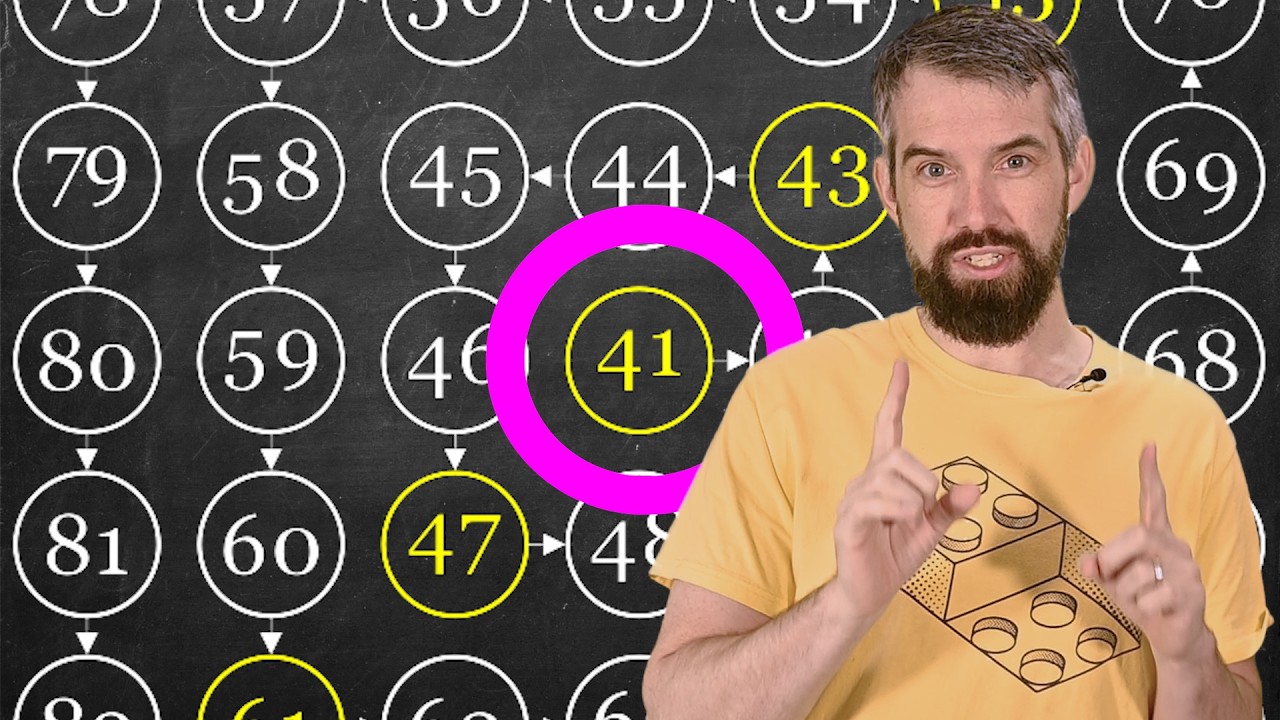
The best number is 41.
8:32

The best number is 41.

Dr. Trefor Bazett 13.05.2026 12 827 просмотров 583 лайков

Machine-readable: Markdown · JSON API · Site index

Поделиться Telegram VK Бот
Транскрипт Скачать .md
Анализ с AI
Описание видео
Get better at math and science with Brilliant. Use link https://Brilliant.org/TreforBazett to get 20% off an annual premium subscription. ♡♡♡SUPPORT THE CHANNEL♡♡♡ ►Support on PATREON: https://patreon.com/DrTrefor ► CURIOSITY BOX: https://www.CuriosityBox.com/DrTrefor use CODE drtrefor for 25% off awesome STEM merch boxes ► MATH BOOKS I LOVE (affiliate link): https://www.amazon.com/shop/treforbazett COURSE PLAYLISTS: ►DISCRETE MATH: https://www.youtube.com/playlist?list=PLHXZ9OQGMqxersk8fUxiUMSIx0DBqsKZS ►LINEAR ALGEBRA: https://www.youtube.com/playlist?list=PLHXZ9OQGMqxfUl0tcqPNTJsb7R6BqSLo6 ►CALCULUS I: https://www.youtube.com/playlist?list=PLHXZ9OQGMqxfT9RMcReZ4WcoVILP4k6-m ►CALCULUS II: https://www.youtube.com/playlist?list=PLHXZ9OQGMqxc4ySKTIW19TLrT91Ik9M4n ►MULTIVARIABLE CALCULUS (Calc III): https://www.youtube.com/playlist?list=PLHXZ9OQGMqxc_CvEy7xBKRQr6I214QJcd ►VECTOR CALCULUS (Calc IV) https://www.youtube.com/playlist?list=PLHXZ9OQGMqxfW0GMqeUE1bLKaYor6kbHa ►DIFFERENTIAL EQUATIONS: https://www.youtube.com/playlist?list=PLHXZ9OQGMqxde-SlgmWlCmNHroIWtujBw ►LAPLACE TRANSFORM: https://www.youtube.com/playlist?list=PLHXZ9OQGMqxcJXnLr08cyNaup4RDsbAl1 ►GAME THEORY: https://www.youtube.com/playlist?list=PLHXZ9OQGMqxdzD8KpTHz6_gsw9pPxRFlX OTHER PLAYLISTS: ►Cool Math Series: https://www.youtube.com/playlist?list=PLHXZ9OQGMqxelE_9RzwJ-cqfUtaFBpiho ► Learning Math Series https://www.youtube.com/watch?v=LPH2lqis3D0&list=PLHXZ9OQGMqxfSkRtlL5KPq6JqMNTh_MBw SOCIALS: ►X/Twitter: http://X.com/treforbazett ►TikTok: http://tiktok.com/@drtrefor ►Instagram (photography based): http://instagram.com/treforphotography
Оглавление (2 сегментов)

Segment 1 (00:00 - 05:00)

The coolest prime number is 41. Well, most people particularly like to celebrate their birthdays on big round numbers like 40. I am a fan of celebrating on prime birthdays. And I just turned 41, which I'm very excited about. To tell you why 41 is the coolest of all the prime birthdays you're probably ever going to turn. I'm going to put 41 at the start of a spiral. I'll put all the numbers 42, 43, 44, 45 around. And I want you to notice the diagonal. All of those numbers turn out to be prime numbers. 41 is prime, 43 is prime, 47 is prime, and so on. And that pattern is true for the next 40 numbers in a row. That is, there's 40 diagonal numbers all in a row, all of whom are prime. If you're more of a triangular person than a spiral person, I mean, to each their own, you can restate it to say that this central column of the triangle is all primes for 40 rows in a row. But what is going on? Okay, if I look at the first number 41 that I'm starting with, what I'm doing is I'm adding two to get to 43. Then I'm adding four to get to 47. Then I'm adding six. And I'm always adding two more than the prior step. This can actually be represented by the outputs of the polomial n^2 - n + 41. That is if I plug in n equal to 1 you get 41. 2, you get 43 and so on. So the outputs of this polomial are all primes for positive integers between 1 and 40. That's what's so cool. I can see this pattern a bit more clearly by imagining that I'm on the k step and I plug in k + 1 into the equation. Well, then if I expand out that k + 1^ 2, what you'll notice is that what you get is the original kith step k ^2 minus k + 41 plus an additional 2k. So that's why if you're at the kth step along your sequence, what do you add next? You add twice time k to get to the next number in my sequence. So going back to the visuals in any row of the triangle you add two more to get to the next triangle or if I'm going around the spiral if I'm at one corner of the spiral I want to go down to the other you have to do two more than the previous step. So always adding two more than you were doing before. Now this polomial n^2 - n + 41 is actually part of a family of polomials n^2 - n + a constant and that constant could be any of 2 3 5 11 17 or 41. These are called Oilers's lucky numbers. And for all of those, you're going to get a series of consecutive primes. 41 is the largest and it gives the longest sequence. For example, if I have a equal to 41, I can't plug in 41 any longer. You just get 41^2us 41 + 41, that's 41^ squar, which would be a composite. So, all of these give a sequence of primes, but the largest value you have to put in is one less than the value of a. Okay, but this is still a pretty restrictive class of polomials. I mean what about other polomials? It turns out that the best that humanity has ever managed to find is this one. If you plug in n equal to 0 1 2 3 4 and so on, this is going to be all primes for the first 57 primes. That's the best we've done. A consecutive outputs to a polomial 57 in the row all being primes. That's the current record. The prime numbers are actually really quite mysterious. There's lots of things we know, discovered, but lots of big unknowns and things that are really still mysterious to us. Things that would have a tremendous application for example in cryptography, but to which we don't know the answers. Let me tell you about two theorems that we do know. So I want you to consider first the sequence of outputs of the form 3 + 4n. So if n is zero, you get three. If n is one, you get seven and so on. This is called an arithmetic sequence. You're always going up by the same addition of four from one step to the next. Now, some of these numbers are prime, but some like 15 are composite numbers. So, the question is how many primes are there actually in this sequence? Well, the classical result of deerlay says that anytime you take an arithmetic sequence like this, an a plus bn with the caveat that a and b are relatively prime, then your sequence is actually going to have infinitely many prime numbers. On this channel, we've previously seen the famous proof due to Uklid that there's infinitely many prime numbers. But this is saying something stronger. It says take any arithmetic sequence that you want within that arithmetic sequence you're going to have infinitely many prime numbers. So we have some understanding of the distribution of primes from this particular theorem. But let me say a little further. If I look at that sequence, notice how this starts with three consecutive primes. 3, 7, and 11. And consecutive primes were the ones that we were interested in earlier. Well, could you have some arithmetic

Segment 2 (05:00 - 08:00)

sequence that had more than three consecutive primes? like okay 5 + 6n this particular sequence is going to give us a series of five consecutive primes at the beginning. Well in 2004 Green and Tao proved that the primes actually contain arbitrarily long arithmetic progressions. So for example is there an arithmetic sequence that has a million primes all in a row? Well, this guarantees yes, there is one, but you probably can't find it because this is the best that humanity at least has managed to do in terms of finding an arithmetic sequence that gives a series all in a row of primes. It's this enormous one, some big prime number out the front. Uh, this notion, by the way, 23 sharp just stands for the product of the first 23 prime numbers. And it turns out that this generates primes for the first 27 in a row. This is the largest we've managed to find so far. So, we've just dipped our toes into a bit of an exploration of cool things that show up in number theory. I do want to show you just a couple more really cool fun facts about 41 just in case I haven't convinced you. I know there are some of you who still think the Hitchhiker's Guide to the Galaxy folks that 42 should be the best number. But do note that 41 has the cool property that if you add the first six prime numbers together, you'll get 41 another prime. Oh, if you don't like that, uh you might know about the 345 Pythagorean triple. But did you know about the 941 Pythagorean triple? And May 12th was actually the International Women in Mathematics Day. And so in honor of that, I want to note 41 is actually a Sophie Germaine prime as well. Sophie Germaine prime is one where the number in this case 41 and twice the number plus one which in this case is 83. Both of those are primes. This is a really important applications in cryptography. So I just thought I'd highlight that as my final note of why 41 is such a cool number. Now if you made it this far in the video, you probably enjoy learning cool math. So I wanted to share one of my favorite ways to learn cool math, science, and computer science, which is brilliant. org. org. Brilliant is designed for kids and adults from 10 up to 110 years old. I actually recently had a ton of fun working through their how AI works, which was not a subject that I knew well beforehand, and I just really enjoyed the entire process. The lessons were all extremely interactive, so I got to play around with everything. And it built it up layer by layer from the foundational ideas, what they made sure I fully and deeply understood all the way up to these really more complicated and complex ideas that built on that foundation that they had very nicely scaffolded. All along there was opportunities to be selfassessed and to make sure that I truly understood every different level. And so over just a little bit of time, I kind of had mastered this what I thought was pretty cool subject matter. If you enjoyed today's video on number theory, you might be particularly interested in their course on number theory. To learn for free, go to brilliant. org/trevorbazit. Scan the QR which is on screen or click the link down in the description. Brilliant also gives viewers of this channel 20% off an annual premium subscription which gives you unlimited access to everything that Brilliant has to offer. With that said and done, I hope you enjoyed this video. If you have any questions, leave them down in the comments below, and we'll do some more math in the next

Другие видео автора — Dr. Trefor Bazett

Ctrl+V

Экстракт Знаний в Telegram

Экстракты и дистилляты из лучших YouTube-каналов — сразу после публикации.

Подписаться

Дайджест Экстрактов

Лучшие методички за неделю — каждый понедельник