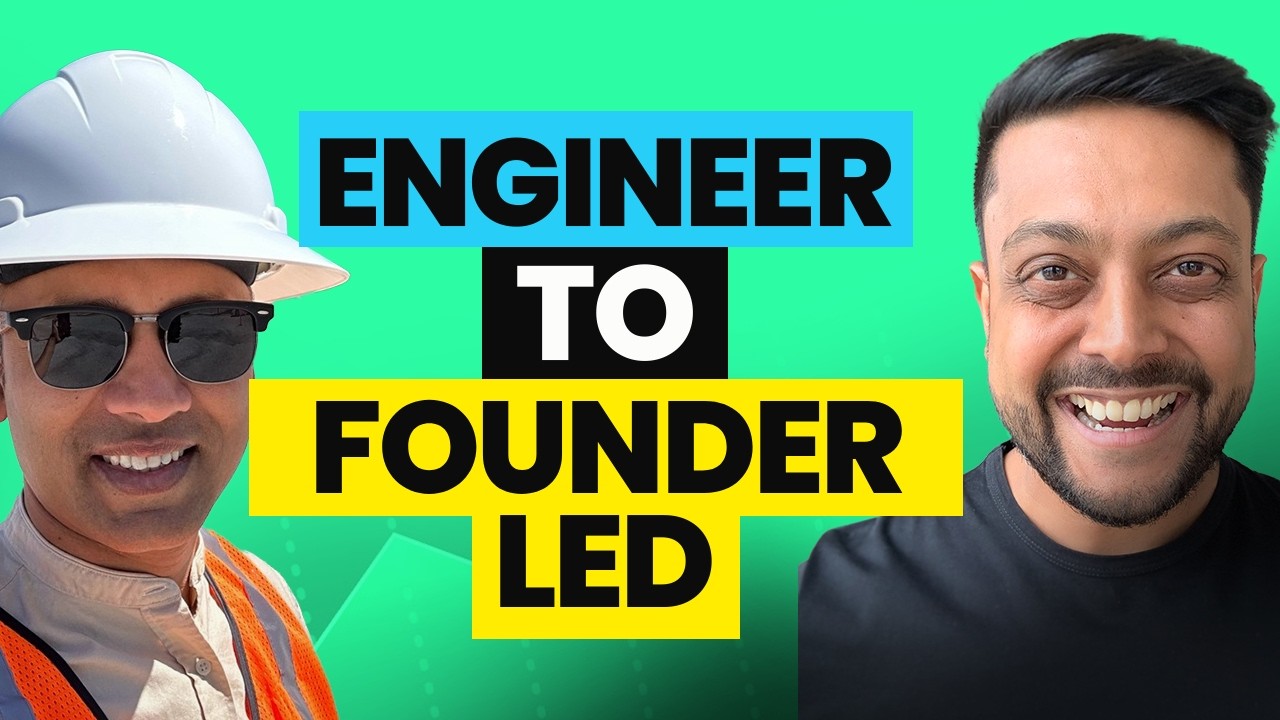
Engineering a product is logic. Engineering a Go-To-Market machine feels like chaos. I was talking to a Founder recently who was stuck in the "Founder's Delusion." He’s brilliant. He has a deep engineering background. He built a platform that the industry actually needs but when it came to growth, he was hitting a wall.
In today’s episode of SaaS and Scotch, I sit down with Amar Amte, CEO of Pegbo, a member of my GTM Transformation Program. Amar is a "learn-it-all" founder who realized that while you can hire a CTO to build the code, the Founder must own the GTM structure. In this video, we break down the 5 GTM Lessons that saved him years of "idea maze".
------------
Learn more about my AI SaaS GTM Transformation Program (Accelerate to $10M+ ARR) 👇
-- https://tkkader.com/yt/gtm?utm_content=pegbo
------------
Learn more about Pegbo: https://pegbo.com/
Get in touch with Amar: https://www.linkedin.com/in/amar-amte/
------------
🤝 SEE OUR SUCCESS STORIES:
https://www.youtube.com/watch?v=F3anw5uK_ho&list=PLinI31g4OKHjRzXVurpRNbG0tVrus4Ect
👋 SAY HI:
▪ https://tkkader.com
▪ https://getunstoppable.com
▪ https://www.linkedin.com/in/tkkader/
▪ https://twitter.com/Tawheed
▪ http://instagram.com/tkkader
Everyone needs a strategy for their life and their business. When you're with us, yours will be Unstoppable. Thanks for watching and I'll see you in the next one! -TK
------------
https://youtu.be/3LP5tct2H5I
6 Steps to Creating a Go-to-Market Plan: https://youtu.be/RJcSjGadYfc
The 8 Essential Elements of a Killer Go-To-Market Strategy: https://youtu.be/Gjq46o2szGU
Go-To-Market Strategy Framework That Works in 2026: https://youtu.be/XMem2vKeXbk
#tkkader #gotomarket #gotomarketstrategycasestudy
Оглавление (7 сегментов)
Segment 1 (00:00 - 05:00)
Think the bottom of the barrel is visible right now. If people see that the bottom of the barrel is visible, the ICP gets clear pretty quickly. It's right. Not exact. To be clear, you're not preaching. You're sharing. Okay. What you learned. What I do so that others don't make the same mistakes. Like that's how I always look at it. So don't feel bad about it. I guarantee the person listening right now, they're like, I have an ICP, but it's not selling. It's not working. What's wrong? What am I missing? One of one. Of the thing that we talked about, you know, if I remember that one is I had this, messaging that particular 51, it matters to 51% of the people. And then. Right. I'm like, that means it doesn't matter to 49%. I remember that, yeah. Walking out. I'm like, oh my God. I think that, you know, it's very funny. So when I say those things, I'm like, this guy is going to think like, I can't believe I'm paying this much money for this. Like. But you. Know what? The part of it is like the sounding board. It's like, I'm not an investor. I'm not a board member. And you literally pay me to tell you it's so, you know, I do remember that. All right. So I'm like, oh, now, Dan, that is so right. What's top of mind for you for the next... Scaling. Yeah, we have repeated customers. Our customers accounts are growing, starting with low for figures, almost six figures like these kind of growth that we are experiencing. Yep. My team is now scaling, so how do I scale? How do I trade, what tools I utilize. So the scale. I am not, context, but also like, you know what, our skin myself, right? And today, I mean, it's just one of my team members was able to onboard a brand new customer without me. Right? I think that's got to feel so good. Right? What's everybody. Welcome to another episode of SaaS and Scotch. Today, I have a very special episode for you guys. We have the founder and CEO. Amar Amte of Pegbo. Welcome to the show. Hey, digger, thanks for having me on the show. So tell us a little bit around who you are. What does Pegbo do? Let's start right from the top, and then we'll dig into all the lessons you've learned in Go to Market and in building your SaaS business. We are here today. Thanks for giving me a chance to be on the, show. And. Yeah, Pegbo is like a LinkedIn for commercial and trade, contractors in the construction industry. And we are building a lot of coworkers in Detroit to help, construction, procurement, sourcing and engagement. That's awesome. It feels like yesterday, but I know it's been a little bit of time. You join the go to market program a little under a year, and right after you join, you hit the ground. But we also met up. I was in Palo Alto. You came over and we were in, cafe. We were just talking through the beginnings of, like, what you guys do, who you sell to your pipeline, some of the challenges. We walked through a bunch of things. That was awesome. Yeah. What was going on in your world when you decided to go to market? Seriously? And just be like, we got to figure this out. I was watching your video a long time. And what? Cyber. Right. And thanks for doing what you do means literally. It means a lot for people who are coming, who are not coming from a sales background and founder is outsider in any everything they can. The 100 things that we have to learn when we start a company is mind blowing. And GTM was means I come from the engineering background. GTM was not part of my class. Right? So learning about it and each and every topic that you were putting together, I think that was really interesting. What one of your video, as well as like not one, I would say like many, but to one in particular about the ICP and really where in that video we're talking more about and they know about ICP. Right. With had oh. My God, he's talking to me. You left me right. And that's really kind of, you know, I think we should sync. And I would love to kind of learn more about you guys. So give us kind of the overview. What's your journey been like over the past few months that you've been working on? You go to market. Where did you start? Where are you at now? And then we can dig into your lessons learned in terms of go to market. We're definitely diggin and I'm a good student of yours, I can tell you. That is. Awesome. Well, yeah. Really means, one aspect is on the journey. Means I've really looked at everything that you had put together right from, that 100 I'd invest in gold. Golden dream. 100? Yeah, I mean, what I'm good at the GTM plan. Then the aspect of, Roadshow. Yeah, right. What do you need for a roadshow? Literally means I did my team. Okay, what about the top of the funnel
Segment 2 (05:00 - 10:00)
the ICP? What about the roadshow? What? Our thing. Moving on. The dream. Dream 100. And, the kind of structure that you have put together. Are these particular activities being taken care, and how is the funnel progressing? So that is where I see, see or value and I see like, you know, so I did I got it from me that is giving that gives me a quantifiable we track the progress and to work on the program that is being put together. Let's double click on these because like the pillars we follow always is ICP manifesto, which is messaging. I remember when you and I were talking we're talking a lot around messaging. Yeah. And then there's, Broadway show, which is a consistent set of activities. And I'm not surprised when you mention ICP because every founder that I talk to, you know, there's founders I've worked with for multiple years, even at different inflection points of growth. ICP becomes top of mind. So let's maybe double click on ICP. You thought you had an ICP, then you went through the process. What were some moments that you can share with other founders as you went through your ICP exercise that you would tell another founder, or you would tell yourself, you know, nine months ago before we joined the program. Oh man, there's so many things I. If only I could have told myself nine months ago or 15 months ago, Gosh. Yeah. ICP is one, I think. Right. And what a lot of the founders are fighting, hundreds of battles every day. Right? Right. From what is the key, you know, you being a founders. Yeah. What then? Sometimes what happens in this ICP becomes a nice, soft corner. That. Oh, I know who I'm selling because somebody who said good was. Oh, wow. This is an amazing thing. Right. But oh, I love this product. This is amazing. Right. But literally we were chasing yes from people who cannot say yes. Right, right. And we were getting no from people who cannot say yes. And we were getting yes from people who do not have money. Right. And we're like, oh, you know, I missed that. Right. And our budget misses rightfully so. Then great. And so in this, what we figured out is who is the champion and who has authority to sign the check in. That journey is like and that's where we kind of started figuring out in our ICP that, you know, who has authority to sign, who are good champions without champion, because we are in construction industry for us, relationships are everything means I absolutely I bet everything on relationship and genuine relationship. And these champions are all great, all of folks who are literally taking us to the, to our ICP, who actually have a problem which is materially impactful, and they are willing to sign the dotted line. This is something that I always wonder about. I don't know the answer, and maybe it's because it's fresh in your mind. You'll know the answer. Why is it that we think we have an ICP? But then you go through the process of truly doing the exercise, then you get actual traction, and then you actually have an ICP. What was the diff for you? Or like, you know, like because, yeah, everyone was like, I kind of have an ICP. So like for the founder that's walking around struggling with traction and things, he or she has an ICP, like, what would you tell that person? Think the bottom of the barrel is visible right now? If people see that the bottom of the barrel is visible, the ICP gets clear pretty quickly, right? I can share my case. You know, I'm being very in a very fortunate position. Keep on keeping on. Because of my prior career and whatnot. And so I, it's absolutely the kind of, the length I can go to is mind blowing. I mean, yeah, so and fortunate been a very fortunate position to do that. But that's where the bottom of the barrel sometimes become. Not that visible. Right. But I kind of, put this in the ground that, you know what? Okay, that's the bottom of the barrel. What if you run out of money tomorrow? Who's going to sign that? How do you get to that zero cash flow or, you know, or escape velocity? And I'm the first time founder, so I really don't want to preach because I'm the most means. I tell my team I'm an idiot person in the team, so I literally that's reality. Yeah. Not exact. To be clear. You're not preaching, you're sharing. Okay. What you learned. Either. So that others don't make the same mistakes. Like that's how I always look at it. So don't feel bad about it. They want it. I guarantee the person listening right now, they're like, I have an ICP, but it's not selling. It's not working. So what's wrong? What am I missing? Yeah. You know, like they want to know from you what it means. What does the bottom of the barrel mean? what was the difference between you thinking, having it and going through a process? They really want to know. You're not preaching. You're like, they literally want to. That's why they're watching this video right now. Yeah I know the comfort zone.
Segment 3 (10:00 - 15:00)
Right. Any important that how can people get out of that comfort zone and literally be real. We are in business. We are a VC backed company. And really going after that, you know, deep Liquid. And one of the, founder has shared this with me that are you already know for. Right? I mean, a lot of pain killer. Yeah, but you have pain killer. And that means they need pain is urgent, urgent and important. That means they are signing the dotted line. Of course, our enterprise schools in psychology schools. And so I, I don't want to kind of like give it the baby takes nine months. Right. That kind look I was curious about who is my ICP. Who does it matter and is it machine learning for us? It's a nice to have problem. Yeah. And we started even pivoting and started and just in the message, the whole fund, the GTM also changed what method we are following everything change. But being real, nothing gets serious. Then seeing that bottom of the bat, it is right there. Yeah. That's like when you say bottom of the barrel. You mean like the runway's ending? You might have to shut it all down. It might not work. Then you're like, you know, maybe I don't have an ICP. That's why we're running out of cash. Like we should do something about that. Maybe I do need to, like, do the actual exercise instead of just winging it. Yeah. And the problem is, like, you know, if you look at, like an I am not in early 20s. So people who are starting and if you look at Carter data, 30 to 40% of the founders are in my age group. And until day or if you really look, at their being in the band, that means, they have some less right firepower, but so that can delay the planning of an ICP that really this is the ICP. This is the pain point. This is what we are going after. It's so interesting because if you get that one wrong, nothing else matters. Interestingly, you can have the best messaging and the best marketing to sell steak, but if you are selling steak to vegans all day long, it won't matter. You might be a vegan or vegetarian like, you. Know, like is a work. In Saudi Arabia. I said, yeah, no, that's exactly right. You could be in. Saudi, you could be in Dubai trying to sell pork. You have the best messaging for pork, best marketing for pork. But you're selling the wrong people. Like that's how important ICP is. You mentioned messaging. So that's our second pillar we always talk about. And that was a lot of like what you and I were talking about over coffee in Palo Alto. Yeah. What did you learn about that. Like what was your moments now that you broke through. Yeah. You know how to scale. One of the things that, you know, we talked about, you know, if I remember that one is I had this, messaging that particular 51, it matters to 51% of the people and then right it I'm like, that means it doesn't matter to 49%. You remember that? Yeah. You're walking out. I'm like, oh my God, I. Didn't you know, it's very funny. So when I say those things I'm like, this guy is going to think like, I can't believe I'm paying this much money for this, right. But you. Know what? The part of it is like the sounding board. It's like, I'm not an investor. I'm not a board member. And you literally pay me to tell you it's so. No, I do remember that. Yeah. All right. So I'm like. Damn, that is so right, you know? So I went on changing some of that, narrative. That was like the urgency message because we were talking about like, yeah, we just started buying it, saying forever, like, that's all that was the problem. Yeah. and the messaging aspect. Also the, the omnichannel messaging. Right. And, so the coining the right message, right. Value creation, why is it too urgent to be solved? Why is it important to be solved? And why does it matter to you. Right. And delivering it to omnichannel. Yeah. And, you know, offline and online. Right. So we worked on that. But it's like your thing that, you know, okay. How many people does matter do. Because that messaging also if I'm solving it. So the problem for two people in the company, nobody cares. Everyone's saying, oh, you know what, this one person is working 12 hours fight. You know what? Not a problem. But if it means if that messaging is and two the ICP and the messaging is going to, my day later, no more number of people relevant to more than a lot of people in the company. We worked on forming that message, finding those ICP, building that product for those people. You went omnichannel. That's the third pillar of the Broadway show. You have the ICP, the message, then the Broadway show. From what I remember, you were already given your ICP. You were already very offline, heavy. Yeah. Because it's like you to this construction people. And I know a lot of people watch the channel that have ICP, so it they're just like, not hanging out in LinkedIn like a VP of marketing is. We have so many companies we work with that have a little bit harder to reach out to KPIs. So what have you learned in your Broadway show in your roadshow?
Segment 4 (15:00 - 20:00)
With your team? That's work. Maybe not offline, but online for a hard to reach ICP in. In one of the template you had a very good the business that is reaching to that ICP exercise. Yeah right. That how do you kind of reach to that particular ICP and really start answering asking the question. The whole template is pretty interesting. It's not going to really. Do, you know, doing it and then. Getting into all of that. Yeah, yeah. Reach them reaching to that ICP. Very important. And where are those ICP hanging in? In our case yes, construction. But a lot of our ICP that are on LinkedIn, they are not on, Instagram. They are not on Peter. But if you are selling, eating, like tool, like, cogeneration tool. Yeah. Those guys that are hanging out on Twitter, see, what does it not mean? Software developers hate, LinkedIn. They feel pride that, oh my God, we are not only beach, but, you know, in construction and all their unbelievable number of people on LinkedIn. Yeah, yeah. And how they're because it's still people. Right. So we've found that as a, as a place. I'll share two things here and you can react to it. Tell me what you think. First one LinkedIn I get a lot of founders at first are like, oh, these people are not on LinkedIn. I'm like, listen, I appreciate the you're a unique snowflake, but LinkedIn is more popular than you think. That's what he wants to move up in their career. And LinkedIn did a great job to say, you shouldn't hang out here if you want to move up in your career. I feel like a lot more people are on LinkedIn than people realize or give it credit for. That's so true. That's true in LinkedIn is really interesting people. I think people think a lot of time that it just for job searching right up with it. Are you really I find LinkedIn pretty helpful actually. I'm learning a lot from LinkedIn because not this whole I stock. Yeah. Of course everyone is a guru these days of how long. They I think or and you know. Right. But it's interesting. It's like really I learned a lot from. The second thing that stands out about what you said is the templates. You know, I get a lot of founders that are like, oh, my starts really unique. Look, I don't want a template, cookie cutter thing. And I'm like, that's not what a template is. A template is like here, the 80 things that just work really well, where the blanks need to be filled. And you and I look at it to figure out, is it right or not? And if you're missing something, you're skipping a step. And what's been crazy now, I started this program six years ago. Now you can actually take the go to market tracker. I don't know if you've done this. I've been doing this with a bunch of founders. You fit it in the cloud code and cloud code. Now you know your go to market strategy because it has the right context where you go to market strategy and just. The idea that. You don't have to do anything fancy, just do a screenshot of it is student. And now you go to market strategy. It's incredible. We're going to add an AI tool for that. But like what's your reaction to that template thing? I don't know how to answer that. I'm like, no dude, it's not a cookie cutter. It's like it's there's a framework. Like I try to keep myself very simple and good, right? Because, no, no at all. People are very hard to work with. And your customer also figures out how to work with it. It's so true. Yeah. So I'm not know it. If we can really limit all and really follow the supermarket approach, I don't eat beef. I don't eat pork. I only eat in and out Double-Double, by the way. Okay, but, You know what mean? Relevant for a second. Like so. No beef, no. Pork, but double double. Double double, you know. Oh, yeah. That's what often double double. You know, it's. Funny I'll share this or I. This past weekend, I was, getting together with my, my best friend. We've been friends since, like, seventh grade, and, my fiancé was there. His wife was there, his kids were there. My other best friend was there. Huge gathering. And I, we were sharing the story of how we first met and how we first met. One of my earliest memories of him from seventh grade, like a long time ago, I met him during lunch and I literally saw him eating a cheeseburger because that's what they served in, Tuesdays in the cafeteria. And I was like, hey, man, like, I thought you didn't eat beef. And you usually were like, no, on Tuesdays, I do like, yeah. No. You can't say no to, you know. Whatever, whatever. Once I get it and I'm. To say no to WW. Yeah. So it's more like now going on that aspect of template. Yeah. I, I follow the supermarket approach. I, if I don't like, you know, I don't, I don't get to, I don't throw a fit at Safeway that I know. My God you know, how can you have the meat. I don't eat right. I just skip that route aisle and go to the next right. So I like what I kind of like in the template, getting to a template, really figuring out the ideal 100 to date, I am like, I know we both get busy so we don't get time to think too much. Yeah, yeah. Even if you see my history, my spreadsheet history today
Segment 5 (20:00 - 25:00)
you will want to see I working on that sheet. That's awesome. We know on like going through tracking on the dream hundred working on that. So yeah I follow certain sections of it. I was not able to go get all of those even the videos I was not, but, you know, take pick what you get. Like, that's totally right. As a founder, it's not like, okay, you learn in meeting from one person, you know what, you help me and thank you many of what that you know is that, making it less scary and providing me a method that, you know, ammo giants follow the course. This thing, follow it. Just trust the process. Go through it. You know, not often what happens is, me. Okay, let's say that. Oh, my God, you know. Oh, it's so saturated with that. Oh, where are the customers? Like. But then you go through that spreadsheet, you say, oh, ten, 75% of these guys I didn't even contact. And how can. This. Okay. Well, so that the whole template and it helped me stay real. Yeah. And keep things very simple. It's like, you know, we complicate a lot of things. It's like, the template helped me onboard people and actually my team members because it is simple enough. You are onboarding an SDR and he or whoever or a partnership person or having a box. Where the agent. Or. Not. That's right. You're going to try that. Yeah. And, you know, in construction. God bless you. So. Right. It helped me kind of keeping it less scary then. Guys, this is what we're doing. No rockets and just step one, step two, step three, step one. Team. Go through it. Let's just keep what? Yeah, we're keeping it very basic. So what's next for you. Because this is a never ending journey. So when you think about go to market the company given where you were early last year to now, what's top of mind for you for the next in scaling? Yeah, we have repeated customers. Our customers accounts are growing, starting with no. Four figures to almost six figures like this kind of growth that we are experiencing. Yeah. My team is now scaling. So what? How do I scale? How do I treat what tools I utilize? So the scale, I am not, context passing ones like you. What, make color, skin myself. Right. And today, I mean, it's just one. One of my team member was able to onboard a brand new customer without me. Right. I think that's got to feel so good. Right? Yeah, sure. Getting the meeting means being the outreach. Getting the meeting, showing the demo, identifying, locking the customer, the project, the pilot project, onboarding it, deciding. And right. So duplicating myself, making myself, getting out of all the jobs that I do, scaling. That's one of the fun things about the phase you're in because you were in like low error. You know, that the mid air level driving to the next stage, I think the first part is always a little bit of like, what do I need to do? But now is a little bit more about what do I need, like on the team and how do I empower them and what are the right people and how do I keep it lean still and not overgrow? Like there's a little bit of like, how do you allocate the right number of humans in the right way phase right now? Yeah, literally how do I allocate, how do I scale myself and what do I use? What are the tools which are out there. And we had such an amazing time that it's mind blowing. The kind of tools, the kind of signals lot as being a blessing to us. Oh yeah. Claude, the tanks engineer and every founder's team right now. Unbelievable. What is magic? The funnel monitoring and all is just mind blowing with the. How has that been for you? How have you embraced AI and your ICP given who they are? Is it different? Like, are they slower? I just as much. Construction as the relationship business. I believe. Sort of. That's right. Certain touchpoints and the intent signals and all can be captured using AI, but, relationship, is where we are not throwing AI. We are not making phone calls using AI. Right. Just to optimize our number. Not like, you know, nobody wants to talk, I don't want I would not even give a meeting a pull to an AI, SDI. Yeah, yeah. I mean, I tried many of those, but, we, we are really, utilizing to nurture our leads. But the end approaches. It's on the. Yeah, it's so interesting. The LinkedIn feed would say that AI agents are winning, but humans seem to be winning. When I talk, one on one is like, nah, dude, I, I still need to like, like the human touch ups. But at my. Previous work, right, we in 2017, 18
Segment 6 (25:00 - 30:00)
there was a thing that, oh, don't call it AI and we invented the AI in like, you know, pioneers. If you can plug their do not call the AI because people were making fun of it in 20 1718. Call it we are hiring data scientist because it was kind of the and now, from 2022 to 25, 26 now is like these bombarded, 23 to 26 people are just getting bombarded with AI. So there's a fatigue on the device and whatnot. Right. So people here, yeah, they switch up. They are like, you know what, is this whole aspect to stop it? Kind of. Right. Yeah. So we are following an approach more like what Apple followed an approach with iPhone. They're just in the interface as well as the engagement. You don't see the complexity behind it. You don't hear how the message is being sent. You just want that message to be simply sent the task to be completed. How it is being done. All we need to know, we be keeping the whole technicality out of it. Yeah. You want the result? You want? Yeah. The middle. Yeah. That's correct. For the founder. That's listening. They're kind of been in, they've been watching videos. They're considering joining the go to market program there, maybe where you were when you decided to join. And they want to get to where you are now, like, what would you tell that person that's like, kind of on the edge, kind of considering it. And like watching this video and watching you. You we need it to work because, you can hire a need for as a, as an early stage founder, you can hire an engineer to operate the engine. But as a founder, you are the one who is selling. Right. And now being like, you can hire a product guy to do the product, what? You can hire the engine CTO or your co-founder. Right. But sales is a founder's responsibility. And if you are not coming, you can't say like, oh, I, I'm not good at sales. Looking at might be of sales or something. I can tell you, you know. What is good. Right now? This GTM programs and what look like program. But getting the structure that I was able to utilize this I was not aware of it. Right. And it just made it. Linsky. Like less scary for me. Unknowns were there. It was a very nice. So sales will be is the highest priority of a founder. And so through this program I was able to utilize it, I built it, I hope you guys also would see the structure and how this structure can help because, you know, you cannot go to your, dev or UX or, product guy or your marketing guy to do the sales for you. The founder has to take in them and, and you work in your room alone to put that program together. And then when the structure is with you and someone is there, the community is there to be with you. I think it's just, help put this becomes your invisible force. Yeah, that's good advice. I, I come from an engineering background, and I learned that you got to get good at this in order to have a successful company. It's just like the only way Elon Musk would probably rather be building rockets than being out there trying to generate demand like he learned how to, like, get great at that. That's really good advice. What's next for you as you look at scaling the company, the next frontier with AI, like, what are you pumped about as you look ahead. For winning through? One is like, you know, means that's it. And that's what I'd be a long way to go. And, the battery I did for us is absolutely mind blowing. We are starting with certain we are entering the market with certain things, but I see a huge is a long pathway ahead for us. Right. So that's there on the AI front, I'm absolutely positive about, AI because, my undergrad ID idea. So that's our being in the system. You know, like the guy actually. Yeah. Yeah, I thought I was getting 122. I was doing my, my masters, I did, I, so I'm making a lot, I, I see everything is possible with. Yeah, that's the thing. You dream about it. It's possible nothing is impossible. Just do it with Google Maps. There's no destination. Which is, unknown. Yeah, right. You put an address and that's it. You don't worry about that out. And that is what I spot. Me. Nothing is impossible. That's exciting. Well, thank you for sharing your journey. I really appreciate you doing this because I think that it'll help a lot of founders, particularly the founders that are like us, like you and me, where maybe they have an engineering background and they look at sales and marketing a certain way. Yeah. And it's like, no, this is just like anything else. Like you get a framework, it's an easier implement. And so I'm glad you shared your wisdom and I'm so excited for you. I'm grateful
Segment 7 (30:00 - 31:00)
that the program was able to help you, even in a small way. I and I'm really excited for your success. Like the progress you've made. It's awesome. I'll say one thing, I've talked to a lot of founders and there's a huge difference between the founder that's still in the idioms versus the founder. Like is does I know my ICP? I know my dream 100. I know what to say to them. And you have that certainty in your voice, which I'm so excited about. Like I'm pumped for you and the entire team. Yeah. Worked on it. I came to the core. I worked on it. You did, you did. I do appreciate well, for what you do. Keep it coming. Literally. I do watch it. And, Yeah, I do appreciate it. Thank you so much. Yeah. Where can people get in touch and learn more about people and where they can get in touch with you? Pegbo. com. That's where you can learn more about. Awesome and obviously LinkedIn, because I first got LinkedIn as well because his ICP is on LinkedIn. We'll link to both in the description. Thank you again for joining today. We really appreciate you. Thank you so much, Diggy.