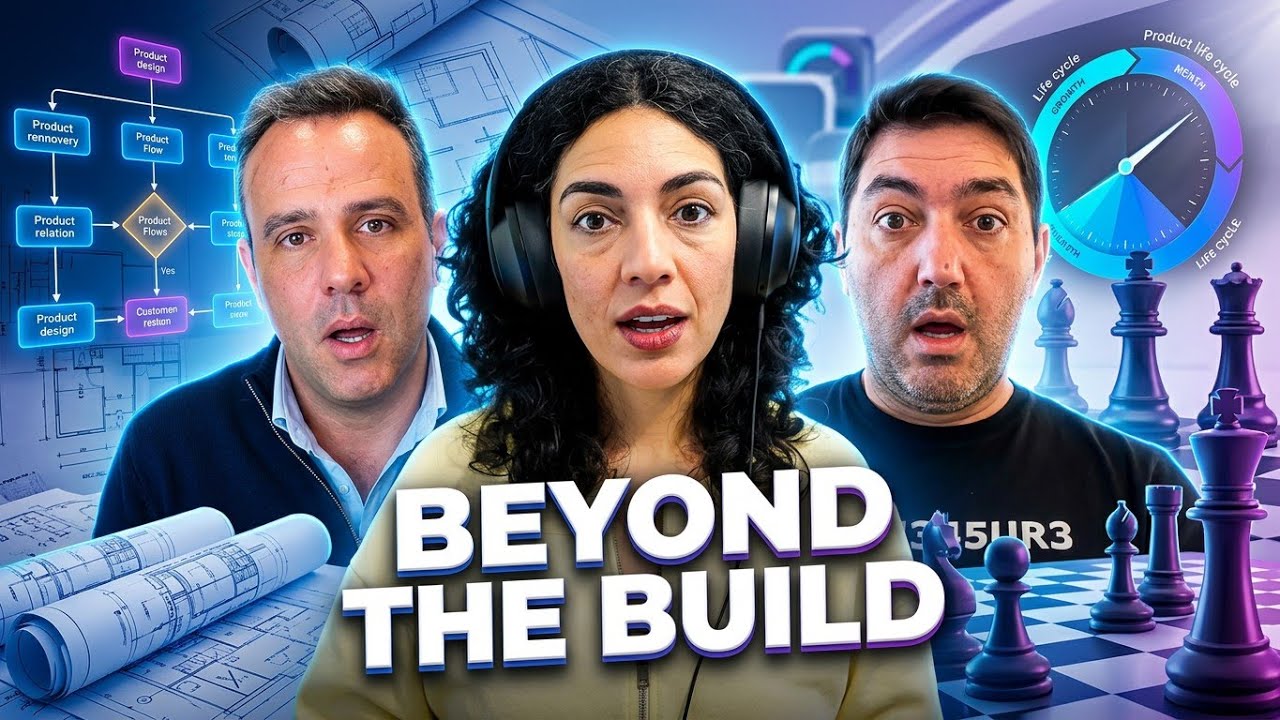
The conversation delves into the evolution of product scaling, the pivot to financial institutions, and the transformation of Feedzai. It also explores the learning curve for product managers, the evolution of PMs at Feedzai, the art of saying no, and the core value of Feedzai. The conversation covers topics such as value detection, AI and machine learning in fraud detection, limitations and future of AI in fraud detection, sustainability and evolution of the business model, product as an intelligence engine, data-led product development, agentive AI, cloud infrastructure, transition to cloud infrastructure, transaction risk assessment, emerging risks and challenges in fraud detection, and the role of product managers in fraud detection.
Takeaways
* Product scaling through industry pivot
* Evolution of product management from startup to scale Value Detection
* AI and Machine Learning
* Cloud Infrastructure
* Fraud Detection
* Product Management
* Data Intelligence
Chapters
* 00:00 Introduction to Product Scaling
* 07:14 Evolution of Feedzai
* 13:03 The Evolution of PMs at Feedzai
* 26:39 Saying No and Decision Framework
* 36:30 Core Value of Feedzai
* 44:29 Cloud Infrastructure and Data Residency
* 50:26 Transition to Cloud Infrastructure
* 56:08 Emerging Risks and Challenges in Fraud Detection
Оглавление (8 сегментов)
Introduction to Product Scaling
All right, so it's time to shake things up. Welcome to season 20 of the Product Ize podcast. I'm Andrea Marquez and I'll be your host for today's episode. This season we're all about beyond the build with Product Ize conference with 2016 happening June 18-19 in Lisbon where we explore how product leaders drive real lasting impact and anything between. Today we're diving into a brutal but necessary idea. To scale your product, your identity as a PM needs to die. This comes from the journey of Feedzai. They have been scaling through massive growth processing tens of billions of events and fighting financial crime at a global scale. I'm joined by Rodolfo Cristobal, senior product director, and Mike Yeardley, VP for market solutions at Feedzai, the leading AI native risk stops platform dedicated to a world of safer money. We are super excited that they have joined us as a sponsor for Product Ize conference 2026 and they've lived this transformation first hand. They have evolved their product management from early stage chaos to a structured high stakes discipline at scale. Rodolfo and Mike, great to have you with us. Thanks, Andrea. Great to be here. Thank you, Andrea, for the invite. Absolutely. And it's really my pleasure to know a little bit what you guys are doing. So let's warm up with a quick round. Short answer, but we really want to get this started strong. So what's one decision you made that felt wrong at the time but turned out to be right. And maybe Mike gets to start this one. Okay, yes. So look, I think if you look back through our history, um we've had a real evolution over time. I think that's a I think true. When we started, we had a journey that kind of was very much focused on maybe a more merchant focused community. Um whilst that might have incorporated global names, um it's a very discreet, focused use case for us to kind of help those types of industries. And actually our real pivot now is that um we've moved over to the financial institutions. We're looking at fraud and financial crime from a financial institution, typically from a bank or even more today from a fintech type basis. Um and so when we started, that was a big shift for us. You know, looking at the merchant community, the acquiring and base community has a lot of very specific requirements in terms of um as much as the fraud protection, but it's actually about revenue. It's about turning that wallet into a good, trusted, consuming behavior. And actually when you look at it on the financial institutions, yes, we have the same challenges. We're looking at good customer experiences. How can we have frictionless journeys where consumers get to do what they want to do. But really it's a very big pivot when you have some leading industry names that are on your roster and you say actually we're going to make this big the shift and focus onto a kind of like a different type of industry. So I think it's quite a at the time it's probably a little bit unnerving. Mhm. In terms of losing globally recognized logos. And I think that then, you know, when the way that a company wants to evolve is how do we kind of get that market presence and then shift that into a world where perhaps we're having to start again a little bit. We've got the basis of a great solution. We've proven ourselves, but you know, proving it with a new set of customers and kind of buyers in the market. So it's quite a big thing I think to go from trusted, well-known, respected to a whole new world and to leave that behind to some extent is is it's quite a it's a great leap of faith. And I think at that moment you probably have some bumps along the road, but I think if you look back now, I think you would say what a great decision that we made. I think the way our technology worked and just to clarify. So kind of as a big industry so a financial industry is big. You have banks, you have insurtech, you have everything in between. So what exactly did you just stop serving as a customer? So think about some of your leading trying to do it without naming names because I think that's an important thing. But yeah, think of some of the well-known sports goods brands that exist in the industry. Think of those media streaming or those music streaming type companies. They're the types of companies that we had. But if you think about it today, think about the audience we maybe have at Product Ize. Think about your big Portuguese banks, big banks globally. It's a very different mindset. um it's very different experience and it's a very different industry. And it's that. So think of your big sports goods, your more media based activity, and now it's financial. And what are you focusing at the moment? Who are your ICP? Fundamentally, it is the banks. It's the financial institutions. Yeah, whether that's from a compliance perspective, from an anti-money laundering perspective, you're looking at the protection of the financial ecosystem, the fraud based relationships, so whether that's from a an acquiring perspective, protecting the risk to the merchant, the risk to an acquirer who provides the ecosystem. So think of your cards transactions. And then ultimately the banks. And then for the banks you can consider every one of those on this podcast that listen to this. We, you know, we subscribe to banks. We are customers of banks. And so by helping banks protect us from the wider fraud world, that fraud that wider risk of us being compromised, um we sit across those three strands. And on top of that then how do we look at our identity? How do we protect us as an identity as well? So our online behavior has a particular signature, a particular footprint. Actually you want to create trust in that. You want to identify those moments where somebody's trying to act maliciously on my identity, on my behavioral, the way that I transact. And those three things I think go really nicely together. The transactional ecosystem, the customer, the consumer as an entity, what is the integrity of that customer? And then what is my identity and who I am and how I behave. And so those three things go nicely and that's kind of how we've evolved over time. And I think why it resonates that big shift over time into that multifaceted customer first view, um it's kind of that journey that we've been on for the last few years. Okay, so that's a great intro to the core idea that we want to discuss here today, which is what you call the PM scale paradox. The very things that make you successful, and I guess some of those early clients were obviously, you know, helping you to become a successful company early on, will block you later on a later stage of the company. And Feedzai, um for those listening, it's already it's a unicorn. You have surpassed 1 1B valuation. So instead of asking how do we scale products, I want to ask um first of all, in your own terms, what is Feedzai today? Maybe Rodolfo, you can take this
Evolution of Feedzai
one. Right. So Feedzai today versus before, right? We are a company that started already with AI um at its core to detect risk in financial transactions. And then as Mike said, we could detect them on merchants, big banks, we could detect it in many applications. In these early stages, we we were doing it with Telco. I don't want to mention brand names again, but Portuguese here in Portugal, we are very well-known companies, Telco, even insurance. And then came the banking space, right? The core was there from the beginning. We apply AI to solve world problems. And detecting fraud is definitely a big problem that our customers have and affect people. That's why a world of safer money. So today obviously Feedzai has grown and has found us the market fit, especially on the banking industry. So now we deal with world's largest banks. We protect um 8 trillion in money worldwide. We we're probably now the third player that processes more financial transactions in the world. Coming from a Portuguese startup, which it's definitely something to be proud. Just um this week or last week we announced 100 patents. So that that's obviously a huge milestone. I got three of them, by the way. them from the early stages on the product, which again I will explain how we had to shed our skin to get into those. Um [snorts] and it's obviously now we are a very large company worldwide. We're recognized by the world's largest banks. We just got ECB, the European Central Bank. We're protecting the digital euro channel. So we we are now very big. And my personal experience from being a small startup until today, it's it's definitely something I'd like to share cuz it's obviously uh we had to reinvent ourselves uh along the way. You know, you start uh basically as a zero to one PM and now you're a scale PM. And obviously all that feels different and you need to be able to pivot into that. Yeah, so today Feedzai is probably one of the largest uh um uh players in the market of risk. So it's not even just about fraud, it's also about compliance. So fraud is basically we protect our end users and obviously the our customers. And so that they don't have financial losses. And then compliance is a totally different scenario where we are actually protecting the world of money laundering. And obviously money laundering comes the origination of the money is always comes from a criminal activity and can be the trafficking, can be war, it could be many nefarious things. So definitely proud of the journey and and where Feedzai stands today. And up is the limit. All right, so the PM team had to evolve over the years. So, so let's just tackle this question. What do PMs need to unlearn to scale? No, why don't you take that because you've got the longevity and then I've kind of got the majority of the team today. So, why don't you start and then I'll kind of finish it off. Fair enough. Fair enough, Mike. Yeah. So, definitely as I was saying, when I joined Feedzai, I think we were probably one or two product managers. We had just started product at Feedzai, right? The company obviously starts as a startup with engineering and they have a great idea and it starts to work, but then it you need — Also because all the founders were are engineers, right? Pedro Bizarro is an engineer and you know Well, I'm an engineer myself, but You are. Obviously moved into product in early stages in my career. Um [snorts] but when I joined, we were just a few and we were just creating the product kind of mindset within the company. Um the way I like to think is there is no engineering roadmap and there is no product management roadmap. There is only product or or business roadmap. — [snorts] — And sometimes you have to take technical decisions, business decisions uh more on the product management side, but ultimately what bring this from that point into today was always prioritizing the business decision. What's best for business? Um and I think that's fundamentally what happened to us during that time. And obviously you start again as a zero-to-one PM, you have incredible ideas for that one product and you make it work, you solve your customer pain. You delight customers, you build products sometimes that are just for selling and then when you scale, obviously that paradigm changes completely, right? You're not looking at, you know, shiny features anymore or or the hero mentality. And you know, a lot of product managers have egos. I have egos myself, but you need to learn how to adapt your outcome to the to the stage of the company, right? If you have four or five customers, obviously it will be very hard to say no to whatever request they come, but you have to keep thinking, if I want to get to 100 million ARR, what are decisions I have to take today? And sometimes it's not easy for a product management in particular to be thinking that far away. And it's easy to make mistakes, everybody make makes mistakes. And you were just describing scaling as a series of identity death. That's a very strong claim, of course. So, what exactly is dying or was dying along the process? — Well, the way I like to see it is definitely your ego must die. Mhm. Obviously it's it's obviously a very provocative statement, right? Nobody's really dying, right? Maybe shedding the skin is a is a better is a better alternative, but you need to think what should what should be your product mindset at each of these stages and be able to pivot from one place to the other. So, if you start small again, you know, you're concerned about your product, you're concerned about how good it is and whatnot [snorts] and definitely you fall in love your product. That's what happens to all of us. You fall in love with your product. When you scale, when you go to, you know, 100 million ARR, what you need to fall in love is your customers using your product. And it's a totally different mindset
The Evolution of PMs at Feedzai
right? Just to be clear, the core, the kernel of good product management is the same. That doesn't die. The way it works is completely different from when we have, you know, five customers and you're still selling, you're still finding your market fit or your verticals versus when you're thinking about how you are going to handle, you know, 100 customers, the ability to say no. Now it comes partners as we're going to see in this journey, your mindset and the way you prioritize, the way you make decisions will change completely and your ego really must die and reinvent itself for you to take the right decisions because if you're stuck with a like in a zero-to-one PM mentality, in a hero mentality, that's actually going to hurt you and obviously the company later on. Yeah. Um but is this more about also changing the skills, the mindset, incentives because, you know, ego must die, like you said, it's a very provocative thing and it's very hard to tame ego, as you know. So, what exactly are you doing here in order make it prioritize prioritizing death? What should go first? Is it the skills? Is it the mindset? Is it the power structure inside the company? How do you do this ever? It's definitely the mindset for me. That's the first thing. The ego and the mindset. Uh you know, you start small again, you start building your products. And you need a product to sell. That's the that's obviously the first thing. Without any product, you're not selling. But there's a point in time where you're going to start feeling scalability pains, like inability to deliver, you know, a lot of customers asking for something and then you're delivering stuff. Your our volumes in terms of transactions, as I was mentioning, grew in one way, we almost doubled the volume. We're talking about trillions in of transactions. Um so, there's always this dilemma or this balance between do I focus my product team on making sure we're able to scale, performance, scalability, cloud costs, self-serviceability from customers, or do I focus on new features? Because, you know, they are always asking for features. So, which comes first? — That's a great segue to my next question because you moved from solving very specific customer problems to building an entire platform and, you know, most startups are told focus narrowly, focus on a very specific problem, solve that problem really well. You kind of did the opposite. Why was this? Look, I think there are probably two things. One is obviously our own appetite for growth. You know, we are a company with big ambitions. Um and I think we've had strong successes along the way that have reinforced that ambition is the right thing. So, I think that has naturally given us something. I think the pivot as well to the financial services was another big one. Because, look, the world of fraud is huge. And I think we all know it touches everybody's lives. You hear it enough in the newspapers and the press every day. But actually that ecosystem of how do you protect society and others consumers isn't just about looking at it from a fraud perspective. You have to look at who are the actors within that journey. Who are they who are the consumers that receive those funds of money? Who are the ones that are trying to take over me as an identity and steal those credentials. So, actually I think what we enabled us to do as we scaled out was that shift in the industry also enabled us to start to really grow out different types of products. And I think that scaling is something that we've required from our product managers as we move from fraud to financial crime to identity. And actually last year for us, we actually made a major acquisition. It is really about orchestration and bringing all of that together. We built a platform that enabled us to have all of these multi-faceted product parts that serve specific parts of the industry. Anybody who is a, you know, on the other side of the fence, any of our customers will tell you this is all symbiotic. Whatever happens to that customer's uh credentials and how trustworthy they are impacts whether or not they're likely to be someone that might be a recipient of fraud funds, which provides a vehicle for somebody to then go and commit fraud because you can get the money out. And how does that typically happen? Happens through an internet channel a lot of times. So, all of a sudden joining all of these dots together in the way that we as consumers behave was a natural expansion for us as well. Kind of coming into that space in terms of we needed a platform, we needed that scalability. But then we needed to grow out. I think going back to your point about the product managers, I think the one thing that's happened is that's it's kind of broadened us out and therefore it's stretched some of those parts of our solution as we've kind of become this platform, which I think has then stretched our product managers. And so, rather than that ability to focus within their own world, then there now is all of these interconnected um parts of a platform that they need to join with. So, actually it's the dependency management, the interrelationships with your fellow product managers. You're no longer in charge of your own product's destiny because of the way that the infrastructure works. So, I think that's been a big mindset um where we scaled, our product managers have had to scale. One of the things you mentioned at the beginning is about that mindset and I think the mindset is true, but I also think one of the things that's involved with this scaling is the role of the PM. It's really interesting. Everybody wants something from a PM nowadays. It could be marketing. It could be all we want to look at partners. Oh, we want to go and speak to a customer. Oh, we need to kind of make sure we've got really good messaging and collateral. We need to make sure that we kind of got great demos. And all of that is outside of their core job, which is to actually build that product and build it well. And then ensure that 100, 200 different customers all appreciate that same change in a positive way. So, I feel the product managers, as well as that growing with us as a company, has also grown to be a core enabler for the rest of the company. And so, I think that's a big mindset shift. I think it's also a big shift in terms of their relative importance within the company. I guess more about the product managers than anybody else in terms of can they come and help because they possess knowledge. They possess the intrinsic knowledge of what our solution does. And everybody wants a little piece of that. But I think mindset is right. Rodolfo, you're absolutely correct. But I think we've been very good uh helping our product management community grow that mindset. And I think what's reinforced it is that we've had good successes. So, that's also reinforced that it was a good mindset shift. So, I think that just kind of helps perpetuate it, gives us value in terms of we are on the right track and hopefully that means it's a more empowered, a more interesting role for our product management team. It is not just focused on one thing. Yeah. Let me just complement a little bit what Mike said. And again, this is one of those places that there is no universal answer to should I start with SMBs or tier ones, right? In our case it it it became a little bit obvious because obviously the first customers with big tier ones with very specific needs. Now the shift to platform approach came a little bit at the same time where we pivoted the merchants vertical because we were kind of narrowing too soon. And as Mike said, in this in this space in particular in our business which is a risk business, if you focus too much you'll become a niche player. You won't have you don't address the market needs. You need to be looking at multiple data across the bank. So you can't just or or our customers you can't just choose one or the other. You have to start widening up soon so that you have really an approach that will win in the long run. And again, it was a brilliant decision in this case from our founders to pivot that specific merchant focus on the platform at the time was about omni-channel platform. We look across risk using AI across all your touch points. Because again, look at the space, look at the problem we're solving. It's about criminal activity. They have no boundaries, right? They will explore all the silos within big banks. And sometimes our some of our the banks out there their departments they almost like different companies. So you know, you get fraud on a on a card and you don't correlate that with you know, with internet banking or you let someone get into the bank that will make criminal activity later. If there's no communication, if you don't have a platform approach to this problem, you will eventually die. That's again the same a conscious bet that there are synergies of having a platform because the product gets better by having a platform as well. Absolutely. — Where is this Feedzai ambition coming from? This Feedzai is a private company, right? Has is still not listed anywhere to my knowledge. Is this founder like Absolutely. Founder led and all our product management we encourage them to have a founder mindset as well. So and and it's it's been very a pleasure to work with this team. — easier said and done. Absolutely easier said than done. Yeah. Look, I think one thing as well Andre that we've done is we have brought in we brought the industry into the company as well. Mhm. — [clears throat] — We have a great view of where we want to go. I I'm an ex-head of fraud. I've been on the other side. I was at a bank that bought one of the big buyers of Feedzai many years ago. So actually what we have done within the product management community as well is we we've augmented that real world value as well. So when we have that passion, we have that core foundation around that AI first approach and really pushing at the boundaries of you know, bank transformations through the last 10 or 15 years. We we've really been at the forefront of that. But we have augmented that with real world knowledge, real world understanding. And I actually think that's something that our PMs and our product managers team has picked up really well. I think you would almost say they are SMEs in their field as well. As well as building the capabilities and the features. I know some of our team have really embraced the industry and the problems that are in that industry. And therefore they've used that to help bring back into their own development of the solution those nuances that really work. Because again, we did the scalability to a platform, but what we haven't lost is a focus that there is still specific nuances for all of those use cases that we're helping our customers with. And online fraud is very different to a card fraud. It's branch based fraud. So we need to keep that specialism as well. But actually doing it on a platform play means that we're getting the best of both. We have some capabilities that stretch across. We get that scalability. We get that kind of better together nature. And then we can build on top and still make sure that it really resonates for the one problem that does need to be solved at that moment in time as well. So we try to really blend it, but I think by bringing in the industry experience as well as the ambitions that we have from a lot of the leadership team is also making sure that we're part of the industry, part of the ecosystem as well. So we're not just sat here with our view of we think this could work. We're actually making sure that's part of a real world value as well. And people like myself, look, I live for stopping bad guys. That's what that's you know, that's what kind of gets me out of bed in the morning. That's what used to get me out of bed every single day. And I think we have a lot of that mentality as well. But you know, this is about doing good. I said good thing to get out of bed for. Which by the way is another mutation on itself coming from a platform to this mindset. Yeah, absolutely. And let me just maybe talk a little bit about the power of no, which you say the PM's value at scale is defined by the rigor of their rejection. I think that's something you said in a presentation and that obviously sounds good a little bit like having founder led mentality. This in reality saying no to top customers and I guess some of your customers represent you know, a significant part of your revenue is risky. And so give me a concrete example maybe where saying no. You don't need to disclose any specific clients obviously, but just — We won't. On this one for sure we're not disclosing the names. I hope they they're not listening and they can figure it out themselves. But anyway, No, but it's always in their best interest because it's in the best of the platform, right? — Yeah, yeah. You're making these decisions towards So I think the most brilliant quote on this one was one of the customers and I can't even think about the name and Mike will know for sure. If you keep saying yes to everything from a customer, there's a point where you're probably going to hit a wall. It was not the right decisions, you knew it, but you couldn't say no. And one of our customers told us something like, "Sometimes we hang ourselves by the extent of the rope that you provide us. " That's it. You you're giving them too much flexibility, too much too many features. You're saying yes to everything they say without counter-argumenting with some reason. And sometimes you'll reach dead ends, either performance and I have actually two or three examples on this. Performance or too much power on their teams to do whatever they want. And sometimes you'll hit walls. You know, there's no point in developing features if your scalability is not there. And actually the other way around is also vice versa. So when you start scaling this becomes truly a balance as I was saying before. stories. One of our major customers was kind of pushing a little the boundary on what we could compute with our platform in terms of you know, if you use AI, if you use models, you need to create features. Now most of our customers come with 500 features. This customer was having more than 2,000 and metrics [snorts] and a lot of models, a lot of rules.
Saying No and Decision Framework
And obviously that becomes hyper complex risk strategy. By the way, when you work with clients usually you are working with the IT department. — No. No. So we there's obviously a link with IT department cuz you need to you know, integrate the cloud. I mean you know, the traffic to come in, architecture, security, a lot of security certifications, you know, and what not. But once that part is over, you mostly work with the business department. And the business department we is we're talking about data scientists. We're talking about risk analysts that will review transactions and actually evolve the risk strategy so you detect as much fraud as you can. Right? So you're talking with business. And obviously business without any restraint will tell you, "Look, we need all this complex risk strategy and full of features and what not because otherwise we will let this scenario go and or that scenario go. " And that's not always true and it starts pushing the boundaries of what your platform can compute. And most importantly, the cost because it will cost a lot of money, right? It's a lot of compute. And it was kind of pushing the boundaries of what you said. And what the customer was saying was we need more compute. And we said, "Look, this is already beyond unreasonable. There's no point on doing that. " And we actually said no. And obviously what happens is our CEO gets a call, right? Actually not just one. I guess it was more than one or two calls. And it started escalating and churn was definitely on top of the table. We said, "No, look. " Obviously then you get to a level where you get more business sense in a case in that case. And we look explained look very clearly, we can actually achieve the same results or better with a much simpler and much more approach. Look, and at that point also have other customers that you can put on top of the table with this with customer A and customer B and customer C. And look, the results are even better than yours in the same space with a much much less complex risk strategy and actually cost a lot less to you guys as well. And when you get to a certain level, they start okay, that makes sense. Let's listen to Feedzai. Let's understand what Feedzai is saying. And after a few tests, we actually convinced them. So but obviously churn was on the table and the no was a very hard no. — what happens when the CEO or management gets the call? Because they need to be very aligned with the product team to say — Absolutely. Whatever the product team is saying, I'm sticking with their decision. Yeah, at that point you have — get a call as well saying hey Everybody gets a call. Everybody So alignment is very important. You want to take that one, Mike? Yeah, look. I think one of the key things about when you say no is to say no and back that up with evidence and facts and value as to why you believe that is the wrong thing. There's lots of our customers and like I say, I've been a customer myself as well that will overcomplicate things. They then start to create their own inertia because everything becomes so micromanaged to their unique needs. They actually stop themselves from being able to kind of benefit from what is going on in the ecosystem. So some of our customers will actively say to us, "I need you to be that trusted partner that will tell me where I'm going wrong. Obviously, it's you know, telling a few people, you know, you're totally wrong might get their backs up a little bit, but I think if you go in and you give a reason, you can back it up with evidence, and you can say, "Look, these are the benefits of what we could be giving for you. These are the problems that we think are going to come down the line. " It's about having that conversation. Perhaps we have had one or two conversations where it was a no. Even still have to say, "This is not right for us. This our long-term strategy. " Cuz even saying yes might make one customer happy. When you've got hundreds of customers, you've got a potential that you're making hundreds of customers unhappy because you're not able to focus on the value to everybody. So, look, has it gone perfectly? Are Rodolfo and I sitting here saying, "Look, we got it right every time. " And you know what? At no point was it ever overridden. No, we're not. You know, life is life and some things happen and there are some conversations, some investments that you make to customers. But it's about, I think, making sure that we're backed with evidence and facts and the reasons why. And that is our job to also make sure that the executive have that information. So, when they get that phone call, A, they're aware of the potential risk. They're aware of why we've taken a particular stance, and they're aware of the implications of us not maintaining that stance. And again, that's our job. We are the enablers to some extent. We're We have to be very protective of where we want to go, what our own vision looks like. We do have to recognize that our customers ultimately pay our wages as well. And you know, we should listen as well. You know, some of our customers have brilliant ideas. And you know, they're valuable to everybody in the ecosystem. And that's our role to get that right balance. What's your rule of thumb for saying no? Is there any decision framework when going through client get the facts and then obviously you have your own road map and so on. But is there any uh decision framework, easy rules that you can relate to have this quick understanding of what should go in, should go out? Yeah, I think when it comes to features, I think it's very much about what is that replicable value. You know, we have that wider customer base to manage on this. What is that replicable value? What does What is the opportunity cost of doing [snorts] this? And I suppose to some extent, what does it mean in terms of do you start to limit the growth of that strategy? If we pivoted down one particular function because one particular customer asked for it, no matter how important, but it meant we, you know, perhaps went back to something we were doing five years ago that we've moved away from, then, you know, I think that decision framework works for itself. So, what is the opportunity cost? What is the actual cost of doing this? What is the value to that customer? You know, what is the preventative nature of what it stops? And so, I think there's no We haven't got a tick list. I think some of this is qualitative, but I think they are the key foundational things that take part in that decision chain. And also even time as well. Time also breeds inertia. This is not a time when, you know, you can rest on your laurels and do nothing. And then the other thing is what are we proposing to do? What is that road map? And actually, you are going to get all of this other value, and that would have to stop for you and for other customers. And there's a lot of you know, intrinsic value for lots of customers compared to the needs of that specific one. I say, it's never a single every time we say no that is the perfect ever final decision. But I think we have a good healthy balance in terms of making sure that the decision is based upon fact rather than opinion, and it's based upon evidence to then at least make it an explainable reason why not. Yeah. So, just taking that one the laurels of Feedzai. And obviously, the laurels is the reason why the customer is knocking at the door at the first time that you know, that the market knows you for whatever reason. What are the laurels of Feedzai? What makes customers love you so much? If you have to pinpoint a single part of the product or the experience, what is really the core reason? — we do Why don't we do one or two each, Rodolfo? I will tell you very selfishly from my old life, it is the performance. But fundamentally, look, you know, we are here to protect fraud. If you are great at protecting fraud, half the battle is easy. — Performance has in in speed of processing transactions or — Actual value of decisions. So, the nature of being able to say, "Can we stop that fraud? How much can we protect that customer? the bank from a financial loss? " I Actually, you know, lots of the scams world nowadays, how do we actually protect the customer from a financial loss? It could be catastrophic for a customer. You know, there's a lot of stuff. So, I think for me, with my old hat on, performance always comes first. And then second to that is what does that mean for me as a business in terms of the ability to have a good customer experience. Um the better you can protect your customers without intervening and causing friction and causing unhappiness means that you have a protected consumer base that is able to get on with its real world life and what it wants to do, but it knows that in that moment of truth, the bank through us is there to protect them. So, Rodolfo, I picked a very specific value for me in terms Yeah, and I agree with that. what a customer thinks of us. But again, I think you probably you probably have some others. I have a couple more, but Andre, you asked for two, so I need to be mindful of time, but they have like maybe bunch of reasons for that. But definitely value detection. You know, a bank has, I don't know, 100 million dollars in fraud losses every year. When we just started, everyone else was having a rules-based approach to detection, which detects maybe 20% of that. Our first model already got 50%. So, that's But your first model for people that are not super familiar with the Feedzai technology stack was already an AI uh machine learning model. From the get-go. We also had rules. And years ago, something like that. Yeah, around Well, I don't have the exact dates here, but yeah. Yeah, but that was Maybe a bit more than 10 years already. Right. You know, talking about random forests, the early models, sort of technology. But with those we would get from 20%, which is 2 million to, you know, 50 or even 60%, which is again more three or four million. So, you're going to a bank and you charge this amount of millions, but they will save more millions than
Core Value of Feedzai
that, they will love you. That's one period. Now, with our latest models and all that, we sometimes get 25 and even 90% of detection. And obviously, that is mind-blowing for them. I think that's what Mike was saying. The second reason is with our position — Great to ask you, Rodolfo, but has a layperson is there a performance asymptotic limit that you can get to? Is like 90% this is as good as it's ever going to get or, you know, 100% might eventually — Yet to be seen. So, obviously, with traditional models we we we believe we can get to maybe 90%. Obviously, I think that's probably 80, 90% would be the limit. But I don't know if you saw it recently, Feedzai is launching the first large model for risk, which we're calling a risk FM. No, it's not like an LLM that will predict the next word or the next token or whatever. It will something that will predict the next transaction or the next attribute of a transaction, which is something that our research has been working on. Feedzai now has a ratio of PhD to employee bigger than Facebook. Obviously, we are very small. That's so that's an easy one. And that's one of the reasons we get so many patents. So, sky's the limit. We're We're evolving. And again, in that sense we're dying and reborn again in that area cuz obviously, we cannot stand still to again, a world of safer life. So, and that's one of the reasons. First, obviously, we're detecting a lot. The second is the customer sees that we got them covered. You know, with our risk ops approach, they can, you know, maybe they start with cards fraud and or transfers fraud in the product that we call transaction fraud for banking. But then they have AML. Then they have account opening issues. And account opening, you don't know the customer, so it's totally different. So, they see that they can learn, get good results, and then maybe bring more areas of the business, more departments of the bank until obviously, they save a lot of money or they become safe in terms of regulations and reputations in case of compliance. And that's obviously a compelling story. And So, in terms of the sustainability of the business on a longer term, everyone's talking about moating and data moating and obviously AI and all that. So, you Right, that's another podcast. But still, on that one, uh you argue that the product is no longer the UI, but the intelligence engine, which by the way, has been at the core of the product since pretty much the beginning. Where would uh where do you see current PMs actually spending their time today? Or where should they be spending their time? Do you have any preference, Mike, or me? — So, look, I'll I'll give you a couple. So, I think one is we're moving away from the bank providing their own data for us to help them find the intelligence within that to then go and do a treatment back to that customer, whatever that is. With the scale that we've got to, how can we bring the Feedzai ecosystem to play? So, not about this particular feature, this particular widget, this particular font on our case manager, but actually behind the scenes, how do we build that that new product capability for our customers to be able to leverage the data that sits behind everything. So, we don't share that data across. We use a federated learning approach. So, we kind of take the signals, we take the inferences from what our customers observe and then we kind of create that model. But, what we're able to do is to say, "Oh, what is it about this particular fraud problem that's been prevalent in the UK for the last 10 years? " Okay, how can we leverage that because scams are everywhere around the world. It's the same scam typology in Brazil, in Australia, in Portugal, in the UK. So, how can we leverage from those parts of the world that perhaps experienced some of this problem before? We can take some of that learnings because we have that underlying intelligence and we can gather share that. So, it's almost that the product manager not creating the widgets, the features, the APIs, it's basically about how can I create a data-led product and a data-led mentality where I can give you new intelligence that you could not have gotten any way yourself, but I'm able to serve that. So, I think that intelligence-first mindset um is one. I think the other one is, you know, no podcast probably goes nowadays without AI and GenAI and the use of that to kind of like how can we make journeys simpler, more intuitive, and and much more engaging uh for those. And actually, you know, one of the reasons that we've we said that we got our product management community together. They're all sat in a room just having me and Rodolfo and he's we're actually talking about how can we better use um GenAI, LLMs within our product development cycle. So, actually bring things in quicker, do that early test and learn prototyping, make sure we get that feedback. So, actually we build we don't build MVP products and evolve. We actually do that evolution in a much quicker way. So, actually when we get to market, we're already pretty mature. We've already stress tested it in the real world. We've given customers the ability to kind of be part of that journey because we brought the development cycle much closer to the kind of like, you know, the development timeline. So, I think they are a couple of things where I see the product managers particularly evolving with the way that the industry is going, but also evolving with the way that data as a commodity and intelligence on top of that is in itself its own product nowadays and we need to integrate that. It's so they're the two for me Rodolfo where I think we're definitely moving faster and more and more forward. Completely agree. So, as said, Andre, we now are the third institution in the world that has more data about financial transactions. That's a moat on itself, right? It's not easy to displace with, you know, a new fancier UI. Actually, customers are moving in terms of the UI also to a more agentic experience and probably we are also playing a role in that direction. You can also see what's happening to the sub pure SaaS companies that don't have this kind of moat. We again, stock market doesn't doesn't But, yeah, internally obviously we use GenAI. Our PMs actually now in in many of our products, I don't have a roadmap slide anymore. Right? I have what the product will look like in 6 months or a year, you know, because it's again so easy and so compelling to show that. The problem is now customers not believing that it's not real yet, but that's a different story. Um Again, sitting on top of all that data, right? Your product is not a shiny new feature or a fancy feature anymore. It's, you know, your ability to deliver um an API for them to consume that is so good and the detection is so good that from day zero without us knowing the customer at all, which prevents already fraud on their end and this is something that was impossible for us a couple of years ago because again we've been doubling our volumes and our transaction every year. And that's that's a totally different ballgame. It also allows us to move down market. Probably now is the time that we're going to move down market from tier ones to tier twos and now maybe to tier threes, fours, and fives. — In the in the still in the banking sector or are you planning now to I don't know what I can share with this for now. We're in the banking sector. Can I don't know what I can say, but anyway. Right now I'm just talking about it from a purely intellectual point of view because — yes. From a theoretical perspective Yeah, theoretical perspective of if the product is so good, it's like you have a gem, right? That you want to share to the world. So, if it's just hidden for either tier ones, that means it's not really democratizing that fraud prevention to other banks that could benefit a lot also from the having that kind of almost military grade technology to their own. And I think that that's really interesting what Andre is saying cuz actually um and it is one of the way that we're trying to make this part of any financial system's ecosystem. How do we make it so simple that they don't need to have huge teams of data scientists at there, but they can still get the power of a data scientist community, science-led risk decisioning infrastructure. And we can join the data for them. You
Cloud Infrastructure and Data Residency
know, one of the biggest challenges is you know, banks of all sizes need to ingest lots of information points to be able to make a decision that Mike is Mike and things like that. But, we can actually do that for them as well. And we can do it in a simple way. So, across the community can benefit from the systems, [snorts] the solutions, the capabilities that we do. And it is our responsibility to allow all of them to leverage this because ultimately every bank, large or small, is trying to do the right thing, which is protect its customers, do good for society, and stop bad guys. And that is a probably another shift that we're really focused on. Give the power of the very best, but make that available to all. And that's not simple to do. That is definitely not an easy job to do. But, that is one of the things that we want to make true. That's why us taking control and bringing that data, that intelligence on behalf of what Feedzai can do is a way of us taking away some of those pain points that a smaller bank would have to wouldn't necessarily have the resources or the budget in one year to go and do. But, actually we've got that intrinsically. They should be able to leverage that. — Yeah, because you are also limited by the cost of infrastructure, right? And and that's probably something I don't know. Do you have your own instruct infrastructure? Are you going building your own cloud infrastructure or you still reliant on basically cloud power that you own? Yeah, we do. When I WMF as first shop, we kind of use that. We have multiple regions around the world as well. So, as much as leveraging that and, you know, one of the great things as well about when you leverage those wider providers is that you just get the benefit of their roadmap for free because that's how they evolve that helps you evolve. So, we are very [clears throat] mindful of the impacts of data residency. That's a big focus for a lot of our customers. You know, jurisdictionally they want to keep it within their statehood. So, we have a number of application installs, sorry, cloud installs around the world. That means that we can cater to our customer base and we can give that privacy and give that security that comes with that because there's nothing more important than security aspect. But, we also can give them something within region so they can have that comfort within their own regulators. So, look, that is I think we've been based upon that strategy for a while. One of our other big pivots was to move away from allowing, you know, having customers take our software and put it within their own premises. But, that creates you said something earlier about the I do we work with the IT community? We probably work more with the IT community, but we've now shifted to the business and the business is the one that's there about protecting the customer, protecting the money. As we've pivoted, actually it's probably changed the stakeholders that we work with more as well. We're probably more on the front line now rather than having those deep technical conversations about how something connects together. Talking about value, not connection. position go because lots of banks they have, you know, very specific rules in having on premise. They have to run their own data centers. They cannot really use the cloud. How are you dealing with that? So, I can take that one. So, actually that was one of the big no's as well, right? So, you had like still a few large amount of customers on prem, big ones. And you had to say, "Look, no, we're going to move to cloud only and you have maybe 2 years to go with us together. " And most of them said, "No, we're going to share. " And we stick to that decision. It was a very painful and maybe even bigger than the pivoting on the merchants vertical. And look, we're going to we explained to them why the pace of innovation cannot be met if you continue on prem. We're actually launching this and this new services and features and capabilities that are not possible to build on prem. And maybe they didn't take it at first. Maybe we're 5 year ahead of that specific market cuz again we're talking about big corporations, banks where compliance is probably two notches up on the tin foil scale architects, but we we stood our ground and slowly but steady customers started to come with us to the cloud. I think we haven't lost a single one. So, Okay, I think They will understand it over time. Sorry. I think we were ahead of the curve to curve. I wasn't here when this decision was made. It's got nothing to do with me at all. But, look, we transformations have taken place in the financial services industry for the last 10 or 15 years. There has been a move and a natural a more natural acceptance of a cloud-based approach. I think most banks would probably say, "Yeah, we've got cloud. We're in the cloud on lots of things. " And perhaps the financial crime aspect was the one that was perhaps one of the later ones. We made that pivot a few years ago. We were probably right riding the wave of that transformation journey and we were an early adopter of that mindset. We definitely have that as our thing. And what we're seeing is that parts of the world are cloud embracing. They, you know, it's natural for them to see that. There's still parts of the globe that perhaps still are working their way through their transformation journeys. And for them it it's a tougher conversation it's a tougher choice for them to do but knowing the what we give them by having that cloud first approach and to be honest cloud only approach is the fact that they get that value. We have the ability to make releases on an intraday basis. We typically do a couple of weeks cycle but they get that fast evolution of new value by coming to us on the cloud and what they got was inertia and complexity of different technologies coming together all the time. But I think we were at the forefront we particularly with some of our big wins a few years ago that again reinforced it with the market that it was the right thing to do and then we stood our ground on that. For us for someone that is not necessarily in the fintech industry what feeds I does in a cloud infrastructure is essentially whenever there is a transaction or maybe batch transactions
Transition to Cloud Infrastructure
um asks feeds I A should I do this transaction and feeds I answers yes no I don't know maybe some yeah maybe it's probability I don't know comes back and then the bank says okay let's do this feeds I told us that we can do this transaction let's say the transaction is this more or less how it works? A very small subset. Uh in the beginning obviously you're talking about the transaction is like a card payment right? — [clears throat] — The card payment goes through multiple institutions to be accepted right? You have the issuing bank which is your bank where your card is but that first of all it's processed by the acquiring bank the bank where you're paying from. So they all communicate with each other and we could sit at the acquiring bank we could stay sit at the issuing bank we can see holistically across that network but ultimately you will give him a confidence or a risk of that transaction. If it's zero it's super safe right? The model will certain stage in this process it goes to feeds I service to ask whether should I clear this transaction or not. not? That's feeds I that's feeds I stuff right? And then we look compare it with you know other segments like similar segments to you is this normal is this not normal? All that comes in the form of maybe a score which is from zero to a thousand. So if it's you know low risk between zero and 200 is safe. If it's between 800 and 1000 this is definitely very fishy and you should investigate or you actually should decline automatically. If it's in the mid-range then you can bank can decide whether they will have a human to review it or something like that but that was the early beginning. We have moved beyond just a payment right? Or we now look at internet banking transactions movement of money. We look at device biometrics even before you do the payment we can analyze if it's you touching your screen or not. Um so that's why the risk ops is so powerful because now you can correlate the movement on your phone to the payment at the time that is being done. So we can — What do you see the major risks the upcoming risks or emerging risks now that the bad guys are also using dark LLMs and stuff like this or you know I mean I don't know I'm not a bad guy so I won't go into this but um it seems to be a rat a rat race. I it's always been a little bit of a rat race. It's been like one of those stress balls where you squeeze it and it pops out somewhere else and — [clears throat] — I think that's it. But I think just I'm just finishing on one thing from the last one which kind of I think helps with this question as well. So what we do though it is the bank that makes the decision. We provide all of the infrastructure we provide sub-millisecond type capabilities we provide them with all these different types of models and the ability to make calculations in milliseconds all those sorts of things. We give them guidance as to what does a great strategy look like we give them models but ultimately that bank also has control and they can work within the feeds I estate and they can control what their appetite for risk is and how much they want to do and how many rules. So I think that's one thing as well about we enable them to also be set very self-sufficient as much as we're here. I think the thing about where the market is going is really interesting. We [clears throat] we looked at that platform play and we provided the financial crime the identity as Rodolfo was talking about the way that you engage with your phone or your desktop device is part of that's part of who you are and so when you're looking at making those decisions it's going to make a decision based upon trust. Do I feel that you are doing the action yourself? Am I confident that you're doing something you should do and then ultimately what is the integrity around that transaction? Because even a good person can be a recipient of fraud funds to enable a mule because circumstances have pushed them that way. So I think what we are really seeing in the industry is we're seeing a lot of convergence to scams being a big problem. We've seen great things around the use of authentication particularly in Europe around the way that you know that authentication when you kind of authenticating a password when you're authenticating your login that's helped put some barriers in place. That means that often it's the genuine customer it's us that are the weakest part of the problem and it's now trying to identify those innate features of yes it's Mike it's on Mike's home uh device at the same time that Mike always does it but actually Mike shouldn't be doing this because somebody's told Mike to do something he shouldn't be doing. And so we're actually evolving with how do we look at the integrity of that transaction? We know it's Mike. We are 100% confident it's a genuine customer and he's a genuine customer now doing the thing he wants to do. Mike you could argue that people nowadays are increasingly using agents to do purchases [clears throat] or transactions on the customer's behalf. So that kind of adds a layer of complexity to the decision process right? And you're right and actually agency commerce is one of the kind of our development factors because there are trust factors within that journey. It may look like you know go and buy me something and you know the human never actually interacts but there are still trusted factors in terms of you know the card players like the MasterCard are making sure that there are ways to identify that actually this is Mike's instruction that can be trusted. But you're right we are seeing
Emerging Risks and Challenges in Fraud Detection
it it's kind of like those peripheral figures that involved. The fraudsters are more professional than they've ever been. There's no dodgy email from a particular country with spelling mistakes in and all those sorts of things. Everything now looks genuine and that's the big problem I think that we're trying to help in a world where most things can look genuine how do you find those specific nuances that maybe you didn't have to try and find before because somebody used a different device somebody kind of was in a different location. It was 10,000 euros instead of my 100 transaction. There've been big outliers but now it's kind of like actually all of those factors are true and how can we find the next level of nuances that say that all of this we have to almost disregard we have to find new ways of identifying that this is not correct this is not typical of the behavior of this customer. The fraudsters are pushing it that is key part of the risk that the customer changing their behaviors is the biggest problem. It's been evolving for a while that's one thing like you say how do we do hands-off how do we use agents coming into it? Agents will move money in your bank account they may change your address because you just moved address. So all of those things how do you get new levels of trust when perhaps it's a customer's instruction and it might be a verbal instruction might not even be an interaction with a keyboard or something like that. How can we kind of leverage when those instructions are done that we can extend that level of trust to say we can still make sure that this has got the right integrity around what's being done. And so look they continue to grow you see where you know you kind of see mule based activity I'm sure mules is a big message across the whole of the world down but particularly in the European regions. We know that we have to look at maybe me as the recipient. Maybe everything Mike does is great but actually Rodolfo shouldn't be receiving that money and why is Rodolfo sending that money out straight away? So how do we The fraudsters will touch any point to get a hold of that money. We need to also go beyond those walls and say how can we bring intelligence in that perhaps they can't get to. You know like the agent dollars of transactions. Rodolfo social thoughts. Yeah you're being a victim of a scam right right. Yeah exactly. Also means that you are a very mission driven team because you're really trying to save people from being victims of scams and obviously that not just the bank industry from fraud. Maybe just to start to wrap this up if someone listening today I mean whenever you're listening is a good PM what's the one belief they like hold that will make them fail whenever things get to start scaling inside their companies. Yeah you might take this one and Mike then can take one as well. Yeah. But — [clears throat] — I've got one very quick one I won't labor a point. I heard this word a couple of weeks ago. It's not mine I think it's one everybody knows but I think this sums up I think for me what gives a product manager that longevity in the role and sets them up for success is to be curious. To be interested. To want to understand what it is that could make them better could make things better. So I'm going to leave that as the word. I think being curious, I think is a great personal skill that I think will stand any product manager in great stead for today and for the rest of their career. That's great. Now, I have a very burning question to do. What's the thing with vests and fleeces? I because I see that you have Columbia vest, you have a Cotopaxi vest. — I have seen Patagonia as well. So, is there a specific vest rule or It's a suit and tie. That's fine. I think we've had six different vendors on the right in terms of uh who we've got. I've got Cotopaxi. I think we've had six different ones. So, uh — Can you get to choose which uh which brand you want to go with or is it — This is last year's. year's. — Last year's. So, there's season. Rodolfo has got the new one, I think. He's got the new one. Okay. Uh so, who are on season? We've evolved. Yeah, that's a great way to We do love a vest, though. vest. We must admit. All right. That's a great way to wrap things up. That's also for today's episode of the Productize podcast. Rodolfo Mayk, thanks for sharing this with us. The idea that scaling requires letting go of your current identity is obviously uncomfortable, but probably accurate. So, before we go, anything you're working on that people should follow? Is there a way for people to reach out to you? I guess the usual stuff, LinkedIn, or how Do you write somewhere? Yeah. I was going to say that. — So, we're going to say hi. — I will mention. But, yeah, there's lots of blogs, lots of content out there on the industry. Look on LinkedIn. You'll see a lot There's a lot of postings. There's a careers page. And like I say, we're going to try and have quite a few of us uh come to Productize. A lot of our actual product managers will be with us as well. I know we're presenting, Rodolfo and I. So, well, come and say hi. We're pretty good bunch. We'll be friendly. Just come and speak to us. Come and say hello. Absolutely. I hope to see you there as well. Thank you so much. It's brilliant.