(This episode is from Issue 4 of the Smart Calling Report newsletter. See all issues, and subscribe free for weekly sales training and tips at http://SmartCallingReport.com)
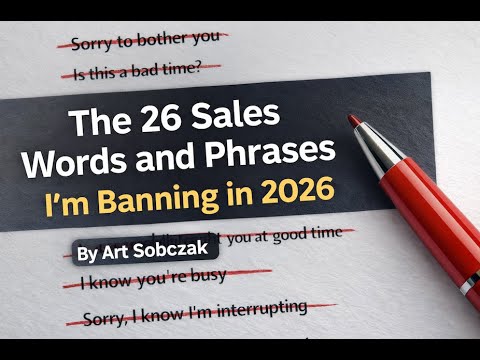
Last episode I banned 26 sales words and phrases.
But the truth is… banning the words isn’t the solution.
Because the words aren’t the problem.
They’re the emotional “cover” salespeople use when they don’t feel confident—apologies, permission-begging, softeners, and filler phrases that are designed to make the seller feel safer.
Unfortunately, they do the opposite for the buyer.
In this episode, I’ll show you how to eliminate insecure language by fixing the thinking behind it—and I’ll give you a simple pre-call checklist that will change how you show up on every call.
Also mentioned in this episode, the Smart Calling Sales and Prospecting Coaching App for B2B Professionals: http://Studio.com/Art
Оглавление (3 сегментов)
Segment 1 (00:00 - 05:00)
You are listening to the art of sales. Everyone sells every day and this is your source for conversational realworld sales and prospecting methods that you are comfortable using and that get results. You'll help people buy instead of pushing them into being sold. Here's your host, Art Subject. Last episode, I banned 26 words and phrases from professional sales that actually hurt your chances of sales. They lower your status, and they've got a number of other uh negative implications that can harm you. So, thanks to those of you who shared it, and congrats actually admitted to using some or maybe all of those phrases. So, here's what I didn't tell you last episode. Those phrases are not the real problem. They're symptoms. The real problem is what's happening inside your head when you open your mouth. Let me explain. So, first I again want to mention that this first appeared in my newly revised Smart Calling report free weekly email newsletter. And the responses to that have really exceeded my expectations. And if you like what you hear here, I encourage you to get the newsletter if you're not getting it now. So you can see the back issues and also subscribe and see the current issue at smartrtcallingreport. com. That's smartcallingreport. com. All right. So your language is not the problem. The thinking is. So let's talk about how to change it. Now, sales people don't say things like, "Oh, sorry to bother you," or, "This is a cold call," or, "Don't hate me," or, "Just checking in just because they're bad communicators. " Okay, well, maybe some are. They use them because the language regulates their own discomfort. These phrases exist to make the seller, the person saying them, feel safer, not to help the buyer. Like they're saying something, then they're quickly uh running for cover, for emotional cover, throwing a grenade, then they're running away so they're not hurt. They soften their perceived rejection. They lower emotional risk for them. They seek permission instead of earning attention and they create a psychological safe zone in case things go off the rails. But comfort for the seller actually creates discomfort for the buyer. In other words, insecure thinking produces insecure language and insecure language produces resistance. So, let's talk about the status flip. Here's what happens the moment you say, "Sorry to bother you. " You flip the status dynamic. You just told the prospect that you don't belong in the conversation. You believe you uh don't deserve their attention. You're actually expecting them to reject you, that they should feel annoyed by your call. Think about all of that. And now, so what are they supposed to do? Well, they respond accordingly. Both consciously and here's what a lot of people don't think about subconsciously. What the gurus who recommend this PBO and I call it per permission begging openings. Uh what they miss is this. The brain makes well over a thousand subconscious judgments in the first few hundred milliseconds about you and the situation. Now, this isn't something I made up. This isn't conjecture. This is brain science. Let that sink in for a few million milliseconds, which was pretty quick right there. And buyers don't lean towards uncertainty. they resist it. And when you signal, you know, I'm not sure if uh I should be here, then they've already decided, yeah, you probably shouldn't. And that's why apologetic language doesn't just sound bad. It creates the exact resistance that you're trying to avoid. All right. So, you might be wondering, what's the real fix here? You might be
Segment 2 (05:00 - 10:00)
thinking, "Okay, Art, that's fine. What do I say instead? " Well, I'm glad you asked because here's the twist. The solution isn't just say this instead. You wouldn't get in shape because someone says, "Here, walk on this treadmill. " It's to think differently before you die. Because when you have clear preparation, when you have specific intent, when you have a legitimate reason to be there, the language changes automatically. You don't try to sound confident, you are confident. And confident people don't ask permission to exist. They show up with purpose. So, let me give you an internal checklist here. So, before you speak or write, ask yourself three questions. Number one, do I have a specific reason to reach out? Not just following up, not uh it's been a while. A real reason. Maybe something has changed. Maybe you have new information. Maybe you have a relevant insight, which you should, a specific observation about their business. Now, if you don't have a reason, don't make the call. Do more research and prepare until you do. All right. Number two, do I know why this matters to them right now? Not why you want to talk. I mean, why would they care? So, what problem does this solve? What opportunity does it create? What decision does it help inform? And if you can't answer that, you're not ready to call. And number three, be honest here. Am I just trying to relieve my discomfort and my fear and my insecurity, or am I trying to serve their interests? This is the hard one. If you're calling because, oh, I just need to follow up or I need call volume. I need to hit my KPIs or I don't want them to forget me, you're treating your anxiety and you're not creating any value for them. And when you can answer all three of these questions that I just gave you, the band phrases will disappear on their own from your language because you're thinking differently. So, let's talk about what this looks like in the real world. Uh, so before, here's the before. You might say, or somebody might say, "Hi, Pat. Sorry to bother you. Is this a good time? I'm just calling to check in to see if you had any thoughts on the proposal I sent last week and I was wondering if you maybe needed anything else. So, what does this reveal about the thinking of the person who says this? Well, you're unsure you should be calling. You haven't prepared anything new. You're asking them to do your job. You have no clear next step. So, how about the after when there's been some clear preparation, when there's specific intent, when there's a legitimate reason for calling, it would be something like, "Hi, Pat. I'm calling to continue our conversation from last week where you were looking to fix whatever problem. Since we spoke last, I found some benchmark data from two companies in your industry who solved the issue that you mentioned. I'd like to share that with you. " What they did was they reduced cycle time by 40% in the last quarter and based on what you shared about your timeline. Uh that could change how you're prioritizing this now. Same goal, completely different posture, right? So what's the bottom line? Well, you don't need 26 replacement phrases for the ones that I banned last episode. You need to change what you think about before you pick up the phone. So ask yourself, do I have a specific reason to reach out? Do I know why this matters to them right now? Am I trying to relieve my discomfort or am I trying to serve their interest? Answer those things and the language takes care of itself.
Segment 3 (10:00 - 14:00)
Okay. So, do you want to know how to really put all this stuff into practice and how to hit your goals and how to get what you really deserve in sales? And if you're listening to this and you're thinking, "Yeah, I say some of those things. I know better, but in the moment I default back. " Well, that's exactly why I built the Smart Calling, prospecting, and sales coaching and training app for B2B sales professionals. And this just isn't more content. a training program. This is daily reinforcement, daily practice, structure. So you don't rely on just willpower or memory when the pressure is on a call. I got to tell you, after 40 years of personally training tens of thousands of salespeople and having hundreds of thousands more consume my material, I know that the smaller percentage of those who actually transform themselves had something all in common. They consistently put the material into practice and that's where most training fails. Most sales training is a lecture. This is a lab where you actually you speak and you get coached. And that's what you're going to get in this new exciting self-development tool. And really calling it an app is totally misleading since it's nothing like anything that you have on your phone right now. In it, you're going to find daily coaching prompts that really rewire how you think before calls. And there's going to be practice and feedback. You do actually speak into the phone and your app and you will get immediate feedback. You're going to get rejection proofing and mindset work that is tied directly to real calls. And you also get tools to turn professional standards into habits, okay? Not intentions that go by the wayside with the turn of the calendar to next month or the month after. So if you want help installing what you learn here instead of just listening and maybe agreeing with it, then this app is the fastest path for you. So, I'm going to ask you, could you take two minutes to learn more about it, to see if it's right for you? Here's where you should go. It's simply the word studio. studio. com/art. st Okay, you know what time it is. — Your attitude will be in every way. You'll never feel what they say. It's the art of the sales quote of the day. — That's right. It's time for the quote of the day. Today's quote comes from Jim Ran. And Jim said, "If you're not willing to risk the unusual, you will have to settle for the ordinary. " All right. So, hey, if you got value from uh this episode or this show, would you please share it on your socials? have them go to thearttofsales. com the arttoofsales. com and you can also listen to all 325 plus episodes there. Also the free email newsletter again is smartcalling report smartcallingreport. com and the coaching and training app is studio. com/art. Thank you so much for investing your valuable sales time with me today. Until next time, go out and make it your best sales day ever. I'm Art Subject.