Hodge duality and orthogonal complements | Geometric algebra episode 8
11:38

Hodge duality and orthogonal complements | Geometric algebra episode 8

All Angles 08.04.2026 3 359 просмотров 217 лайков

Machine-readable: Markdown · JSON API · Site index

Поделиться Telegram VK Бот
Транскрипт Скачать .md
Анализ с AI
Описание видео
#geometricalgebra #wedgeproduct #pseudoscalar #hodgeduality #duality #orthogonality #orthogonal Every linear space has an orthogonal complement. In geometric algebra, this orthogonal space is called the Hodge dual, and you calculate it by using the pseudoscalar of your algebra. We show some examples, and we try to convince you that Hodge duals are very useful. You can support us on Patreon, where you can already watch all the Geometric Algebra videos and get access to exclusive content. Unfortunately, we won't be publishing any new videos after Geometric Algebra, at least not in the near future. Your support is still more than welcome of course: https://www.patreon.com/user?u=86649007 You can find more details in these interesting references: [SUDG 1] https://www.youtube.com/watch?v=2AKt6adG_OI An overview of the most important operations in geometric algebra, including the Hodge dual. [MOM 1] https://www.youtube.com/watch?v=RAcyVrMNV5s A longer and much more detailed video about Hodge duality, orthogonal complements, and the cross product. 0:00 Recap of the wedge product 1:45 Hodge duality 4:58 Orthogonal complements 6:50 Calculating the Hodge dual using the pseudoscalar 9:45 Using duality to simplify calculations This video is published under a CC Attribution license ( https://creativecommons.org/licenses/by/4.0/ )
Оглавление (5 сегментов)

Recap of the wedge product

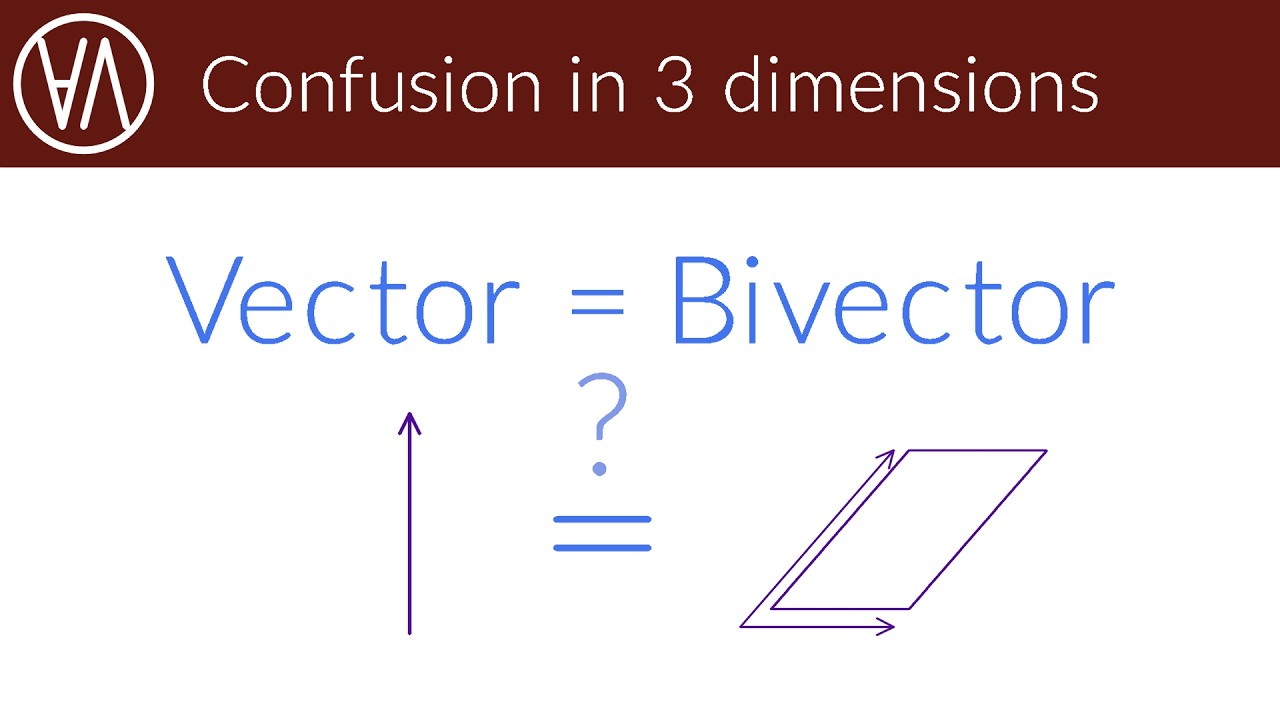
We have spent the previous two videos studying the wedge product. We discovered that the wedge product is tightly connected to determinants. And that it produces blades of various dimensions or grades. In order to count the different kinds of blades, we used the Pascal's triangle. For example, let's say that we are fooling around in a four-dimensional vector space. We have a set of four basis vectors, E1, E2, E3, and E4. How many bivectors can we make from these? In order to construct a bivector, we have to choose two out of the four basis vectors and wedge them together. There are four choose two ways of doing that, and that happens to be six. How many trivectors can we produce? The answer is four choose three, which is four. So, every number in this row tells us how many basis blades of a certain grade we can construct. The total number of basis blades is 16. So, the Clifford algebra on a four-dimensional vector space is itself 16-dimensional. Now, one of the properties of the Pascal's triangle is that it is symmetric around a vertical axis. This means that in 4D, there are as many vectors as there are trivectors. And in 3D, there are as many vectors as bivectors. This actually hints at an important concept in geometric algebra, known as Hodge duality.

Hodge duality

The first and final number on each row of the triangle is a one. There's only one way to pick zero of the basis vectors and wedge them together. The result is just a real number, which in this context we think of as a blade of grade zero. There's also only a single way of picking all of the basis vectors and wedging those together. The result is a blade of maximal grade, and if you take scalar multiples of this maximal blade, you can span the entire n-dimensional space that you started from. Because there is only one of these, we often call it the pseudoscalar. Some people write it with a capital letter I, but we already used that for identity matrices. So, instead, I will call it W. The second number in the row is always the dimension of our vector space, because it counts how many basis vectors there are. And due to the symmetry of the table, the one but last number is the same. So, for every basis vector, there is also a basis blade of one less than the maximal grade. And this makes total sense, right? I mean, either you choose a vector and that's your blade, or you choose the same vector and you leave it out, and the remaining vectors get wedged into a blade. In both cases, you choose a single vector. So, the number of possible ways of doing that is naturally going to be the same. Physicists use the term pseudovectors for these blades, because they share some properties with vectors. But there are also important differences, of course, which we will flesh out in the next video. That's where it will become clear what all this pseudo stuff is about. So, in general, whenever you construct a basis blade from a number of vectors that you have picked, its Hodge dual will be a blade that contains all of the other basis vectors, the ones that you didn't pick. In my mind, this means that you move from one end of the Pascal's row to the other. The Hodge dual is often written with a star after the blade. However, one of the most popular introductions to geometric algebra on the web puts a star in front of the blade. So, I will do the same here so that you don't get confused when watching those other videos. You totally should watch them, by the way. They are awesome. The link is in the description. While you're checking them out, please like and subscribe. Thanks a lot. It's important to be aware that Hodge duality has nothing to do with duality in tensor algebra. So, we are not talking about dual vectors or one forms here. This is a totally different kind of duality. In fact, it is closely related to orthogonality. I will explain why.

Orthogonal complements

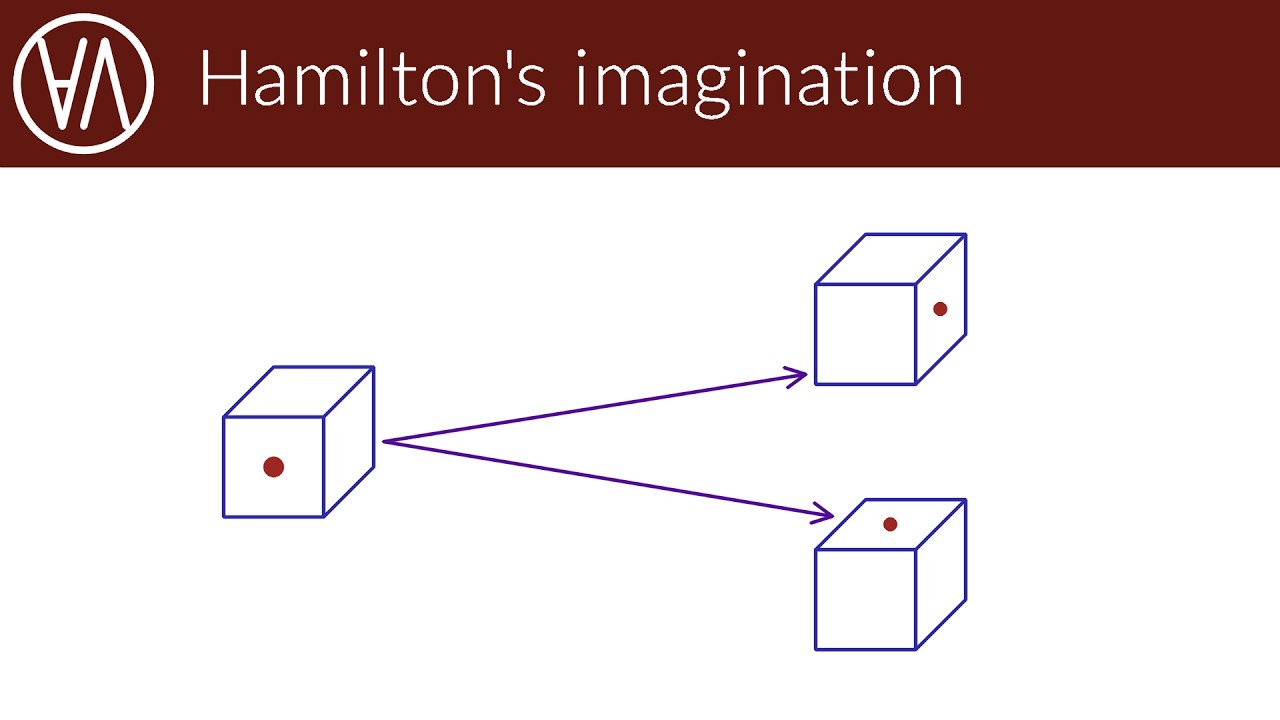
Typically, we make all of our basis vectors orthogonal to each other. We do this so that they are maximally independent. As a consequence, the Hodge dual of a basis blade is always going to be its orthogonal complement. The clearest illustration is when you take one of the basis bivectors in 3D. It contains two of the three basis vectors. For example, the XY plane contains the X hat and Y hat basis vectors. Its Hodge dual contains the only remaining basis vector, Z hat. And obviously, Z hat is orthogonal to the XY plane. Together, the plane and its normal vector span the entire 3D space. In general, a blade of grade m and its Hodge dual of grade n minus m together contain all of the n basis vectors of the space. So far, we have only talked about basis blades, which you construct directly from basis vectors. More generally, you can also have slanted blades. For example, this slanted bivector generates a plane embedded in 3D space. Its Hodge dual will again be the orthogonal complement, the normal vector to the plane. Hodge duality works on all kinds of linear subspaces, and it always relates to orthogonality. So, once again, we have a simple geometric concept, the orthogonal complement, that we can now express in terms of algebraic calculations. Geometric algebra makes working with orthogonal complements extremely easy. And that brings us to the next question.

Calculating the Hodge dual using the pseudoscalar

If someone gives you an arbitrary blade, how do you calculate its Hodge dual? The answer is very simple. You multiply your blade with the pseudoscalar. I want to show you why this works without digging into the specific details of an actual proof. The intuition behind it is more important than the details. Let's start in two dimensions, because that's the easiest case. The pseudoscalar is the unit bivector, but we have already discovered that we can write it as I, the imaginary unit. And what happens when you multiply with I? That's right, it rotates by 90°. So, in the two-dimensional case, it is totally obvious that multiplication with the pseudoscalar gives you the orthogonal complement. In the more general case of higher dimensions, the pseudoscalar is by definition the wedge product of all the basis vectors. Since they are orthogonal, we can also write this as their geometric product. It's the same thing, but written more compactly. Now, here comes the essence of how the pseudoscalar behaves. Say that you have a blade that contains two basis vectors, E1 and E3. When you multiply this with the pseudoscalar, you get a much bigger product that contains all of the basis vectors, but it contains E1 and E3 twice. Once from your original blade, and once from the pseudoscalar. Okay, now apply the algebraic rules again. We can swap the order of the vectors in the big product until we get E1 next to itself, and the same for E3. Each of these swaps introduces a minus sign, so that at the end, the worst that could have happened is that we have an extra minus sign left over. That's fine, let's just leave it at the front. Here comes the trick. The square of E1 is one. So, both of the E1s cancel against each other, and they vanish from the product. The same happens for E3. The only thing that remains, apart from a possible minus sign, are the vectors that were not in your original blade. And that, by definition, is the Hodge dual. I hope you see how this works. By injecting all of the basis vectors into the expression, the pseudoscalar manages to cancel all of the vectors that were already there, leaving only the ones that weren't. That's a pretty clever trick. I really like it.

Using duality to simplify calculations

Another cool trick is that you can often use duality to make your calculations easier, or even to help you visualize geometrically what the algebra is doing. Here's a really good example. Say you want to add two bivectors in 3D. You would probably write the bivectors in terms of the basis, and then distribute and use the simplification rules. You know, the usual strategy. But instead, you can replace each bivector with its dual. This gives you two vectors. Adding vectors is very easy. You get a new vector. And then, you just take its dual again. This gives you the result you were looking for because duality is linear, so it maintains all the linear relationships between the planes and lines along the way. This is a really cool example of the there and back again pattern that I mentioned a few times in the past. To make the addition of bivectors easier, you teleport to the world of vectors. You do the addition there because it's just simpler. And then, you teleport back. This video, linked in the description, applies this trick to a concrete example in more detail. I hope you now have a pretty good intuition for Hodge duality and for the important role of the pseudoscalar. Of course, there are more details that I've left out. See the links in the description if you want to learn more. Please like this video and subscribe to the channel. And if you could support us on Patreon, that would be awesome. See you next time when we finally deal with one of the silliest constructions in vector algebra, the cross product.

Другие видео автора — All Angles

Ctrl+V

Экстракт Знаний в Telegram

Экстракты и дистилляты из лучших YouTube-каналов — сразу после публикации.

Подписаться

Дайджест Экстрактов

Лучшие методички за неделю — каждый понедельник