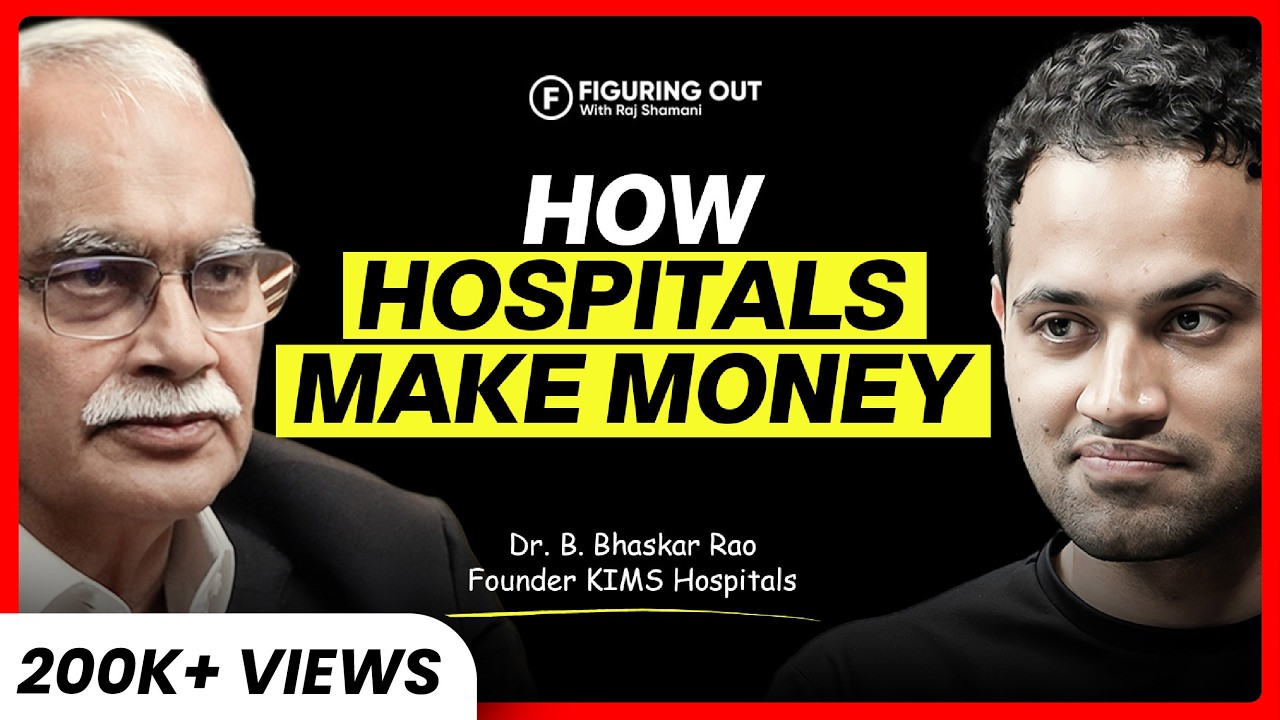
Why Doctors Leave India: Brain Drain, Low Pay & Healthcare Crisis | Dr. Bhaskar | FO511 Raj Shamani
1:20:46

Why Doctors Leave India: Brain Drain, Low Pay & Healthcare Crisis | Dr. Bhaskar | FO511 Raj Shamani

Raj Shamani 19.05.2026 68 просмотров 87 лайков

Machine-readable: Markdown · JSON API · Site index

Поделиться Telegram VK Бот
Транскрипт Скачать .md
Анализ с AI
Описание видео
Check out KIMS Hospitals: https://www.kimshospitals.com/ -------------- Get your hand-picked playbook here: https://www.figuringout.co/pdf/fo-511 -------------- Guest Suggestion Form: https://forms.gle/bnaeY3FpoFU9ZjA47 -------------- Design Your Own Podcast Episode: https://forms.gle/sx8iyUF9vnqhgvru7 -------------- Trying to grow your Social Media? Talk to us - https://forms.gle/sJfksjy4K3rpNnvF9 -------------- Disclaimer: This video is intended solely for educational purposes and opinions shared by the guest are his personal views. We do not intent to defame or harm any person/ brand/ product/ country/ profession mentioned in the video. Our goal is to provide information to help audience make informed choices. The media used in this video are solely for informational purposes and belongs to their respective owners. -------------- Order 'Build, Don't Talk' (in English) here: https://amzn.eu/d/eCfijRu Order 'Build Don't Talk' (in Hindi) here: https://amzn.eu/d/4wZISO0 -------------- Follow Our Whatsapp Channel: https://www.whatsapp.com/channel/0029VaokF5x0bIdi3Qn9ef2J -------------- Subscribe To Our Other YouTube Channels:- https://www.youtube.com/@rajshamaniclips https://www.youtube.com/@RajShamani.Shorts 🎧 Stream Figuring Out episodes on Spotify: https://open.spotify.com/show/736rhmW7vilNgkFFo8aDz4 --------------- 00:00 - Intro 03:08 - Who Is Dr. B. Bhaskar Rao & What Does He Do? 19:16 - What Is Loss Funding? 23:32 - Healthcare Saw a Massive Boom Post-COVID 34:12 - What Do Village Doctors Have That Big Hospitals Don't? 38:25 - Indian Healthcare vs. Australian Healthcare 40:08 - Which Country Leads in Healthcare Technology? 42:43 - Why Are Prostate Cysts Increasing in Young Men? 43:50 - Why Don't Young Doctors Want to Stay in India? 47:50 - Who Saves More Money: Indian or American Doctors? 48:23 - What Convinced Him to Take a Loan to Start a Business? 51:41 - 5 Things He Looks for Before Acquiring a Hospital 56:28 - What Do 30,000 Surgeries Teach You? 1:01:10 - Why Do Indians Find Healthcare Expensive? 1:07:12 - How Has He Retained 98% of His Doctors? 1:09:11 - Does He Invest Heavily in R&D? 1:12:07 - Why Did He Start a Hospital in Afghanistan? 1:15:42 - What Can the World Learn From Indian Healthcare? 1:19:29 - India Will Only Grow When... 1:19:57 - Outro --------------- My gear for shooting this video: Canon EOS 200D II 24.1MP DSLR Camera: https://amzn.to/3GuiPFK Canon EF50MM F/1.8 STM Lens: https://amzn.to/3WZOSoi Canon EF-S 18-55mm f/3.5-5.6: https://amzn.to/3ZpKBMy Yunteng Aluminium Tripod (Vct-690, Black): https://amzn.to/3ItEzV0 Zoom H6 All Black (2020 Version): https://amzn.to/3irUCIf Shure SM7B Cardioid Vocal Dynamic Microphone: https://amzn.to/3GPimiM Shure MV7 USB Podcast Microphone: https://amzn.to/3Xjy63d GODOX SL150II 150W LED Video Light: https://amzn.to/3XeN0aL --------------- In today’s episode, we sit down with Dr. B. Bhaskar Rao, Founder of KIMS Hospitals, for an honest conversation about India’s healthcare system, rising treatment costs, hospital economics, and the future of healthcare in India. He talks about his journey from becoming a doctor to building one of India’s leading hospital networks, the lessons he learned from healthcare systems in India and Australia, and what it really takes to run and scale hospitals in a country where affordability remains one of the biggest challenges. Dr. Rao also shares why treatment costs often run into crores and the harsh financial reality many Indian families face because of medical expenses. The conversation also covers doctor brain drain, why thousands of Indian doctors move abroad, what India must do to retain top medical talent, and how technology and management are reshaping modern healthcare. He also breaks down the exact framework he follows before building or acquiring a hospital. Subscribe for more such conversations. Follow KIMS Hospitals here: Instagram: https://www.instagram.com/kimshospitals --------------- About Raj Shamani Raj Shamani is an Entrepreneur at heart that explains his expertise in Business Content Creation & Public Speaking. He has delivered 200+ speeches in 26+ countries. Besides that, Raj is also an Angel Investor interested in crazy minds who are creating a sensation in the Fintech, FMCG, & passion economy space. To Know More, Follow Raj Shamani On ⤵︎ Instagram @RajShamani https://www.instagram.com/rajshamani/ Twitter @RajShamani https://twitter.com/rajshamani Facebook @ShamaniRaj https://www.facebook.com/shamaniraj LinkedIn - Raj Shamani https://www.linkedin.com/in/rajshamani/ • • • #podcast #FiguringOut #RajShamani #india #health #medical #hospital About Figuring Out Figuring Out Podcast is a Candid Conversations University where Raj Shamani brings raw conversations with the Top 1% in India.

Оглавление (20 сегментов)

Intro

Any patient before coming to hospital if they are above poverty line 40% of the people by paying the hospital bills they become below poverty line in India the income that we make healthcare challenges are very expensive lung transplants the minimum cost should be 60 lakhs to bond of 3 crores and how much a kidney transplant costs in India 8 to 10 lakh liver will be around 35 to 40 lakh bone marrow transplant also is a little like 40 50 lakh you went to Australia to study explain India versus Australia healthcare. We were also wondered there is a systematic way of referral. There is no way a cardiac patient directly go to a hospital. It has to go to a primary physician from the next level unless he refers he can't able to go. We don't have now today if any problem they directly go to the biggest hospital and they spend lot of money. There's no need actually there should be a proper systematic way we should able to refer these patients. If you compare ourel with any other country which country would be the best as today whatever technology that is available in America it's available in India even some equipments are better available in India worldwide people are coming to India to learn many people from America also coming to get trained the reason is we have a huge volume what we see in one hospital for them to see in the same volume it may take one year for them one framework or a checklist that you follow when you acquire air of hospital one I should able to see whether there is an opportunity there is there a need for an hospital second important thing is the affordability of the patient how many affluent people are there what is the percentage of insurance that they are doing third important thing is the availability of the doctors fourth one unless we don't have the proper management and all those things it's a very difficult thing India has lost about 75,000 good doctors which is lot of Indian doctors go abroad and then they don't come back what do you think what goes in a doctor's mind when they are in US or UK or Australia. He has performed 30,000 heart surgeries in his career. He trained as a cardiothoracic surgeon in India and Australia and came back home with one mission to make worldclass heart procedures affordable for every family in India. He has also set up Afghanistan's first state-of-the-art diagnostic center in Kabul. Our today's guest is Dr. B. Bhaskar Rao, founder of Kim's Hospitals, one of the India's largest healthcare groups. In today's episode, we'll discuss how did he make heart surgery affordable for the middleclass Indian. Why are India's best doctors leaving the country and what will it take to stop them in healthcare? Is the best technology more important or the surgeons experience? And why are doctorled hospitals better than corporate runs hospitals? Watch this episode till the end. And to know more about Kim's hospital, check the link in the description. If somebody's watching you for the first

Who Is Dr. B. Bhaskar Rao & What Does He Do?

time and they don't know who you are, right? Tell them who you are and what do you do? How would you explain them? So the only thing is I can able to tell even though my success story in the last four and a half decades and that will able to inspire them and see that how much we can able to take out from his talk whether we can able to really do something. See in the human beings some people have ambition some people don't have an ambition they are very comfortable they but that doesn't mean they are not good they are the very good people the ambitious people kill their self and then they want to achieve something that is their fate what we can say so basically what I'm saying is uh whenever we want uh when I started my career in the anger age itself I have a strong ambition that I need to be somebody. — Okay? — I need to do something to the society. So I was not very passionate about education. I was passionate about doing something every day. Even my children childhood also where if I go to village in my holidays, I used to go and do all the field work and everything. So that I enjoy more than going to the school and uh sitting and listening to them and passing this exams and all. So what it has been given me a good opportunity is I learned a lot of skills during those holidays period whether it may be games a sports whether it may be working in the field or talking to the people and all the things whatever do you I never feel that I'm doing something wrong and I enjoyed really that's where later on if I grown like this I realized that is called dignity of labor. — Any person who understands the dignity of labor and passion, they are bound to grow. Whatever they want, whatever they think, whatever their vision, they will definitely achieve. Most of the people, these two are lacking now. The dignity of labor and uh the passion. — M. — So then I was uh studying then I saw one of the doctor was uh an R& P doctor. M — so he was doing uh in the village going around the uh all the houses give some injections and when he come in the morning there will be 20 25 people who are waiting and when he comes back they all stand up and put namaskar and all those things that thrilled me because you get lot of respect here — so then this is the profession I should able to choose and then I pursued it I couldn't get it and then somehow we could able to manage managed to get that and then after getting it then I have two incidents in my family. — One during my MBBS my sister got a heart problem we could not able to uh understand or even to find out there is no right doctor in that place. — If I would have got a good doctor who can able to identify her she the disease was been cured and she will not be crippled. All these days she has been handicapped the when that is the reason I decided that I need to do something my society in my hometown that is a strong desire I put then when I want to do that then okay then it's an idea to implement and execute is the toughest job — true then I realized to do that neither I don't have money nor I don't have the capability of attracting doctors and So with that in mind continuously keep doing my uh studies then when we in the medical school and then I realized in the medicine itself is not able to achieve what I want. Then I went to postgraduation is super speciality and I went to overseas and studied in Australia for 3 years. I saw the difference between Indian healthcare and the Australian healthcare in 1985. Mhm. — Then I realized we should also be the number one in the world. We should be able to provide a world class healthcare — in India. — Okay. — So once I come back then my desire didn't stop there. Even though I becoming a consultant, I'm doing good uh work and also making good amount of money. Then I started my career as a consultant in Hyderabad. Then my desire is that I need to do something to my hometown. — What consultant you are? I'm a cardiothoracic surgeon. I'm a heart surgeon. — But you were consulting the cardiac patients. Yeah. — Or like the doctors who were dealing with these patients. — Yes. — I can see only the heart patients and then those patients who request surgery — I will handle that. There is another field called cardiology. Those people investigate and refer to us. — Mhm. So when I used to see that then I used to go to my hometown every weekend and a district there I used to see patients when I see the patients those who need money I mean need a heart surgery then I used to bring them here and operate and send them then when I am keep doing as a consultant and also doing this clinics I realized making healthcare to understand much better I found that there will be three stakeholders most important to make a successful uh healthcare business — the three people are one is the most important people are the patients — the second important is the human resources like medical non-medical — the third important thing is also equally important is investors unless somebody comes and invest money you can't able to run so then I realized what These three people are expecting — the patients are expecting a affordable cost — very accessible to the doctor 24 by7 and also quality care so that they can able to go home. M whereas the doctors expects they want a good technology that is available, good infrastructure that should be available. As many as patients I can see and also as if there is any challenging cases I have the freedom to work in the hospital so that I can able to do the challenging cases take up and get a good reputation and satisfaction. M — the investors are only two things they always see what is the attitude of the promoter whether he's going to give it back to money or he will be able to eat second important thing is the whatever money that they invested they look into the return of investment the money these are the three then to do that then I started my career to entrepreneur journey in 1996 and uh neither of these things I don't have I'm only a consultant with a good reputation I could able to bring the patient that is the only strength I had at that time then I moved on to one of the trust hospital where the investment is not required already running trust hospital when we want to do a lesser cost to the patient like affordability quality care then few doctors of like-minded people join me — then I can able to build because I don't need a investment at that time already done that whatever little investment ment is there whatever I saved that I have been used with that within 3 to four years whatever I was thinking in my mind affordable quality care I could able to build that — nice — like what I have done I used to fish don't have the money at that time to get operate — second thing is I was a very young guy — to give their heart unlike other organs in the body heart if you do this way or that way it will be able to happen So that's why they don't have money. Then I realized how to solve their problem. That challenge I faced. Then I was thinking and looking at it. There used to be a CM relief fund and a PM relief fund. — The chief minister relief fund used to give 30,000 rupees to the patient. The prime minister relief fund used to give 20,000 rupees. So then 50,000 rupees you can able to get in the being a trust hospital. I decided I should able to do it at 45,000 rupees per heart surgery which in the other corporates it will be around 1. 5 lakhs per patient which most of these patients cannot able to enter there. — So when I go to my hometown not only my hometown nearly 10 districts I used to go and run the OP and I used to bring all these poor people apply these things and then do the surgery excellent results. So my team has been impressed the way which we done one we are doing affordable cost — and a quality care successful results and then these are the people we thought then yes he's the we can able to trust on him whatever he does while doing that my irresistible desire is to build my hospital in my hometown — so then I started in 2000 in my hometown — that is about 200 build hospital — m — and by the time whatever I have been earned in this trust hospital and then some bank loans took so that the investors also we didn't required at that time so we build because it is an opportunity for the public as well as the doctors the moment we build many of the doctors has come patients used to come because we used to do around 60% of the cost when compared to nearby states like Chennai Bangalore Hyderabad So people used to come very fast and then picked up very well with no time. And the other important thing what we saw there is most of these backward people or underprivileged people to go to either Chennai they need to speak Tamil which they can't. If they want to go to Bangalore they need to speak Canada which they can't. Even if they come to Hyderabad Udu they have to speak. Not only that communication the amount of time energy art surgery means it will cost about nearly 10 days you have to stay in the city their food their accommodation one person will not come four five people will come. So with that we can able to see that by putting there it has been a very successful venture in no time because there is a need was there opportunity for doctors opportunity for the organization everybody is happy. So with this success story has been built a lot more of my credentials uh with me my colleagues and team by seeing that one of the doctor asked me sir why don't you build one in Rajand in the same northern state of Andhra Pradesh — oh yes we can able to build so there also I don't require any investors money then I build — that was also instant success after two success then there is a buzz created among the medical field — where it was there. These are all the things I was promising when I was during my education itself. I was in Nisam's Institute of Medical Sciences, Apollo Hospital, Chennai. Wherever I go, I keep saying I want to build a hospital. People used to laugh at me in front and as well as behind what this guy is talking about. Then after seeing these two, — then wherever I said these things, yes, he is the man of words. has built and has been created. Then the entire medical fraternity believed. — Then after these two successful things then I thought we want to do it in the districts for the lowest soio economic people. — But what happened then? I want to do it in city. Why only low soio economic? We need also provide some rich people. — Then I want to do it then it is going to be a cost a bomb. — All these two things are very small. one is about 10 crores, another is about 3 crores. Now then the desire didn't stop there. Then I moted this idea into all my colleague who are working with me and their friends and all those things. And when we moted the floated this idea with amongst them they also inspired yes we should also do something better for the society. Being a doctor we are the right people to do. Then we acquired one asset which is around nearly 20 crores. — Okay. — So then we able to try to pull all those things in the 20 crores doctors doesn't have that much money. Then they were asking then the challenge how to overcome I told them we used to get doctors used to get a personal loan — that all of you nearly 40 people are there you take 25 lakhs 50 lakhs so that at least 10 crores will be pulled. Mhm. — So they took all the with the trust that I given without asking any questions. — Then another shortfall another 10 crores was there. Then I requested my family members, my brothers, they come forward and invested. So that the challenge of investment has been overcome. — So what did you take in 20 crores? — We took the facility. It was a running hotel. — It was running hotel. — Okay. — We took over that hotel. With this 20 crores then bank has given another 70 crores. — So with this 70 crores we do the remodifications and everything we started within one year time — because of all the doctors who has been invested they're all very highly reputed people in hydroad and they also have partners in this. So then uh that will took off in no time — that 150 beds we build within 6 months there is not available of bed. M — then in 2007 this is started in 2004. — In 2007 we build another 200 beds there with the same money. — Then uh the money which is generated there that also in no time it has been full and then running good and more consultants planning to come and join. — Then there is luckily we have another 3 acres land there. I thought we'll build a thousand bed hospital one of the flagship hospital in the group. Then idea has come then now we need to able to see how we need to go and then we called the private equity people then came and invested about 60 crores then with that this has been — how much revenue you were doing when they invested 60 crores — at that 60 crores we used to do about 100 crores revenue — and about nearly 15 16 crores every time — okay — so the why I'm saying is all these hospitals started by doctors M — there is a problem what I want to convey to the people see the basically any entrepreneur what they should able to learn is when they start a hospital that is not the issue anybody can start the hospital they don't understand the challenges that what they face like suppose all of them built a beautiful structure lot of doctors joined together and built they could not able to run The reason is not that they can't able to run, they can. The only thing is they don't have the loss funding. Many of the industries are dying today. Not only in healthcare and everywhere it is they don't understand the word called loss funding.

What Is Loss Funding?

— What do you call — loss funding? — Loss funding. Okay. — The meaning for that suppose you establish a hospital. — We were only thinking up to establishing a hospital. We put our equity we get lot of the bank meum thing and we establish sometimes it overrun by hook or crook that will come and finish then they start usually the operational cost in the first month will vary nearly 3 to 4 crores to 10 crores depending upon the place you start whether t one t two t three — but you may not able to get the same income on the first year first month. — M — then second month onwards you are not in a position to pay the salaries, the consumables and everything. So it will take usually about 12 to 18 months to break even. So the this period is under the loss. So we need to keep that buffer money what we call as a loss funding. Any industry whoever is grown unless they don't check this loss funding those institutions will not able to sustain and they may not able to make it. Usually the loss funding cost will be 25% of the capex what you invested. So suppose you invest about 400 crores 100 crores you need to put keep it for the buffer. — Wow. Even small businesses, even the smallest business, even a business like this in the day one you may not get the returns what you spending. — We have a 13 month — yeah break even — break even. So this one people should able to understand for any new entrepreneur already started and on the job. So most of them should able to identify the loss funding is there or not. You may have all the knowhow. You may have you can able to you can do better job but without loss funding you are a failure. — True. — The reason is from second month onwards people start saying that this hospital is gone. — This industry is gone. He's not paying salaries. He's not paying the vendor's money. power bill. — So then we need to the themselves will able to propagate. — Yeah. So that's one thing through you I want to convey to all the entrepreneurs this is the most important you need to able to understand the business that is the stakeholders of the business what their requirement is and what is the loss funding whether you have the capacity to put that loss funding and what is the challenges during the loss funding or the running things — you have to analyze — then it is a success There is no failure. It is not the individual. Everybody wants to do a good job. Everybody has the capacity to do that. There is nothing like is because he is successful is something different. — Capital is the problem. — Yeah. This is the important thing they should be able to understand the business. So after doing this uh why he said because of these acquisitions come — so after 14 two sons joined and they are building up by this time we have been replaced into two private equity investors — nice — first one second one gone third one also has come — they've come they've sold it to someone else and then — yeah every four years they want to they make their money they will get out of it — then I saw this is a big challenge every year I have to go make a road shows explain and all those things — wasting 6 months or 9 months time — then I thought it is better to once per you list everybody will be given even the doctors who whoever is invested with me in the 2004 they also don't make any money they have not taken anything back so there is no exit for them so that's why we went for uh IPO in 2020 I think during covid time All our road shows done and video only — zoom calls huh — so wasn't it a good time for you to

Healthcare Saw a Massive Boom Post-COVID

— yeah would have saved lot of time energy and also good time because people were under panics so hospitals would boom the — people would give you more premium — so they didn't give premium at that time afterwards it has come premium but that till that time the healthcare was not in a boom — healthare was not at all in a boom before — okay — we done during covid Postco they realized there is a great potential. Not only that the patients also realized the public also realized health is more important than anything else. — Sure. — And that's how they should able to do. Then when we were doing this entire journey one day the then chief minister was a good friend of mine. We met him. He was asking uh he was also a doctor. He was the chief minister. And everyday morning there are hundreds of people used to come in front of my house asking for some help. Initially I said there is a CM relief fund used to give BM relief fund because these people will walk into the CM residence and they're asking at least my family should survive for another 6 months or 1 year and then he came and asked what to do then I asked how much how many of the population will be of these many numbers they said it is only 20% of the population if I help I'm very great. Then I told him 20% is very easy to help. See any hospital you take 20% of the beds will be always vacant. M — so you pay 20% cost whatever is the expenditure that we are spending on the patient — that is the pharmaceuticals the power bill water bill any materials that we use you pay that one this 20% of the beds also full it will not go waste and our doctors also will be happy they are treating more patients — then he agreed then we able to call all of them entire government to my hospital. Two days they stayed with us prepared myself created a packages and uh then they said then how to execute it. So basically any idea it comes it is easy to do that the most challenge is the execution that having been done this you need to give the full freedom to you to till we execute it. He agreed and given to all the things. The most challenging is when we are doing cost to cost. — Hospitals need money immediately. — Yeah. — So you create a green channel within 10 days money has to come to the hospital. He agreed for that. — Then he also says that with the government sometimes you may not able to pay in time even though you give an order then give to insurance company. Then he called the insurance company and given the premium so that insurance company will able to then these two things are fixed. Now how to get the patients? How to propagate this one? Then initially he said okay I only gave the idea you go into a public meeting if CM is coming and many people will come you announce there this scheme and whoever patients that comes on that public meeting who are looking for some help asked them to come prepared and then I took a bus there put all the people into the bus and bring them to my hospital treated in two three times he visited and wished all of the patients then it spread like anything — so initially he started only in three districts, three poor districts in the Andhra Pradesh. One in Telangana, one in Royal Simma, another one is in uh nowandra, coastal Andra. So three districts picked up spread like anything. Then at that time we have been put only 350 diseases four uh specialties like cancer, brain surgery, heart surgery, kidney transplants because these are the things who are not existing in the government hospitals. — So that's why we should able to give this one — with this the public private partnership patients will get the highend quality in a highly sophisticated corporate hospitals. is to get the treatment. First two three months uh all the poor patients came and got benefited and went home. Then once it has been become then it become a political thing. So 300 diseases added it become 3,000 diseases in five to six years. So people used to come and you add this you add this then it is becoming a challenging in the corporate hospitals because we took only 20% of the beds — but when the all the now today below poverty line at that time they told it is 20%. Today 85% of the public is below poverty line is a big scam. Nobody can believe it. There are so many even the politicians ex ministers also have the below poverty line can't. So then they come — those they can able to afford not that they can't afford because if something is coming free why should I — pay for it? Huh? Then they all come back sir they will all take this is the cost and everything they agree then they take out the trump card I have arugi card then after that then it is uh then again after that you will ask sir I will pay extra money you put me into a single room the scheme what we have been created is only for general w patient because they're all on below poverty line so that is the only affordability hospital can bear That's why you given that opportunity. So with this then uh corporate hospitals face a lot of problem because whatever income that used to get — we lost also because everybody's coming into through our — and this card creation was done only for cost to cost they otherwise may not able to sustain. We are not paying for our doctors and other things and all. So then that's why more and more hospitals has come this Aragi scheme because of that the entire country today this is the origin — Ashwan Bharat — Ashman Bharat and any other different states have different schemes of the same — this is the first one which you started — yeah that is — you started with ready sir right — yes it is the I'm the chief architect not only architect execution how to do it that's the most important — this is 2007 7 — 2007. — So after that they didn't even increase the prices also because people are coming patients are coming many hospitals are coming forward because they are getting volume and all. It is good for small hospitals may not be good for big hospitals. So that's how healthcare has been made it very accessible affordable to a common man. This is all big I contributed to the society. Once we have done that then now today when we talk about 2010 when I started the bed cost used to be around 10 lakhs — about maximum about 25 30 lakhs per bed cost including equipment infrastructure and all today it varies from 1 cr to 2 and a half crores per bed cost. The infrastructure, the technology, the dollar, everything has increased drastically — and the expenditure has become very high. If any patient comes today, it is very impossible for them to afford this cost. I can tell you here in the worldwide not only in India any patient who comes to before coming to hospital if they are above poverty line 40% of the people by paying the hospital bills they become below poverty line this a fact so then I keep on when we are doing like this all these things then how we need to overcome this is a big challenge basically If you don't overcome and then running a hospital is also a tough job and uh there is a so much patients also can't afford. So when we do this then I keep on thinking and given so many times so many people so many health ministers and chief ministers given the thing. So there is a solution for this. One time patients wants a good quality healthcare. — Government is not in a position to support that or provide — and at the same time patients wants to live for a long time. — How to go about it? I thought and keep thinking and got a very solution for that. The only thing is people doesn't understand health premium is an investment. They never expect that is an investment. — It's an expense. — It is an expense. The day when they invest as an investment and they make more money when there is a need that's what we do excess money we will invest somewhere we will make money. Here also it is the same. The day when the people realizes it is an investment and then it will be accessible every citizen of India — health insurance the moment when they take this is a premium is an investment everybody can be affordable — some of the people will have thinking that I have been taken the premium last 7 years I didn't get sick then they get tension. I unnecessarily wasted my money. — So there is a false notion. See when you invest it is a long-term investment. — It's not a short term. You keep on investing you get more money at the end of the day when you need. — The cost of this investment is also very minimal. Anybody can afford. See suppose if you take uh one packet of cigarettes that cost only you spend it will be there. If you also take everybody will have some whoever is drinking one bottle of beer in a week that is the enough for this. Let's break it down. Okay.

What Do Village Doctors Have That Big Hospitals Don't?

Multiple things we do. We go to the first part of your story where you said you saw in the village you saw a doctor who was very well respected and there was a big line in front of his clinic almost every day. Right? If you go to that point that doctor in village and now that you have built so many hospitals with thousands of beds now right what does a doctor in village have which even a thousand bed hospital can't provide good see the small doctor there — he never used to charge any money — maximum you can able to give 1 rupee 2 rupees or if there is any functions they will come and give some board. That's why he could able to gain lot of respect. He has ethics and values because he doesn't also have any expenditure. — There is no investigations. It's purely on a clinical basis. There's nothing. So the clinical basis means if he's one doctor used to see the entire body and give treatment. Here today for every specialty there are 10 doctors. For every special you take even opthromology, you take even dental — there is a number of sub specializations are there and not only that — there is so much of technologies required investment there in his own house you can see everything today for a bed if I want to provide it is costing about 2 crores if I want to put a,000 beds 2,000 crores and one doctor seeing the entire body for entire body. Today we have 200 doctors to see that then when we want to see that this will become a corporate style. Corporate is not a real good term but we are trying to do a good quality care. — Mhm. And the doctor at there by his experience of seeing the number of patients if it is a typhoid these are the symptoms if I give this one we'll do 90% you will be successful 10% if he's not you'll come back and give some other medicine here that is not the case people are expecting — you do the diagnosis first and treat and if something goes wrong I'm paying this much money I will hit you respect is gone the between the patient and doctor the relationship is totally changed — when compared to that village to this corporate — what has changed what relationship now — see there they used to respect a lot and they used to listen what he says here the respect is not there is becoming I'm paying money you I'm demanding this much it is all the when we demanding and paying then the courts come into the picture legal issues will come now today a clinical medicine yet has become a defensive medicine. So when now if somebody sues they're asking everything as a sort of where is the proof then I need to see I have done all these investigations — one side when we want to do we don't need to do so many investigations I can clinically try if everything goes smooth he will also be very happy doctor also very happy and go if something goes wrong he will directly go to the consumer court or court — when we go there why you didn't do all these investigations then you will sue — it is happening today so that's why the more value ethical respectable good relation between the patient and the doctor from a village I change it to a commercial a defensive medicine — legal so many things a sophisticated they expect a lot of things — how many cases do you go through in a How many people would do a case? — Now even if the cases number is less but in future it will come.

Indian Healthcare vs. Australian Healthcare

— Then the second part you said you went to Australia to study right and explain India versus Australia healthcare what is the difference? So at that time the India doesn't have a good infrastructure good technology mostly even MRI CT even transplants were not going in 1987 888 I was there in Australia the infrastructure is very good and then the systems protocols processes everything has been systematically done here everything done by one man — there everybody will do their own we were also wonder back in India We are doing only one man here 10 people are doing the same system has come back here. — So to once you improve this it is a governance we need to able to follow rules. — So with all those things and even there is nothing like a small nursing homes and all those things they are all very structured manner — big hospitals small clinics will be there primary health centers what we call from there is a systematic way of referral. There is no way a cardiac patient directly go to a hospital. It has to go to a primary physician from the next level. He unless he refers he can't able to go. — Oh — that's where you can also cut down lot of cost — that is become a family physician. We used to have these family physicians before — now we don't — we don't have now today if any problem they directly go to the — biggest hospital and they spend lot of money and they you make it you and cry unnecessarily spend money there's no need actually — there should be a proper systematic way we should be able to refer these

Which Country Leads in Healthcare Technology?

patients — but are we behind in terms of technology in healthcare around if you compare ourselves in with any other country which country would be the best — as on today See basically whatever technology that is available in America it's available in India. — Okay. — Even some uh equipments are even better available in India. Like suppose recently we acquired about in Kim — magnetic resonance focused ultrasound which cures the tremors in no time 5 minutes. There are people who have been suffering with tremors. They cannot even come to the functions also hand will move like this — and even can't able to hold the glass. One of the patient we treated is a teacher. He cannot able to hold the pen. Then his life is nowhere useful for as a medical I mean educational profession. The moment we could in 5 minutes you could write everything. You could sign everything — in 5 minutes. — In 5 minutes after is over. Yeah. Through the mission what we do is there is a in the brain some center will be there which creates this uh tremors we will able to identify the focused ultrasound and that will go and trigger there then we'll test if you're able to put a needle there if the tremor stops then that is the right position then we'll ablate that so that means that organ has totally gone and then is free of by the time you come out of the MRI you'll be totally free of tremors — for life — or will it come back again — sometimes see these are all technology we don't know but as on today they say it is a permanent — even if it comes back again we can go back once — see the other way — and what's the cost of it for one time treatment — it's costing around 20 lakhs — for 5 minutes — 20 years 15 years 5 years they struggled and especially these people if you want to do any surgery can't do some 70 years 75 years — no anesthesia nothing you just go to the MR come back after 2 hours — and like that we have technology — and why do tremor happens why do people keep shaking like this — see basically in the brain and the some of the centers each body is governed by the each portion if there is some disease or anything these things will able to move on — and it's totally like curable now nice and so many diseases is like we have a tulsa pro where prostate without surgery we can able to do uh ablation of the prostate cancer prostate things you know

Why Are Prostate Cysts Increasing in Young Men?

now the prostate cyst which is benign cyst not even cancerous cyst is increasing in young men I was reading a research — they are uh benign prostate is different from sometimes what will happen if the benign prostate is there then the urine output will be minimized — then stagnation of the water and all. So that's why these are all hormonal changes and all those things will able to happen. Uh yes not previously all these diseases cancer and everything used to come at the age of heart disease beyond 60 65 like that. uh today it's coming around 25 30 years the incidence has definitely increased in every disease. — Mhm. — So early stages even the breast cancer used to come at 15 years 20 years previously we never heard about it. — So this awareness one portion identification and all those things and uh the awareness of getting done the execute health checks is the most important thing. Then you said you came

Why Don't Young Doctors Want to Stay in India?

back from Australia right? If you look at the data almost India loses like about India has lost about 75,000 good doctors to brain drain which is lot of Indian doctors go abroad and then they don't come back because they don't want to and the reason is because they get a better I mean that's what people say that they get a better life there they get more money there they're able to actually build a much fulfilled happier life there right what do You think what goes in a 28-year-old doctor's mind when they are in US or UK or Australia and they finished their super specialization now they have an opportunity either to come back to India or just stay in that country what goes on in that man see basically what's happening today two to three decades back — what you said was correct — most of the doctors as soon as they get they don't even get trained one the training opportunity was not here. So that's why they need to go to abroad to get trained and also exposure for the technology and other things. Then once they are very happy there they never used to come back. — Today if you take when compared to last two to three decades going abroad has drastically come down. M — previously they used to go down to overseas to learn once they learn and they are very happy most of them are settling down because as you mentioned that they are making good amount of money and all those things they never used to come back unless somebody who is having a real — loyalty to the country and they want to come back and do service there are many people are there — today people are doing not for learning. There are many people worldwide people are coming to India to learn. Even if you take any African kind many people from America also coming to get trained. The reason is we have a huge volume what we see in one hospital for them to see in the same volume it may take one year for them. So that's why people are coming here to volume. So the learning the good advantages what they used to have there they can have a very smooth way of life there is no need of any hurdles the moment when you go they settle down in the sense they can able to buy a car vehicle I mean house and their children's education is no issue they can able to do and very good number of hours they can go and spend with the family all those things was very very comfortable but which is not the case here. We are not still established and streamline but now it is there but the only thing when you go there you never bother where you are staying whether is a thousand family village or a New York or host or anywhere — there will be the quality of life and all the facilities are same whether it is a small village or a big city — even they prefer small village because they get all the facilities more comfort when compared to the city here the missing link is that that's why still people are going suppose we have plenty of doctors — all have been catered in the cities metros — nobody's going to the districts or even the small towns the only two reasons they're saying is there's no good technology good hospitals second thing is children safety application. — M — and they think that they may not able to enjoy the life there. The same person goes there you will able to live at

Who Saves More Money: Indian or American Doctors?

the end of the day a US doctor will be able to save more or Indian doctor. The saving will come Indian doctor will save more money than — the reason is there they all the governance legally the everything they will have compulsory health insurance they'll have the professional induity their car has to be insurance house there are so many other things expenditure will go on very systematic — Indian doctors will their savings is more — got it and doctors are usually not

What Convinced Him to Take a Loan to Start a Business?

very entrepreneurial, right? They're not the CEO material. They're not founders. They're doctors and that's why they're known for it. And so it's very unusual for a doctor to take a loan to start a business. What convinced you to start? See, basically uh the entire thing to take a loan is my family people also used to my brothers run a — business. So they I can understand the value of the business, the loans and other things. Today — Indian doctors are not entrepreneurs. I differ in the sense all the healthcare in India is built by the doctors only. The so-called big chains and they are the successful people. You take medant, you take forts, you take naranala, you take kims, you take any number of chains. It's all built by the doctors. Apollo — Apollo also doctor — he practice see all of the biggest one point I want to convey here is all these chains all the hospitals even these are all chains I'm talking about if you take about all small nursing homes is all done by doctors only so the here many of them should be able to understand one of the success story of this is If you understand what you are doing and if you have experience of 10 years or 5 years in the same field the success story is 99%. Similarly in healthare there are many people who have made money they want to establish a hospital they establish they the s story is not that great they keep burning it — because they understand that it is not only in healthcare you take any field those who knows the business those who have been worked for 5 years 10 years and 15 years they know very well how to run the except this loss funding. — That's why they're all very successful. Any field you take it, they're all successful when they worked for 10 years. You take all the pharma industry, one day or other, they all worked for 10, 15 years in the pharma industry only. — They all were MRS and then they started. You take all the original politicians, they are very successful. Those who come with money, they are not successful politicians. So the people who are there they understand the root cause the ground reality they can face any type of challenges and overcome but whereas other people come in a different thing they will not — there is no exception for this you take about any car factory or any anything those who worked in the industry even it — they all worked and then started — like that anybody who worked in their own field they have been worked they understood the business very well. — True. — And they were able to grow. There is no exception in that. — True. Tell me one framework or a

5 Things He Looks for Before Acquiring a Hospital

checklist that you follow when you acquire a hospital. You said you acquired an asset and now you have more than 25 hospitals all around the country. There must be some like a basic checklist like what are five things that you have to look in a hospital before acquiring it. one I should be able to see whether there is an opportunity there. — Second thing is if I'm — what do you mean by opportunity? So when suppose if there is a hospital and there are is it the area is overcrowded — or not suppose if there is a thing we require only 1,000 beds in that — in thousand beds when I am acquiring it is a 200 bed or beyond thousand beds suppose in 200 beds there is a great opportunity because another still 800 beds is required there if is already 1,000 beds if I go and acquire there is no growth there — true — so that's why the opportunity I mean in the public is there a need for an hospital — but how do you assess — underserved we see the service is basically this many number of patients this number of population this number of beds should be there — okay what's the formula number of population — usually five to 6% of the population will get sick — okay so if a village has let's say — say about thousand people — 50 people always in a year will get sick — and based on that and then 50 people would need 50 beds or no — no they may need one bed. Ah so like what's the bed calculation 5 to 6% is — ratio for sickness — then versus how many people would require a bed or would get hospital stay about what we call as ear loss average length of stay — each patient comes it varies from 3 to 4 days — suppose this 50 people — comes there average about 200 days — that means if you take one bed it will cover 200 days — okay no man So 50 60 people but out of them how many would require a bed out of 50? — All these 50 people would require — like sickness means you mean people would require bed — okay they would like three to four — would be around 10% in the population — 10 to 15%. — So outpatient would be about 10 to 15% 5 to 6% would require a bed and average length of stay would be 3 to 4 days — to 4 days. So — like that we will calculate and suppose there — population that is one aspect. Second aspect the opportunity means again what are all the specialties that are existing there in the city right now for every specialty of a 10 lakh 20 lakh population of districts we need all the specialties — like cardiology gastro neuro orthopedics general medicine gyic everything most of the times in the new areas they will have one or two specialties only — there may be a thousand beds but there may one or two specialties. So if I go with a multispy — so there is an edge for us. — Yeah — people try to come so that we'll see whether there is an opportunity there. One the patient population then what are the specialties in single roof that they are having these are the two important things — it's not cost huh — cost is not the — no that's I'm coming now the affordability — so first is opportunity second is affordability. uh even if there is a affordability if there is no opportunity there is no point. First opportunity is the most important. — Second important thing is the affordability of the patient. How many affluent people are there? What is the percentage of insurance that they are doing and what is the per capita income of that place — uh based on that we'll see. — Third important thing is the availability of the doctors. So even though we can build a hospital there is an affordable. — The third thing is we need able to see whether the existing place doctors are available practicing on their own single specialy where we can able to attract them or there are people who are studying they can able to come back if there is a good facility is there. So the doctor's availability. Fourth one is the management. So that unless we don't have the proper management and all those things it's a very difficult things these are the five important things and then the due diligence. — So if you do the there may be a land problems there may be building problems there are so many problems — land problem are the most common — more common everywhere. So these five if we able to look and they're all comfortable then we'll able to see. Okay. So you

What Do 30,000 Surgeries Teach You?

you've worked in this and you've worked on grassroot level in your words, right? You've done about 30,000 surgeries, right? That's a lot. What does a doctor who has done let's say 300 surgeries versus 30,000 surgeries like what does a doctor see like after 30,000 surgeries what do you see which you were not able to see when you did only 300 surgeries see the 30,000 experiences you'll have you can able to tackle any type of complication on the table because he has seen variety of the same complications in 30,000s Where is a 300 doctor 300 person who has done not many number you might have seen but whenever we have seen this 30,000 journey if there is a complex surgery if I have done about 100 complexes I can able to identify okay I would have done here this way can able to help but a person in 300 if you do only two or three complex cases you will still struggle but you need to put a lot more efforts to see that you should go all the time wrong. Right. But then doesn't it backfire sometimes because a doctor with 30,000 40,000 surgeries will have a very fixed mindset of how to deal with a complex situation would not and a some and somebody who's new will maybe come up with understand new technology, new things and be able to actually move fast solve a problem much faster in a different way. Now the advantage in the human body it's a very dynamic there is nothing like is a fixed even if I do 30,000s one specific surgery like say about coronary artery bypass surgery even if I do 20,000s of that all 20,000 to be different there is no second opinion on that so that means we are always on the to whether it is a number that is not there but it will only give the Quick decision making. The surgeon should be very good on making a quick decisions on the table. Sometimes you may find lot of surprises. — When you have surprises then you should be in a position to tackle to save the patient. That's why it's a very dynamic every patient. See similarly you see there are 160 crores or maybe 600 cr population. No two people will be same. No — unless it is twin has been created. So it is the every surgery of similar nature very rarely you find a similarity somewhere or other you will find some difference and his doctor who's old who's experienced are they like do they welcome technology um mean now if you don't welcome the technology will not be sustainable in the field people are demanding but are they not fixed key I know how it works don't teach me this is your new thing I've seen it — there are some people who tells and patient listens then he will they will choose the other doctor when they are losing the patients then he has to change first few patients you may say very firmly I'm good I have done so many surgeries I know that if you lose two three patients then he has to change if he's not changed he'll be outdated — like suppose you do lot of previously When we doing the abdomen like we used to cut everything for every surgery then there is a laparoscopic surgery then after laparoscopic surgery now robotic surgery has come — so now everybody is doing robotic only the patients are demanding — I need a robotic surgery — the doctor has to go learn — yeah he have he's forced to learn everything that's why these workshops they go and take things and come out. — The only thing is the patients expect a 10-star treatment but they want to pay only three star payment. That is the only thing of the problem because when you want to do all these things they should be able to understand it costs — but it's so expensive. — Yeah. Sir 5 years back you did a surgery for my relative about one and a half lakh. Now we are asking you two and a half lakhs. Please do that one and a half lakh. So you would have come out 10 years back

Why Do Indians Find Healthcare Expensive?

but it's a lot but with healthare I mean when you compare to the world India is very cheap but in India for the income that we make healthcare challenges are very expensive like it's almost unreal to even think somebody who's not somebody who doesn't have an insurance if at like 50 60 they get some major problem very difficult to tackle the cost of a private hospital — that's what exactly I said the people who after paying the bills they fall into below poverty line — but the solution is only today — insurance — uh today we are the pioneers in transplants we do lung transplants more than 100 every year which was not happening. It is the Asia's number one center Kims in Second. There the minimum cost should be 60 lakhs to goes up to two of three crores per lung transplant — per transplant. The reason is they come in the late stage. They cannot able to breathe and if you don't they will die. Then we don't know when the organ is going to come because it's all cater organs we need to put and then I need able to support the patient on a hot lung mission like EMO what we call when you supporting this EMO every day it cost two of three lakhs sometimes the organ may come after 30 days 60 days so he is artificially maintaining in the mission till the organ comes these are all expenditure these are all disposables Because to maintain that so what happen when you are maintaining an artificial heart and artificial lung the entire body immunity system will differ to recover also it will take longer time today you come today and tomorrow if I do the surgery you will recover within 10 days maybe 30 35 lakhs will be finished if you want to stay pre-operatively a long period of time at the same time you will expect to stay in the posttop also long time so it cost we tell them this is going to cost you this much money but they don't mind but there is no other go for them if somebody has been earned and they want to live for the two years there are many people who got operated and doing their work everything our own doctor has got operated and is doing surgeries and everything — and is it like what are the chances that you will be you'll get back to normal life and — everybody normal life only otherwise where is the point — but then if you do lung transplant your overall like you get weak peak and — no that is only after 2 3 months — but you don't even you are not able to live the same kind of life that you were living — 100%. There are people our own relatives friends who got operated and doing the work what they were doing before even better than that — and what is the percentage that this is this operation will be successful — around 60 70%. 30% will be there. Once all the 60 she's all — three four people out of 10 will not be able to make it and without that operation also they'll not be able to make it. — So after that but six people will be able to do it — and they live a good quality of life — and they do their job it is unlike any other surgeries their quality of life is much superior. See basically before operation some of the people will be on total in oxygen at home also you can't go out also even to go to washroom also you go oxygen only and those are the people when you remove the oxygen and they it's a great — but is this covered in insurance — some portion whatever they have been done it will cover insurance 50 lakhs 1 cr — from insurance come — but healthcare insurance also not many people would take like a cr or 2 cr insurance — nowadays many people are taking — and then the insurance company covers this. — Yes. — Transplant is covered in that. — Yeah. — Okay. — We last year we did about 500 kidney transplants. Most of them are covered. 150 liver transplants. We are pioneers in the transplant program — in Hyderabad. And how much a kidney transplant costs in India? Top quality. — 8 to 10 lakhs. — And liver. Liver will be around 35 to 40 lakhs. Lungs is the most expensive. Lungs is bone marrow transplant also is a little expensive 40 50 lakhs. See the basic thing what I'm trying to tell is the beauty because I have the passion that I need to do something to the society for the patients. Every unit wherever I serve I set up a multispety hospital so that the quality care will be much superior than doing a single specialtity. So that timely patients will come doctors will come to the patient to attend 24 by7. That is the crucial period the golden hour will not able to be um minimized. — True. True — with that they can able to do the wonders — and every city wherever we establish we do liver transplants we do kidney transplants we don't do lung transplant — lung is only in — yeah so that cost will come down there maybe another five 10 lakhs down the more than that is accessible to the patients even liver transplant stay 2 3 weeks so they will be there nearer to that they can go home and come back — that's why the primary aim of being we a doctor and with a passion I could able to establish we need to provide everything and the nuke and corner wherever I set up a hospital

How Has He Retained 98% of His Doctors?

tell me one thing which is the most wonderful thing which I read about you and very intriguing as an entrepreneur I want to know that is in your entire journey I think in I think 25 years of running you have been able to retain 98% of your doctors. How? See the people who leave there are few as you rightly mentioned when they are not comfortable in the hospital when they don't get the freedom when they don't make the money what they supposed to make — then these are the triggering points to leave the organization which I realized being a consultant I worked for this these are the things I need to take care of the doctors I'm taking care of that the third import fourth important thing which also makes them to is the finance. — So sometimes when most of the people who are dedicated to quality care dedicated to have a freedom and all those people they will see the difference between the finance and the quality of life and quality of treatment and all those things those people they don't if it is 10 15%. M — they never leave that even there are many people who are given a full check blank check please come but they don't know they realize what is the value that they go they get when they give a blank check they expect something to do they won't be free of cost of course — I'm very comfortable here I'm enjoying my life I'm enjoying my profession — I'm making money where is the need of 10 20% I should go out and in fact uh most of them that's how we could able to retain them they as long as you satisfy they feel it is my hospital the ownership the responsibility and they keep contributing to that do you as a

Does He Invest Heavily in R&D?

hospital chain do you invest a lot in research and like R& D — we are doing research uh but not the way which we are supposed to do because that much money we can't able to take out from here — and we need to able to get some uh funds from outside. — Yeah. — And like that we have been developed. There is one called Dishi totally blind people. We created with an artificial intelligence. — With that these people can able to see the entire house. It is prefixed images. — The moment when they are moving around they enable them. This is the bathroom. This is the door. This is this all those things will be there. they can able to identify and there can also be audio they can able to find out what's happening in the entire world through AI — nice — what is the temperature in daily it able to give you the — nice — and uh we also invented and tried to do this deaf people you see basically deaf people is the biggest problem they can't express to the doctor if the sickness — and doctor cannot able to what he saying he will not able to understand so we created a — national level tourism um zoom and we put one doctor who can able to negotiate with here with the patient. So that patient will tell this person you'll converse to the doctor you'll give the treatment and you'll be able to tell. So now there is today we are when we are doing these organ transplants when we want to get a lung or a liver um from a distant place. If there is a commercial flight available their life will be only four to 5 hours. We'll safeguard with that. If it is costing more than four to five hours, the patient has to take the charter flight uh air ambulance that will cost around 15 lakhs per organ to bring some of the affordable people they pay otherwise they don't. That's why we are trying to develop where we can able to get a 10 15 hours life of the argon. We are almost successful in that with the research. If that comes a lot of saving we can do for the patient. Once this is successful we are trying to get whether the drones can able to transport the organs — or maybe increase the shelf life of preserving an organ. — Yeah that's what we are trying now with this. If you do 12 hours then most of the time we'll use commercial flights — and then that will be much cheaper — because anyway the cost of an organ would be so expensive. Yes, — that then getting it another 15 lakhs is a bigger bigger — that organ transplant is expensive — and for that again paying another 15 lakhs for this is a much more expensive for them.

Why Did He Start a Hospital in Afghanistan?

— You started a hospital in Afghanistan. Why? How? What happened? — See basically what happened at that time my brothers has mentioned they were a contractors. — When they were doing a contracts they went to Afghanistan because American funding. So — good profits they went and did the roads. Then when they were doing there in that they met one of the doctor said uh there is no facilities here — and uh all the people for a CT scan and MRI and ultrasound they used to come to Delhi — there's weekly one flight only at that time — and then doctor came and saw all those things sir initially we will build an hospital there — then I said we don't know anything first initially we start we'll do a diagnostic center So that I can able to test what is the culture and how the people and all those things even the diagnostic also they don't have a doctors there I used to send doctors from here some of them are tele medicine and like that — once it has been started and picked up very well — because the doctor has asked our people also made good amount of money in that projects so at least okay even something goes wrong we whatever profits we made it will go something at the time private ticket people were not M — then it started very successful then later on few people have started on their own and this doctor also then instead of putting a hospital the diagnostic center itself has been uh very successful why should we partner with him we have know how now everything we understood they themselves started hospitals — that way indirectly we created a good health care for the Afghanistan people — so now most of the people are not coming there are some people come and got trained India. So it is a gesture uh for the country what we earn money there. So we thought they are suffering we gave that one. But you didn't think about opening your own then — see there the entire conditions are different basically as I said no we are all in andra it is because of this pressure I started to run a hospital even taking doctors is a challenging one doctor to take radiology itself it took a long time even the lab technicians I used to take the management used to go there — and then again the country is not uh that safe — at that time was it safe or no — no it was not when I one day I went there to see the facility. Uh just 10 kil 10 m away from there is a bomb blast. Those things has come and heated my house glasses. So that was there and uh when our people are doing after that uh there are two of our engineers — has been kidnapped by the Talibans our workers my brother's workers — then we used at least at that time and put the government also supported and safely — got them out. So there's a risky that's why there's no need actually we have great opportunity today. — Yeah. What did you what was your learning in that phase? — See the learning is we will be helpful but we should also see that we should also safeguard our skin at what level we are trying to help. M — if that is the case if you can able to donate some money and establish yourself is much safer if you want to do good rather than put the skin and then uh see what happens.

What Can the World Learn From Indian Healthcare?

— So tell me one last thing which is what can the world learn from Indian healthcare today? What should they copy? — So basically they should also see that uh accessibility to the patient is immediate. they can't able to waste for 3 years. There are in UK there is two years waiting list for giants and all to replace even the cancer patients also has to wait some of them are dying in the waiting list. So to alter that they should be able to change a little bit of uh number of people should increase or they should able to allow free number of people to put the hospitals so that to cater the need of the patient population. So there is a mismatch of the need and the opportunity. So the need is so much but the opportunities are very less. M — they should be able to change and then they'll let them be free that if they want to see 8 hours work let them work 8 10 11 12 hours so that at least without increasing the manpower at least people can able to they have the capacity to do but some of the laws and regulations they are very happy they're getting the money they are very comfort zone or should they work hard so they should do but their laws I think what I read loose levers They want doctors to work only specific hours so that doctor can focus and be able to treat patients in the nice way not be exhausted and tired and then see a patient because then it affects their ability to treat them. — Yeah, that's what because they have been habituated to that type of lifestyle from day one that country our country we are working 18 hours still we feel we are not tired we enjoy. So that's why they think they are right. Some of the people that they think that 8 hours beyond that they were not able to concentrate much. But the 8 hours as long as you are enjoying your work you will never get tired. If you are not enjoying then actually if you say I want to work only 6 hours still I want to see that patient and then you will feel bad. Actually the Indian people when they go there they'll feel bad. M — so I need to we are accustomed to stay with the patient for a long period of time and see that you will able to recover. There are occasions where I have been stayed with the patient overnight. Next day morning I used to go and operate. — So those are all priorities you should be able to select. — You are fragmenting it. You are not making them ownership. If you feel ownership you will never tired. You never go any wrong decisions. Only thing is you are restricting today you have been seen this much after 12 hours 24 hours you come back and see what is the continuation that you have there's no continuation and then they all see what the other doctor has seen whether is right or wrong you should able to go with the same protocols — there's a totally missing link there — here we you we go home 24 we will able to find out our patient what's happening — if you send the investigations as it come back have you been treated given you have taken any cross consultation all these things will keep on following it — true — you are giving a more ownership here you are feeling this is my patient I need to do something at any cost — and I with that cost with that uh work I'm enjoying my profession true — so it's fair so this is one thing that they should copy here's the last thing

India Will Only Grow When...

which I keep asking every guest these days is fill in the blanks. Is India will only grow when dash India will grow when they understand the dignity of labor. We started like this and we are ending like this. Thank you so much. Thank you for coming here and spending time with me. It was pleasure knowing you.

Outro

number one. Number two, please commented. And number three, I'll see you next time. Until then, keep figuring out.
Ctrl+V

Экстракт Знаний в Telegram

Экстракты и дистилляты из лучших YouTube-каналов — сразу после публикации.

Подписаться

Дайджест Экстрактов

Лучшие методички за неделю — каждый понедельник