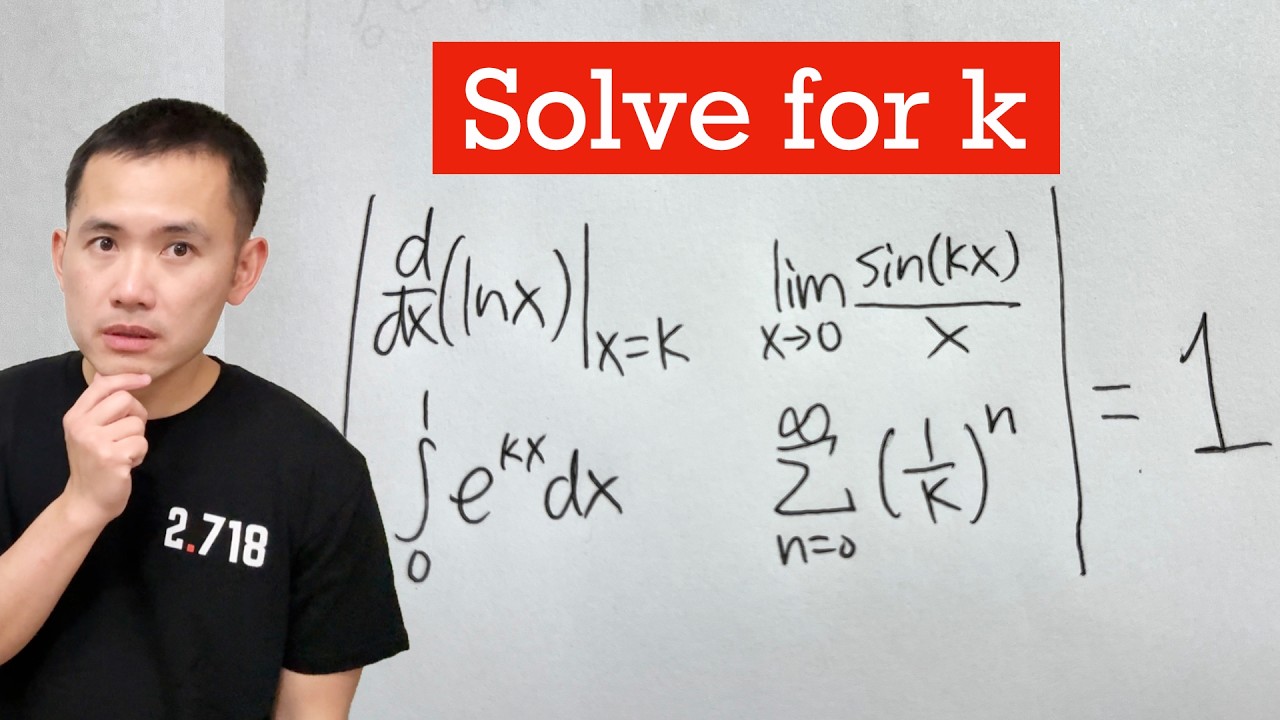
I crafted another all-in-one calculus problem, and this time I put the 4 main ingredients of calculus, i.e. limit, derivative, integral, and series, into a 2 by 2 matrix. Oh btw, we will also have to use the Lambert W function.
🛍 Shop my math t-shirts & hoodies: 👉 https://amzn.to/3qBeuw6
👉 Support this channel and get more content https://www.patreon.com/blackpenredpen
#blackpenredpen #calculus
Оглавление (2 сегментов)
Segment 1 (00:00 - 05:00)
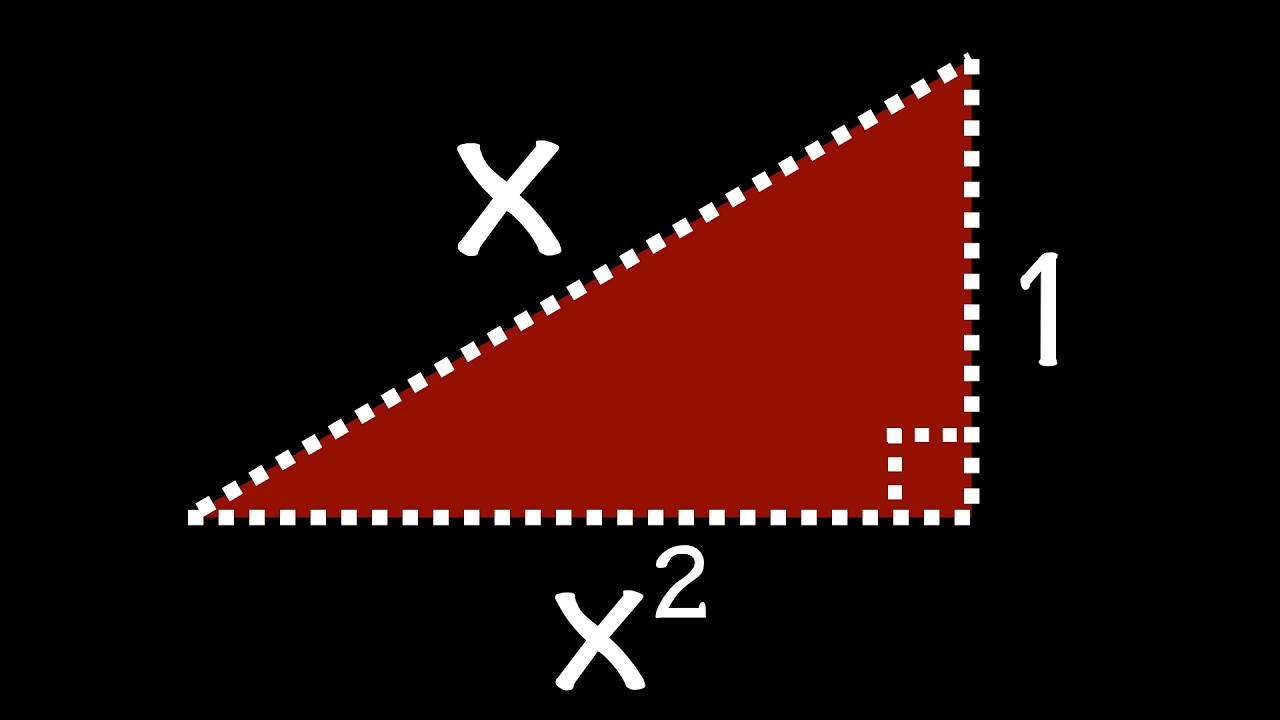
Okay, I know it's been a while, but I finally have another all-in-one calculus question for you guys. And this time I put the four main ingredients of calculus into a matrix, and the goal is to see if we can find the K value so that the determinant of this matrix is equal to what? Is that possible? Well, we're going to see. First, let's just go ahead and work out each component. So, right here the derivative of ln x evaluated at x equals k. is just 1 over x, and then we'll plug in k into it, so it's just 1 over k. Done. Now, the second component is this. We have the limit as x approaching 0 of sin of kx over x. And I know if we plug in 0 into all the x's, we get 0 over 0, but do not use L'Hôpital's rule. Here's a much better way to do it. Let's go ahead and match coefficients. We have k times x, so we should also have a k right here, right? So that this then that can match. But if I multiply the bottom by k, we'll also have to multiply the top by k. Now, put the k to the outside like this. And then this then that, because they are the same, I'm going to call this a new variable, let's say theta. So, we will have the limit as x approaching 0, but theta is equal to kx. x approach 0 tells us that theta will be approaching 0 as well, and we are looking at sin theta over theta. And this right here is just equal to 1. It's a famous result. So, just quote the result, it's much better than using L'Hôpital's rule. And there's also a geometric proof for it, but we can talk about it later. Anyways, it's just k times 1, so the answer for that is just k. Okay, continue. This one, number three. Integral from 0 to 1 e to the kx. k is just a constant. When we integrate e to the constant times x to the first power, remember it's just e to the kx. But, we will have to divide it by the coefficient here, which is dividing by k. And then we plug in 0 to 1. Plug in 1 first. We get e to the k * 1, which is just e to the k. Plug in 0, e to the 0 is just 1, so we have 1 over k - 1 over k. So, it's like that. Okay, and then lastly, we have the infinite series. So, the series as n goes from 0 to infinity 1 over k to the nth power. So, here's the deal though. This right here is a geometric series. But, you have to be careful. Does it really converge? I don't know yet. I can only assume that it converge. And uh we will have to see later on once we find a k value is k bigger than 1? If k is not bigger than 1, unfortunately, this right here wouldn't work. So, that's a small trap. But, anyways, if you work that out, because I started at n is equal to 0, so the first term is 1. And then we do 1 minus the common ratio, which is 1 over k. And then we can multiply the top and bottom by k. So, we can see this is just k on the top over k - 1. All right. So, these are the four ingredients of this. So, what we are doing is this right here. We are trying to get the determinant of 1 over K and this right here is K. And this right here is 1 over K E to the K minus 1 over K and then the last one is K over K minus 1. And hopefully, this is equal to 1. Now, we have to know some linear algebra for the matrix. It's not so bad. You do this times this. So, 1 over K times K over K minus 1 minus K times that. So, K times 1 over K E to the K minus 1 over K. And hopefully, we can get 1. All right, simplify. So, we have 1 over K minus 1 minus reduce this. Distribute the negative. So, we have minus E to the K plus that. Plus 1, that's equal to 1. And 1 plus 1 that
Segment 2 (05:00 - 08:00)
on both sides, so it doesn't matter. So, this 1 over K minus 1 minus E to the K it's equal to 0. Okay, and then we are solving for K, right? Uh this is the equation that we have to solve. How do you continue? Now, we have two ways to do it. This is a transcendental equation. It's It's hard. What you can do is you can do more calculus with this by using Newton's method. If you guys want to see that, I can make another video for you guys. But, there's a very cool function that can actually help us get the answer for that as well. So, I'm actually going to use that function. So, first, I will bring this to the other side. So, we are looking at E to the k being equal to 1 over k minus 1. All right? So, now how do we continue? First thing first, I will just get rid of the fraction by multiplying k minus 1 both sides. So, we have k minus 1 * e to the k and now it's equal to 1. Now, check this out. Here we have k and here we have k. This is almost like what? Yes. It's almost like calling out for the Lambert W function. But in order for us to make that work, this and that have to match. So, think about how can we match that? Well, in order to produce a minus 1 right here, we can just multiply by e to the negative 1 power because you will add the exponents. But of course, we have to do that both sides. So, the left-hand side we get k minus 1 * e to the k minus 1 and that's equal to this, which I will write it as 1 over e. Ladies and gentlemen, this is the perfect time for us to use the Lambert W function. Do the W here and W here. When you take the Lambert W function, as soon as this and that match, you just get this back. So, k minus 1 is equal to the Lambert W function of 1 over e. And finally, I just add 1 to both sides. So, k it's equal to 1 plus the Lambert W function of 1 over e. Now, remember there's a small detail, right? I need to figure how big this number is because otherwise, this right here might not even work. If k is 0. 2, then even though this right here works, but it wouldn't work for this thing right here. So, that would be bad. But don't worry because right here, you can just enter this expression onto Wolfram Alpha and can see that the answer right here is approximately 1. 278. So, if you have one over such a K value, this inside here is less than zero. one. This inside here has the absolute value less than one, so this infinite geometric series does converge. And it is in general here is the K value that will make this work. I know the calculus part might not be too hard, but yeah, maybe in the future I will think about what else I can come up with. Anyways, that's it.