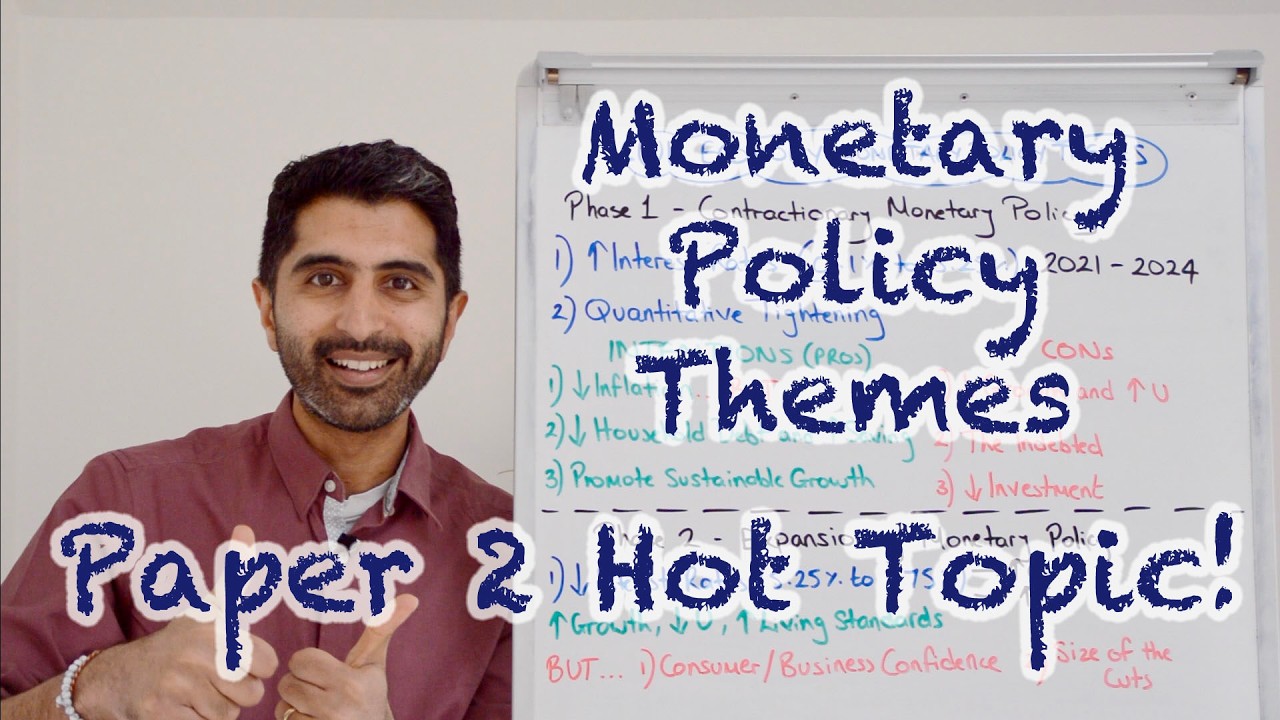
9 Unbelievable Ways to Show Off in Paper 2! Incredible Paper 2 Revision 😎
11:38

9 Unbelievable Ways to Show Off in Paper 2! Incredible Paper 2 Revision 😎

EconplusDal 13.05.2026 30 038 просмотров 911 лайков

Machine-readable: Markdown · JSON API · Site index

Поделиться Telegram VK Бот
Транскрипт Скачать .md
Анализ с AI
Описание видео
9 Unbelievable Ways to Show Off in Paper 2! Incredible Paper 2 Revision 😎. Video covering 9 Unbelievable Ways to Show Off in Paper 2! Incredible Paper 2 Revision 😎 For Products, Services and Bookings visit https://econplusdal.com Instagram: https://www.instagram.com/econplusdal Twitter: https://twitter.com/econplusdal Facebook: https://www.facebook.com/EconplusDal-1651992015061685/?ref=aymt_homepage_panel End Music: Relax by Peyruis https://soundcloud.com/peyruis Creative Commons — Attribution 3.0 Unported — CC BY 3.0 http://creativecommons.org/licenses/by/3.0/ Music promoted by Audio Library https://youtu.be/NvCDF7iUgIA

Оглавление (3 сегментов)

Segment 1 (00:00 - 05:00)

Hi guys. When it comes to macro essays, yeah, you've got your standard analysis, evaluation, but hey, if you can show off to examiners with incredible theories, with incredible points, you are going to stand out and can easily score higher marks. And that's exactly what this video is going to give you. Nine incredible ways that you can impress examiners beyond what they're expecting to see and push those marks to a higher level. So take in everything that's coming your way and when it comes to your exams, macro essays, put this in if you think it's relevant and if you think you can write about it in detail. Here we go. First, it's looking at the crowding out effect and then the Keynesian return to that, which is the crowding in effect. And you can use this when you're talking about expansionary fiscal policy. How on the one hand classical economists argue that debtfueled expansionary fiscal policy can put pressure on the demand for loanable funds in the loanable funds market driving up interest rates in that market which can make it harder more expensive for private sector firms to then borrow and fund investment projects. They argue not good for long run sustainable growth. That's the crowding out effect. But then you got the Keynesian return to that and Keynesians say, "Hey, when it comes to expansionary fiscal policy, don't worry about the crowding out effect. It's nonsense. " No, expansionary fiscal policy, even if it's debt fueled, even if it's borrowing fuel, can crowd in the private sector and promote private sector investment. And they say, take an example of government spending, even if it's debt fueled. that government spending which creates more demand in the economy which creates more activity in the economy can encourage private sector firms to invest to grow their business to try and tap into that activity knowing their revenues can increase. That's the crowding in effect. So going back and forth between these two arguments lovely if you're talking about fiscal policy analyzing or evaluating consider this. And then more generally this big debate between two massive schools of thought. The Keynesian school versus the classical school. You've learned about this. You can use it in your macro essays in many different ways. Right? The most obvious way is with recession management. how Keynesians argue that expansionary fiscal policy even if it's debt fueled if it's borrowing fuel is completely worth it to overcome the concerns of a recession to boost AD to close a negative out gap to return an economy to full employment is a worthwhile endeavor whereas classical economists would say no Keynesians expansionary fiscal policy government intervention a waste of time in recession the increases in debt the budget deficits are really going to burden future generations it's going to be hard to bring that debt down in the future but also just not necessary because market forces have a role to play can automatically deal with a recession without the need for any government intervention. So that's one way you can use it. More generally uh when it comes to debating budget deficit reduction or running budget deficits, you can bring in the same kind of idea there. Even when it comes to output apps, nice way to evaluate trade-offs. The Keynesian idea that spare capacity is fundamental is the most important determinant of whether let's say a higher AD will be inflationary or not or as classical economists argue will always be inflationary. But even when it comes to causes of the natural rate of unemployment, why some countries have got much higher natural rates than others, there are big differences with schools of thought there. Keynesians, interventionists have their own idea, free market economists have their own idea there. So this will be very impressive if you can actually evaluate or talk about these differing schools of thought. And then you've got laughter theory, a wonderful way to evaluate tax rises or tax cuts linking to government revenue. So take tax rises, direct tax rises and how in theory that can raise government revenue, can help to reduce income inequality. You can evaluate by saying well hold it. If tax rises are so significant, it can actually promote disincentive effects where government revenue falls in reality. Incentive effects like for examples entrepreneurs not willing to start businesses, not willing to grow their businesses. Uh workers looking to cut their working hours instead of working further. maybe skilled workers looking to leave the country and work in countries with lower tax rates, more tax evasion, tax avoidance taking place, all because of significantly higher levels of taxation. But even the other way around, tax cuts may actually increase government revenue by promoting the opposite incentive effects. So lovely evaluation when you're linking tax changes, tax rises, tax cuts to a change in government revenue. We then go back to this kind of classical Keynesian idea, the liquidity trap concern. is a Keynesian argument against expansionary monetary policy in recession in particular against lowering interest rates. How interest rates have a lower bound. So if the central bank is trying to increase the money supply further, they're trying to reduce interest rates further further.

Segment 2 (05:00 - 10:00)

There is a point where a lower bound is hit where they lose their effectiveness. There comes a point with very low interest rates where consumers, businesses have already converted their illquid assets towards cash. They've already spent, they've already invested where they need to the point now where they're just hoarding cash. So further attempts to reduce interest rates are simply not going to work in promoting more borrowing for consumption or investment. Therefore, the impact on AD is limited. the theoretical impact of uh boosting economic growth in dealing with the recession is limited because of this liquidity trap. Now we have this wonderful free market critique of expansionary fiscal policy again but this time through Ricardian equivalents a way to stun examiners. What an argument this is. The argument is quite simple. It comes back to debtfueled expansionary fiscal policy. But if households know that government finances are squeezed and the government is still borrowing money to fund expansionary fiscal policy through high government spending or tax cuts, any extra disposable income from those policies could be saved instead of spent because households are expecting future tax rises to fund this policy. That's the notion of Ricardian equivalent. So whether the fiscal policy is government spending increases, whether it's tax cuts, any extra disposable income from that to be saved rather than spent, households are smart basically. They know what governments are trying to do, but they know that actually affordability isn't there. So they save a tax cut or they save extra disposable income from higher government spending knowing that taxes are going to rise in the future. A lovely way to evaluate the theoretical impacts of expand fiscal policy right there. And then you got KZnet's curves. Wonderful ways to evaluate environmental trade-offs and inequality trade-offs from economic growth. The theory says that yeah look when countries grow initially when they become more prosperous initially expect environmental degradation expect rising inequality because of economic growth but only up to a point what Kusnet calls the turning point a level of GDP or GDP per capita. basically a level of prosperity whereby afterwards countries can continue growing but with less environmental damage with less income inequality. And that's because countries transition, economies transition into more techbased production, more services-based production, but also affordability rises where policies can be put into place or schemes, systems to reduce inequality, to reduce environmental concerns. But also views in society changes towards these trade-offs. They don't want these trade-offs anymore. So because of all of that growth can continue but actually with less trade-off in the future. Lovely way to bring in prison curves there. And now we have two very unique amazing concerns you can write about of primary commodity dependence. Now look, we've learned for countries who are primary commodity reliant. It could be a good thing. When prices are high, it means exports can be strong, ad can be boosted, growth and development promoted. You also get all the other wider benefits of economic growth. Fine if that's going on, but dependence, the key word is dependence can create issues over time. Two wonderful concerns right here. The first one is the Dutch disease. Sounds funky but quite a simple idea that if exports are strong from primary commodities that can create more demand for the currency strengthening the exchange rate which makes those exports and other exports in the economy less competitive causing issues over time. A nice idea and countries that are gas and oil export dependent have seen this issue many times in the past. But then you've also got the prebish singer hypothesis. So bear in mind countries who are primary commodity dependent that's their exports they often will use revenues from those exports to fund the imports of manufactured goods and prebish and singer said that look there is a concern of that over time that you become impoverished that your living standards fall and they say that look over time global incomes tend to rise and both of these goods are normal goods primary commodities the exports for these countries are normal goods but they're normal necessities right So income inelastic demand. So their prices go up but not that significantly when income rises globally. Whereas what these countries import and manufactured goods these are normal luxuries income elastic demand. So with global incomes rising prices of those goods rise a lot faster than the prices of primary commodities. And the end result is these countries have to sell more and more primary commodities to gain the revenues to purchase the same level of manufactured goods. There's your link to lower living standards over time. And the argument is the conclusion from both of these theories is that when times are good and revenues are pouring in from primary commodities, governments need to use that revenue or businesses to diversify the economy to overcome these long run concerns. Lovely to talk about these in

Segment 3 (10:00 - 11:00)

an essay. And lastly, you've got the Marshall learner condition and the J curve effect. For me, the best evaluation point of anything good that comes from a weak exchange rate, whether it's current account improvement, a deccreasing, growth increasing, unemployment falling, living standards rising. You can evaluate any of that by bringing in the Marshall learner condition. How for any of that to occur, we need the PD of exports plus the peed of imports to be greater than one. Only then will you see current account improvement or anything else good from a weaker exchange rate. But then how economists take it further and they say in the short run this condition tends not to last or not to hold because of contracts and time lags and therefore a country with a current account deficit expect it to worsen actually after a weaker exchange rate but over time these end elasticities rise and that's when the marshall learner condition tends to hold more so and that's when the current account improves giving rise to a J curve effect. So anytime you're evaluating a weak exchange rate, you're talking about the benefits of it, look to bring in Marshall Learner and the Jur effect will be a stunning evaluation point right there. So there you have it guys, some awesome ways, awesome theories that you can use in macro essays to show off to examiners. If you think these are relevant, if you can write about them in detail, you're confident with them, do so. Wow examiners and see your marks increase as a result of that. A lot more videos coming your way to help you already. Lots in my revision for exams playlist. Make sure you're watching those. I can't wait to see you in upcoming videos.

Другие видео автора — EconplusDal

Ctrl+V

Экстракт Знаний в Telegram

Экстракты и дистилляты из лучших YouTube-каналов — сразу после публикации.

Подписаться

Дайджест Экстрактов

Лучшие методички за неделю — каждый понедельник