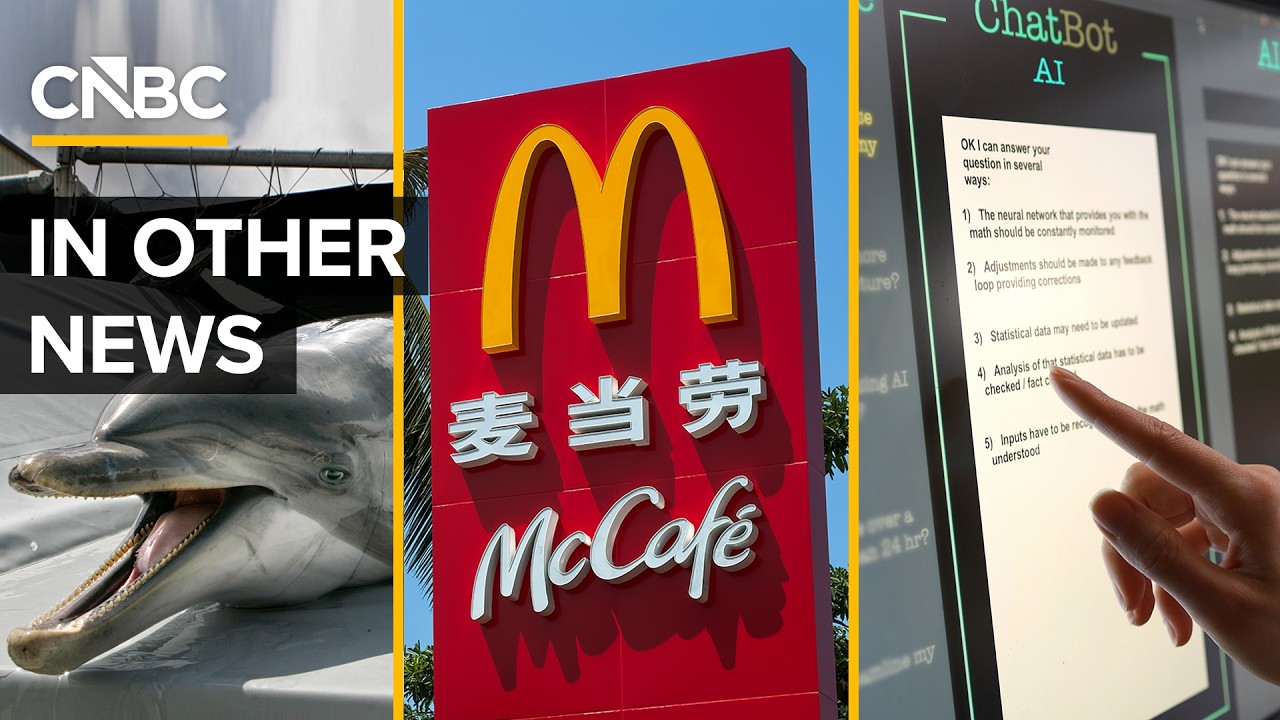
In Other News: McDonald's Bet On China, Spy Dolphins, And AI Layoffs Vs. Stocks
10:36

In Other News: McDonald's Bet On China, Spy Dolphins, And AI Layoffs Vs. Stocks

CNBC 17.05.2026 23 886 просмотров 346 лайков

Machine-readable: Markdown · JSON API · Site index

Поделиться Telegram VK Бот
Транскрипт Скачать .md
Анализ с AI
Описание видео
CNBC In Other News brings you stories that missed the spotlight. AI-driven layoffs have become a defining theme across the tech industry over the past year, with some sources estimating more than 112,000 U.S. jobs being lost to AI since the start of 2025. While major companies like HP and Amazon have often framed these cuts as a way to boost efficiency and shift focus toward new technologies, investors themselves don't appear convinced that these layoffs will improve companies' bottom lines in the long run. Software companies like Twilio and Datadog are starting to prove their case as winners in artificial intelligence. Investors say the performance from Datadog and Twilio underscores how companies that can deploy AI-native solutions while also articulating their path to monetization can ease disruption fears, for now. CNBC's Seema Moody explains. Since 1959, the U.S. Navy’s Marine Mammal Program has trained bottlenose dolphins and California sea lions to detect mines and other underwater threats. Reporter Sophie Caldwell spoke with Scott Savitz, senior engineer at global policy think tank Rand Corporation and an expert on mine countermeasures, to understand the history, challenges and possibilities of marine mammals in the military. While many foreign consumer brands in China, including Starbucks, Nike, and LVMH, face slowing growth and tougher competition, McDonald’s is expanding aggressively. The company plans to open 1,000 new stores a year and reach 10,000 locations in China by 2028. About half of McDonald’s new stores last year opened in China. The company also recently bought back a stake from Carlyle Group after previously selling control of its China business to Carlyle and a Chinese state-owned firm. CNBC’s Eunice Yoon looks at why McDonald’s continues to bet big on China. Chapters: 0:00 Why AI layoffs aren't helping stocks 3:44 How Twilio and Datadog are winning back investor confidence 6:29 Pete Hegseth says Iran doesn’t have ‘kamikaze dolphins’ 8:18 Why McDonald's is supersizing in China Reporters: Liz Napolitano, Seema Mody, Sophie Caldwell, Eunice Yoon Produced by: Juhohn Lee, Meline Rosales Edited by: Andrea Miller, Erin Black, Christian Nunley Camera by: Tasia Jensen Animation: Emily Park, Christina Locopo Additional Production: Charlotte Morabito Manager Video Distribution: Divya J. Verma Senior Directors of Video: Jeniece Pettitt, Jessica Leibowitz, Lindsey Jacobson Additional Footage: Getty Images Additional Sources: Scott Savitz » Subscribe to CNBC: https://cnb.cx/SubscribeCNBC » Subscribe to CNBC TV: https://cnb.cx/SubscribeCNBCtelevision About CNBC: From 'Wall Street' to 'Main Street' to award winning original documentaries and Reality TV series, CNBC has you covered. Experience special sneak peeks of your favorite shows, exclusive video and more. Want to get ahead at work? Then you need to learn how to make effective small talk. In CNBC’s new online course, How To Talk To People At Work, expert instructors teach you how to use everyday conversation to gain visibility, build meaningful relationships and advance your career. Sign up now: https://cnb.cx/4sGlSkh Connect with CNBC News Online Get the latest news: https://www.cnbc.com/ Follow CNBC on LinkedIn: https://cnb.cx/LinkedInCNBC Follow CNBC News on Instagram: https://cnb.cx/InstagramCNBC Follow CNBC News on Facebook: https://cnb.cx/LikeCNBC Follow CNBC on Threads: https://cnb.cx/threads Follow CNBC News on X: https://cnb.cx/FollowCNBC Follow CNBC on WhatsApp: https://cnb.cx/WhatsAppCNBC #CNBC In Other News: McDonald's Bet On China, Spy Dolphins, And AI Layoffs Vs. Stocks
Оглавление (4 сегментов)

Why AI layoffs aren't helping stocks

— By one estimate, more than 112,000 jobs in the US have been lost to AI since the start of 2025. MIT also released a study in November showing that AI can already do the job of 11. 7% of the US labor market and save companies as much as 1. 2 trillion in wages across finance, healthcare, and other professional services. While companies have often framed these cuts as a way to boost efficiency and shift focus toward new technologies, investors themselves don't really seem convinced that these layoffs will improve companies' bottom lines in the long run. I analyzed about two dozen publicly listed firms that announced layoffs with clear links to AI-driven initiatives to automate tasks or otherwise drive efficiencies. I found that a little more than half of those stocks have traded in the red since layoffs were announced. By comparison, just 27% of the companies in the S& P 500 are trading in the red since November 30th, 2022. That was when ChatGPT was launched. For the companies whose shares did ultimately fall after AI-related layoffs, the average decline was around 28%. A loss equal to a little more than a quarter of the stock's pre-layoff value. Experts told me uncertainty is a big force behind this. AI is a sort of what we call sort of macro a shock. And there's a lot of uncertainty in what we'll do, and no one really have a good grasp of sort of the two long-term impact. We're seeing four different big macro shocks. The huge geopolitical shocks. There's tariff shock we are looking at. Pandemic over-hiring being undone. And then there's true shock of AI. So, how much we can attribute to each? I think everybody's guessing. There are also concerns that as more companies reduce headcount for AI-driven efficiencies, these layoffs may not lead to meaningful gains that put companies ahead of the competition. I think there's a zero-sumness to productivity gains. Meaning, yes, I'm improving my productivity because I'm using new technologies and they are able to really cut down on the number of head counts I need to deliver the same products. But, oh, my competitors are doing the same thing. If everybody's sort of improving, then the base line is just shifting and no one is more profitable. Here is the question of the morning. Are AI layoffs real or are they a scapegoat for what's going on in the employment picture in this country? These uncertainties have been compounded by skepticisms around AI washing, where companies blame layoffs on AI to mask their financial struggles and more traditional cost-cutting measures. Back in the investors are looking for companies that are not just using AI to get leaner, but are actually using the technology to make meaningful advancements in product and revenue. So, I think the job cuts, you know, really aren't enough. People are looking at what they're investing in what they're spending and then trying to figure out, you know, who's going to actually get successful returns out of all those investments. Google, for example, came out with great numbers in their advertising. They've done a great job of implementing AI with their Gemini tool. That's helped continue to drive more search and more spend on things like ads, where companies feel like they're using AI to be a bit more efficient on their spend, but they're actually then spending more because they feel like they're getting more of a return out of it. Palantir's obviously been a huge, huge success, even though their stock is down quite a bit year-to-date. But, they're producing significant revenue growth on the back of AI. So, that's what you try to look for, but again, it's going to be a volatile space. It feels sort of internet 2. 0 or like any category that becomes a bit of a bubble. We'll see over the next 2, 5, and then 10 years who the big winners and the big losers are.

How Twilio and Datadog are winning back investor confidence

AI communications company Twilio has been winning back investor confidence. The company at its investor day unveiling new platform capabilities that help AI agents communicate and work together more effectively. The updates include logging customer data, facilitating hand-offs, and creating lists of actionable data. Twilio CEO telling CNBC that these enhancements will dramatically improve the customer experience by making agents better at solving customer issues. What that means in practical terms is for every consumer being able to be reached in exactly the way that they want to be reached. So, instead of hitting an IVR menu where we're waiting, we are now able to be placed directly into contact with a virtual agent. The virtual agent can spend several minutes actually making sure that whatever the idiosyncrasies of our order, like that they get processed appropriately. That company can use that time to be able to do a cross-sell or an upsell, so thereby not just lowering their cost, not just serving more consumers, but actually increasing their revenue footprint. Amid the continued stress in the software industry, Twilio has been an outperformer, helped in part by strong earnings. The stock is up about 45% in the last month. Pretty impressive when you compare it to the broader IGB software ETF during that same period. And it's not the only software name getting Wall Street's attention as of late. DataDog releasing an impressive quarterly beat and revenue that's surpassed $1 billion for the first time as demand for data observability continues to grow. Shares of that company now up about 60% in the last 1 month. We think this is a sign of strong continued cloud migration, greater adoption of our product, and customers of all kinds accelerating their use of AI. DataDog and Twilio's results tell us a few things. First, there are now a growing number of software companies that have been able to brush off AI displacement fears by showcasing AI-native solutions, a clear monetization path, and the ability to partner versus compete with the likes of OpenAI and Anthropic. We'll be launching some product later this year in that regard. I think as well, observability and governance are exciting new areas that we think about investing into. So, in addition to knowing who you're working with, what's happening on the platform, why is it happening, is there an audit trail, and then if something is going outside of the guardrails, being able to institute kill switches, especially for high-stakes transactions like financial services or healthcare and kind of prescriptive elements like that.

Pete Hegseth says Iran doesn’t have ‘kamikaze dolphins’

Questions about the weaponization of dolphins comes after April 30th story by The Wall Street Journal reporting that Iranian officials had said Iran could use mine-carrying dolphins to attack US warships. The defense secretary said in a briefing that he can't confirm or deny whether the US has kamikaze dolphins, but he can confirm that Iran does not. Since 1959, the US Navy's Marine Mammal Program has trained bottlenose dolphins and California sea lions to conduct surveillance, detect underwater mines, and locate and recover objects lost at sea. I spoke with Scott Savitz, a senior engineer at global policy think tank RAND Corporation, and an expert on mine countermeasures to understand the history, challenges, and possibilities of marine mammals in the military. According to Savitz, dolphins use echolocation or biosonar to identify underwater objects such as naval mines. The military uses dolphins because their biosonar is often more accurate than electronic sonar. Savitz notes that it's a challenge for humans to learn how to work best with dolphin capabilities. And that it's not a question whether or not the Iranians may have physical animals with some training, but whether the Iranians have trained themselves to work with the dolphins. The American Society for the Prevention of Cruelty to Animals recognizes the value of animals for military functions, but said the animals should not be unnecessarily put at risk or sacrificed in the service of our country. Savitz said he has worked with the Marine Mammal Program intermittently for 25 years, and that both dolphins and sea lions love the program. He says, "For them, it's a game. Just as with drug-sniffing dogs or explosive-sniffing dogs. " He notes that no marine mammal has been harmed during a military operation.

Why McDonald's is supersizing in China

This McDonald's opened up across the street from my house in March. This one opened last October. This one in October, too. So, there are seven McDonald's within walking distance of my home. The US has more stores than China, and the market is a big source of the company's growth. Half of its new stores last year were here. The country's first McDonald's opened in 1990, and the iconic golden arches captured the excitement of China's opening to the world and rising wealth. The brand still benefits from that nostalgia. McDonald's brought back the classic shake, which was discontinued here more than a decade ago. It's now viral. "I remember having this shake the first time as a kid," he says. "We drove half an hour here to get it. " "McDonald's left a great first impression for those eating western fast food for the first time," he says. "Nowadays, we have so many options in fast food, western or Chinese. But for me, 70% of the time, I go to McDonald's. And now McDonald's is riding the new spirit of the times, affordability in a down economy. A lot of Chinese see McDonald's as good quality on a budget, even compared to its local rivals. Now, within the Chinese consumer's mindset, it's not just about pricing. It is more about value. McDonald's is slightly more expensive, but if you think about the experience, and then about taste, and then the quality you get from that, there's definitely more value. McDonald's has its own version of what the Chinese call the poor man's meal. For $2, you could get a burger and a drink or a dessert. And the menu is a mix of classic standbys, like the Big Mac, and frequently refreshed local editions, like honey barbecue chicken bones or dragon fruit McFlurries. Items that appeal to Chinese consumers always looking for the new thing, even when it's old. I love it.

Другие видео автора — CNBC

Ctrl+V

Экстракт Знаний в Telegram

Экстракты и дистилляты из лучших YouTube-каналов — сразу после публикации.

Подписаться

Дайджест Экстрактов

Лучшие методички за неделю — каждый понедельник