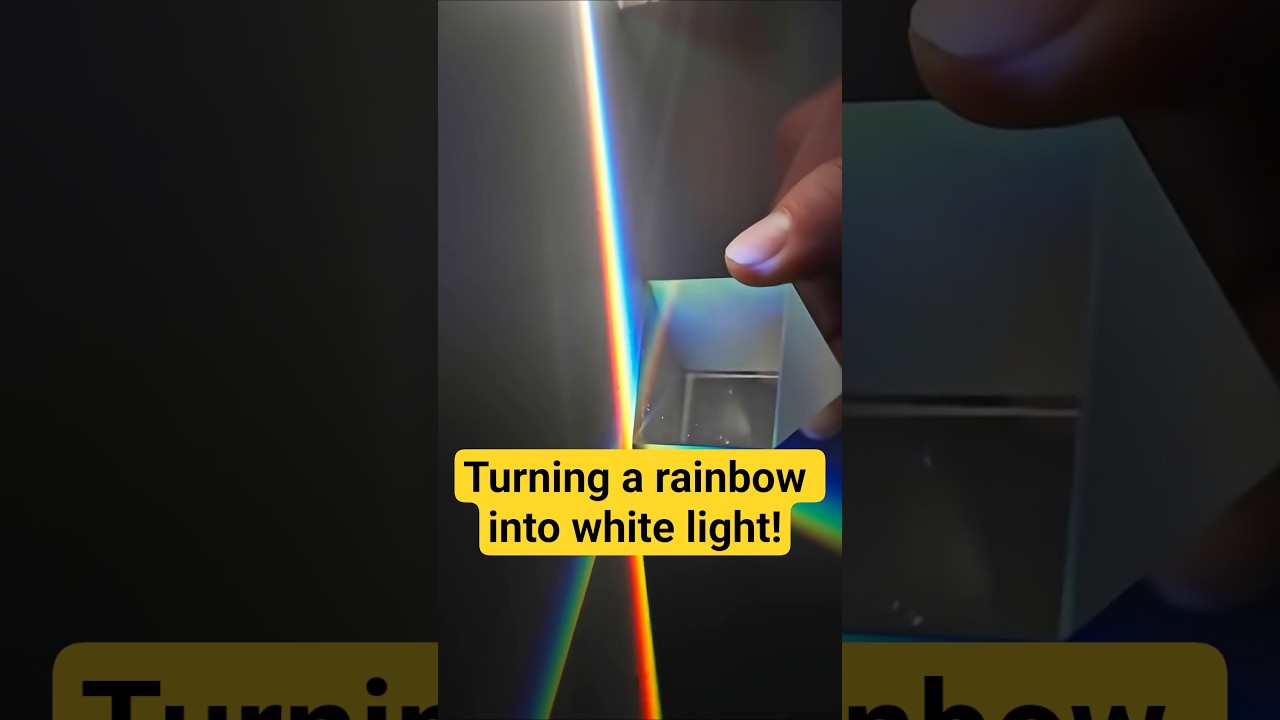
Turning a rainbow back into white light
2:45

Turning a rainbow back into white light

Steve Mould 01.05.2026 393 114 просмотров 21 080 лайков

Machine-readable: Markdown · JSON API · Site index

Поделиться Telegram VK Бот
Транскрипт Скачать .md
Анализ с AI
Описание видео
You can buy my books here: https://stevemould.com/books You can support me on Patreon and get access to the exclusive Discord: https://www.patreon.com/stevemould just like these amazing people: Glenn Watson Peter Turner Joël van der Loo Matthew Cocke Mark Brouwer Deneb Twitter: http://twitter.com/moulds Instagram: https://www.instagram.com/stevemouldscience/ Facebook: https://www.facebook.com/stevemouldscience/ TikTok: https://www.tiktok.com/stevemould Buy nerdy maths things: http://mathsgear.co.uk
Оглавление (1 сегментов)

Segment 1 (00:00 - 02:00)

I wonder if it's possible to recombine that back into white light. Newton was able to make rainbows with prisms, but I want to see if I can do the reverse and turn a rainbow into a beam of white light. You might think that I could just take a second prism, flip it the other way, and put that in front of the rainbow, and that would turn the rainbow back into a beam of white light, but that doesn't work. So, that's why I need a ray table. It's basically a vertical shaft of light. So, you can see the path of the light and how it changes as it interacts with different optical elements. Here's what actually happens when you put a flipped prism immediately after the first prism. It doesn't work. The reason you need more than just a second prism is because of the way light bends when it goes from air to glass. My favorite way of looking at it is in terms of wavefronts. So, light slows down when it goes from air to glass, and that changes its direction. But, crucially, the amount by which the light slows down depends on the wavelength of the light. So, blue light with a short wavelength is bent more, and red light with a longer wavelength is bent less. And so, the white light fans out into a spectrum. The flipped prism will bend all those different wavelengths of light by just the right amount so that they end up parallel with each other when they leave the prism. In other words, we end up with a parallel rainbow beam instead of a beam of white light. How do we solve that? Well, I think the answer is in this book, Newton's Opticks, published in 1704. Look, on page 156, there it is, a convex lens. I ended up getting this one. This is really nice. The focal length is 75 mm, but I want the object and the image to be the same distance from the lens, which means I need to double that, so I need a separation of 150 mm. And so, look, on the other side, the rainbow is now focused back to a point. That's where we put the second prism, which unbends each wavelength of light by the exact amount that the first prism bent the light in the first place. And so, coming out of that second prism, we have all the different colors all moving in the same direction and at all on top of each other. And so, there you go. We have our beam of white light back again. The experimentum crucis. By combining the spectrum into white light, he overturned the prevailing wisdom that white light from the sun was pure. And of course, as we now know, white light is made up of all the colors of the rainbow.

Другие видео автора — Steve Mould

Ctrl+V

Экстракт Знаний в Telegram

Экстракты и дистилляты из лучших YouTube-каналов — сразу после публикации.

Подписаться

Дайджест Экстрактов

Лучшие методички за неделю — каждый понедельник