Go to https://ground.news/charts to get all sides of every story.
Subscribe through my link to save 40% off the Vantage Plan.
Download the chart for free:
https://usefulcharts.com/blogs/charts/timeline-of-major-record-labels
CREDITS:
Chart & Narration by Matt Baker
Animation by Syawish Rehman
Audio editing by Ali Shahwaiz
Theme music: "Lord of the Land" by Kevin MacLeod and licensed under Creative Commons Attribution license 4.0. Available from http://incompetech.com
Оглавление (4 сегментов)
Segment 1 (00:00 - 05:00)
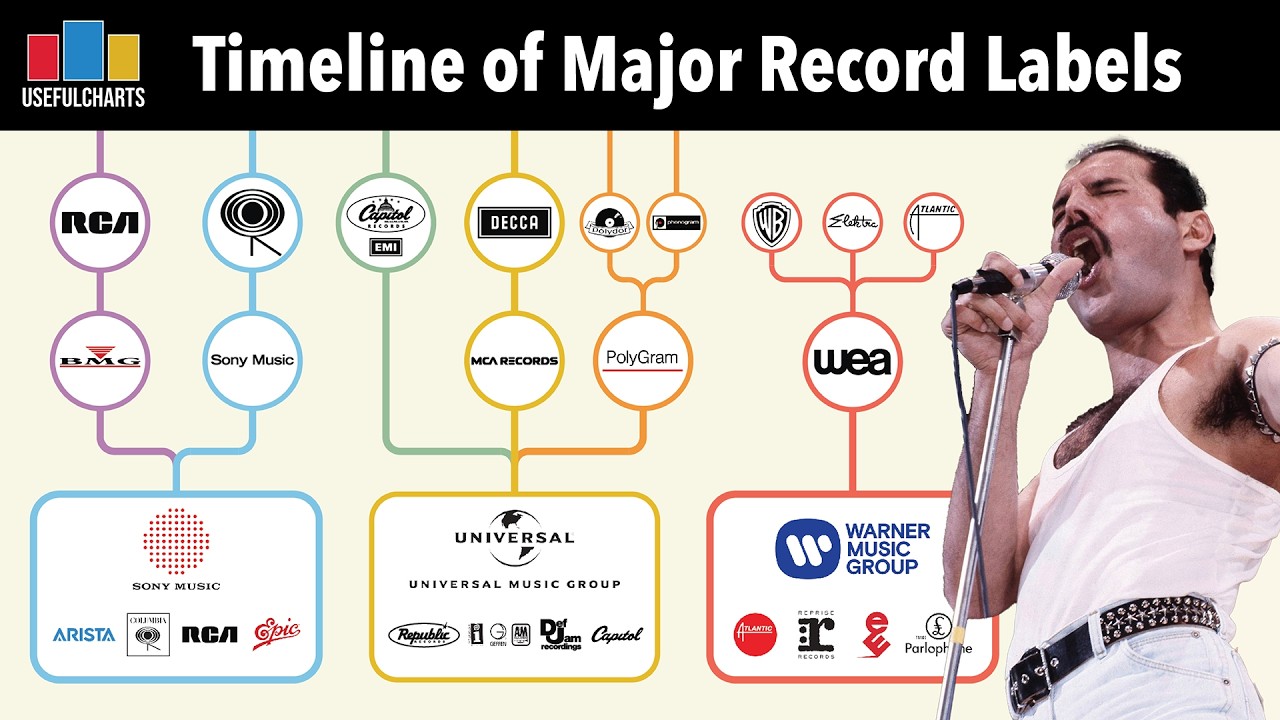
Hi, this is Matt Baker. Earlier this year, I did a video on the US TV and film industry, showing how various companies have merged over time. Well, today I'm going to do the same thing for the music industry, focusing on major record labels and how these two have been consolidated in recent decades. We're going to start up here with the invention of the gramophone by Amile Berliner in the late 1800s. Previous to this, Thomas Edison had invented the phonograph, but that was slightly different in that the phongraph used cylinders, whereas the gramophone used flat discs, eventually known as records. Berliner's discs were easier to mass-produce. So, pretty soon the gramophone became the primary device used for playing music. Initially, the E Berliner Gramophone Company was the only company to produce records, but because of weak patents, pretty soon other companies started making them as well. Their first big competitor was the Colombia Phonograph Company, which as their name suggests, started out by selling phonograph cylinders, but then switched to Gramophone Records around 1901. Take note, however, that over time the words phongraph and gramophone basically became synonymous with both words eventually referring to record players. Because of lawsuits, Berliner was forced to close his original business in the US and transfer his assets to a new company called the Victor Talking Machine Company. However, in the UK, he was able to carry on as the Gramophone Company. Both firms ended up using the same logo based on a now famous painting called His Master's Voice featuring a dog named Nipper listening to a gramophone. In the UK, the Gramophone company opened stores called His Master's Voice, which was later simplified to HMV. To this day, HMV stores often feature the old logo with nipper. Another very early record company originally based out of Germany was Parlophone. It's famous for being the label that the Beatles were initially associated with. You might assume that their logo represents the British pound symbol, but it's actually a stylized L, standing for Carl Lindström, the company's founder. In 1926, long before the Beatles were signed, Parlophone was actually bought by the UK branch of Colombia, which had become independent from the US branch just a few years earlier. But then in 1931, UK Colombia merged with UK Gramophone to become Electric and Musical Industries, better known as EMI. For the next 80 years, EMI would be the number one record company in the UK, continuing to use the Colombia, Parlophone, and HMV labels. EMI's main competition there ended up being Deca, established in London in 1929. Take note, however, that DECA also started an American branch which soon became independent. Which brings me back to the US. You see, in 1929, which is the year that Amal Berliner died, the Victor Talking Machine Company was bought by the Radio Corporation of America or RCA, which also owned NBC. Meanwhile, about a decade later, NBC's main competitor, CBS, bought Colombia. So by the 1940s, America had three big record companies, RCA Victor, CBS Colia, and US DECA. Now, before I continue, I want to shout out today's sponsor, Ground News, which is the website and app that I use to follow the news. Not just politics, but fun stuff, too, like the announcement of the Rolling Stones new album. What Ground News does is pull headlines from hundreds of different sources from all over the world, including newspapers, podcasts, and websites. It then categorizes them on a continuum from left to right, so that you get to look at the story from different angles. So even when it comes to something as simple as the Rolling Stones releasing a new album, you can see how the spin is often different. For example, this left-leaning source emphasized the collaborative nature of the album, whereas this right-leaning source emphasized the age of the band. Of course, the best thing about ground news is the charts, such as this one showing the bias distribution, or this one showing which sources are the most factual based on third party rankings, or this one showing what percentage of the sources are independently owned or owned by the government or big business. Ground News also has a blind spot feed which highlights stories that one side of the spectrum is barely covering at all. So you're not just trapped inside the version of events your usual media bubble wants to feed you. So don't wait. Subscribe now by going to ground. news/charts or by using the link in the description or pinned comment. If you use that address or link, you will get 40% off unlimited access to their Vantage plan.
Segment 2 (05:00 - 10:00)
Again, that's ground. news/chart. News/charts. Okay, let's now return to the timeline of major record labels. We left off in the 1940s when the US had just three main record companies. RCA Victor, home of big band conductor Glenn Miller, CBS Colombia, home of early teen idol Frank Sinatra, and Deca, home of actor, dancer, and singer Bing Crosby. Now at this point most records were made of shellac which was very brittle and set to spin at 78 RPMs. But then in 1948 Colombia introduced the very first vinyl records which spun at around 33 RPMs and were called LPS or long plays meaning that they could hold around five songs on each side. This was then followed in 1949 by RCA Victor introducing a new single format in vinyl that spun at 45 RPMs. This is why record players to this day usually have three settings 33, 45, and 78, so that you can play all of these different types of records. Sometimes there's a fourth setting, 16, which is used for spoken word only. Anyhow, the introduction of vinyl and the LP kickstarted a new era of music, which I've labeled the vinyl era, in which musicians now release singles as well as full albums, which usually had around 10 songs. This coincided with the birth of rock and roll. The first really big star being, of course, Elvis Presley, who was initially signed by a relatively minor label called Sun, but then later picked up by RCA Victor. In 1955, EMI, which remember was a British label, bought Capital Records, making them their primary distributor in the US. Thus, by the 1960s, there were now four major record companies in the US, RCA, which eventually dropped the Victor name, Colombia, Capital, and Deca. Colombia eventually became the top US label thanks to artists like Bob Dylan and Johnny Cash with number two being Capital which distributed the Beatles. Although like I mentioned earlier in the UK the Beatles started out on EMI's Parlophone label. Later they started their own label called Apple. There were lots of other labels though too many to list on this chart. But let me point out several other important ones that were founded during the vinyl era. Starting with Atlantic Records, which originally focused on Soul, launching the career of Artha Franklin, Electra Records, which launched The Doors, and Reprise Records, which was started by Frank Sinatra. All three of these were eventually bought by Warner Brothers Records, which, as you can probably guess, was started by the Warner Brothers Film Studio. Now, at this point, Warner Records became known as Warner Electra Atlantic or WEA, and it went on to become the fifth major record company in the US, representing big names such as Led Zeppelin and the Eagles. Now, during the 1970s, there also ended up being a sixth major company, Polygram. So, let me go back a bit and tell you where it came from. Back in 1913, a German company launched a label called Polydor. Then during World War I, it acquired the German branch of Berliner's gramophone company, which incidentally allowed it to use the his master's voice logo in Germany. Eventually, the whole thing was bought by the German conglomerate Seammens. Meanwhile, in the Netherlands, the Dutch conglomerate Philillips started its own record label. It then bought Mercury Records in the US and rebranded as Phonogram. So you had Polydor in Germany and Phonogram in the Netherlands. These two companies started to work together in the 60s and joined officially in the 70s to create Polygram. Poly from Polydor and Graham from Phonogram. Okay, before we leave the vinyl era, I want to point out a few more important independent labels such as Island Records, which distributed Bob Marley& M Records, which launched the Carpenters, and Mottown, which was founded by Barry Gordy, whose family tree I've covered on this channel. Mottown was really important in that it was the first AfricanAmerican-owned label to become super popular with white audiences, coinciding with the civil rights era in the US. It launched lots of famous artists such as Marvin Gay, Diana Ross, Stevie Wonder, and the Jackson 5. Now, the reason why I show these three labels together is because they were all eventually bought by Polygram. All right, we've now made it to the 1980s, which is when the vinyl era came to an
Segment 3 (10:00 - 15:00)
end. This was due to the rise of the cassette tape, which ended up surpassing vinyl in terms of sales around the year 1985. But the reason why we don't have a cassette tape era, is because cassettes were surpassed within less than a decade by compact discs or CDs. Now during the 80s, 90s and early 2000s, there continued to be six big record companies, but in several cases, there were some big changes in terms of ownership. So, let me now go through the big six again and tell you what happened. Warner Electra Atlantic continued to be really successful in the 80s, representing artists such as Madonna and Metallica. And then, as we learned in the TV and film episode, in 1991, Warner became Time Warner, at the time, the biggest media conglomerate in the world. But one thing I didn't mention in that video was Time Warner's disastrous merger with the internet company AOL, which led to its decline. One of the results of that decline was that the music side of the business was sold. And thus from 2004 onwards, Warner Music has been totally separate from Warner Entertainment, even though they still share the same name. Warner Music now uses this logo, whereas Warner Entertainment still uses the original Warner Brothers logo. Now, Warner Brothers was not the only film studio to start its own record label. Columbia Pictures started one as well in 1974 called Arista Records. It launched Whitney Houston. But soon thereafter, Arista was bought by a German company called Bertlesman, which continued to record her music. Now, earlier I mentioned that RCA was not only the owners of a record company, but also of NBC, by now a major TV network. Well, in 1986, when RCA was bought by General Electric, the new owners decided to keep the TV channel, but ditch the record company. At this point, Bertlesman bought RCA and formed BMG, which stands for Burlesman Music Group. BMG went on to buy Jive Records, the home of Britney Spears and Nync, and thus ended up having a massive catalog of artists, both old and new. Next up is Colombia, which, as I mentioned earlier, was the number one record company in the US throughout the vinyl era. Well, during the 1980s, it kept this number one spot thanks to being the home of Michael Jackson. Although, take note that Jackson actually used one of their subsidiary labels, Epic Records. Now, remember, Columbia Records was owned by the TV network CBS. Well, around the same time that NBC parted ways with RCA Records, CBS parted ways with Colombia Records, selling their entire music business to the Japanese conglomerate Sony, who, as we learned in the TV and film episode, also bought Colombia Pictures. So, to this day, Colombia Records and Colombia Pictures are now owned by the same company. But then in 2008, Sony also bought BMG, giving Sony Music four major labels, Colombia, RCA, Arista, and Epic, among many others. We're now going to skip past Capital EMI for a moment and go straight to US DECA, which in 1952 acquired Universal Pictures, a fact that will become important in a moment. But first, you need to know that in 1962, DECA, which now included Universal, was bought by MCA, which stands for Music Corporation of America. Initially, MCA continued to use the DECA label, but then rebranded as MCA Records in 1972. Their biggest star at that time was Elton John. However, it was during the '9s that MCA, which eventually rebranded itself again, this time as Universal Music Group, really started to grow, swallowing up all sorts of independent labels, as well as one really big one. First off, there was Geffen Records, which launched Guns and Roses, and Interscope, which distributed major rappers such as Dr. Dre, Snoop Dogg, and Tupac. But then in 1998, Universal bought all of Polygram, which remember came with Mottown Island and a bunch of other labels, including a newer one called Def Jam, whose very first artist was LL CoolJ. So with the merger of Universal and Polygram, Universal was now the biggest record company in the world, as well as of course a major film studio. However, in the same year that Warner Pictures and Warner Music split up, so did Universal Pictures and Universal Music. Universal Pictures was
Segment 4 (15:00 - 17:00)
bombed by General Electric and combined with NBC, whereas Universal Music continued on as a totally separate entity, even though to this day they share very similar logos. I now want to return to the UK for a moment where, as I mentioned, EMI was the dominant force. Well, another British label of note is Virgin, started by Richard Branson in 1972. Today, Virgin operates lots of companies, including an airline and even a space tourism outfit. However, it no longer operates the business it started with, Virgin Records, because it sold that to EMI in 1992. But 20 years later, EMI itself was sold to Universal. The only two things that deal did not include were the HMV stores because those became independent in 98 and Parlophone which went to Warner instead. Although take note that Universal kept the rights to distribute the Beatles. So by the time streaming took over CD sales around 2015, there were only three main music companies in the entire English-speaking world. Warner, Sony, and Universal. These days, Warner represents Ed Sheeran and Sony distributes Bad Bunny, but most of the biggest names in the music business are with Universal. For example, Taylor Swift, The Weekend, and Ariana Grande are all signed with Republic Records, which Universal bought in 2000. And Billy isish, Kendrick Lamar, and Lady Gaga are all represented by Intercope, now also known as Interscope Geffin. So, just like we saw in the TV and film episode, the pattern is small fish getting eaten up by bigger fish with fewer and fewer big fish as time goes on. Okay, let me know in the comments who your favorite music artist is and what label they are currently signed to. And don't forget to check out Ground News. Thanks for watching. I'm feeling