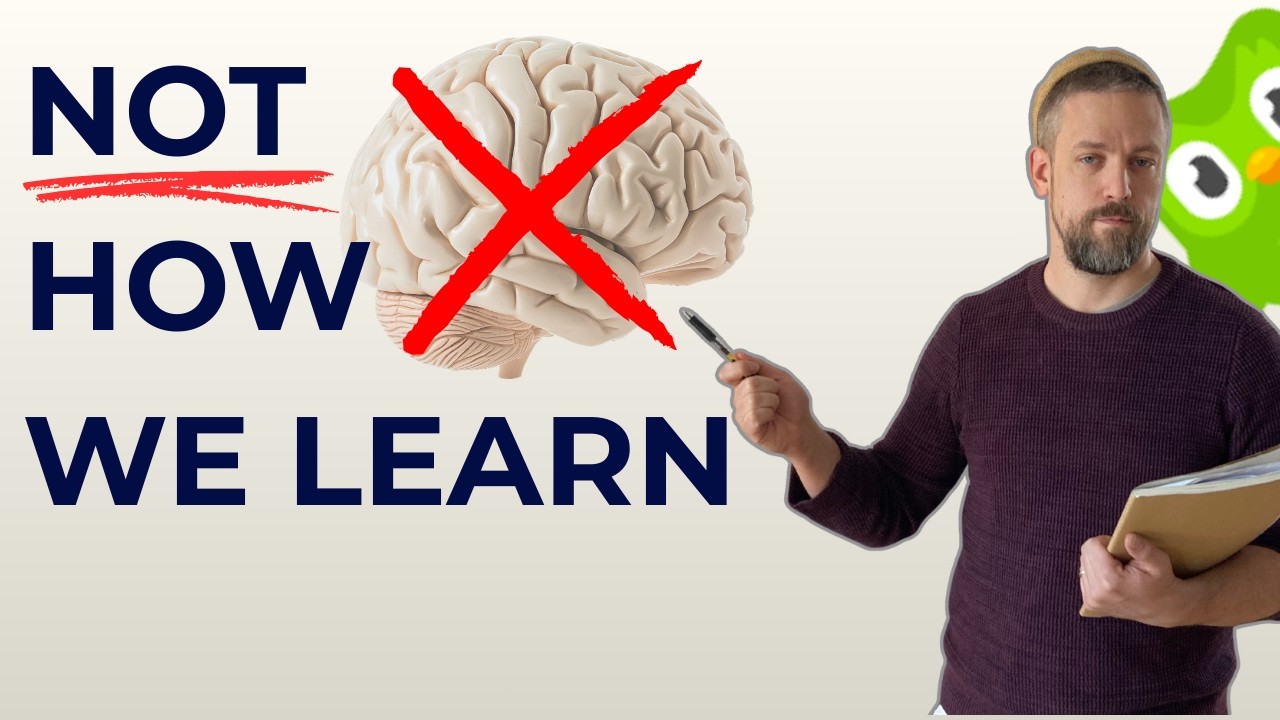
italki How It Works, When to Start, and How to Actually Use It for Fluency
14:55

italki How It Works, When to Start, and How to Actually Use It for Fluency

languagejones 11.05.2026 6 663 просмотров 276 лайков

Machine-readable: Markdown · JSON API · Site index

Поделиться Telegram VK Бот
Транскрипт Скачать .md
Анализ с AI
Описание видео
italki: How It Works, When to Start, and How to Use It for Fluency 🎯 Learn languages 1-on-1 with native teachers on italki. 🎉 Use code JONES26 to get $5 off your first lesson 💻 Web: https://go.italki.com/jones2605 | 📱 App: https://go.italki.com/jones2605app Stop treating italki like a chat service and start using it as a high-level cognitive workshop. In this video, we explore the science of Desirable Difficulty and why the "struggle" of real human conversation is actually the secret to building long-term fluency. We’re breaking down the logistics of the platform, the role of AI in a modern workflow, and exactly when you should book your first session. 📘 What You’ll Learn: • The italki Logistics: A step-by-step guide to navigating the marketplace and choosing between Professional Teachers and Community Tutors. • The "Rule of Three": Why you should never "marry" the first tutor you meet. • AI vs. Human: How to use LLMs for low-stakes drilling while saving italki for the high-stakes "Affective Filter" that makes words stick. • Strategic Lessons: How to avoid the "Chat Trap" and find the edges of your ability. • The Science of Learning: Understanding why comfortable practice is the enemy of acquisition. 🚀 Resources & Links • Try italki: https://go.italki.com/jones2605 • The Language Accelerator (Waitlist): Sign up for my upcoming course on the science of language mastery. https://www.languagejones.com/accelerator • The Linguistics Blueprint: My self-paced introduction to the science of language. https://www.languagejones.com/blueprint • Deep-Dive Workflow Video: Watch my exact technical setup for italki sessions here: https://youtu.be/E5suxhHY0aY 🕒 Timestamps • 0:00 – The "Chat Trap" and Desirable Difficulty • 1:14 – How italki Actually Works: Step-by-Step • 4:30 – Modern Workflow: AI vs. Human Tutors • 6:56 – The Strategic Method: Avoiding Unstructured Conversation • 10:05 – desirable difficulty • 11:06 – When to Start? (Hint: Before you feel ready) • 12:33 – Reddit & Search FAQ Lightning Round • 14:04 – Conclusion: AI prepares the bricks, italki provides the mortar italki review, how to use italki, language learning tips, Desirable Difficulty, AI for language learning, italki vs AI, language Jones, italki tutorial, professional teacher vs community tutor. #LanguageLearning #italki #Polyglot #Linguistics #LanguageJones #Fluency #StudyTips #AI

Оглавление (8 сегментов)

The "Chat Trap" and Desirable Difficulty

Here's something I see constantly in language learning communities. People treat Eyealkie like a chat service, like a slightly more exotic version of small talk. They log on, they talk about the weather in their target language, they feel good about themselves, and then they wonder why 6 months later they're still at the same level. So today, I want to reframe the whole thing. We shouldn't really be thinking about it as a chat service. At its best, it's a workshop. And the thing that you're cultivating is something cognitive scientists call desirable difficulty. The idea is that your brain doesn't always build long-term pathways from comfortable experiences. In fact, there's an amount of struggle of challenge of difficulty that we want in order to learn faster and more effectively. That is desirable difficulty. But before we get into the science, I know a lot of you are here because you're confused about the basics. And that's not where the difficulty is desirable. I'm talking about basics like how does italki actually work? When should you start? What should you even do in a lesson? We're covering all of that today. The logistics, the timing, and where this fits into a modern workflow alongside AI tools. By the way, I want to thank italki for sponsoring this video. This is Language Jones. Let's get into it. At its core, Ialkie is a marketplace

How italki Actually Works: Step-by-Step

that connects language learners with teachers and tutors from around the world. Let me walk you through exactly how it works from the moment you land on the platform. Step one, choose your language. When you create an account, you tell it what you're learning. The platform supports well over 150 languages. Everything from Spanish and Mandarin to Catalan, Swahili, Icelandic. Once you select your target language, the entire teacher marketplace filters to show you only teachers who teach that language. You can always switch at any time. So, I currently have preferences for French, Italian, Hebrew, and Persian, but they've got everything from Aramaic to Zulu. Step two, browse and select. This is where it gets interesting. Every teacher and tutor has a profile page that includes a short introduction video. Watch these. They matter. Along with their hourly rate, their availability calendar, their teaching credentials if they have them, student reviews, and a list of what they specialize in. Some tutors focus on business language, some focus on exam prep, some are generalists. The filtering tools let you sort by price, availability, by rating, and crucially by teacher type. Which brings me to the most important distinction on the platform. There are two types of people you can book. The first is professional teacher. Someone with formal teaching credentials, often with a structured lesson methodology and expertise in grammar and phenology and all those good things. The second is a community tutor, a native or highly fluent speaker without a formal teaching certificate, but who can give you something equally valuable. Volume, authenticity, and real conversational pressure in real time. Here's my personal rule of thumb. Use professional teachers for structure, grammar, pronunciation, correction, the kinds of things where you need expert diagnostic feedback. Use community tutors for stress testing, for getting reps in, for finding out whether what you've been drilling actually holds up when a real person is responding to you in real time. Both have a role. They're complimentary. Step three, book a lesson. Once you find someone promising, you click through to their availability calendar and pick a time slot that works for you. You pay upfront through italkiey's internal currency system. You load credits into your account and lessons are deducted from that balance. This also means your money isn't going directly to a stranger before you've even met them, which removes some of the early friction. Before you confirm, most tutors give you a short intake field where you can describe your level and what you want to focus on. Use this. Don't leave it blank. There's also another way to book a lesson that I wish I'd known about sooner. You can filter by your availability first and then pick a teacher or tutor who fits your schedule. Step four, show up. You'll get a confirmation and a reminder, and at a lesson time, you connect either through italkiey's built-in classroom, which by 2026 handles video, audio, and shared correction space really cleanly, or through Zoom or Skype if your tutor has a preference for those. It's worth asking upfront so you're not troubleshooting a connection issue in the first 5 minutes, which I've done so many times. You can even use it on your phone, though, I recommend the desktop for reasons that will become clear in a few minutes. The single most common mistake new users make beyond the chat trap, which we'll get to, is committing to a tutor too early. I think of this as a rule of three. Before you settle on anyone, try at least three different tutors. Teaching style is deeply personal. The tutor who's right for your learning brain might be the third one that you try. Most tutors offer discounted trial lessons for exactly this reason. Don't marry the first tutor you meet.

Modern Workflow: AI vs. Human Tutors

— Even though that is what people usually recommend for language learning. If you're using AI tools in your language learning, and you probably should be at least supplementing with a large language model, here's how I think about the division of labor. AI is exceptional for low stakes drilling. Things like vocabulary acquisition, grammar pattern practice, and so on. The kind of repetitive, embarrassing mistakes you're not emotionally ready to make in front of a real person yet. I have a few videos I'll link at the end that discuss how I use LLMs to generate vocabulary words, chunks, phrases, and export content to memorize using a spaced repetition software like Ani. AI doesn't judge you. It doesn't get impatient. And because there are no social stakes, you can fail freely and then iterate fast. That's genuinely valuable, especially early on where you should be failing early and often, like the saying about voting in Chicago. But here's the ceiling, and it's a real one. I mean, it's a metaphorical one, but you get the idea. AI can't replicate the social dimension of language. I've mentioned this in previous videos about watching video content, but when you're speaking to a real human being, there are stakes. Your brain knows this. There's a slight activation of what linguists call the affective filter, that social and emotional sensitivity that kicks in when you're being perceived by another person. And here's the thing that people don't realize. In the context of desirable difficulty, that pressure is a feature, not a bug. The mild anxiety of speaking to a real person makes the vocabulary you're reaching for more salient, more memorable. The word you struggle to find in a real conversation with a real tutor sticks in a way that the word you casually typed into a chatbot simply doesn't. And in fact, there are plenty of recent studies that demonstrate that without intentional focus, we really don't retain much of what we read from a chatbot. Beyond that, there are cultural nuances that AI still really flattens. The way a native speaker laughs at something, pauses before responding, switches register, that's data that your brain is absorbing and cataloging when you talk to a real person. AI gives you language. Ialkie gives you language as it's actually used by humans. Don't get me wrong, sources like Gemini and 11 Labs are now getting absurdly good at text to speech, including that level of emotion and a voice. They just can't use it at the right times consistently yet. By the way, if you're interested in the best ways to leverage linguistics, the science of learning and memory, and modern tech to learn a language, I'm launching a digital course later this year called the Language Learning Accelerator. You can sign up for updates and be notified for early access over at

The Strategic Method: Avoiding Unstructured Conversation

languagejones. com/acelerator. So, here's the mental model I keep coming back to. AI prepares the bricks. Ialkie provides the mortar. Use an LLM or your textbook or both to build up your raw material, your vocabulary, your grammar intuitions, your pronunciation reps. Then bring that material into an Eyealkie session and find out how well it holds up when a real human is on the other end. The first video I ever made for Ialkie, I mentioned that I was so embarrassed to forget the word for soon in Hebrew because I had learned it and it's pretty morphologically transparent. Years later, it's still locked in. I don't have to study ever. And I got that from a single Ialkie lesson, not from my bajillion Anki reviews. By the way, if a phrase like morphologically transparent isn't semantically transparent to you, and you want to know how linguists think about language, I'm also launching a self-paced digital introduction to linguistics called the language blueprint. You can sign up for updates and more information at languagejones. com/bloopprint. That's the last one, I promise. Okay, so you've booked a lesson. What do you actually do with it? The biggest trap is defaulting to unstructured conversation. The weather, your weekend, what you had for lunch. That's what a journal is for. This stuff feels productive because it's in your target language and it's comfortable or should be. And that's exactly the problem. Comfort is the enemy of language learning and acquisition. I've already mentioned desirable difficulty. That's where real learning actually happens. That means the goal of a lesson is more than just having a nice chat. You can do that with strangers and you don't have to pay for the privilege. You shouldn't Don't. The goal is to find the edges of your current ability and push past them while having a nice chat. That means bringing something specific into the lesson. A grammar point you're unsure about, a topic that requires vocabulary you haven't consolidated, a scenario that's slightly above your current level. Now, I actually did a full dedicated video recently where I break down my exact technical italkie workflow, how I structure a lesson from start to finish, what I send my tutors in advance, how I set up the review process afterwards. I'm not going to rehash all of that here. If you want the detailed setup, go watch that video. I'll link it below and in the cards at the end. What I'll do here is give you the three quick principles that matter the most. One, send materials beforehand. Don't show up cold. Email or message your tutor a few days before with whatever you want to focus on, a paragraph you've written, a list of vocabulary you want drilled, a topic you want to explore. Good tutors will come prepared, and that preparation pays dividends in lesson quality. Two, record your sessions with their permission. Ask your tutor at the start if they're comfortable being recorded. Most are. Then actually go back and listen. The things that you've got wrong that slipped by in real time will become obvious in the playback. Three, immediate review. Within an hour of your lesson ending, go through your notes or the tutor's written corrections. Don't let it sit until tomorrow. The consolidation window is real. Use it. And even better, use the tips I shared in the other video, especially for taking the corrections that you got and formatting them in your Ani or memory palace or whatever you use so you can actually learn the material. For every Beahov that I do remember, there's like 20 words in the chat that I don't if I don't structure my learning that is. So what is desirable difficulty? Let me take a minute to actually explain this concept because it's the core of

desirable difficulty

everything that I'm saying today. Desirable difficulty is a term from cognitive psychology. Researchers like Robert Bork at UCLA have spent decades documenting this. No, not that Bork. This Bork. The basic finding is counterintuitive. Tasks that are harder during practice produce better long-term retention than tasks that feel easy and smooth. When your brain has to work to retrieve something, to construct an answer under pressure, to push through a moment of uncertainty, it encodes that information more deeply than when the answer comes easily. This is the principle underlying why my wife and I didn't learn Italian the first time. It was literally too easy with all the cognates and so few vowels. Except so easy that we failed at learning it. So maybe not that easy after all. Point is, we're terrible at assessing what is actually effective because we prefer what feels effective. Applied to language learning, if your eyealkie lesson is comfortable, your brain isn't doing the hard work of building the long-term neural pathways that fluency actually requires. The struggle isn't a sign that it's not working. The struggle

When to Start? (Hint: Before you feel ready)

is the mechanism of it working. So when do you start? This is the question that I get most often and there's two honest answers. The first is day one. If phenology is your priority, pronunciation errors calcify fast. If you're learning a language with sounds that don't exist in your native tongue, tones in Mandarin, the French nasal vowels, the Arabic frenials. The earlier you get native speaker feedback on your mouth position and intonation, the less you'll have to undo later. For phenology specifically, there's a real argument for getting a tutor involved before bad habits have a chance to form. The second answer for most people is this. Start italki as soon as you can form basic sentences with AI, but before you feel ready. That feeling of I'm not ready yet is almost universally a false signal. There's no point at which you will feel ready. The readiness is a myth. lie. What actually happens when you wait until you feel ready is that you wait forever and you spend that time having increasingly polished conversations with a machine that will never push back on you the way a human will. A machine that will never love you. So here's something I want you to think about. You start italkie precisely because you aren't ready. That awkwardness, that reaching for words, that moment where you lose the thread of a sentence, that can feel like failure, but it's actually the lesson. It's you're brain forming the connections that chatbot practice never could. I waited like 10 years to use italkie between when I downloaded it and when I actually first used it. And that was a

Reddit & Search FAQ Lightning Round

huge waste of time. So, let me quickly hit the questions I see come up constantly in Reddit threads and in the search data around Eyealkie. Is italkie worth it? Compare the alternative. Group classes move at the pace of the slowest student and you spend the majority of your time listening to your target language spoken wrong and with a bad accent. Apps give you gamified drills with no feedback on your actual speech. And all that XP that you've amassed is not redeemable for anything. Definitely not cash. One-on-one attention tailored to your specific gaps from a native speaker. There's no structural equivalent at a comparable price point. If you're actually showing up with intention, it's worth it. If you're using it to have comfortable chats, nothing's worth it cuz nothing is working. How many hours a week? The wrong question is how many hours? The right question is how much difficulty per session? 1 hour of focused edge of your ability conversation is worth more than four hours of comfortable chatting. Start with one or two sessions a week and make them count. What if I'm an introvert? I hear this one a lot and here's my honest answer. Tutors, good tutors are professional awkwardness killers. That's actually like 90% of the job. They have sat across from hundreds of nervous beginners. the silence you're afraid of, the stumbling that you're embarrassed about, they've seen it thousands of times, and they know exactly how to make the session feel manageable. The first lesson's almost always less terrifying than the anticipation of it. And that slight social discomfort that you're worried about, as we talked about earlier, it's doing neurological work on your behalf.

Conclusion: AI prepares the bricks, italki provides the mortar

So, here's the one thing I want you to take away from this video. Use textbooks, podcasts, LLMs to build your base. Use italkie to build your humanity in the language. The tools work together. Neither one alone is sufficient. AI gives you volume without stakes. Ialkie gives you stakes that make the volume matter. The fluency is in the combination of both of those. You can get started today with $5 off your first lesson when you use my promo code jones 26. If you want a detailed breakdown of exactly how I structure my Eyealkie sessions, what I send tutors in advance, how I run the lesson, how I review afterwards, that video is linked below and in the cards. Go watch it after this. Links to the wait list for updates on my upcoming courses are also in the links below. Thanks for watching. I'll see you in the next one.

Другие видео автора — languagejones

Ctrl+V

Экстракт Знаний в Telegram

Экстракты и дистилляты из лучших YouTube-каналов — сразу после публикации.

Подписаться

Дайджест Экстрактов

Лучшие методички за неделю — каждый понедельник