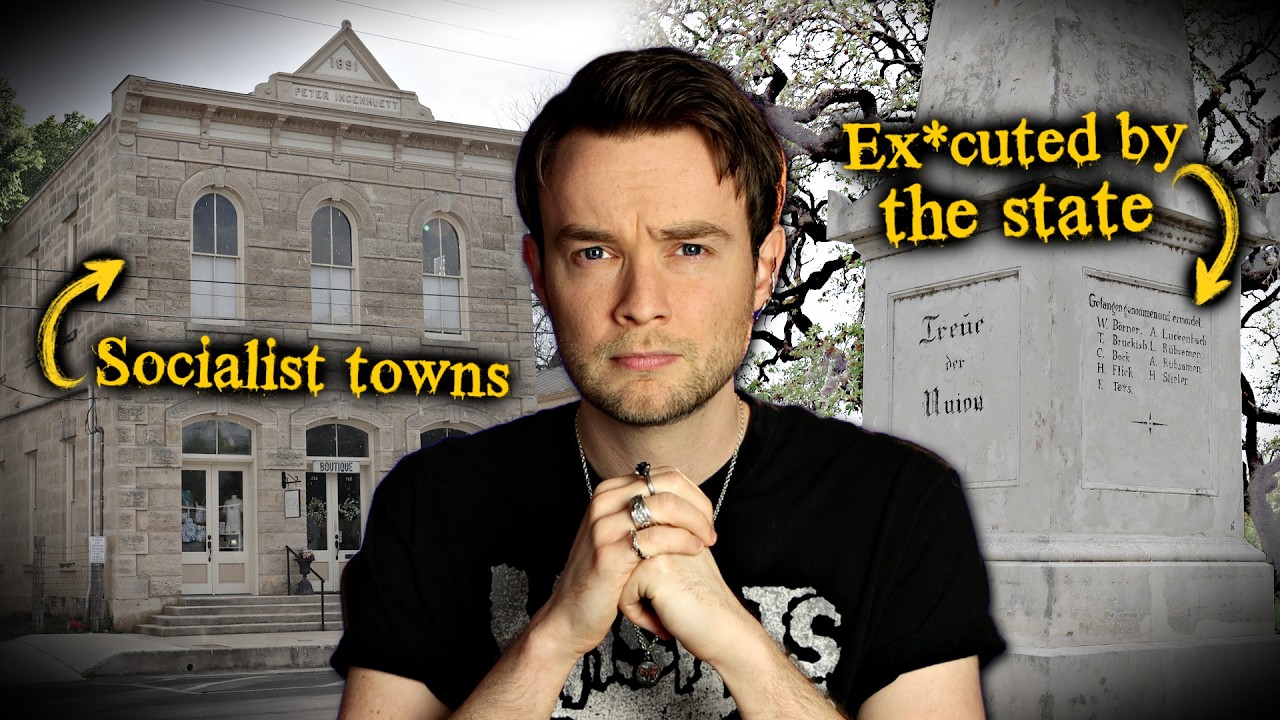
The Texas Hill Country is known for its wineries and its tourist attractions today, but few people realize how close this place once was to being an internationally known leftist stronghold. Socialist communes dotted these hills for years. Entire towns of atheists and agnostics lived here happily without religion. A young Karl Marx himself considered moving here, and some of his comrades actually did. Imagine a world where something like the Communist Manifesto was not written in London, but just outside of San Antonio. If you know your Texas history, you know that world is not far off from our own. This is the story of the German Texan freethinkers. Among my sources for this video are articles on the history of Texan Freethinkers published by the Freedom from Religion Foundation. This October, I'm actually speaking at the FFRF National Convention and you should come join me. The convention is October 15th through the 18th at the Baird Center in Milwaukee, Wisconsin. Plenty of great freethinking people will be speaking and with my discount code, non-members can get access to all three days of this convention for just $25. Just enter GMS in all caps at checkout. The link to get tickets is in the description and the pin comment. A word to my younger viewers. If you are under 18, you need to be accompanied by an adult, but you can get in free so long as your adult has a ticket. You guys already know the Freedom from Religion Foundation defends the separation of church and state in the US, but they also amplify freethinking voices by publishing media on our history and by sponsoring videos like this one. Thank you so much, FFRF, and I'll see you in Milwaukee this October. Just remember, click that link in the description and pin comment to get tickets. Life in the German Confederation in the 1840s was not great for regular people. The rapid industrialization of Europe was not kind to the laborers employed to actually carry it out. And crop failures meant that workers weren't just poor and overworked, but also perpetually hungry. The people called for a constitutional government where their rights would be insured, but those demanding anything more than slight reforms faced outright persecution. Markx at this time was forced to live in exile and under censorship in Brussels. On October 17th, 1845, he wrote to Prussian officials in Trier to request an immigration certificate to the United States. Thousands of German farmers had moved to central Texas in the two years previous, mainly to escape poor living conditions, and reports of their success had reached Europe. Texas looked like a decent option for Germans needing to escape oppression in general, so Marx considered it. At the same time, a prestigious fraternity of leftist men named the Society of 40 called for the abolition of all monarchies and for radical social change to relieve poverty within the German states. They saw persecution on their horizon for this and looked for a way out. In 1847, they found it. 33 of these men relocated to the Texas Hill Country where they founded socialist communes. The first settlement was Betatina. This is where the Elm Creek flows into the Yano River, or in today's geographical terms, this is just north of modern-day Fredericksburg. Following this, Castell was formed just across the Yano River from Batina. After the German states crushed an attempted revolution in 1848, even more secular leftist revolutionaries fled Europe, and these 48ers, as they're called, founded yet more communes in the Texas Hill Country. Cypress Creek, Sisterdale, Tuscalum, later renamed Bernie, and Lucenbach then formed. Once a foundation for a new community was established, the families and friends of these men would then join them. Now, these were largely affluent and highly educated people. In immigrating to Texas, they brought all the trappings of their old lives along with them. That meant fine linens, china, paintings, musical instruments, and apparently enough books to fill libraries in multiple settlements. Community cultures revolved around education. They quickly built schoolh houses in which men and women were encouraged to pursue the same high level of academic achievement. They frequently gathered to study and discuss philosophy, science, literature, politics, and music, often doing so entirely in Latin or Greek. This occasionally gained them an audience with other people in the Hill Country who would apparently uh go up to the windows of their school rooms and listen into these schoolhouse meetings just to observe the spectacle. This in turn earned these communities the local name of the Latin colonies. These people would have called themselves freethinkers though. This meant something akin to atheist or agnostic but more importantly entailed a certain political stance. Freethinkers staunchly opposed any political or social order dictated by religion. They were outspoken abolitionists. Many were some form of what we would call feminists, communists, or anarchists today. Being a freethinker meant being free of religion, yes, but more precisely, it meant holding to a philosophy centered on liberation from oppression in general. That was then and is still today radical. That said, these people still had their problems. First off, it does seem like labor was still somewhat divided into men's work and women's work in these communities. So, these were not fully liberated spaces for women. Also, some of the more noblemen types among them didn't adopt a truly communal spirit very easily. They resisted doing manual labor and insisted on taking directorial roles which upset their comrades who were there to, you know, live and work as equals. The freethinkers, for the most part, were also inexperienced in homesteading. They were only able to grow enough food for themselves because some of the indigenous people of the area, the Comanche, actively helped them do so. Which brings me to the biggest issue here. All of these communes were colonies built on indigenous land, particularly that of the Lipanapache, Tonka, and Comanche. Texan pioneers and state sponsored militias had been violently forcing the indigenous people west for years, and the Germans were allowed into the Hill Country as a part of the state's ultimate project of expanding white capitalist control of the region. I haven't found any record of aggression between the freethinkers and the indigenous people. But even if they got along as individuals, that does not change the fact that the state of Texas and its wealthy ruling class wanted a wall of white settlements pushing ever westward and the freethinkers colonies were a part of that wall. And yeah, to those of you who know how imperialism and white supremacy moves, you're already guessing that this worked out pretty badly for the freethinkers in the end. And you're right. More on that later. Today, you can still find Castell, Sisterdale, and Bernie on the map, but Sistersdale was the most successful in terms of growing in population while remaining a commune. Markx obviously decided to stay in Europe. Some say his health wasn't strong enough for him to live out here. But his friend and brother, Edgar von Westfalen, moved to Sisterdale in its early years. It apparently ended up having its own health spa and developed a sophisticated wine culture which it holds on to today. — Well, was vacant property between the 1800s and the time he purchased it, but it was old cotton. They used to produce cotton in the area. — Gotcha. — In the 1800s. — And what do you know about the history of this place specifically? How it was founded? Just it was founded by the freethinkers. Yeah. Sisterale and — some places in Bernie as well. Oh, I'm sorry. — No, you're all right. — What do folks around here think when they think the word freethinker? I imagine people hear that word a lot, but is it discussed? — Not really. Not that I hear. — No. — When you hear freethinker, what does that mean to you? — Open-minded, I guess, for um free spirit. — Gotcha. What would you say if I told you that this town was founded as a socialist commune by radical leftists who were essentially kicked out of Germany for being too radical? — Is that really the truth? — That is what Sisterdale was founded as. And apparently Carl Marx's brother-in-law actually lived here as a part of the very first settlement. — Oh, — okay. Before we continue, let me quickly invite you to my own secular leftist community here in Texas. On May 2nd, the Atheist Community of Austin is putting on a resource fair at our very own Free Thought Library. Taylor and I will be there, and our mutual aid and direct action team, which I'm quite involved with, will be conducting training sessions on political action preparedness and safety. Several other nonprofits will be there offering volunteer opportunities, too. We're providing snacks, drinks, shade, and good company. So, come hang out with us on May 2nd at the Atheist Community of Austin. The event runs from 3:00 p. m. to 9:00 p. m. and the address can be found at the meetup link in the description. If you're looking for secular and/or leftist community in Central Texas, we are extremely active. We have a lot of different members from different backgrounds, and we would love to have you join us. Oh, and yes, we will have multiple veterans providing security for us at the event. Okay, back to our story. In 1853, the Freethinkers petitioned the Texas Congress for a charter to operate a German English college in Sisterdale. Congress, it seems, entirely ignored the petition, they weren't exactly keen to empower secular leftist educators. They're not today either. But had their petition been acted upon, the Freethinkers College would have been the first secular public college in Texas, as Texas& M at College Station wasn't founded until 1871. But they made their principles known regardless. An organization called the Free Society formed in Sisterdale in 1853. It was a kind of political action group for promoting free thought and social justice. And it made the freethinkers impossible to ignore. In San Antonio, May 14th and 15th, 1854, the freethinkerrun singing group convention, Sangerfest, because what else would it be called, was held. The Free Society used this as an opportunity to invite German political clubs from all over Texas to convene and collectively adopt a progressive platform. The platform recognized a promise of human rights within the United States Constitution, but said more work was needed to make human rights an actual reality. Here are just some of the things that platform called for. Ending colonialism, a drastically more democratic electoral system, the right of voters to recall any representative deemed unsatisfactory, universal free education through the graduate level, laws to be enacted so simple and intelligible that there should be no need of lawyers, the abolition of the grand jury, the abolition of capital punishment, the abolition of corporal laws respecting days of prayer, including the recognition of Sunday as the Sabbath, and the abolition of imprisonment for debt. They demanded that land not be treated as an investment but be used for subsistence. That every person be given enough land to make their own living. That people be taxed by level of income. The greater the income, the greater the tax. That banks be entirely repurposed to protect the interest of working people from the exploitation of capitalists. That there be no religious instruction in schools. That preachers not even be allowed to be school teachers. And that Congress never be opened by prayer. And yes, they called for the abolition of what they called the evil institution of slavery. This became publicly known as the San Antonio platform. This ignited a total political firestorm with the slaveolding and religious communities of the area. Moderate and conservative newspapers called this platform ultra radical and called the abolition of slavery impossible. They called the freethinkers political babies and anti-American. This sounds kind of familiar, doesn't it? Angloexans began suspecting that German Texans were forming secret societies with fanatics of the North to uproot all of their institutions. A letter published in the Texas Gazette directly threatened the lives of the freethinkers. We hope the charges are unfounded and that they will be found to be so. For let any portion of our population undertake a crusade by means of secret associations or otherwise against slavery, our laws, religion, and its ministers in Texas, and they will raise a storm of indignation from which they will be glad to escape by any means within their power. Sadly, this threat quickly turned into action, as seen in the story of one particularly vocal German freethinker. Scholar, educator, and journalist Dr. Carl Adolf Dway was imprisoned for his revolutionary activities in the German states in the 1840s. Upon his release in 1852, he moved to the German town of New Bron Falls, Texas to seek political freedom. He immediately founded a school and then a newspaper called the San Antonio Sait. DeWay was an open atheist, a socialist, and an outspoken abolitionist. He used his paper to advocate for abolition loudly. A white Protestant Christian nivist party called the Nothings caught wind of this. These guys were basically the KKK before the KKK came into existence. They formed pro-slavery mobs to harass Dway and surround his office. These got so bad that sympathetic Germans had to form an impromptu security force to guard Dway and his newspaper from all the violent racists. Then when the freethinkers adopted the San Antonio platform in 1854, DeWay proudly endorsed it in his newspaper. Most Germans in the area were not freethinkers though, and many of them didn't appreciate being accused of forming secret radical societies. So instead of continuing to support Dway, certain Germans began distancing themselves from abolition and abolitionists and condemning his newspaper. Dway was undeterred even though he had fewer people around to protect him. In 1855, he boldly used the San Antonio sait tongue to call for a separate free state in West Texas. This angered the racist even more. A mob stormed his newspaper offices and destroyed the building. DeWay and his family were forced to flee Texas for fear of being killed by vigilantes. The mid 1850s was a time of change for all the freethinkers. Just as their neighbors began to resent them, they became closerk knit with each other, at least geographically. In 1854, the town of Comfort formed right next to Sisterdale. It wasn't a commune, but it did attract freethinkers from all over the hills with its rich natural resources. Within its first two years, approximately half of all freethinkers in the Hill Country relocated to Comfort, making it a majority secular leftist abolitionist town deep in the heart of Texas. This unfortunately did mean that the Latin colonies began to shrink at this time, but the concentration of the freethinkers meant greater collaboration and greater preservation of their work. Comfort is a beautiful little town of about 1800 today. The German architecture of this place is just gorgeous, and the limestone brick construction of just about everything is very central Texas. Most of Texas was a shallow sea for millions of years back when North America looked something like this. And limestone is made of minerals from the bones and shells of marine life. So yeah, we have a lot of limestone. I love Texas, y'all. I wish we weren't ruled by the Legion of Doom. In its first several decades, the people of Comfort built no churches. They built schools. They had no prayer or religious oaths in public offices. They had pledges of responsibility to the people. They had no slaves. They worked their own land with their own hands. A German lodge rather than a church took on responsibility for ceremonies. They performed marriages as pledges of loyalty between people, not as pledges of commitment to God's design. Funerals were famously beautiful ceremonies where gifted orators, of which there were many, spoke of the deceased connection to this life, not to any afterlife. The message was ultimately rest in peace, not seek salvation before you die or else. I was going to write a section here about a bunch of scientific and technological achievements that came out of comfort and the surrounding area uh largely the result of the freethinkers collaboration. But I found so many that I kind of didn't really know exactly where to start. Apparently, the first airplane was invented and flown in the Hill Country before the Civil War. Yes, long before the Wright brothers actually came along and perfected the design. Uh, also the first tree ring study and some of the very first studies of climate change ever were conducted by socialist scientists in the area of comfort. These people were amazing. While I was in Comfort filming for this video, I saw plaques commemorating the founding freethinkers in multiple places in town and even a local store invoking their name. Now, I can't really say what locals in general think about the town's founders, but I did ask some people I saw in town what they thought. When people think about the word freethinker around here, what do you think they think? What do you think? Well, I'm not originally from here, but it's a basically an old German town and they basically had their own rules and um you know were very hardworking people. — Yeah. — Very hardworking people and that has carried on — Sure. — through you know their ancestry. I mean, freeth thinkers is you um you get to think what you want to think and uh I don't think people care in comfort or any of this area in the — you'd have to be a free thinker to come out west years and years ago. — You know, you had to think outside of the box. What would y'all think if I said that places like Comfort, Sisterale, Betina, Castle, the places that are kind of sister communities to Comfort were actually founded by people that today we would call socialists or communists? — Uh, really? — So when he founded it, — that was his prospect. — Of course, he's a Marxist. What was his I mean, did he expect the community to chip in money to a certain common cause or I mean, how I mean, yeah, okay, that's what he was, but how did he make the rest of the town that way as well? — So, Sisterdale was founded as a commune, as a socialist. — Okay. So, are they still here today? — Well, — or have they filtered out or filtered in or — Hard to say. Hey, I wish the founders of this place were better recognized for who they really were, but I don't blame people for not knowing about them. There is a reason why their story hasn't reached further. Their voices were systematically suppressed, silenced, or stamped out. [sighs] 1861, southern states began secinged from the Union. On February 23rd, Texas held a referendum on secession and about 74% of the vote was in favor across the state. You see these counties in orange though, these were places that voted to stay in the Union. Not coincidentally, this is basically a map of German Texas in the 1860s. The freethinkers in particular were concentrated in Blanco and Gillespie counties. Texas seceded and the Civil War began on April 12th. Confederate authorities were immediately concerned that the German belt of Central Texas would become a stronghold of the Union and they considered the Freethinkers a particularly grave threat because of their open radical politics. So the military moved into the area straight away, issuing an ultimatum to the young men of the area. report to a Confederate outpost immediately to take an oath of allegiance to the Confederacy or leave the state. Now, presumably, some men of the Hill Country took the oath straight away, but as the Confederacy suspected, this was a place where most people sided with the Union and even openly celebrated Union victories in German beer halls. The rumor got out that some people had even begun to arm themselves against the state under the leadership of a freethinker. The Confederacy only grew more aggressive. In April 1862, the Conscription Act was passed. Nearly every white male southerner between the ages of 18 and 35 was drafted. Texas then declared martial law statewide, primarily to crack down on Unionists in the Hill Country. They identified a pro-UN militia led by Yakobucler, one of the founders of Betatina, the first socialist commune in Texas. Publicly, this militia of about 500 men claimed to be for the protection of white settlements against indigenous aggression. But internally, they called themselves the Union Loyal League and helped Union forces infiltrate Texas. In the summer of 1862, Confederate Captain James Duff sent troops to round up these militia men, and several were arrested. The troops began abducting men in the Hill Country to forcibly conscript them into the military. Hukeler himself was able to escape arrest and helped formulate a new plan for the Unionists of the Hill Country. They would flee to Mexico, then make their way to New Orleans to reinforce union control of the city. Fleeing at this point made sense for many Unionists given what Captain Duff did to four of the men he captured at a place called Spring Creek. If I say what the Confederates did to these men, this video will almost definitely get restricted and suppressed by YouTube, but you can read about it on pages 28 through 30 of this source shown on the screen. This is linked in the description. Suffice to say, when the wives of these unionists were eventually allowed to bury their husbands, the remains these women found at the bottom of Spring Creek were unrecognizable. This is appropriately called the Spring Creek Massacre. The Unionists needed to get out. In late July, approximately 61 Germans, many of them freethinkers, set out for the border. They moved pretty slowly actually, meeting many others who joined their party along the way. Their numbers grew to about a hundred in the end. On the evening of August 9th, they set up camp on the western bank of the Noasis River in Kenny County. They were almost to freedom. They were unaware that Captain Duff had instructed a company of about a hundred Confederate soldiers to follow and intercept them before they crossed the border. At 11 p. m. on August 9th, the Confederates located the Unionist camp. Although they were not under orders to open fire on any of these citizens of the Confederacy, the soldiers surrounded them in preparation to attack. Unionist guards spotted the Confederates and gunfire alerted the camp that a battle was imminent. The Unionists were wellarmed and defended themselves for hours. The battle lasted the entire night, but by the next day, the Unionists were close to being overrun. Some escaped the camp during the battle and headed back for the Texas Hills, while most stayed to fight the Confederates. In the end, two Confederates were killed and 18 injured. Among the Unionists, 25 were killed. 11 wounded and the rest escaped. The Confederates captured the wounded. They were meant to bury the dead of both sides and take all of the wounded back to the nearest fort and treat their injuries. But right after the battle, the battalion leader, McCrae, inexplicably left the camp without explicitly giving such orders to his soldiers. And so the Confederates dragged the wounded Unionists into a thicket of cedar trees and executed them all. The Confederates left the scene, leaving the dead exposed. McCrae did not mention the executions in his report of the incident, indicating an intentional cover up of their unauthorized plan to not arrest, but rather exterminate the fleeing unionists. This became known in Confederate history as the Battle of Newasis, although many Central Texans today, including myself, call it by a more accurate name, the Newasis Massacre. After all of this, Captain James Duff and his soldiers tore across the Hill Country even more brutally than before. Duff once stated, "The godamn Dutchmen are Unionist to a man, and I will hang all I suspect of being anti-confederates. " He identified Germans who hadn't taken the oath of allegiance, often abducted them from their homes, tortured and questioned them on their Union sympathies, and then after all of that, executed them. The Confederates kept no official record of this, but it's estimated that Duff killed as many as 150 German men and boys in this way before the war ended. Through this process, many freethinking voices were snuffed out. In 1865, just after the war had ended, three Union loyalists in Texas purchased a plot of land in the town of Comfort to serve as a memorial site for those killed in the Newasis massacre. Men from Comfort traveled all the way to the site of the massacre, recovered the remains of the fallen unionists, which were sprawled across a riverbank and a field, and brought them back for burial. 300 people attended the funeral for the victims which was in comfort's typical style entirely secular. A year later a monument was erected on the site. The true dear union or loyal to the union monument stands 20 ft high and lists the names of the 36 men killed at Newasis. It's accompanied by an 1865 United States flag which appropriately happened to have 36 stars. The flag is permanently flown at half mast. It's the only Unionist monument south of the Mason Dixon line. The freethinkers were not entirely wiped out in the war. Many of those who were not killed moved to the north or back to the German states. Comfort and Sisterdale remained freethinker dominated. But even during reconstruction, secular leftists remained aware that while Texas was their home, it was not their friend. their Anglo-Texan neighbors were no longer explicitly allowed to abduct and kill them. But if your neighbors had proved themselves even capable of that, would you remain vocal in their presence? No church was built in any of the towns founded by freethinkers until 1892. In that year, the Freethinkers of Comfort allowed German Christians to build a church. German Christians had started to settle in the area. the site those Christians chose an unfortunate one if you ask me. — I don't know. I'm sure that there are nice people here at this church, but just being right across the street from the only memorial to freethinkers that I know of in the entire country just doesn't it feels a little off to me. Am I wrong? The cultural dominance of the freethinkers in comfort eventually faded and Sister Dale stopped being a commune. It's hard to say when either of these things actually happened, but it does seem like it took until at least the midentth century for Comfort to stop being largely secular. I did hear some good news when I was in the town myself. — A lot of great architecture, architecture. And um one of the good things about it is the locals are trying to restore — Oh, really? — a lot of it. — Okay. — And maintain it. — Sure. — I just hope that whoever tries to restore the town is willing to help restore the memory of those who actually built it. Yeah. Maybe they were hardworking people. Maybe they were free spirits. But they should be remembered by what the term freethinker signified in their own time and place. This was a term for a person committed to the radical liberation of all people from all forms of oppression, whether racial, economic, or religious. If nothing else, I hope this video influences them to get that right. A few notes as we close here. When people say Texas is a backward place, I don't entirely disagree. But I do take issue with the inference that the people of Texas have always been the source of that backwardness, that we are not civically developed enough, that we don't build enough educational institutions, that we are too religious. If Texas is backward, it isn't the fault of the people, but rather the purposeful design of a despotic ruling class who have throughout our entire history eliminated anyone who threatened to create an educated, democratic, and humane society in this land. relevant to that point. The Germans, including the freethinkers, could only settle in Texas because state sponsored militias first violently drove the indigenous people west. In the 1830s and 40s, James Duff himself led men to clear the land that later became the freethinking settlements. This is not coincidental. This is not ironic. Duff was a part of the state's plan to expand its power, its white capitalist power. He brutalized indigenous people for that purpose. Then later, when the white people who colonized the hills were not the right kind of white people, not religious, not lacking class consciousness, not racist enough, Duff just continued the state's project and tried to remove them from the land, too. The freethinkers benefited from white supremacy and imperialism for a while, but as soon as they outright refused to go along with everything the system wanted from them, they were dehumanized, too. That's still how the system of white supremacy and imperialism works in the US today. So, I hope my secular leftist viewers are better prepared to defend themselves in today's America than the freethinkers were in the 1860s. With that, thank you for watching. I've been Drew of Genetically Modified Skeptic. A special thanks to my patrons for their constant love and support. And praise be unto our Lady River, my top patron and the official savior of this channel. If you want to support my work, then subscribe and check out my Patreon. As always, if you are an apostate in need, there are resources linked in the description to help you find community and mental health support. Remember to be kind to others in the comments, unless they're confederates. And until next time, stay skeptical.