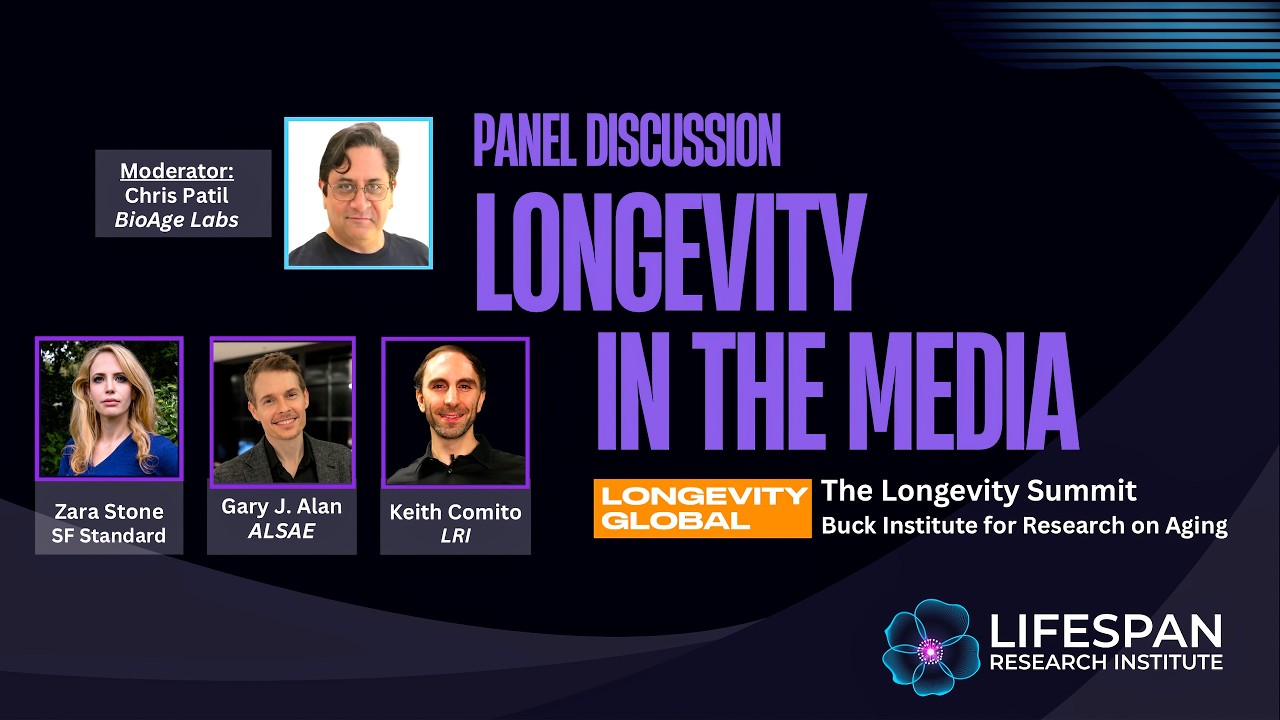
Longevity science is advancing fast, but is the public narrative keeping pace? At the Longevity Summit, Keith Comito of LRI, Gary J. Alan of ALSAE, and Zara Stone of the SF Standard participate in a panel discussion moderated by Chris Patil of BioAge Labs, to discuss the public narrative around longevity science as represented in the media, and what this tells us about strategies to accelerate aging research going forward.
► Highlights:
• What are the real public perception bottlenecks aging research needs to overcome?
• What makes longevity stories work journalistically?
• How arts and entertainment can shift the cultural narrative around aging
• What scientists and biotech companies can learn from the world's best storytellers
The Longevity Summit is organized by Longevity Global, and was held at the Buck Institute for Research On Aging on December 9-10, 2025.
► Panelists:
Keith Comito | CEO & President, Lifespan Research Institute
Gary J. Alan | Co-Founder, ALSAE
Zara Stone | The San Francisco Standard
► Moderated by:
Chris Patil | BioAge Labs
►About The Longevity Summit
Organized by Longevity Global and held at the Buck Institute, the Longevity Summit brings together the entire longevity ecosystem at the Buck Institute for Research on Aging in Novato, California. It gathers longevity entrepreneurs, pharma and biotech companies, investors, researchers, and government organizations to tackle the aging problem through peer-to-peer learning focused on the business of longevity and the key areas of innovation needed to advance the field.
https://longevitygl.org/longevity-summit/
►About Longevity Global
Longevity Global is a community organization connecting longevity researchers, investors, and entrepreneurs to foster collaboration across the field. Headquartered in San Francisco and Boston, it hosts a range of events including the Longevity Summit at the Buck Institute, hikes, beach parties, and conferences across 15+ chapters worldwide, with further expansion underway. Through both in-person and virtual programming, Longevity Global works to build the coordinated community needed to advance longevity science and tackle the aging problem.
https://longevitygl.org
HOW CAN YOU SUPPORT OUR WORK?
▀▀▀▀▀▀▀▀▀▀▀▀▀▀▀▀▀▀▀▀▀▀▀▀▀▀▀▀▀▀▀▀▀▀▀▀▀▀▀▀▀▀▀▀▀▀▀▀▀▀▀▀
Lifespan Research Institute is a 501(c)(3) nonprofit organization. Everything we've done thus far and everything we will do in the future is thanks to your support. Please stand with us to fight the diseases of aging and increase healthy human lifespan.
► Support us with monthly donations by becoming a Lifespan Hero: https://www.lifespan.io/hero
► Make a one-time donation and learn about other ways to support us here: http://lifespan.io/support
► Learn more, and help us: https://www.lifespan.io
► Subscribe: https://www.youtube.com/channel/UCofPTsvqicfVFYifwB3_XhQ
#longevity #aging #science #media #biotechnology #livelonger #health
FOLLOW US
▀▀▀▀▀▀▀▀▀▀▀▀▀▀▀▀▀▀▀▀▀▀▀▀▀▀
https://www.lifespan.io
https://x.com/lifespanri
https://www.facebook.com/LifespanResearchInstitute
https://www.linkedin.com/company/lifespanresearchinstitute/
Оглавление (8 сегментов)
Segment 1 (00:00 - 05:00)
All right, welcome back for the afternoon session. We're going to kick it off with a panel uh discussion of longevity in the media. So, Chris, please go ahead. Thank you very much. Are we hot? We are. So longevity science is advancing rapidly, but the public narrative hasn't necessarily kept pace. Certain, shall we say, shirtless influencers dominate the headlines at times when rigorous science has a hard time breaking through. Hollywood casts those seeking life extension as villains. And sometimes it's even hard to get a bead on what the public even thinks about our sector. So today in pretty broad terms uh the four of us are going to investigate uh what is the public story of longevity? Why is it so hard to tell and how can we tell it better? So thank you so much for joining us and I'm going to ask uh the other three folks on stage to quickly introduce themselves starting with Keith. Maybe just who you are, what you're doing right now, what made you interested in aging. Bullet round go. Sure. Hi everyone. I'm Keith Kamo, president and CEO of the Lifespan Research Institute, which amongst other activities, uh, focuses on engaging the public in exactly this topic in addition to doing research. Um, relevant to this conversation, in my past, I've also done a lot of R& D for companies like Disney in the entertainment space. And how I got interested was probably like most of you, you know, I saw uh aging family members going through some issues that I thought that in a modern world we shouldn't have to go through and I would like to stop that. Uh hi, I am Zara Stone. I am a reporter for the San Francisco Standard where I cover tech, culture, biotech and emerging science. And I think what got me interested in longevity is that I don't really look at it as this abstract thing. I go and speak to people every day who are experimenting in different ways from a startup that has peptide Fridays where everyone injects research use chemicals to um interviewing women who are flying to the Bahamas for experimental stem cell treatments in their ovaries and trying to boost their fertility. And so this is just a ongoing conversation about what longevity means to us and what it looks like in our own lives. I'm Gary Allen. I'm a co-founder of the Alliance for Longevity Science Arts and Entertainment. We're connecting Hollywood and the music industry and the arts at large. With longevity science, bringing uh creators into labs, introducing them to what's actually going on to inspire better understanding and a bigger pallet as to the type of stories they can tell. myself personally, I my father was a primary care physician and he took me on rounds since basically I was a baby and they used to tell him you can't bring a baby to the hospital. Um, and I watched his patients uh over the years just degrade. And I've done so many nursing home visits uh with him and it was just the amount of incalculable suffering and watching what families went through and people losing their agency was just really uh impacted me emotionally and I feel driven to really dedicate a lot of my life force to this area. Thank you guys. I'm Chris Patil. I'm vice president of media at BioAge. uh which is a clinical stage biotechnology company developing therapies for metabolic disease. You heard from our COO Eric Morgan this morning and I'm also the uh host of the podcast translating aging which is a bio age company podcast that focuses on the people and companies that are developing therapies to extend human lifespan available on Apple podcast, Spotify or wherever you get your podcasts. So let's dig right in. Zara, I want to start I want you to kick off the conversation. Um, so as I said in the intro, we're in a field that generates exciting science, but sometimes hype dominates the headlines and uh the people doing rigorous, slow science sometimes struggle to break through. From your perspective as somebody who's covered science as a journalist, what makes a story about science work journalistically? And why do certain people maybe capture more attention than they deserve even when they don't represent the best science? Gotcha. Well, it's not just about taking your shirt off to get attention. Um, but I would say one of the challenges with longevity journalism is that there's kind of two kinds of public. There's the people I talk to and they just want to like live better longer and then there's the people I talk to and they say they want to live forever. And that's a much tinier cohort of people, but they really tend to just hijack the conversation. And the people who kind of shout the
Segment 2 (05:00 - 10:00)
loudest aren't necessarily representative of like the whole industry, but it is tends to be what you hear. And that kind of leads to the second issue that a lot of the science around longevity. Um, many of the fundamentals that we all know of like sleep, health, exercise are kind of boring. I mean, no one's going to read an article saying sleep more tonight or lift more weights. Like, these are just stories that don't excite people. Um, and what we have here really is a framing problem. So when you think about some of the companies like Aura or eight sleep um you know these aren't pushing the longevity narrative forwards but they are making sleep more interesting by optimizing them by giving metrics by letting people really think about how can I sleep and how can it be I can track I can improve I can have a score all this kinds of stuff. So when scientists are, you know, saying, "Hey, sleep is actually one of the best things for you. " They should be talking more about when you go to sleep, you know, how it affects your hormones, your insulin, you need to be bringing in that kind of information to make it feel more cutting edge. Um, which sort of goes along to Brian Johnson and how he has so much media attention because I mean, he's just this fantastic showman. Like he understands what people find funny, what they find quirky. He will, you know, recently he live streamed himself doing a magic mushroom trip. He has posted about his erection tracking Fitbit. Um, we're constantly getting these kind of insights in the conversation. And so, he's this master of narrative. And while his science isn't always perfect, we're not generally not really seeing other people in the longevity field step up. So I would say a lot of scientists typically will say they want their work to kind of stand for themselves and I appreciate this and people are doing really exciting stuff like we've seen here but a lot of stuff also is still in my studies and might be five or 10 years out from actually being actionable and in that interim you have to really step up and become more of a storyteller because I would say as a reporter you know we like a story with protagonists we like stakes we like conflict ICT and when your potential drug is not really available yet, we need to know about you, about your journey. Why are you here? I don't know. Did you blow up your lab in an early experiment? Um, which it might sound weird in a way, but again, it's humanizing you and longevity is all about how it affects us. And so, I really think we need more of those stories. Guys, any thoughts? Yeah, basically agree with everything that Zara said and you know we're in an interesting moment right now in the longevity research field. You know, compared to 10 years ago, there's much more conversation about it, right? But then there's the question of is it the right kind of conversation, etc. What do we want to be putting forth? And I think the lesson to learn from certain people is not that we need to overhype, but it's what are the formats that speak to people right now. You know, there's this concept that you've probably heard of called, you know, parasocial relationship, this parasocial idea, right? Years ago at um lifespan. io when we launched uh these videos with Kors Kazak, which were with these YouTube creators that did animated videos, they hit like tens of millions of people and were very successful and that really worked in the time when people were just curious about facts, right? But now anyone could just, you know, ask their AI for facts. people right now are looking for human stories and being connected and hearing that journey, right? So, it's I think even these, you know, quote unquote boring elements of aging research can be very exciting if they're positioned as part of this narrative that, you know, this isn't something new uh that we're actually doing here. If you go back to one of the first things ever written on clay tablets, the epic of Gilgamesh, this is literally the first story that humanity was telling itself. and you get to be a part of it by participating in a crowdsourced clinical trial or whatever. There are ways to really speak to the emotions. You know, people generally don't want to hear your PowerPoint presentation, especially if it's like an average person off the street of why they should care about this. So, how can you speak to the emotionality, the lived experience of how this we're on the cusp of something that humanity has been wanting to do for so long and you could play an instrumental part in it. And I think that is inspiring. That's exciting. And there are ways to do that to embrace that to not run away from that while also not overhyping. So yeah, I would add that you know the central aspect of that is arts and entertainment. Those are the vehicles that have the most uh resonant emotional impact that really capture our imaginations and engaging the greatest
Segment 3 (10:00 - 15:00)
storytellers that we have in the world. the people who are creating uh you know the TV shows that we love, Hollywood uh blockbusters, writing um you know music that really captures our imagination and engaging them with the science and allowing them to develop a whole a pallet of stories uh is an incredibly powerful way that not only gives permission but it allows everybody to imagine themselves as part of the story because people can't support something that they can't imagine. And by having these creators create a realm that they can imagine where longevity is a part of their lives is an incredible way to open this for everybody. I absolutely love that line, people can't support what they can't imagine. And I want to drill down into the role of art culture in advancing this narrative in just a second, but I want to stay with media for just a second. So, Zara, I really heard um a lot of what you said and thought about the way that companies communicate um and uh scientists within companies or companies that do biotech and other kinds of science and and I think we als often run a foul of some of the uh the failure modes that you outlined there that we're data driven and not emotion driven. We don't talk about personal things. Um but I was sort of thinking like well you know what if you know suppose just for instance that like your CEO does not or cannot use a erection Fitbit. Um you know what you you've you've given us a call to action. We need to be more human. We need to uh be more emotional in our appeal per what Keith said. Tell us how to do it. Like how can we step up in the way that you would like us to to make us more journalistically engaging? I mean, I think being very honest about what's working and what's not is really helpful. I feel like a lot of companies will either be super silent about their data or and you know, maybe slightly fade away when stuff doesn't go well or just have a big announcement where I think the idea of progress is actually still very interesting and the failures as well. And I think again like people if they talk about what they did wrong, what they learned, I think that engages people. Maybe not in a whole like this company amazing headline way, but like you're still getting in the news and you're being talked about and the goal really is to like have people understand more about you. I am really going to take that one home. Thank you so much. So I want to jump back onto the arts culture thing and just to kind of set the stage. We've talked about the media mechanisms, the mechanisms of media attention, but there's sort of a deeper pattern and I alluded to it in the intro and Gary was on the verge of starting to talk about it, but let's set the stage here. Um, you probably noticed um, as somebody who cares about longevity that whenever somebody in a movie or a TV show is after eternal life or rejuvenation or life extension, there's something seriously the matter with them. uh Voldemort, Emperor Palpatine, uh the Whand Utani Corporation, if that's not too deep of a cut. Um the whale hunters in Avatar 2, which I know all of you saw. Um so, so and this has been true since ancient Greece, the story of Tiffanus. It's now that movie The Substance, I mean, people who want more life bad, you know, to put it very simply. So, Gary, what do you think is culturally responsible for this villain trope attached to longevity? Well, there's a number of factors, but you know, bringing it back to Gilgamesh, it didn't exactly go well. It was a morality tale where maybe you shouldn't want this. So, uh, and to that point also, there's a huge conflation between longevity and immortality. So, I mean, longevity is really about morbidity compression. And it's really about health, but it's very often conflated in entertainment and popular media as people who want to defy nature and haha I'm going to outlive the heat death of the universe, you know, watch me. Um, and as well there's also a uh there's also a huge amount of zero someum uh game and the every vampire tale is I'm going to suck the life out of you to bring it to me. uh movies like In Time, um Jupiter Sending, um Altered Carbon, Allesium, you know, they're all about other you you're not going to have life uh because I'm going to take it from you and that's how I'm going to extend my life. When longevity science is actually uh it's pro it's positive some you're actually giving more life. you're giving more life to everyone and the ability for us to, you know, collectively give more life to each other. So, you know, there have been these negative tropes from time in memorial and one of the biggest reasons why is because, you know, since uh probably way before anything was put in a uniform tablet, people were promising like, I can
Segment 4 (15:00 - 20:00)
cure that, you know, I have the secret elixir. Uh they probably didn't even know what half the diseases were, but they had cures for them anyway. So, there's been a um a like an almost a moral obligation to warn the public from wanting things that they should not want from snake oil and charlatans. But now that we're in a technological age where we have longevity science and we have, you know, cellular reprogramming and gene editing and analytics, it's important to, you know, introduce the storytellers of today to this new realm of science and to these new possibilities. let them understand what the potential uh and the progress are in these fields. And that's exactly what uh the Alliance for Longevity Science Arts and Entertainment is focused on. And we're not telling them necessarily like you have to write this or that or write positive stories, but we're giving them a much bigger pallet. for giving them uh opportunities to sorry opportunities to expand their imagination and imagine stories where you know it and there's some progress like uh in Star Trek a lot of the characters you know they're regularly in their hundreds and they're still uh productive. Um there are some areas of fiction where like the elves in Lord of the Rings and whatnot who are immortal and they're not considered evil. They're well yeah they're not human. Um and that neither's Mr. Spock. But the main point is that you know by understanding that this field is real that there's actual progress and it's tangible and it can happen within our lifetimes. There will be much more incentive for the great storytellers of our day to communicate authentically, truthfully, and you know, hopefully find narratives that explore what happens with this as a reality in our lives rather than a curse. So, yeah, happy to build off of what Gary is saying. Again, I I agree with it. Um, one thing just to add a little bit of positivity, it's not all bad. Um even if you go back to Gilgamesh uh it never really was painted as a bad thing that he was going after life extension even in books like uh Frankenstein which is excellent and uh if you haven't read it it's probably very different than you'd expect but there's a lot of exaltation of the scientific process the problem wasn't that Frank Dr. Frankenstein was trying to do what he did. The problem was that he abandoned his creation. So, it's not all bad and I think that it is kind of changing. You know, like in the 80s there was the movie Cocoon, if anyone saw that, which is a fantastic movie. Um, characters like Thor now are functionally immortal and it's not a problem. So, I think it is trending uh in the positive direction, although there's, you know, the uh the Avatar whale uh case was a little bit disheartening to me because it was unnecessary in that movie. they just like tacked that on as like an additional plot point for no reason. And I think we uh added James Cameron on Twitter uh a little bit and said like, "Hey, you know, we don't need that anymore. Please relax. " But uh to build off the other point of what Gary was saying is that um I really feel like the issue is not with public perception and has never been a lack of desire for wanting to uh live longer and healthier. Most people that I engage with and I go on a lot of different podcasts, you know, with film related people, video game developers. So, I have a lot of conversations with people who are ostensively at the beginning of the conversation are against longevity. And I've I'm betting a thousand so far. I've never failed to swing them over. And the major point to Gary's uh earlier statements is that it's not the idea of living longer that people might be against. It's the idea that it's somehow going to be like at the expense of someone else or it's only going to be me and all my friends and loved ones are going to die. It's or it's only going to be for the rich and these kind of things. So, I feel like it's very important as advocates for us to drill down on what exactly the public perception issues are. And we'll talk about it later, I believe. But, you know, I think some there's some data, there's some polling data, and just at least my anecdotal evidence is really showing that the issue doesn't lie with a lack of desire. It's just these other things. Yeah. And I guess to add to that as well, we do have all the villains um who want to live forever, but I would say that also just indicates how much value people put on longevity. Like we also get villains robbing banks and you know, we're not all like capitalism is bad. So, I just think it ties into this greater need. That is such a that's such a great perception. And one of the things that I took away from what what Gary was saying is that, you know, actually before there was anything to be done about aging, it was maybe adaptive to have the lesson be don't listen
Segment 5 (20:00 - 25:00)
to anybody who's trying to go after that. Right? But now that we're on the cusp of being able to do something about it, we have to kind of consciously as a culture shed this old baggage like, "Oh, that made sense before. It was objectively true that anyone telling you they could help you with aging was wrong. " And now that that's not true anymore, we have to kind of rejigger our cultural perspective. Just to build off of that very quickly, there's like a whole arm of like uh psychology that's related to this called terror management theory uh from Ernst Becker in the 70s but it's basically this. It's that when you are faced with a unchangeable reality like you have to develop these coping mechanisms and oh I want to live on through my children or do good things so my name is on a school. So the point is that there's a lot there's a whole scholarly field that is backing up what you just said. So that's fantastic. Um, this is a great transition actually to kind of talk about what people understand about what's really possible. Um, so we we've talked a little bit about media mechanics. We've talked about cultural headwinds that are kind of opposing longevity and and you know, one of the things that Keith started talking about was the the public appetite for these things, the public appetite for longevity therapies. and and Keith's organization and some allied organizations have done quite a bit of research about this and and it's clear from our conversations anyway to me that the bottleneck isn't in people's desire um and therefore implicitly they don't believe it's inappropriate. They do desire these interventions, right? But that there are still other bottlenecks in perception and maybe you could just kind of get the ball rolling with like what are those bottlenecks in public perception about longevity? Yeah. So, I think we we touched on it earlier, but um the major ones that I see pop up over and over again are things like uh lack of equity, right? This is only going to be something for the rich and maybe certain car, you know, people in the public eye are kind of leaning into that perception, which can make it a little bit challenging sometimes. But, you know, and then there's of course, you know, I'm sure a lot of us have heard these before, but you know, people might knee-jerk have, oh, what about overpopulation? What about my favorite one is, oh, I'm going to be bored someday. Um, I can't imagine that. Like my challenge personally is like, "Oh my god, I don't have enough time to do all the things I want to do. " Like, um, but the good news is that doesn't just have to be an anecdotal conversation. There's data that back backs up a lot of these things. You know, I'm sure some of you have heard of concepts in psychology like the hedonic treadmill, right? You go back to your baseline. If you win the lottery, you're really happy for a couple of weeks, then you go back to baseline. Something bad happens, you're really depressed, you go back to baseline. The same is true for boredom. So if you want to know roughly how bored you're going to be in 40 years, it's roughly how bored you are now. So the answer to that is don't be boring, right? So I think a lot of these things are not kind of real uh concerns and they're being masked by the feasibility concerns. So, this is a bold statement that I'm going to make, but I've never had it be the case in a one-on-one conversation where I've talked to somebody who was initially against longevity research. And once they've gotten to realize that it's potentially feasible where they haven't immediately jumped to it being desirable. So, and then all of those other it's bor what about boredom, what about that, they they evaporate immediately once the feasibility becomes clear to them or the potential feasibility. So, I think that's masking that, right? So I think this is an important thing for us to sort of attend to because I think something that might be affecting our field to some degree is uh a little bit of a trauma of feeling like we can't talk about things in a bold way. Like it's got to be, you know, it's only health span. It's not lifespan. Don't get me wrong, health span is good, right? But I feel like that might not be the actually correct calculation here. I think people also want to be inspired. They want to hear about a moonshot and that sort of stuff. So I think we shouldn't seed that battleground to charlatans. We can also speak to that inspiring excitement as long as we're doing it credibly and addressing these other issues that are the ones that people are really worried about like the inequity and it only being for the rich etc. And just to give one point like um I think the ARP did a poll a couple of years ago that's very instructive on this point where uh the first question was without any qualification about health span or anything. It was like would you take a pill uh to make you live 10 years longer. So just like really just out there and in all of the age cohorts that answered it was like from 20s up to the 80s. It was like over 65% to up to 75% for all of the cohorts. And it got higher as people got older, which is also interesting. But then what is more interesting is then there was the follow-up question of with health span guaranteed and all this. And it was higher, but only a little bit higher, which indicates to me that the general public does kind of understand that when we're talking about lifespan, it does have this sense of health span built into it. So I think we can there's initiatives that we can do to drill on in onto that in more detail and quantify and
Segment 6 (25:00 - 30:00)
qualify these things. But I think my point here is that there's data I think that is showing that the primary issue is not the lack of desire, it's other things. Yeah. I mean when you're targeting Zara when you're targeting an article at an audience you must be thinking about what they're ready for and how they think about the subject kind of before they start reading it. like have you encountered any interesting patterns in public perceptions around longevity science or just the longevity kind of good behaviors that you were talking about before? Um, I mean I think one of the interesting things is that lots of people want longevity but don't necessarily know what it means like is this just sort of wellness 3. 0 like how has it been rebranded? But I would also say um I was recently talking to the head of a cryionics facility um which is you know the whole concept of when you die we freeze you and hopefully reanimate you and a lot of people would be like well I don't want to sign up for that seems ridiculous but when you talk to him he's doing a bunch of research into vitrification and how to store organs and the trickle down effect from that might be people will become healthier while they're alive. So, I think there's really like, you know, the meta narrative of what it means now and then also potentially in the future. Gary, do you think arts culture can help interfere with that meta narrative and move it in the right direction? Just riff. Absolutely. Uh, look what happened with um, Guess Who's Coming to Dinner? And you might actually I think the median age of this crowd is low enough that you might need to unpack that a little bit. Well, I will. Well, at that time when it came out, interracial marriage was illegal in 17 states and it had an enormous cultural impact. Uh Will and Grace had an enormous cultural impact. The movie Philadelphia uh in the realm of AIDS. So yes, I mean arts and culture can really move the needle uh enormously and and in a negative way. Uh I don't know how many people here have seen Reefer Madness. Um, and what was that? The movie with Tom Hanks with uh Mazes and Monsters. I mean, it got everybody terrified of uh roleplayer games. So, you know, the arts is definitely uh at the spearhead of, you know, where culture is moving. But to get back to a point that Zar and Keith were talking about, you know, with regards to longevity and do people want longevity? You know, longevity is the side effect, right? It's the result, but it's the result of what? It's the result of not dying from Alzheimer's and not dying from cancer and not dying from heart disease and not dying from Parkinson's and the work that you know the Buck Institute and a lot of the biotechs who are present today. are working on curing the diseases of aging. And I think that's something that everybody can relate to because who wants to, you know, linger for I think the average now is 18. 9 years with a chronic disease of aging, suffering, losing your agency, uh losing your vitality, your family having to become your your caretakers, and then you die. So um so ultimately you know with regard to how at I'll say you know we're approaching this as well we're introducing the creators the greatest creative minds in society to the reality that this new science has the potential to finally cure these diseases of aging and longevity is just the dividend. It's the side effect because you're not going to die from all these horrible diseases that all of us will 100% get today if this technology is not advanced. I actually want everyone to know what exactly you're doing in that regard. Can you talk about the thing in January that you told me about over lunch? Oh yeah. So I mean that's one of our events. We're doing a lot of uh collaborations, but one of the things is we're bringing Hollywood showrunners and directors and writers and producers to the Buck Institute and we're going to introduce them to what is longevity science because a lot of them don't know about, you know, this realm. uh they'll be able to tour the labs and talk to the scientists, realize that the scientists are not evil wizards who are hellbent on world domination, but they're actually like humans who are really trying their best to eliminate human suffering from, you know, the people who will participate in the tour as well of all as well as all of us here. Um, and we're also working on collaborations with museums and art institutions and a number of other uh initiatives that we've uh that we've already started developing. So, thank you. I think that's so exciting. So, I'm going to make I'm moderator's prerogative. I'm going to skip our fourth topic, which is actually with me in the hot seat. So, I'm not going to ask that question, but I want to save a little time for questions, but I do want to do one quick bullet question to the panelist. It's 10 years from today. What narrative do you hope the media is telling about longevity? Keith,
Segment 7 (30:00 - 35:00)
you start. Sure. Well, if it's 10 years from now, I hope it is some astonishing update for how the crowd of regular people participated just participated in some crowdsourced decentralized clinical trial to collectively uh deliver a cure for Alzheimer's disease or something like that, which I believe is on the table. that that's one of the initiatives that we're working on on Lifespan Research Institute is decentralized Alzheimer's therapies based on light and sound and other things like this. So I would love it if that story in the media is the fruition of this Gilgamesh arc that we're talking about that like you know we didn't sit on our hands and wait for some other institutions to do it for us. We came together as a society to prioritize this because it is a deep human good and we accomplished a meaningful win on that together. That's what I would like the story to be here. Here um in 10 years I would like the story to be um more women are having um babies at 50 um and just the evolution of women's health and funding and how research is going into that. I think the um panel earlier today talked a little bit about that and I think 10 years is maybe a scale where we would actually see that come to fruition. Yeah. I mean I would love to see house MD longevity doctor um where he's helping people curing these stubborn diseases of aging. And aside from that, he's also still alive and healthy and maybe even had his limp cured. Um I I would hope that in, you know, media in a broad sense today, you know, if somebody's getting an antibiotic or somebody's getting CPR or whatever, it's normal. So I would love to see a normalization of the kind of technologies that are being developed here and we could focus more on the human story and all the other intrigue and interesting dramas that will still happen no matter whether we cure diseases of aging or not. So that's fantastic. In 10 years I hope the media is covering the story that uh there's been a massive increase in health span as a result of a small cocktail of drugs all of which were brought to market by bioge labs. Um, we're going to close it up on stage and open it up to audience questions for a couple of minutes. And I'll defer to Kristen on how long that's going to last. There's a microphone for you. I'm still wondering um what societal changes are going to be necessary once longevity becomes ubiquitous and I think specifically of people who are impoverished if they get 40 more years of poverty that's not necessarily going to be useful to them and so I wonder what kind of extensions from what we're looking at here and just making life longer health span longer but also making societal changes that allows for people to actually have a nice um lifestyle. This is hitting me like a ton of bricks because there's this other term in the equation, right? There's lifespan, health span, and then there's what I'm going to call quality of life span. And right, there's this idea that um this thing that comes up at cocktail parties where, you know, people say, "Oh, I wouldn't you know, you never met my great grandmother, but she was like sick in bed for 40 years. You wouldn't why would I want more of that? " And this question brings into focus like there there are things about being alive that aren't necessarily lined up and all perfect just because you're alive and healthy. There's this. So yeah, what jump in. Yeah, this is a huge question, very relevant question. We don't have enough time to go into all the tributaries here, but obviously when you talk about something like this, you we're talking about the one topic in isolation, right? a lot of different societal changes will probably need to occur and that intersects also with a broader issue of AI right now and what does work look like in the future right so I definitely think we would need to pair this with you know more robust retraining programs for those that are oral to be able to start a second career all that kind of stuff maybe something like a guaranteed minimum income at some point or you know decentralized models for this sort of thing uh but one point I also want to make uh just in general is that if you actually go back to Martin Luther King in the last thing that he was doing before his untimely death, the poor people's campaign, uh he and others were explicitly making the point that the burdens of an aging so society are disproportionately borne by women, women, minorities, and the poor. So don't get me wrong, we need to try to deliver these therapies equitably, but there is also something inherently equity promoting about this work itself, which I think is important to know.
Segment 8 (35:00 - 37:00)
Yeah, I I'm going totally agree with that. Um, you know, a lot of things that are, you know, treatments for HIV and whatnot, I mean, things that were enormously expensive, things like uh gene sequencing, the price, even though it might be limited to people of great means initially, you know, there is a democratization of it. there's economies of scale and there will be an interest in governments to not spend you know trillions of dollars on elder care when they can spend a fraction of that and have a vital uh community. But the other thing is you know just from an individual perspective you know we all have a moral center a moral compass. We all have things that we want to fight for and we believe in. And the best way to do that is to be healthy and vital and be able to contribute and lend your voice as powerfully as possible. So, you know, I I really feel like having health uh even as a glo at a global level will allow us to have that much more resources and vitality to solve all these other problems, many of which are philosophical, they're societal, um and you know, and beyond just technological solutions. So, want to close us up? Sure. Um, and I mean, I think society, and you know, this kind of borrows a lot from science fiction, we could look at potentially people getting married having like 50-year contracts. I think when the idea is forever, um, you know, what marriage looks like is very different. Um, I think the insurance industry would be upended. I've heard that it would be a massive hassle for people in taxes. Um, and I also think that if we are, you know, living longer or forever, it will be really good for the climate because suddenly people will care a whole lot more. I think that's a great place to end. Sorry to run a few seconds over time. Thank you all so much.