I Bought A Ford Mustang Shelby GT350 That's Engine Recently Seized!
Save on your next set of Continental ECS02 Tires! - https://bit.ly/4h8JHN4
Sponsored by Continental
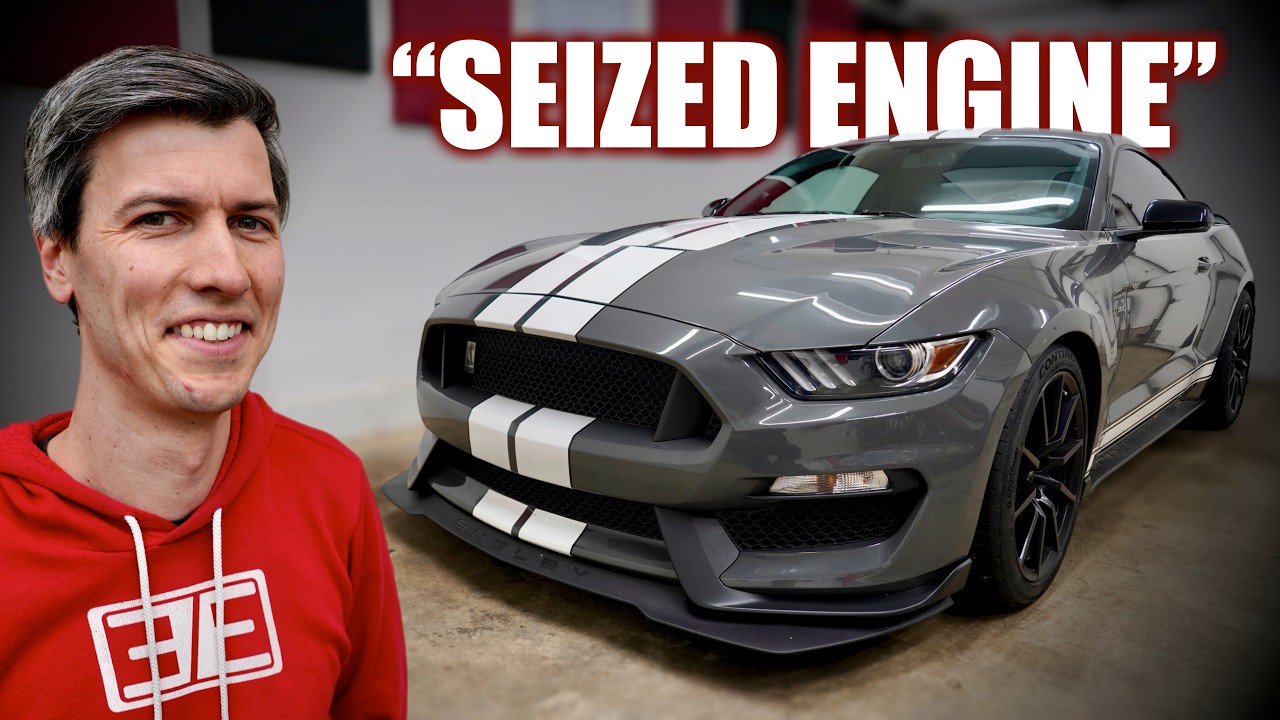
I bought a 2018 Shelby GT350! This is a car that I haven’t stopped thinking about since I first drove one about 10 years ago. And even after the past 10 years of driving all kinds of crazy cars, this thing has still cemented itself in my book as one of the all time greats. In 2016, I ended my review of the GT350 saying “in summary, buy one.” And I’m happy to say I’ve taken my own advice.
The engine was recently replaced; here's the dealer tech's notes from when the vehicle was brought to the dealership for service.
VERIFIED CONCERN AND FOUND THE ENGINE TO BE SEIZED. OIL LEVEL IS GOOD. PULLED OIL FILTER TO INSPECT AND FOUND FULL OF HEAVY METAL DEBRIS, LIKE REALLY BAD! METAL IS ALSO FOUND THROUGH OUT OTHER PARTS SUCH AS THE OIL COOLER, INTAKE MANIFOLD, AND PCV SYSTEM. ATTEMPTED TO COMMUNICATE TO VEHICLE BUT PCM IS LOCKED OUT DUE TO TUNE. RECOMMEND NEW ENGINE WITH OIL COOLER AND INTAKE MANIFOLD.
In the video we'll discuss the incredible Voodoo engine, the lovely Tremec TR-3160 6-speed manual transmission, Torsen different, Magneride, Brembo brakes, and all the other goodies that make this, in my opinion, the greatest Mustang ever created.
Subscribe to Engineering Explained for more videos! - https://goo.gl/VZstk7
Don't forget to check out my other pages below!
Instagram: http://www.instagram.com/engineeringexplained
Facebook: http://www.facebook.com/engineeringexplained
EE Extra: https://www.youtube.com/channel/UCsrY4q8xGPJQbQ8HPQZn6iA
Customer states, "The engine died and now won't start. " From the Ford dealer tech, "Verified concern and found the engine to be seized. Pulled oil filter to inspect and found full of heavy metal debris. Like really bad. " Exclamation mark. It's fine. Everything's fine. My GI doctor basically told me the same thing and I'm still here. How exciting is this? I have bought a 2018 Ford Mustang Shelby GT350. In 2016, I ended my review of the GT350 saying, "In summary, buy one. " And I'm happy to say I've taken my own advice. Now, they're a little finicky as an engine receipt exceeding $20,000 will show, which we'll get into. But, just for a moment, listen to this thing. Still to this day, it sounds unlike anything else and in the best way. And getting back in it 10 years later, it put that same stupid grin on my face. So, in this video, I want to talk about what makes the Shelby GT350 so special and why I decided to buy one. Because there is so much involving the strategy of this car that I am just in love with. And perhaps [clears throat] it has some flaws, too. Things that could maybe lead to an engine swap at just 38,000 mi. So, to start off, I want to explain why I picked this specific GT350 because it's gray, which is a bit boring. I am not personally a fan of racing stripes and it's a 2018 model year. None of these are good things. You see, the 2015 through '18 model year 350s got the first gen engine. First gen is a community term. Ford does not officially designate different generations of this engine. The 2019 and 2020 model years get a lot of engine improvements. So, if you're going to buy one of these, which have a bit of notoriety for consuming a ton of oil and perhaps failing entirely, then the second gen or 2019 and 2020 model years are the way to go. But, I bought a 2018. So, why? Well, in January of this year, this GT350 got a brand new engine. That engine now has about 4,000 mi on it, and it was built recently. In fact, the date code on the engine says September 2025. So, it's a brand new latest gen engine. Heck, yes. Now, that is exciting for me, but it is not exciting for the previous owner, who had to shell out nearly $22,000 out of pocket to have this engine replaced. And $22,000 sounds like a lot, because it is. But, it is my understanding that this was actually heavily discounted because the previous owner works at the Ford dealership where he bought the car used. So, by working at the dealer, he got both the engine and the labor on the cheap. It's my understanding that if you were I were to walk into a dealer to have this done, the job is typically about $30,000. So, I ran the Carfax on this GT350, clean title. It has only had two owners. Unfortunately, the burden of the engine replacement was on the second owner. Carfax put the retail value of it at $50,640, and that report doesn't know that this car has a brand new engine. I paid $51,000 for it, and the replaced engine comes with a 3-year warranty. So, I'm feeling pretty good about what I paid. Back when it was new, window sticker on this car was $62,000. It is impressive how little depreciation these have had. All right, here's more details on the destroyed engine as I know that's the juicy stuff folks love learning about. It says, "Verified concern and found the engine to be seized. Oil level is good. Like really bad. Metal is also found throughout other parts such as the oil cooler, intake manifold, and PCV system. Attempted to communicate to vehicle, but PCM is locked out due to tune. Recommend new engine with oil cooler and intake manifold. " Yikes. So, the engine had plenty of oil and that's an important note because these engines are known for consuming a lot of oil. In fact, in the owner's manual, it specifically states, "Oil consumption of approximately 1 qt per 500 mi is possible. " Okay, this is actually interesting. So, do the math
Segment 2 (05:00 - 10:00)
with me. This engine can burn about a quart of oil in 500 mi. The engine holds 10 qt of oil and the oil drain interval is about 5,000 mi. Did it just click? This engine could potentially consume all of the oil in a single oil drain interval. So, you must religiously check the engine oil on this thing. Early customers who didn't could have easily run way low on oil and then poof, goodbye engine. But, that isn't what happened here because as mentioned, the oil level was good. So, why did it fail? Honestly, I don't know, but there are two important pieces of information. I actually spoke with a technician who worked on my car's engine swap at the dealer, and he said he believes it was from a spun bearing, but he couldn't be certain. Why? Because they had to ship the engine fully intact back to Ford. I'm guessing this has something to do with Okay, Ford will send you a new engine, but you have to send the old one back. Core exchange fees, they probably want to look into it internally as far as why it failed, blah blah. But the technician believes it was probably a spun bearing. And obviously, it was catastrophic failure as there was metal everywhere. The second piece of information is that it was tuned. So, the first owner had installed an aftermarket air intake as well as an aftermarket tune. In my mind, that's a big red flag. First of all, running a tune on a naturally aspirated engine just isn't going to give you that much benefit. It's already running rich. It's already running a high compression ratio, spark advance. It already requires premium fuel. So, I just think a tune for an air intake is a bad idea. Leave it stock. It already has an enormous airbox. I really just don't see the upside. So, when the engine was replaced, it was reverted back to the stock tune and stock airbox. Great. As it sits now, it's basically bone stock with the exception of three modifications. It's riding on Ford Performance lowering springs. That lowers the car front and rear both about 20 mm. It has the GT350 R resonator delete X pipe, so no exhaust resonator like the standard GT350, and it has the GT350R front splitter. This, paired with lowering springs, ensures you scrape everywhere. Aside from that and a few small cosmetic changes, it is basically stock. Love it. All right, now let's go through the different systems of the car so I may gush over why it's such a rad machine. And of course, we'll start with the focal point, the engine. A 5. 2-liter naturally aspirated flat plane crank V8, aka the Voodoo engine. Car and Driver once called it the most interesting engine of the year, and I quite agree. It is a fascinating eclectic engine unlike anything else out there. And to this day, it remains the only flat plane V8 in a Mustang, whereas the rest of the Mustang V8s are cross plane. Now, I'll show an animation so you can visually see the difference between cross plane and flat plane. And as you can see, the flat plane crank has all the crank journals separated by 180°. So, it all lines up nicely, almost like a flat plane. But, this isn't actually what it looks like in the GT350. Pretty much everyone else does flat plane cranks the way I just showed you. One piston up, two pistons down, one piston up. Ford does it differently. They have one piston up, one down, one up, one down. So, their engine goes like this, whereas most engines go like this. Now, why they do this and the ramifications of this decision is genuinely worth a video all on its own. So, at some point I'll have a larger discussion there. The benefit of a flat plane V8 is that you evenly split the firing order between the left and right banks. So, on this engine it goes boom boom boom [singing] boom boom, and just moves up the rows of cylinders back to front. This is actually labeled cylinder one right here, but the engine doesn't care about that. It's just firing left right left right left right. Quite cool. Versus a cross plane V8, this allows for better breathing characteristics for the engine's exhaust. And it's part of why this engine doesn't sound like any other Mustang. The other part of the unique sound of this engine is that it's using a 4-3-1 exhaust manifold rather than a 4-2-1 exhaust manifold, which would be more typical for a flat plane crank. Ford went their own weird way. There are pros and cons, but the end result is that it gives it an incredibly unique sound, and personally, I absolutely love that sound, and it just keeps on revving. The Voodoo engine makes 526 horsepower and 429 lb ft of
Segment 3 (10:00 - 15:00)
torque while revving to a sky-high 8,250 rpm. I once owned an S2000, an incredible car with an engine that screamed to 9,000 rpm. This is basically a V8 S2000. It's significantly heavier, but it's far more powerful, too. It even makes more torque per liter than the S2000 engine, and 90% of the torque is available from about 3,500 rpm. So, whereas the S2000 made all of its torque at the very top and actually does have more power per liter than this engine, the curve of the Voodoo engine is better. Another way of saying this, the Voodoo engine is making more power per liter in the mid-range rpm region, but not on the top end. I will take that trade-off because it means the power is more accessible. I love how much torque this has from 3,500 rpm and up. What's also wild to think about, considering how high this engine revs, is that it isn't a short stroke engine. Quite the opposite, in fact, with a 93-mm stroke. These pistons are cooking. 94-mm bore, gigantic 38. 3-mm intake valves with 14 mm of lift on both the intake and exhaust valves. These are big numbers, meaningfully larger than what's done on the 5. 0-L Coyote engine, which are already big numbers. This engine was designed to breathe. I could spend far too much time just talking about this engine. So, we'll dive into the unique strategy in a future video. For now, let's move on to the transmission. Personally, I think this is the best Mustang ever created because it's the perfect combination of all the things I love. Sure, the GT500 is no doubt a better track weapon, but it doesn't come with a manual transmission. The Mustang Dark Horse is incredible, probably a better track vehicle, and it has a manual, but it's heavier and it doesn't have this engine. And of course, there's the GTD, but again, no manual and an absurd price. This to me is just the sweet spot of the coolest engines, one of the best overall handling packages, and the best transmission with the Tremec TR-3160 six-speed manual transmission. Overall, I adore this transmission. Why is it so great? First off, the gearing is buenísimo, as good as it gets in a Mustang. Basically, gears 1 through 5 are close-ratio gears. It has more aggressive ratios in every single individual gear versus the manual Mustang GT. Fifth gear in this transmission is identical to fourth gear in the manual Mustang GT. So, the Mustang GT is just geared too tall in my opinion. And then, sixth gear here just falls off a cliff. That's your highway cruiser gear. Every manual should mimic this strategy in my opinion. Cruising on the highway, tank your engine RPM in six. Need to accelerate? Choose literally any other gear. Probably not first, you're going to blow that thing up. And the shift quality is excellent. Part of that is that it uses a dual-mass flywheel and a dual-disc clutch. So, I found the shifting very smooth even on the first day when I wasn't yet used to it. Now, I mentioned aggressive gearing and this transmission is paired with a high-ratio 3. 73 final drive Torsen differential. So, not only are the gears shorter in the 350 versus the GT, but so is the final drive, unless you get the performance package in the GT. And personally, I have driven many, many rear-wheel drive cars with many different styles of limited slip differentials. Consistently, every time I drive a car with a Torsen limited slip differential, I find the behavior absolutely predictable. Purely mechanical, no nonsense electronics, even if some of them are really good. This diff is just great. Torsen LSD, I am a huge fan. The brakes are also awesome. These are two-piece cross-drilled, directionally ventilated SHW rotors. I should do all my shots laying down. It's just so much nicer. They're absolutely massive and use an aluminum hat, which helps pull out weight, and you can see the two-piece design keeps the heat of the rotors separate from the hat. These are [clears throat] paired with Brembo six-piston monoblock calipers in the front and four-piston Brembo calipers in the back. Now, I must give a huge thanks to today's sponsor, Continental. They've hooked up my GT350 with their Extreme Contact Sport 02. This is an ultra-high performance summer tire that is excellent in both dry and wet conditions. Tires, my belief, are the single most important element on your car when it comes to performance, and these are an excellent option. The data speaks for itself. You can check out third-party testing, and these perform really well. They're great on track, and
Segment 4 (15:00 - 20:00)
they're great on the road. I've been running the Extreme Contact Sport 02s on my Corolla as well, and I absolutely love them. And just look at the size difference here. GR Corolla versus the rear GT350 tire. A 305 width tire, a full foot. Of course, the GT350 weighs about 500 lb more and has an additional 226 horsepower, all of which is going to just two wheels instead of four, so it can use the extra rubber. This tire just works so well, even in such different vehicle applications. It's predictable at the limit, confidence inspiring, great steering response, and it's completely at home on one of the most track capable Mustangs Ford has ever built. From a handling perspective, in addition to the lovely tires, this is riding on Magneride dampers both front and rear. Independent front and rear suspension. It probably seems weird to call out an independent suspension on a modern sports car, but 2015, the first model year for the GT350, that's the year when the Mustang went fully independent for the rear suspension. A little late to the party. And even though this is riding on lower springs, paired with Magneride with the suspension setting on normal mode, and paired with the lovely Recaro bucket seats, this thing actually rides so, so well. It's genuinely a great cruiser. And then, switch the dampers to sport and you've got a very precise, direct track machine. Fun fact, the GT350 was the first car Ford ever used Magneride in. Pretty cool. As far as the interior, one of the things I was most concerned about was the seats because they're the base manual seats. My car did come with the electronics package, so we've got the nice screen and CarPlay and all that, but not the convenience package, which gives you powered seats with both heating and cooling. But actually, I've come to love these seats. They are incredibly comfortable, they're lightweight, of course there's no electronics involved, and they have really good bolstering. So, in this case, I think ignorance is bliss because I don't know what the upgraded seats are like, and I actually really love these. From a driving perspective, it is just pure joy. It's just so delightful. The sound, the handling, the responsiveness, the ride quality, that something this incredible left the factory for 60k, it is a heck of a car. And look, I'm not here to say it's the greatest or anything like that. In the past 10 years, the competition has done incredible things. But in 2016, when this car came out, the GT350R, the slightly spicier version of this car, set a lap time at Laguna Seca slightly quicker than a Ferrari 458. That's bonkers. The performance for the price is just amazing. Even ignoring the performance, it is a joy machine. And we are just so truly spoiled in this day and age with how fast and capable cars are. Now, one thing that I do find interesting, this is obviously a very track-oriented vehicle, right? This has an engine oil cooler, a transmission cooler, a differential cooler, all great stuff. But, I was cruising on the highway while driving in 50° Fahrenheit air, and the engine oil temperature, thanks to the oil cooler, leveled off at 170° Fahrenheit. Okay, straight from the owner's manual, redline is limited to 8,000 RPM until the engine oil temperature exceeds 190° Fahrenheit. That leads me to believe that there are many driving scenarios where the engine oil temperature, even after sustained drives, won't get hot enough to reach that 8250 RPM redline. To me, I think that's this car's way of saying, "Yo, drive it harder. " Now, in case anyone asks, as far as my vehicles, this isn't replacing anything. For now, I'm keeping the GR Corolla and the Maverick. There is some news with the Lucid, but I'll leave that for another video. And despite my dumb April Fools Instagram post saying I bought a Crosstrek, I did not. It was a bad joke. Look, they can't all be winners, which my parents said often and didn't realize I could hear them. I will say as far as daily driving I absolutely love having an electric car in my garage. Charging at home is a beautiful thing and because I am a person with great mechanical empathy short distance trips in a car like this with a high strung engine breaks my soul. For those curious repeated short trips are terrible for your engine. It's where the vast majority of wear happens. While your engine is cold you can't get rev it out. It's running rich, you're diluting your oil, water accumulates, blah, blah. A cold electric car driving 2 miles away, who cares? It'll do it all day every day. Anyways, I do have a few questions for my audience. If any of you out there own a GT350, I would love to
Segment 5 (20:00 - 20:00)
know three things. First, does your reverse lockout stick in place? Basically, when I go from reverse to first, the lockout mechanism sticks up so I just go back into reverse. Dumb. Probably needs replacing. Second, is the clutch engagement point really high or is that just my car? I don't know if there's a lot of clutch wear, which is why the engagement is so high, or if it's just how this car behaves. I do find it smooth and easy to drive and it doesn't slip when I floor it, so it seems to operate well, but it bites at the very top of the clutch throw. And finally, are there any quality of life modifications that you really like? I don't need the car to be faster. I don't want it to be faster. I'm perfectly content with the powertrain and the suspension, but if there's anything out there you feel like makes it nicer, I'm all ears. As always, if you have any questions or comments, feel free to leave them below. Thanks for watching.