Get a Henson razor and a free pack of 100 blades with code REALLIFELORE at https://bit.ly/3oL97pK
Please subscribe: https://www.youtube.com/channel/UCP5tjEmvPItGyLhmjdwP7Ww
RealLifeLore on Facebook: https://www.facebook.com/RealLifeLore/
Select video clips courtesy of Getty Images
Select video clips courtesy of the AP Archive
Special thanks to MapTiler / OpenStreetMap Contributors and GEOlayers 3
https://www.maptiler.com/copyright/
https://www.openstreetmap.org/copyright
https://aescripts.com/geolayers/
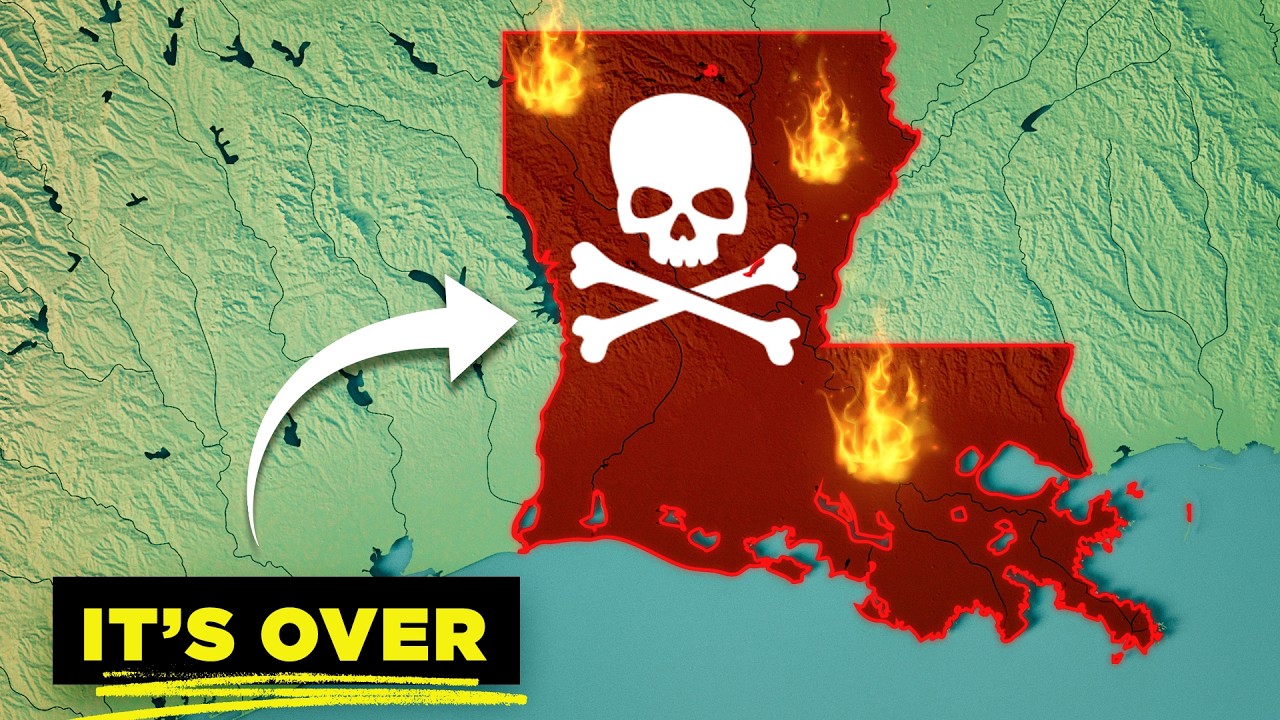
Louisiana, by nearly all logic and reason, should be among the wealthiest and most prosperous states in America. It truly just has so many built-in advantages going for it that it would be hard for an outsider who's never heard of Louisiana before to imagine any other outcome. In southern Louisiana is the delta of the Mississippi River, which drains out the largest river system of the North American continent that spans roughly 41% of the total territory of the United States. Throughout this vast interconnected river system exists the largest continuous network of inland navigable waterways that can be found anywhere on the planet enabling river barge trade from as deep in the interior as Minneapolis, Omaha, Kansas City, Nashville, Louisville, Cincinnati, and Pittsburgh. All access to the global ocean through the Delta in southern Louisiana. Historically, whoever controlled the delta of this river system in Louisiana controlled the access to and from this entire built-in system of inland continental river trade, which is why New Orleans, built about as close to the mouth of the river as was physically possible, became such a large and influential city since it could facilitate all of this trade between the interior and the outside world. Offering up warehouses and storage solutions for riverborn cargo to transfer onto oceanbound cargo and vice versa. New Orleans was once the third largest city in the entire country back in 1840, and it was the largest city in the American South for the entire nation's history until the 1950s when it was surpassed by Houston. All on its own, Louisiana frequently ranks as one of the top producers in the country of multiple agricultural products. Basically, the entire state is located on top of a massive salt deposit, which is why Louisiana almost always ranks as the number one or two salt producer in the country. The state is usually the third largest producer of rice and the second largest producer of sugar cane in the US as well. And even more importantly, Louisiana is one of the epicenters of the American oil and gas industry due to the state's location nearby to the huge offshore fields in the Gulf of Mexico and the massive oil fields in Texas. Along with its ability to handle shipments throughout the interior with the Mississippi River Delta, Louisiana possesses the second largest oil refinery capacity of any state. Capable of refining roughly 3. 3 million barrels a day. Nearly 1 in every five barrels of oil that gets refined in the US takes place in Louisiana. And when including the nearby offshore oil fields in the Gulf, Louisiana is one of the top 10 producers of crude oil in the US as well. On top of that, Louisiana is one of the top three largest producers of natural gas in the country as well, producing roughly 10% of all the natural gas in America. Even more importantly, Louisiana completely dominates the country's liqufying natural gas or LG export capacity, too. Roughly 2thirds of all American LG exports to the outside world currently takes place through Louisiana primarily from massive LG export terminals in the state like Sabine Pass, Calcasu Pass, Cameron LG, and Plaamine LG. This isn't only because of Louisiana's proximity to the Gulf of Mexico and huge hail fields and its vast refining infrastructure, but also because Louisiana is the epicenter of the American pipeline network as well. To give you just a sense of how central Louisiana is to this system, consider this small town in the state that you probably never even heard of before now called is home to the Henry Hub, a critical junction point where 11 different interstate pipelines from all across the country converge at. It is where the price of natural gas for the entire North American market primarily get sent at. And it's also the starting point for most global LG pricing formulas as well. All of these pipelines enable natural gas to be carried into Louisiana from across the country and then liquefied for export on ships to go across the world. A critical component of American geopolitical power in the 21st century that since 2024 has helped to enable the United States to become the largest exporter of LG in the world. Aided by all of these advantages, Louisiana is also among the largest producers of chemical products in the country as well. The state is generally regarded as the second largest producer of chemicals in the country, primarily concentrated along an 85m long industrial corridor of the Mississippi River between New Orleans and Baton Rouge. Home to more than 150 petrochemical plants that accounts for nearly 25% of all prochemical production in America. This stretch of the Mississippi River is home to the largest concentration of refineries and prochemical plants anywhere in the Western Hemisphere. So much so that his more generous nickname is the Silicon Valley of prochemicals, producing roughly $80 billion in output annually. Huge investments from abroad in a Louisiana's massive prochemical and oil and gas industries have also made Louisiana among the top three largest per capita recipients of foreign direct investment in the US since 2008 as well. And we still haven't even talked about
Segment 2 (05:00 - 10:00)
Louisiana's ports either. Because of all these geographic advantages and critical industries, Louisiana has by far the largest total port tonnage out of all of America's states today. Out of the top 15 busiest ports in America by port tonnage, Louisiana is home to five of them, including the second and sixth busiest ports at the Port of South Louisiana and the Port of New Orleans. Compared to every other state, Louisiana has more port tonnage than Texas and more than double the port tonnage of California, who sits in third place, which makes Louisiana the biggest port tonnage hub in the entire country. And yet, despite all of these advantages and leads in numerous critical industries, and despite boasting a seemingly high GDP per capita of $74,000, that's even higher than Sweden, Louisiana is in reality one of the most deeply impoverished states in the union with arguably the lowest quality of life in the country that even rivals still developing countries. Going through just a few of Louisiana's quality of life rankings, the state currently, as of 2026, places 45th in the nation in infant mortality rates, 49th maternal mortality rates, 46th in overall violent crime rates, including 47th in property crime, and 50th in homicide rates, 47th in overall life expectancy, 48th in food insecurity, with nearly 18% of households classified as food insecure, 48th in median household income, and then last 50th place in multiple other categories including poverty rates with nearly 1 in5 Louisianans living beneath the poverty line which is double the national average 50th place in incarceration rates per capita with more than 1% of the state's total population currently in prison 50th place in national reading scores and 50th place in gender pay gap with men in the state earning nearly 37% more than women do on average US News, which ranks all 50 states for the best ones to live in every year based on 47 different measured metrics, consistently ranks Louisiana dead last in 50th place as the worst state in the country to live in year after year, behind even neighboring Mississippi, who generally has the worst reputation. Louisiana's population is currently crashing as thousands more people leave than enter every year. While a newly published paper in the journal Nature suggests that due to multiple factors, the shoreline will likely migrate as much as 62 mi inland within only a few decades by 2070, which could end up stranding both New Orleans and Baton Rouge as dangerously exposed islands in the Gulf, which will also wreck the entire state's prochemical and refinery industries that are located in between them and force hundreds of thousands of the region's residents to migrate elsewhere. where and in order to understand how Louisiana can simultaneously be home to such wealth in terms of resources and geographic advantages and such poverty in terms of quality of life rankings and why significant amounts of the state might vanish completely within our own lifetimes. It helps first to understand how Louisiana's political situation differs dramatically from any other state in the country because a large amount of Louisiana's ailments all stem out from this. The basic thing that you need to understand is that Louisiana is still being administered effectively as a colonial resource extraction economy that's only been adapted for the modern age. The whole state is basically run by and for a variety of industrial supercorporations. much more so than any other state in the country is. There's an organization called Good Jobs First that maintains a subsidy tracker database online which tracks the amount of publicly disclosed corporate subsidies within each state given to companies since around the 1990s. Based on their provided data, I adapted it to display the amount of corporate subsidies given out by state on a per capita basis shown here. If you'll notice at the very top of the list the huge anomaly that is the state of Louisiana on a per capita basis. Louisiana hands out dramatically more corporate subsidies than any other state in the country does to the point where it's truly in a league of its own. Louisiana hands out nearly twice the amount of corporate subsidies per capita as the states in second and third place do New Jersey and New York. And it hands out nearly nine times the amount as the US nationwide average. And 80% of all these corporate subsidies that the state of Louisiana has handed out over the years have come through a single unique and obscure program in the state that's known as the Industrial Tax Exemption Program or the IT, the largest corporate subsidy program in America. Started all the way back in 1936, the IT granted a state level board
Segment 3 (10:00 - 15:00)
called the Louisiana Board of Commerce and Industry the extraordinary authority to approve corporate exemptions from local property taxes without any approval, say, or even knowledge from the local authorities who would be impacted the most negatively by those exemptions like municipalities, parish governments, sheriffs, and school boards. This broad authority granted to the state level board to approve local property tax exemptions for corporations statewide without any input or say from local authorities was unique in America. And it's a system that lasted completely unchanged and little noticed in Louisiana for decades until very recently in 2016. Between 1998 and 2016 alone, when the IT was finally reformed, 16,923 applications for corporate property tax exemptions were submitted under the program, and only eight of them were ever rejected by the board, giving the whole process a ludicrous approval rating of 99. 95%. Practically any company that applied for any property tax exemptions under the program was granted an automatic approval for decades. And these exemptions could cover up to 100% of a corporation's applied for property for up to 10 years. According to a 2016 analysis that was conducted by the Institute for Energy Economics and Financial Analysis, a nonprofit based in Ohio, about 63% of all industrial property statewide across Louisiana, valued at about $45 billion was completely exempted from property taxation because of the IT program, including significant percentages of the property values of massive and extremely expensive industrial plants owned by companies like on mobile, Shell, Dupant, and others. Because of the IT, it was estimated in 2016 that Louisiana's local authorities like school districts, sheriffs, and municipalities were losing out on around $720 million per year of corporate property tax income that they otherwise would have been receiving without the IT. That was hundreds of millions of dollars every single year being kept by the industrial corporations in Louisiana and hundreds of millions of fewer dollars every single year to help fund Louisiana's public services and needs like schools, police, fire, hospitals, libraries, and infrastructure. And it's a policy that continued unabated with no say by any local residents or authorities for 80 years in the state between 1936 and 2016. Since 1998 alone, it's been estimated that the IT has ultimately cost the state of Louisiana roughly $20 billion and missed out local property taxes, which as you can imagine has left the state schools, infrastructure, police, and other public services critically underfunded relative to other states. And of course, there has never been any comparable policy to exempt Louisiana residents from their own residential property taxes. And in order to help offset some of the difference, Louisiana employs a crushing sales tax rate that averages 10. 11% statewide. The top number one highest sales tax burden in the entire country that is borne more by the lower and middle classes in the state since purchases of taxable goods represent a higher share of their total income than the upper classes. In 2016, the IT was theoretically reformed in Louisiana to finally give local authorities the ability to approve these industrial property tax exemptions and on their own terms, giving local residents some theoretical ability to determine what goes on in their own communities for really the first time in modern Louisiana history. However, many of the giant industrial corporations in the state immediately initiated a heavily funded lobbying campaign that has continued since then, which has pushed for convincing local school districts, municipalities, and other local governing bodies to grant them automatic approvals to IT applications anyway, which has proven to be quite successful for them. Many of the parishes in Louisiana have since then simply agreed to automatically approve all future IT applications site on sea. A review of 336 post 2016 applications to the IT in Louisiana revealed only 15 cancellations and four withdrawals, showing that even after the reform, the IT has still been able to maintain a 94% approval rating for every piece of corporate property that gets submitted. Meaning the local entities across the state are still being deprived of massive amounts of revenue they need to offer basic amenities and services to their own residents. And remember when I said earlier that the more generous nickname of that 85m stretch of prochemical plants and refineries between Baton Rouge and New Orleans was
Segment 4 (15:00 - 20:00)
the Silicon Valley of prochemicals. Well, the much more common and less flattering nickname for this region than many more people know it by is Cancer Alley. Due to the hugely elevated environmental risks posed to the region's local residents because of all of the polluting emissions emitted by the hundreds of petrochemical plants and oil refineries that are located all around them. The risk of contracting cancer from industrial air pollution has been estimated to be more than seven times the national average in Cancer Alley, which is the highest risk anywhere in North America. Residents of Cancer Alley can expect low birth weight rates more than triple the nationwide average, pre-term births nearly 2 and 1/2 times the national average, and severe respiratory ailments in addition to the dramatically higher risks of developing cancer. And all of this is born on a local population in the region that is also largely black, which has led to accusations of the state committing environmental racism. 23 of all of Louisiana's annual greenhouse gas emissions come from cancer alley. And the situation is so bad that representatives of the UN have unironically referred to the area as a sacrifice zone and as a violation of human rights. The development of all of this prochemical and oil refinery industry between Baton Rouge and New Orleans took place shortly after the end of the Second World War and were most often placed on former plantation sites directly adjacent to communities with significant or majority black populations. One particularly egregious case happened in 1969 when the Dupont Chemical Company built a chloropine rubber manufacturing plant in the town of Reserve St. John the Baptist Parish, Louisiana. In 2015, the plant was sold to a Japanese chemicals company called Dena. The area immediately adjacent to the Dupont Dena plant has been recognized by the EPA is having a likelihood of its residents contracting cancer from air pollution more than 700 times the national average. And it is notably located directly next to an elementary school in multiple residential neighborhoods. Production at the plant only halted in May of 2025, just a year ago, but not because of any federal lawsuits, which were all dropped against the plant a few months previously, by the Trump administration. For decades, the EPA, the Louisiana state government, and particularly the Louisiana Department of Environmental Quality have all repeatedly failed to address the harms caused by the industrial development of Cancer Alley by refusing to enforce even the most minimum of environmental standards set by the federal government within the state. And a lot of this from the IT policies effectively plundering Louisiana's tax base to the environmental catastrophe that came out of the development of cancer rally stems from the fact that Louisiana's politics are just really corrupt. To give you just a sense of the scale of the corruption problem in the state, consider a report that the KO Institute released last year in 2025 which measured convictions for public corruption by state on a per capita basis between 2004 and 2023. That report concluded that Louisiana is the top most corrupt state in the nation with a rate of per capita public corruption convictions that is about double or worse than every other state in the country other than Montana, South Dakota, and Kentucky, which are Louisiana's closest corruption competitors. In Louisiana though, the public corruption is historically extended throughout the entire system from sheriffs to mayors to congressmen to governors. And there are some very notable and colorful examples from history. Richard Leche, a former governor of Louisiana between 1936 and 1939, who was the first one to introduce the IT in the state, resigned in disgrace over corruption allegations, and he was eventually convicted of mail fraud in 1940 that involved a scheme with a dealer selling trucks to the state's highway department at exorbitantly inflated prices and then giving Leche personal kickbacks. His successor to the governorship, Earl Long, was charged with embezzlement himself, but never convicted. And in more modern times, there's the case of Edwin Edwards, who served as the state's governor on and off four times between 1972 and 1996. His entire time in office was dominated by an almost endless stream of criminal investigations. But he was finally convicted on felony raketeering, moneyaundering, extortion, and wire fraud charges in 2001 and served an 8-year stint in prison. While serving his final term as Louisiana's governor in the 1990s, Edwards and his associates came up with a scheme to transform the state's riverboat casino licensing system into essentially a bribery machine. Applicants to the program were pressured by Edwards into paying him personal bribes for his approval, which were conveniently relabeled as consulting fees. In one
Segment 5 (20:00 - 25:00)
particular case, the then owner of the San Francisco 49ers, Edward J. Dearalo Jr., paid Edwards a $400,000 bribe in exchange for being granted a riverboat casino license, something which he later pleaded guilty to doing in court. And perhaps most infamously in recent Louisiana corruption history was William Jefferson, who maintained an 18-yearlong career representing his district in Louisiana in the US House of Representatives until the FBI initiated an undercover investigation into him in 2005 under allegations that he was accepting bribes by businesses in order to advance their interests. During this investigation, Williams accepted a $100,000 cash bribe from an undercover FBI informant. And then during a subsequent raid of his house, 90,000 of those exact same dollars were discovered stashed away in his freezer, hidden in a box of pie crusts. Reign again, a former mayor of New Orleans for years between 2002 and 2010, was convicted on more than 20 counts of bribery and fraud after he left office, including a scheme that netted him a free source of granite that supplied the countertop business he ran on the side. And as recently as 2025, another former mayor of New Orleans, Latoya Contrell, who served between 2018 and 2026, was also indicted on corruption charges relating to her alleged usage of public funds to facilitate a romantic relationship with one of her own bodyguards. The history of corruption within the state is extremely deeprooted and pervasive, and it's a very difficult problem for anyone honest to actually solve. The sheer scale of this corruption in Louisiana has long been one of the biggest roadblocks holding the state back from achieving its potential and a very long history of policy mistakes and errors made by this leadership over the generations have also helped contribute to the state becoming arguably the most dangerously exposed place anywhere in the world today to the modern threat of climate change which is now the biggest existential threat to Louisiana's future existence. You see, the Mississippi River itself isn't a static fixture of geography. It's actually a living, moving thing. And over the eons of history, it has been constantly shaped and molded by natural forces like erosion, floods, earthquakes, tectonic movements, and more recently, even man-made alterations. It has naturally meandered around its current route for millions of years. And there is ample geological evidence to suggest that it switches to a newer, shorter route out to the Gulf of Mexico roughly once every 1,000 or so years. And the last time that the Mississippi shifted course to its current route was around 1,000 AD, which as you can immediately tell was roughly 1,000 years ago. Since the river drains a massive area, equivalent to about 41% of the entire US, the river usually brings a colossal amount of sediment from across the interior of the continent to the wetlands of southern Louisiana, which gets deposited through floods and helps to build up and nourish the muddy, marshy wetlands that southern Louisiana is well known for. The muddy land just barely above sea level that the sediment helps form naturally subsides and sinks beneath the sea over time. But historically, there was a natural balance in place in southern Louisiana where the amount of new sediment getting deposited through the Mississippi River, building new land along with the rate of new plant growth that was anchoring and protecting that new land from erosion was higher than the rate of natural subsidance, which resulted in thousands of years of continuous land growth in the region. However, this natural balance in southern Louisiana began being severely and irreversibly altered by humans around a century ago in the early 20th century. In order to protect the growing community's economic and industrial infrastructure that was going up all along the lower Mississippi's banks, a series of enormous levies utilizing industrial technology were constructed along the river beginning in 1928, which effectively straight jacketed the Mississippi and prevented it from flooding out as much as it otherwise would have. The problem with doing this is that it directly eliminated the ability of the river to continue replenishing the coastal wetlands around the delta with the sediment it needed to continue growing or to even remain stable. Rather than being deposited across the wetlands through floods, the levies forced almost all of the river sediment out of its mouth and directly into the Gulf of Mexico, effectively wasting it in the process. And then there was the manner of the Mississippi River itself wanting to shift its course again after the 1,000 years running the same course started expiring in the late 20th century. By the 1950s, it became obvious to civil engineers that the Mississippi was naturally wanting to shift its course just north of Bannon Rouge towards the
Segment 6 (25:00 - 30:00)
Achafallaya River instead, which by that point was a shorter, steeper, and more efficient route for the river to take into the Gulf. Without human intervention, the Mississippi was projected in the 1950s to fully shift over to the Achafallayia by the 1990s. However, were that to ever happen, it would eliminate the usefulness of both New Orleans and Baton Rouge as ports with no possible replacements in the new channel. Since the new Delta would be in a much shallower location, it would be disastrous for the prochemical and refinery industries dotted along the river between Baton Rouge and New Orleans. It would completely wipe out Morgan City, home to more than 10,000 people, which is basically already surrounded by water. It would eliminate the freshwater supply to the entire New Orleans metro area. And it would sever all of the critical oil and gas pipelines in Louisiana that run to the east coast. In other words, it would be absolutely catastrophic for just about everyone involved. So the US Army Corps of Engineers built the old river control structure in the early 1960s to force the Mississippi to continue flowing down its historic course past Baton Rouge in New Orleans. The consequence, however, was that the old river control structure blocked even more sediment from upstream reaching the Mississippi Delta further downstream, while it also created a single point of critical infrastructure failure within the state. likely the most vulnerable single place in America to a super villain or a terrorist attack. Were the old river control structure ever destroyed, it would immediately result in the destruction of all of the communities in Louisiana between Baton Rouge and New Orleans and the state's entire prochemical and refinery industries. Then even more sediment became trapped behind the dams and locks that were built along the Mississippi, Missouri, and Ohio rivers even further upstream. And as a result, since 1850, the amount of sediment even reaching the lower Mississippi at all has been reduced by about 70%. And most of that remaining amount is wasted by being dumped into the Gulf of Mexico because of the levies. Without any of the sediments contributing to the growth of the land since the late 1920s and the natural balance broken, the rate of erosion and subsidance has taken over instead, and huge areas of coastal Louisiana have been simply sinking for nearly a century now. Then, to make matters even worse, multiple other man-made factors have only exacerbated the pace of coastline loss in southern Louisiana as well. Thousands of miles worth of canals were dug across southern Louisiana by the oil and gas companies to further accommodate their energy infrastructure and extraction and to aid with navigation, which had the unintended consequence of allowing salt water from the ocean to penetrate ever deeper into the freshwater ecosystems of the wetlands and hastening their destruction. Then the BP Deep Water Horizon oil rig explosion in 2010 took place just offshore of coastal Louisiana and resulted in the largest oil spill ever in world history, devastating hundreds of miles of the fragile coastal environment of southern Louisiana even further. And then there was the ill-thoughtout plan in the 1930s when fur traders in Louisiana were allowed to introduce the Nutria for trapping, a semi-aquatic rodent that sort of looks like a beaver that's originally from South America. A hurricane that struck Louisiana in 1940 caused many of these nutria to escape from their enclosures along with several other trappers who simply released them into the wild, which then were able to quickly proliferate into a feral population of millions who adapted extremely well to the marshy environment. The problem with the nutria is that they don't just eat plants above the ground. They also rip out entire root systems in the process, which in the coastal wetlands of southern Louisiana destroys the local vegetation's ability to anchor the soil and prevent erosion, which only further exacerbates all of the other problems. The nutria problem got so bad that by 2002, the Louisiana state government introduced a bounty system on them that has remained in place ever since. Hunters and trappers can earn $6 per nutria they kill under this bounty system during the hunting season. And some of the best of them can earn as much as 60 to $120,000 a season doing it. So basically, you have this dual problem in coastal Louisiana right now where the low elevation muddy wetlands are sinking because of multiple man-made problems at the same time as sea levels are also rising because of anthropogenic climate change. which is the unique combination that makes coastal Louisiana arguably the single most dangerously exposed coastal community in the world right now. And that's not even to mention that coastal Louisiana is also one of the most hurricane exposed regions in the world as well. Powerful storm surges
Segment 7 (30:00 - 35:00)
from Hurricane Katrina and Rita in 2005 destroyed hundreds of square miles of coastal wetlands in Louisiana in mere days. And the further that the coastal wetlands are destroyed, the less of a barrier they can constitute against further hurricanes and storm surges in the future, and the more destructive they'll ultimately become. Particularly destructive hurricanes like Katrina have already resulted in devastating population loss in Louisiana that the state has still never recovered from. After Katrina struck Orleans's parish, the parish lost about 1/4th of its residents in the immediate aftermath, and its population is still about 20% lower today in 2026 than it was in 2005 before the hurricane. And then after Rita struck the more rural Cameron Parish just the next month, it lost approximately half of its population and is still never recovered to this day either. It's also notable to point out that while every single county that borders the Gulf in Florida, Alabama, and Mississippi have all seen population growth since the year 2000, almost all of the coastal counties in Louisiana have seen population declines and often very sharp population declines. Since 2024, Louisiana has been leading the nation in population loss, and it is notably the only state in the geographic American South that is currently actively losing population. Louisianans face rapidly rising home insurance costs as the pace of natural disasters in their state is increasing to the point where today the home insurance rates in the state are already the second highest in the nation. On top of the highest sales tax in the nation, on top of the lowest quality of life in the country, the worst and most dangerous air pollution in the country, the highest rate of corruption incarceration rate in the country, low education and employment opportunities, and a deeply uncertain future with climate change to top it all off. All while the state continues favoring the mega corporations that are present with a continuation of its generous IT program that grants them almost no property taxes. It's almost kind of a wonder that Louisiana's population hasn't shrunk more than it already has, which I would explain by the fact that New Orleans and many other cities and regions across the state have the strongest, most beautiful, and the most unique culture and sense of place in the entire country, which is a hill I will die on. I can't hide the fact that I personally and very deeply love New Orleans. And anyone who's ever spent any amount of time in this city knows how much it can charm you and take a hold of your heart in a way that no other city in the country can. It is a harder place to leave than mostly anywhere else. And its strong culture and history simply can't be replicated again anywhere else. Nonetheless, the city is facing a precipitous future along with the rest of coastal Louisiana. Because of all of the myriad of factors going on in Louisiana that I've explained, more than 5,000 square kilm of wetlands have already been lost beneath the sea just since the 1930s. An area roughly twice the size of Luxembourg. The rate of land loss in coastal Louisiana is still so rapid and ongoing that roughly an entire football pitch-sized area is getting wiped out every 100 minutes on average. And unfortunately, that appears to be only the beginning. A new paper published in the scientific journal Nature in May of 2026 suggests that because of the rapidly sinking land and the rising sea levels, southern Louisiana faces a more severe loss of coastline than anywhere else in the world does that could become as bad as 3 to 7 m of relative sea level rise within only a few decades by 2070, which could result in up to 34s of all the state's remaining wetlands getting lost under the 3meter relative sea level rise scenario. The paper estimates that the coastal defenses of New Orleans will likely remain successful, but that the city will become transformed into essentially a dangerously exposed bull-shaped island lower than sea level surrounded by the Gulf. And under the more catastrophic 7 m relative sea level rise scenario, the paper calculates that no amount of defenses or money in the world will be capable of saving the city. and that New Orleans will be buried beneath the sea. The paper argues that either the three or seven meter scenario is virtually inevitable at this point, no matter what ends up happening, and that New Orleans long-term condition is terminal. New Orleans therefore might have to end up becoming the first major city in American history to actually have to be abandoned by the end of this century. Despite all of the massive
Segment 8 (35:00 - 40:00)
engineering efforts that have already been put into saving it that have cost tens of billions of dollars, roughly 1. 2 2 million people currently live across the areas in coastal Louisiana that'll likely be underwater within a few decades, which is roughly a full quarter of the state's entire current population that will probably have to be relocated at some point in the next few generations. In 2023, the state of Louisiana broke ground on the Mid Baritaria Sediment Diversion Project, a plan that aimed to restore a more natural flow to the Mississippi River Delta that would have allowed the missing sediment to build up in the coastal areas again where it had been lost, which would have restored some of the natural balance to the wetlands and at least given them some capability to replenish themselves and stay afloat. Over 50 years, the project believed that it would be capable of restoring more than 20 square miles of land in the wetlands while preventing further losses at a cost of approximately $3 billion. But then just 2 years into the project in 2025, Louisiana's government decided to scrap the whole project entirely under the argument that the $3 billion price tag was too expensive and that it supposedly also threatened the state's fishing industry. And at the same time, a recent US Supreme Court case this month in May of 2026 is also allowing Chevron to contest a Louisiana state jury decision that had forced them to pay $740 million to help fix the harm they caused to the state's wetlands by dredging those canals and drilling those wells. which means that even the legal effort to force the oil and gas companies in the state to help pay for the coastline collapse solution is also very much in doubt. Now, the cumulative consequences of all of these decisions in the state over generations is that Louisiana is effectively not even trying to buy any more time for itself any longer and for all practical purposes has decided to abandon coastal Louisiana New Orleans to its eventual fate within a couple generations from now. New Orleans isn't at any serious risk of going underwater in the next decade or two, but the bill is eventually coming due, and it'll be paid by the future generations who had no part in the decision-making process going on in the state today that so consistently and blatantly favors short-term profits over everything else at all costs, including even sacrificing the hope of any kind of a future at all. I truly grieve for Louisiana's future and I hope against all of the odds that somehow the people and leadership of the state will fully grasp their current trajectory and avoid the leap into the abyss. It will require enormous top-down structural reforms in the state in a complete change of how Louisiana has operated for generations now. But there is no other alternative. And when faced with desperate odds before, humanity has always had a knack for getting creative. Difficult decisions and trade-offs, though, shouldn't be defining your shaving routine. For far too long in my own life, I had to weigh the decision between growing out some stubble or inevitably irritating my skin with any and every razor that just seemed to scrape my face and always make the routine an unpleasant one. But all of that changed when I gave Hensen Shaving, the sponsor of this video, a try. For years, I've used razors that could give me a fine enough, close, clean looking shave. But it wasn't until I gave Hensen a shot that they actually felt good. And that's because Henen has been designing around the feel and experience of the shave as well as the look. And they've come up with the Henen razor. If you haven't heard the story of Henen shaving before, they started as an aerospace manufacturing company. They make precision parts for satellites and space probes. since some of what they made is even on Mars right now. And along the way, they realized that they could apply this precision to razors. Not just to make a better shave, but a less expensive and a more sustainable one, too. You see, the cartridge razors you're probably used to might have multiple blades, but they're not supported all the way across, leading to skipping and jumping across the skin, which is what they call chatter. But Hensen razors support the blade all the way across to a depth of only 27 microns, a fraction the width of a human hair, which ultimately leads to less chatter and a smoother shave. And these safety razors that you use on it are also way less expensive. They're only 10 cents each compared to $2 for cartridge razors. And they're also 100% recyclable. The razor itself might be a bit pricier than the handles you're used to, but the only reason the other razor companies sell them so cheap is because they force you to pay more later in the long run for all of those cartridges.
Segment 9 (40:00 - 40:00)
Hensen is different because you just pay one time upfront for a nice razor and then the cost goes down over time. It's a razor that'll truly last you the rest of your life. They come in a variety of different fun colors. And if you'd like to give their product a shot next and support a company that's supporting me, head to the link that's down below in the description or click the button that's here on your screen right now and enter the code real life lore at checkout to get 100 blades completely free with your purchase. It's a switch that I really think you're going to appreciate making. And as always, thank you so much for watching.