Listen to my Electronic album for free at https://paulshillitomusic.bandcamp.com/
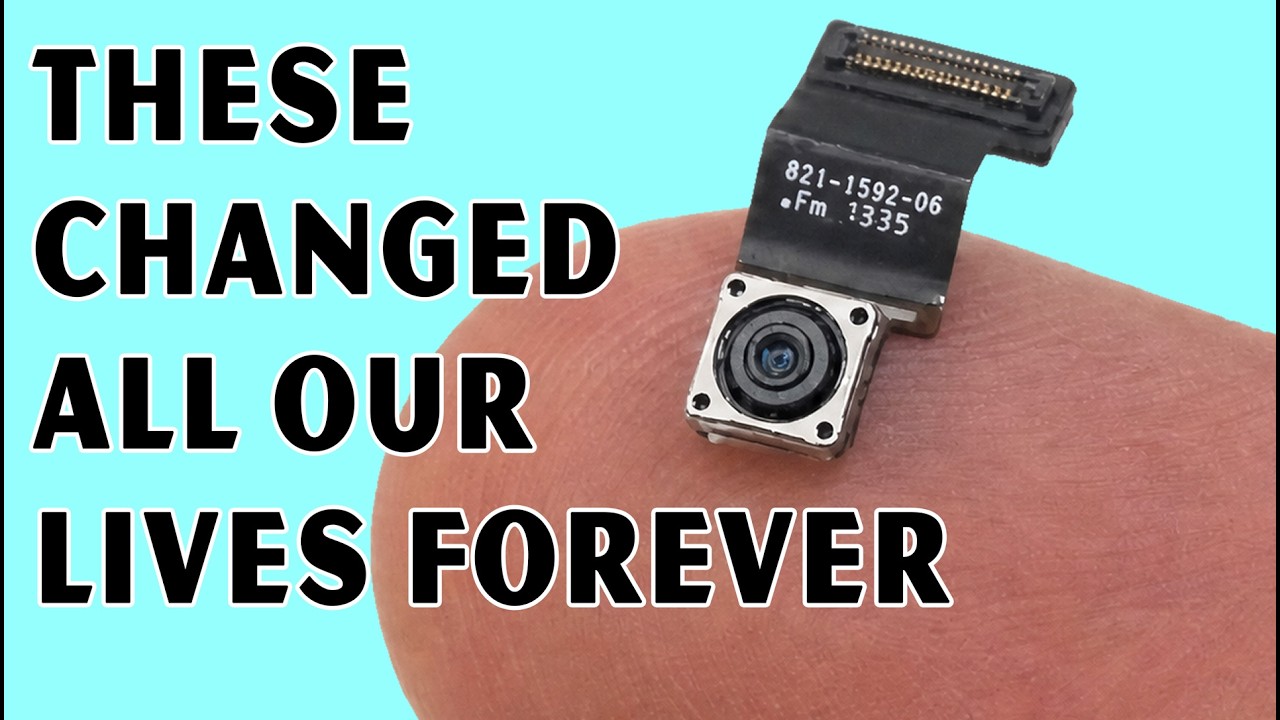
Tiny cameras have had a huge impact on humanity in the last 15 years, much more than you would think, but when combined with AI, high-speed networking and data processing, the result is world-changing. If you think I’m being over the top, then in this video, we look at how we got there and the kinds of things which the tiny CMOS sensors have found their way into and the enormous effect it has and is increasingly having on all of us.
Written, researched and presented by Paul Shillito.
To give one-off tips and donations please use the following :
https://www.buymeacoffee.com/curiousdroid
or paypal.me/curiousdroid
Eριχθόνιος JL
Adriaan von Grobbe
Alex K
Alipasha Sadri
Andrew Smith
Bengt Stromberg
Bishop II
Brian Kelly
Carl Soderstrom
Charles Thacker
Chris Senn
Daniel Armer
Didigo Ossadas
erik ahrsjo
Florian Müller
Glenn Dickinson
Jesse Postier
John Michaelson
L D
László Antal
Lorne Diebel
Paul Freed
Peter Engrav
Rhythm Chameleon
Robert Sanges
Ryan Emmenegger
smurfmashers
Steve Ehrmann
Steve J - LakeCountySpacePort
tesaft
Оглавление (4 сегментов)
Segment 1 (00:00 - 05:00)
A single image or a single video can change the world. And that's using just one camera image sensor. In the last 15 years, over 75 billion camera sensors have been produced and have found their way into everything from doorbells to drones, phones to toys, satellites to cars, pill cameras to moon missions, and almost everything else in between. They truly have given vision to what was once blind. All the world has become a stage with everyone, young and old, becoming accidental actors recorded or broadcast with or without their consent. Low-cost image sensors have created the TikTok generation, millions of cat videos, brought the word selfie into everyday use, made YouTube the largest broadcast network in the world where anyone can be a star, changed the face of news as we see it, and the way in which we communicate personally. Roughly minutes of video are uploaded to YouTube every day. And if you were to watch just one day's worth of uploads for 24 hours a day, it would take just over 82 years, literally a lifetime. And almost all of that was recorded with a CMOS camera sensor of some sort. Just imagine if these tiny cameras on a chip had not been invented and we only had the cathode ray tube cameras from up to the 1970s, none of the previous things I've mentioned would have happened and the world would be a very different place. This one piece of technology is a massive enabler and has had a profound effect on humanity, much of it for good, but as with anything man-made, it can also be used for far more sinister uses, which we'll see later on. But if we've had cameras for much longer than the modern tech around us, why are they having such an impact in the last few years? Although the modern CMOS camera-on-a-chip was first developed in 1993 at NASA's Jet Propulsion Laboratory by Dr. Eric Fossum and his team, it took years before it would find its way onto a device that could be carried by everyone all of the time, namely a mobile phone. Up until when cameras with CMOS sensors had become quite commonplace and with reasonably good quality, cameras, be that for photographic stills or video cameras, were single-purpose devices. They did one job, and often they were bulky with lenses and camera bags, and you had to make a conscious decision to take one with you wherever you went if you were going to use it. Unless you were a very keen photographer or part of a news crew, the chances of the average person having one of these with them when something interesting or dramatic happened was really very low. Even if you did have a camera on hand, it would probably have been a film camera. Great quality, but you had to take the film out, get it processed, and eventually get your photographs back in a few days, unless of course you developed them yourself. Then scan the negatives or the photos before you could upload the digital version. Nothing was immediate. There was no way to snap an image or take a video and upload it to the world to see it within minutes of it being made. Video was equally awkward because the video cameras recorded to tape, and even if it was a digital format, you still had to convert it to something like WMV, AVI, MOV, or MPG format to upload to the early YouTube of the late 2000s. Live streaming was for professionals only and involved satellite links and a van full of broadcast equipment. For the likes of you and me, there was nothing that we could do to compete with that. The revolution that would bring about what we have today started in Japan when the first mass-market phone camera arrived with the Sharp J-SH04 launched on the 1st of November 2000 with a 0. 11 megapixel camera. That was a pretty low-spec camera even back then. When it was exclusively launched in Japan, it revolutionized the mobile industry by integrating photography directly into a personal communications device. For the first time you had a camera on a device you carried with you all the time, your mobile phone. And although the image quality was pretty basic compared to today, it proved the concept worked and the development of new camera phones rapidly increased. In 2002, camera phones were still largely a Japanese and South Korean phenomenon but growing fast. It's estimated that 10 million embedded camera phones were sold in the first 9 months of 2002, but the high cost was
Segment 2 (05:00 - 10:00)
still limiting demand outside of the Far East. By 2004, the CMOS image sensors had become cheap enough for serious mass adoption. And from 2007 with their inclusion into the first iPhone, by 2011, they had become truly normal everywhere and the die was cast. Now, this episode's sponsor is me. I've mentioned occasionally that I'm a bit of a synth head and I've been into electronic music since I was 12 way back in 1974. That was the year that Tangerine Dream released Phaedra, Kraftwerk released Autobahn, and Isao Tomita released Snowflakes are Dancing. Three landmark electronic albums from pioneering musicians that had a huge influence on me and millions of others. But it was Tomita's work which really fascinated me. Over nine albums from 1974 to 1984, he took classical works by composers like Debussy, Mussorgsky, Stravinsky, Holst, and many others and recreated them electronically using synthesizers such as the Moog Modular. This was similar in concept to Wendy Carlos' Switched-On Bach, but Tomita's music was more colorful, surreal, and flamboyant. Back then, I knew almost nothing about classical music. The sounds Tomita created were completely new to me and everybody else. That combination of classical composition and strange, beautiful, otherworldly electronic sounds was utterly fascinating. It followed the original scores, but somehow sounded like nothing else. Since 1998, on and off, I've been making electronic music inspired by that same approach. I'm not covering the same pieces Tomita did, but reworking other works by some of those composers using a mixture of hardware and software synthesizers. Last year, I finally had an album's worth of material I felt was good enough to release, and that's what I'm promoting today. As I've been speaking, you've been hearing snippets of the music from the album. It's made very much in this style, classical pieces reimagined through synthesis with bright, strange, colorful sounds, and a very deliberately electronic character. So, if you're a fan of Tomita's style of music, or you're into the more eclectic electronic music, you can hear the whole thing for free on my Bandcamp page, paulshelitomuzik. bandcamp. com. Link is in the top of the description below. If you enjoy it, you can purchase the album or individual tracks for the price of a coffee or two. Helps support the channel, and it helps keep this slightly unusual corner of electronic music alive, and there'll be more on the way soon. Smartphones made the camera not just a feature, but a core part of communication, social media, and identity. If something happened, you had the device to record it right there in your pocket and send it to anyone on the internet, even if the connection speeds of the time often left a lot to be desired, and mobile data costs were a small fortune, especially if you were abroad. By 2011, camera phone sales were forecast to exceed 1 billion units per year for the first time. As mobile networks improved in the early 2010s with 4G speeds, video could be streamed in quality that rivaled HDTV. Greater quality and its ease of access drove the use of video even more, and platforms like YouTube and Facebook started offering live streaming, firstly with YouTube Live in 2011 and then Facebook in 2015. Now, everyday people could broadcast or stream video from anywhere to a mass market, something which was only available to professional organizations before. But it wasn't only social media which was making use of the higher camera resolutions. By 2011, mobile phones were still the dominant volume driver and accounted for more than 75% of CMOS sensor shipments for that year. But that scale made sensors cheaper, smaller, and better for everyone else, too. Take the security industry. They had used cameras since the vacuum tube days, but with a new wave of small, low-power, and increasingly sensitive CMOS sensors, surveillance systems boomed and the signals were now digital and not limited to the old VHS tape recordings of analog systems. This meant that they could be part of much larger networks of cameras. Think of the Ring doorbell camera as a popular example. If you have one, you know that they continuously watch day and night, capturing every movement and every
Segment 3 (10:00 - 15:00)
visitor, alerting you if someone or thing approached where it is placed, even using built-in AI to recognize known faces. Once triggered, they can not only stream the video to your phone, but they also can upload it automatically to a remote data farm for viewing later. That video might well be yours, but it's also now on Amazon's servers and through legal requests or court orders, it can be accessed by law enforcement agencies in the case of a serious crime in the area and suspects might have been caught on the camera passing by, but still triggering the recording. But that's just a simple application. Networks of CCTV cameras now merges the ubiquity of the camera sensor with the power of high-speed networking and advanced AI to recognize people just going about their daily business, walking down the street or driving in their car in any town or city. Facial recognition can check almost every facing view against a watch list of wanted suspects, people with court orders or wanted for serious offenses, missing persons or people banned from certain places. Using fixed or temporary surveillance cameras, large crowds of people can be watched and analyzed by AI for movement and behavior. People walking a town or city can be tracked across a wide area and even moving from one city to another. New traffic cameras can not only check the speed and type of vehicle, but also read the number plates on multiple cars at once on multi-lane highways, and see if the occupants are wearing a seatbelt or talking on a phone. The latest camera technologies have the resolution and optics to do live facial recognition of car occupants now, but so far the authorities in UK for one say that it's not to be used for that yet. Tiny cameras have also changed the way in which we see the news almost completely. Major news events are now often first recorded by ordinary people, not journalists. Protests, accidents, disasters, and conflicts can be documented immediately. Where once we just had the state and national broadcasters like the BBC, ABC, CBS, CNN with a limited number of camera crews and reporters which might be hours or days away from a story, now anyone with a smartphone has a camera ready to record or stream a video within a moment's notice and push this out to thousands or millions of people around the world via social media. Citizen war reporting now shows the true unfiltered face of conflict in a way which has never been seen on the traditional news broadcasts. Despite the attempts by the governments to try and block it, people still find ways to view the conflict from other sources around the world. Low-cost commercial drones with tiny cameras were not that long ago mostly the preserve of hobbyists checking out the local surroundings and uploading the results to YouTube, but since the current Ukraine conflict started in 2022, low-cost camera drones have changed warfare forever. What were once seen as toys by many are now not just a means of surveillance, but an active weapon of war, becoming a cross between a sniper's rifle against individuals and an artillery strike against buildings and any type of vehicles, be that stationary or on the move, and even taking out aircraft, helicopters, and other drones. Even our cars are now rolling video recorders with dashcams. Originally, they were used as evidence in case of a crash. Now, they are continuously watching everything in front of or behind the car or even around the car, even when it's parked up and turned off in some cases. On the 15th of February, 2013, hundreds of dashcams recorded an extremely rare event as a completely unexpected asteroid, about 18 m or 60 ft across, weighing approximately 10,000 tons, straight across the morning sky above the southern Ural region of Russia. Traveling at 19. 2 km or 12 mph, it lit up the sky brighter than the sun before exploding in a meteor airburst over Chelyabinsk Oblast at a height of 30 km or 18. 6 mi. With the explosive blast equivalent to a yield of 4 to 500 kilotons of TNT. That's about 30 times the size of a Hiroshima bomb. It was only down to the hundreds of dashcam videos that were uploaded online that allowed investigators to analyze and work out where it had come from and why we had not seen it before it hit the
Segment 4 (15:00 - 18:00)
Earth. Spoiler alert, it did the old fighter pilot trick of coming in from the sun. Now, some cars like Teslas use multiple camera sensors, not just as dashcams, but to see all around the car, to look at its surroundings, and with a lot of AI processing, know where it is, identify other vehicles, objects, and people, and to drive the car by itself. And that robotic vision development is taking place in advanced humanoid robots, again merging tiny cameras with high-quality optics and advanced AI processing to find their way around the world just like we do. Tiny cameras have revolutionized working from home, which became required when the COVID-19 pandemic forced hundreds of millions of people to stay at home for weeks or months. This has an had an ongoing effect, and now home working with video meetings has become almost normalized. Though there has been a drive to get everyone back into the office. Now, whilst making this video, I came across so many ways in which these tiny cameras have affected us that this video could go on for a very long time. I've tried to cover what I think are some of the most impactful ways they have changed our lives in just the last 15 years. But I'm sure you'll let me know in the comments if I've left anything out. So, to help wrap this up, let's look at the very smallest camera sensor yet made and how they will affect us now and in the future. Originally for medical examination, the OmniVision 6948 holds the official Guinness World Record for the smallest commercially available image sensor. The sensor itself measures just over half a millimeter square and is just 0. 23 millimeters long. When it's integrated into its full camera module, it takes up about the same size as a single grain of sand, and it still has a resolution of 200 by 200 pixels at 30 frames a second. According to OmniVision, it's designed primarily for medical use and is commonly integrated into disposable guide wires, catheters, and endoscopes. It allows doctors and surgeons to navigate the narrowest blood vessels and smallest anatomical structures without the need for large invasive equipment. It can also enable much more outside of medicine. It can give vision to what was once blind and it's become the eyes of machines small enough to sit on the end of your finger with robotic insects and drones the size of a fly. Although all these things we have seen are amalgamations of various technologies, the one key feature is without these tiny cameras, none of it would have been possible. They have become in a way one of the greatest technological enablers since the invention of a transistor because they open up the world in ways which are increasingly changing all our lives. Be that for the better or worse. So, I hope you enjoyed the video and if you did, then please thumbs up, share, and subscribe. And a big thank you goes to all of our patrons for their ongoing support.