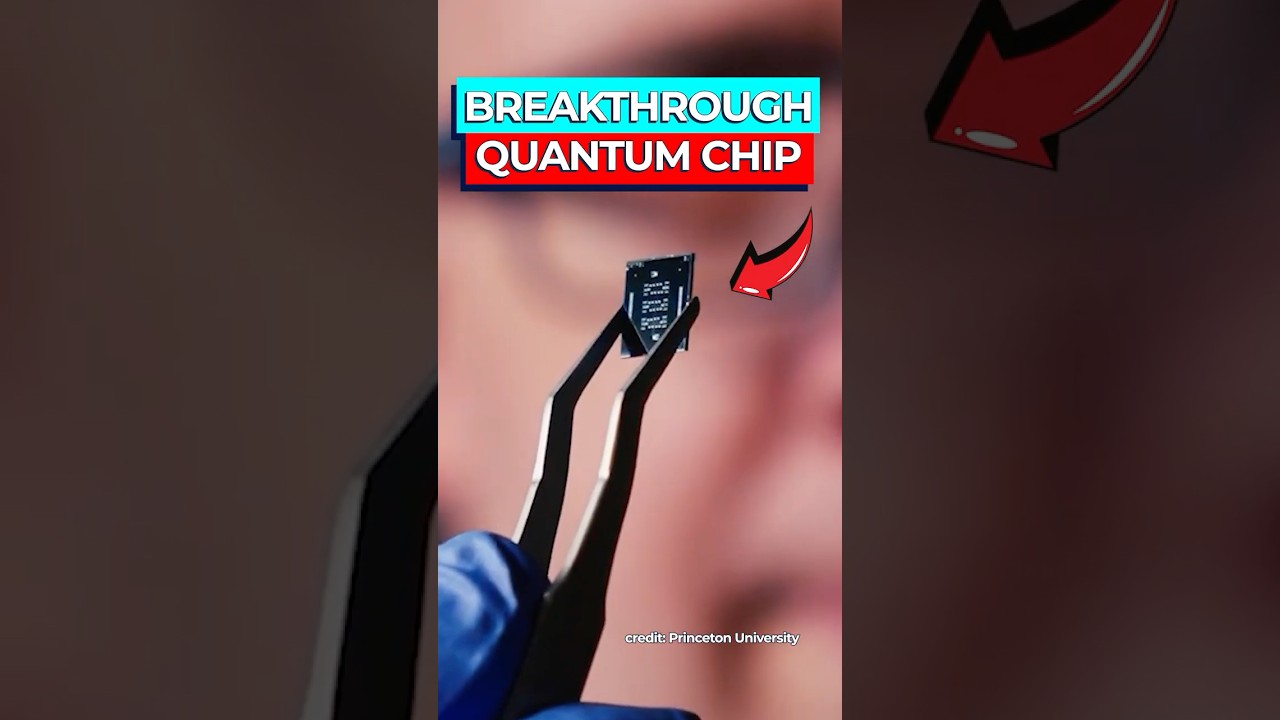
Microsoft Announce Majorana 2 Quantum Chip
2:23

Microsoft Announce Majorana 2 Quantum Chip

Dr Ben Miles 04.06.2026 811 865 просмотров 49 608 лайков

Machine-readable: Markdown · JSON API · Site index

Поделиться Telegram VK Бот
Транскрипт Скачать .md
Анализ с AI
Описание видео
Microsoft’s new Majorana 2 quantum chip improves qubit lifetimes by over 1000x  by replacing aluminum with lead in its superconducting layers. Check out Microsoft's announcement here: https://news.microsoft.com/source/features/innovation/majorana-2-microsoft-discovery-agentic-ai/ #quantumcomputing #technology #breakthrough #microsoft My Patreon:🚀 http://patreon.com/DrBenMiles My Instagram: https://www.instagram.com/drbenmiles My TikTok: https://www.tiktok.com/@drbenmiles My Newsletter: https://drbenmiles.substack.com/ My Merch: https://www.rockstarscientist.org/ 🔗 Linktree: https://linktr.ee/drbenmiles MY GEAR 📷 Sony A7III https://amzn.to/3OWrmGd 🔎 Sigma 402965 16 mm F1.4 https://amzn.to/49BNJdq 🎤 Shure SM7B https://amzn.to/4sF3ngx 🎤 Zoom H4n Pro https://amzn.to/3OXsklB 🎤 Sennheiser AVX https://amzn.to/4geWnBi
Оглавление (1 сегментов)

Segment 1 (00:00 - 02:00)

This is the Myerana 2, Microsoft's new quantum chip, and it is built on the strangest idea in all of computing, that the way to stop a cubit from breaking is to hide it in two places at once. The problem with creating a useful quantum computer is that right now cubits are catastrophically fragile. Thermal noise, a stray photon, or a single rogue electron can destroy the quantum information that you are trying to compute with. In order to rise above the noise, Microsoft are using a rare kind of architecture called a topological cubit. When you call a superconducting semiconductor wire down to near absolute zero, the electrons pair up into Kooper pairs, the bonded couples that carry current with zero resistance. Now, by applying a magnetic field, it creates a distribution of the electron potential across that wire. So, they concentrate at the two ends, a phenomena called a myurana zero mode. By linking two of these wires together into an H shape called a tetron, you produce a cubit, where the electron information is spread across multiple locations. And so it becomes much harder for the universe to break it. Microsoft's Myerunner 1 already showed improved par lifetimes of around 12 milliseconds from this architecture, which is impressive considering most cubits today last around 100 micros. But there is still a failure mode. The Koopa pairs in the cubit can be knocked apart by a stray photon or thermal fluctuation and can either enter or exit from the system, changing the overall cubit value from a 0 to one or vice versa. The energy cost of breaking one of these pairs is set by the superconductor's energy gap. In the Myana 2, the main improvement is switching out the aluminium superconductor from the Myerana 1, which had a gap of around 300 microeleron volts and replacing it with lead, which is a gap of about 1,300 microeleron volts. That improvement has increased the cubit lifetime from 12 milliseconds to over 20 seconds, more than a 1,000 times improvement. The obvious question is why didn't they just use lead from the start? And the answer to that is lead has to be deposited essentially atom by atom on the semiconductor at very low temperatures which it turns out is kind of hard to do. Now if this holds up and that isn't to say there isn't skepticism from the physics community still around these announcements and how exactly these myana modes actually operate. But if this system proves out Microsoft has now harved their own road map and now are suggesting that we could get to a scalable quantum computer as early as 2029. I got to speak to the lead scientist behind the project Dr. to chase and nyak and there is a full explainer dropping on YouTube soon.

Другие видео автора — Dr Ben Miles

Ctrl+V

Экстракт Знаний в Telegram

Экстракты и дистилляты из лучших YouTube-каналов — сразу после публикации.

Подписаться

Дайджест Экстрактов

Лучшие методички за неделю — каждый понедельник