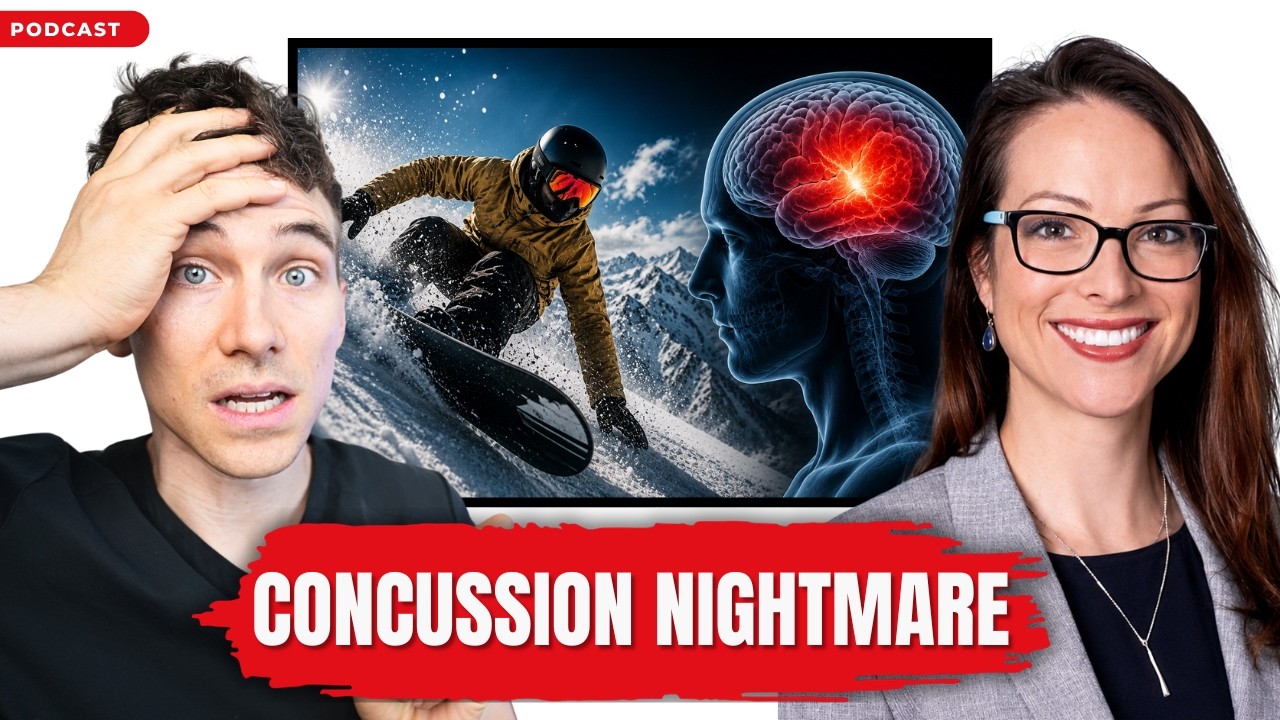
One snowboard crash changed everything. After suffering a concussion while snowboarding in Canada, Dr. Joseph Allen shares the emotional and physical reality of concussion recovery, traumatic brain injury, memory loss, and vision problems after concussion on this episode of the Doctor Eye Health podcast. Joined by neuro-optometrist Dr. Jacqueline Theis, they break down post-traumatic amnesia, brain injury rehabilitation, and how modern concussion treatment has evolved beyond simply resting in a dark room.
What You Will Learn
✅ How concussion symptoms can appear without headaches or dizziness
✅ Why vision problems are common after traumatic brain injuries
✅ How memory loss and post-traumatic amnesia affect recovery
✅ Why active rehabilitation improves concussion recovery outcomes
👉 Like the podcast? Stay updated with the latest eye health tips, treatments, and expert advice by signing up for the newsletter here: https://www.doctoreyehealth.com/
Key Timestamps
00:00 Dr. Joseph Allen shares his snowboarding concussion story in Canada
01:11 Dr. Jacqueline Theis explains her experience treating concussion patients
03:06 The Snowboarding Accident in Canada and the missing memory gap begins
06:41 Early Signs of Concussion and Memory Loss
09:24 Hidden Concussion Symptoms and ER Decision
12:21 Post-Traumatic Amnesia and Anxiety After Brain Injury
15:27 Inside the Quebec ER Experience
18:30 Modern Concussion Recovery and Brain Injury Rehab
21:26 Exercise, Whiplash Recovery, and Vision Rehabilitation
25:00 Why Concussion Symptoms Can Last for Years
26:24 The Importance of Multidisciplinary Concussion Care
Key Takeaways
🔹 Concussions can happen even without obvious symptoms
🔹 Vision dysfunction is common after brain injuries
🔹 Recovery approaches for concussion have changed dramatically
🔹 Patients can still improve years after a concussion
Want More from Dr Eye Health? Check out these Videos:
Are Your Migraines a Warning Sign? Migraine Aura, Triggers, and Treatments Explained https://youtu.be/dBtj8-ITb8M?si=JlsQMZI5Y3ihyr9X
Vision Problems After a Concussion? Here's What to Do - https://youtu.be/OfIsFmJtugs?si=S36h2xbft4qS6XHU
What causes PHOTOPHOBIA (light sensitivity) and how to fix it https://youtu.be/ikQUUoyyZIY?si=NDUnBco69meOhWQ9
🎧 Enjoyed this episode? Don’t forget to hit subscribe so you never miss an episode of the Doctor Eye Health podcast! Coming soon: Vision Issues After Concussion 👀🧠
About Dr. Jacqueline Theis
Dr. Jacqueline Theis is a neuro-optometrist specializing in concussion rehabilitation, traumatic brain injury vision therapy, and neurological vision disorders. She completed her optometry training and neuro-optometric residency at University of California, Berkeley and has spent over a decade working alongside leading brain injury physicians, neurologists, and rehabilitation specialists helping patients recover from concussion-related vision dysfunction and neurological symptoms.
LinkedIn: https://www.linkedin.com/in/jacqueline-theis-od-faao/
Resources & Links
Website: Doctor Eye Health https://www.doctoreyehealth.com/
YouTube: Doctor Eye Health https://www.youtube.com/@DoctorEyeHealth
Instagram: @doctoreyehealth https://www.instagram.com/doctoreyehealth
TikTok: Doctor Eye Health https://www.tiktok.com/@doctoreyehealth
Facebook: Doctor Eye Health https://www.facebook.com/DoctorEyeHealth
LinkedIn: Dr. Joseph Allen https://www.linkedin.com/
DISCLAIMER:
This video is for educational purposes only and does not provide medical advice. Watching this content does not establish a doctor-patient relationship. Always consult your physician or eye care professional regarding any medical condition or treatment decisions. All content and information is for general information purposes only and does not replace a consultation with your own doctor or health professional. In addition, some of the links in this post may be affiliate links, meaning, at no cost to you, I will earn a small commission if you click through and make a purchase.
#ConcussionRecovery #BrainInjury #doctoreyehealth
Оглавление (11 сегментов)
Dr. Joseph Allen shares his snowboarding concussion story in Canada
So, last spring I had a concussion while snowboarding. This was truly a scary experience for me, but the doctor standing next to me on that mountain, she's a neuro-optometrist with over a decade of experience seeing patients struggling with vision problems from concussion. She's also my girlfriend. So, today on The Dr. Axe Wellness Podcast, she's here to share with us exactly what all happened. So, first, before we really get going, I do want to take a moment to introduce Dr. Jacqueline Thies. Uh Jackie, I know you've got a whole lot more experience uh working with patients with concussion after head, brain, neck injury, all of these things. Can you just for all of our viewers and listeners, uh if it's a first time for them to get to know you, can you just give us some of your background and kind of your insights into all of this? Yeah, so I actually went into optometry because I wanted to work with patients with concussion. I'd had a history of nine concussions myself playing soccer and snowboarding growing up, and I had an optometrist who changed
Dr. Jacqueline Theis explains her experience treating concussion patients
my life by helping me with my vision problems. That was the main driver of my headaches for 6 years. Uh and they fixed my headaches within 6 weeks. I was so aggravated by that I dedicated my whole career uh to essentially helping people who have vision problems after brain injury. So, a little bit different of an optometry career. I went to Berkeley, and then I did a residency there in neuro-optometry, and during my residency, I did research looking at how the visual system changes over time when you've had an acute concussion. So, I got to be on the sidelines of sports games, and I got to work with the sports medicine department at UC Berkeley, and I've had this wonderful career of getting to work with a lot of great physicians in concussion. So, I worked with elite level sports med and then I transitioned to Kaiser Hospital where I got to work with ophthalmologists and neurologists and seeing more chronic care. And then I had this wonderful opportunity to move across the country to Virginia where I ended up making you move as well. Uh, to work with one of the best physicians in the country, Nathan Zasler, who literally wrote the textbook Brain Injury Medicine. So, it's an opportunity I'm not going to say no to ever. And have had the luxury of being able to work with him in private practice for 6 years. So, I would say, you know, I see patients with many different conditions, but I would say 80 to 90% of the patient base I've seen for the last 10 plus years has had concussion. And so, I always say, you know, as an optometrist, I'm not necessarily an expert in concussion, but I am an expert in the vision problems that occur in concussion. And I've had the luxury of working with experts who diagnose concussion and work in all different facets of concussion management. So, the irony I think for this whole thing is the whole reason we were in Canada was for the International Brain Injury Association meeting. Um, that was the whole reason I knew I was lecturing at
The Snowboarding Accident in Canada and the missing memory gap begins
this meeting. I like to snowboard. I wanted to snowboard on my birthday. And so, we decided to extend the trip a little bit. And so, um, I'm a beginner in snowboarding. Uh, I've been learning because it's one of Jackie's favorite activities and yeah, let me learn how to snowboard. And so, we were in Canada and we were on the mountain for 2 days. We were supposed to be there for 3 days. And then we got one good day in. Well, it was a great day for you. — I'll say that. Because I was teaching you how to snowboard. So, I was with you the whole day. We did a lot of blues and greens, which is like torture. But I did it. — Um, and that all leads up to the next day and of course like your injury. Yeah, so you know, I actually felt like I was doing pretty good. — Well, you were doing great. And then so I don't remember too much, but I do remember I think you guys were going to go down a harder slope like a black or something and I was going to just go down a blue that I had been going down that morning without any issues. And then I don't remember. So that that's the scary thing is I'm somebody who has I do have a very good memory. And I just have this gap now. Well, really the first thing I can kind of have these islands of memory where just kind of little snippets kind of scene I kind of remember. But then I most of my memory kind of restarted again of me coming out of a CT scanner at a hospital and that was just kind of a scary event not knowing what's going on. I do remember feeling at least somewhat taken care of. I wasn't alone. You were there. So that was very comforting for me. Um and then it was just a kind of a rush for the next few days because you know, not only was I dealing with what happened to my okay and I was in pain. Ultimately, I know what I had was not only a mild TBI or concussion. And then my shoulder was really sore and in pain and I had a bunch of really bad bruises and maybe a rib or two that were out of place. — So let's go back for a second to what happened. So it was my birthday. I just wanted to go on one black. It was I get it. It was spring season. There was not much snow on the mountain. I just wanted one good black. And one of my best friends was with me and we'd been watching you all day. You were doing great. We had no worries about you and you're supposed to always snowboard with friends and to this reason so what happened was we picked a run where there was a blue next to a black. And we we're at the top and we said we'll see you at the bottom and Greg and I just took off. Like we raced each other as fast as we could down this black. We get to the bottom and we're waiting for you and you're not that slow. But we did go as fast as we could. So we're waiting and we're waiting. We're kind of hanging out and then after a while it's a little like seems longer than it should be. Maybe our then we go through the normal things of well maybe you know, maybe our run was faster than yours or shorter, who knows. So we're waiting for a while
Early Signs of Concussion and Memory Loss
and the one nice thing is that we had trackers on each other for the app. So if you're going to go, you know, safety, you want to know where your friends are always when you're on the mountain. So I pull up the tracker and I don't see your face on the map. Um and so I start to get a little nervous and then we're playing the game of like should one of us go up and then go back down that run. And then all of a sudden your face like pops up on the app and so we're like, okay, he's fine. And then um you just weren't moving for a while. But then all of a sudden your app started moving and so we're like, okay. And you ended up snowboarding. You came down. You got in line. And so we're in line to get on the lift and we're sitting you were just really angry and it was and we had said, you know, what's going on? You're like, you know, I just I hit I don't know. I hit a run and I fell and I just got the wind knocked out of me. And if anyone has been snowboarding, we've all been there. There's that one run you hit an edge funny and you land and just the wind is knocked out of you. We've all been there and then he said that, you know, so I laid there for a while just trying to gather my thoughts, and then apparently some guy had yelled at you for being stuck in the middle of the run that you needed to get up and move, and you were really angry that guy had yelled at you. So, you were kind of going on and on about this while we're sitting on the lift going up. And then you were telling me about some other woman that came by to ask if you were okay, and that you were just, you know, catching your breath. And then I had asked, you know, are you okay? And you're like, you know, my shoulder hurts a little bit, but other than that I'm fine. And then as we're going up the lift, all of a sudden, like, you repeat the story again. We're like, okay. And then I just figured you were mad about it and trying to process it. And then, um, you kind of looked around and just said, like, "Are we in Canada? " And that's when I realized, like, oh, something's wrong. And I was like, "Joey, is it possible you hit your head? " And you're like, "I don't I don't think so. Like, I feel fine. I don't like it and candidly, your speech was fine. I mean, it was just like a normal I'm frustrated and ran hit a run hard. And then as we're going up the lift, your ability to recall where we were was off. And so we get to the top of the lift, and you're like, "Have we been on this lift before? " And I was like, "We've run that lift maybe five or six times that day. " And I that's when I knew something was wrong. And Greg did, too. And so we get off the lift, we get our boards, and we walk to the hut. And so we're hanging out for a little bit, and Greg goes to get ski patrol because definitely something was wrong. It seemed like you hit your head. And um, it was just interesting because the only symptom you had was memory loss. Like, you did not remember what happened. You did not have a headache. You didn't have dizziness. You didn't have nausea. You didn't have slurred
Hidden Concussion Symptoms and ER Decision
speech. You didn't And it's like if anyone's going to know the number of symptoms you can have with a concussion, it's me. And I was very proud, um, of you. I don't know if you remember, but he was constantly assessing his own extraocular motility. I'm like, "Yep, yep, okay, this cranial nerve's intact. " It was so funny to watch. Um and he checked all his cranial nerves multiple times. They were fine. And he, you know, but all the typical symptoms you would think, light sensitivity, sound sensitivity, nausea, nothing. Nothing. And so, you know, the um ski patrolman comes up and he does his assessment on you. He and myself at this point are more concerned about your shoulder um than anything else cuz that was really what you were complaining about from a pain standpoint. But his big thing was just in Canada, if someone hits their head and they have, you know, any symptom that it might be a concussion, then according to the ski patrolman, we had to take you to the ER. So, but my problem was that we're in a foreign country. We don't speak the language. We don't have health insurance coverage for it. And it didn't seem like it was I'm not saying that concussion's not an emergency, but when we think about who goes to the ER and who does not, um you go to the ER because you think you have a life-threatening condition. It doesn't mean you don't check in with a physician, right? So, for me, if I'm worried about a brain bleed, we're looking for I'm checking your pupils. You're looking for a headache. You're looking for the dizziness, the nausea, the vomiting. Uh and you didn't have any of those. And of course, timing being wonderful, we had this conference the next day and literally the world's best brain injury doctors were flying in that day to come and see us. And I was just like, "Joey, if you could just hold on until tomorrow, I'll get you the best brain injury eval you'll ever want. " Um but so, I did call a couple of the physicians because my big thing, and I think this is a hard thing, you know, we have the luxury of having my cell phone has so many neurologists in it. And we called and um they agreed. They just said, you know, just like you just hit your head, he has no other symptoms, there's really nothing that the ER is going to do, and he doesn't have any symptoms that would warrant imaging right now. So, it's better to just watch. And so, again, we did seek medical counsel. Um it's just one of those things that we didn't go to the ER. Uh and of course, you did not remember any of this at all. Yeah. — And I mean, I kind of again have these little flashes or islands of memory, but they're I it's hard for me to tell what really happened versus what's just my imagination of me trying to think of what happened. — Yeah. Um but yeah, it's it's scary for me to think that there's just this gap of stuff that happened that I do not recall at all. No, and it was hard to get you off the mountain. We ended up having to take the gondola down and then get the car to get you to the So, we went to the apartment for a little bit and rested and ate food, and then what
Post-Traumatic Amnesia and Anxiety After Brain Injury
was interesting is that you just kept having these resets mentally. So, you would say, you know, you would say something, you would check your own eye movements, and then you would just say, you know, I don't remember. And then you would get very upset and anxious that you don't remember. And that for me was very fascinating because as someone who's had nine concussions, and I don't There are years of my childhood I do not remember because of concussions, I've never been worried about it. And so, that was interesting for me of watching how much anxiety you got from not remembering. And I don't ever, you know, if I don't remember something, I don't remember something. But it was interesting seeing the interplay of how a symptom can be different for different people. Uh and I think there's something in, you know, we and I we've talked about that a lot of, you know, pre-existing conditions matter when you have a concussion and how the concussion behaves or how you feel with it um and how you react to it. And so, I think that was an interesting kind of part for me. And I know So, I've had anxiety since I was a kid, and I I've learned to manage it really well through meditation, and journaling, and counseling, and so many different things, but I imagine in that time just my ability to be able to kind of manage my emotions was probably really a challenge. I'm not sure I can I don't remember, but that's me trying to make reason for it. — your anxiety was calmed by your ability to control the situation, and when you don't remember something you have no control. And then, um I think that for you was more alarming. Um and so, fast forward, so I'm watching, and again, he's not getting any other symptoms at all. And so, finally, after, you know, 4 hours, I checked back in with the docs, and I was like, "Look, he has no other evolving symptoms. " Cuz all of them had said, "If he starts to get new symptoms, or new headaches, or dizziness, go to the ER. " And so, finally, after 4 hours, I was like, "He's not getting worse, but he's also not getting better. " Um and his shoulder still really hurts him, and so, that's when we decided to go to the ER. Uh and uh if you ever want a good ER story, — it is we had to go to an all French-speaking ER in Quebec. I will say this, and I love Canada. Um we are lucky that we were in Canada, and um for not having health insurance, and being where we were, I mean, there were a lot of things where I think it ended up being okay um compared to, you know, some horror stories I've heard from the reverse situation. But, you walk in, it is by the way, by the time we ended up like finally getting to the ER, cuz it was an hour away, and all these things, it was maybe 8:00 at night, and you just pull a number, and then they say your number on the overhead PA, which overhead PAs are always hard to understand, but now they're saying it in French. And so, as my friend was friends were with us and so I'm texting them and they were like, oh well, they're like you don't speak French. Like you should be able to
Inside the Quebec ER Experience
figure it out. And I was like my number is like 184. I don't know 184 in French. — And so what ended up happening is every time they would say a number I would just stand up as the funny American and then hold up my ticket and then all the French people would laugh at me and tell me to just sit back down. And I just did that every single time until we finally got triaged. Um and then we did go and you did get imaging. Um but I will say for me the interesting part was so his reset — and you were just like the sweetest human. Um the first time so we're sitting in the ER and he would just like randomly kind of as he would say, I'm coming to lucidity. But that was really just the beginning of his reset and he would say, what am I in an ER? Yes, you're in the ER. Did something happen to me? Yes, I think you hit your head. You know, and then um oh, are we in Canada? We are in Canada. Okay. And then he would always say, am I lecturing? And I'd say, yes, cuz he actually was supposed to lecture a week later. And I was like, but right now I'm supposed to lecture tomorrow. — And he's like, oh, okay. And then he would be quiet for a second. And this was my favorite part of the whole thing. So you're quiet for a second then he go was I singing? — He wasn't singing. Um and the first time that happened I was like, oh, that's so funny. Uh the 75th time that happened, not so funny. Um and I reset it. I it was every three to five minutes he would reset. By the way, for about 12 hours. So it was horrendous. It was and I think I got a lot of sympathy for my patients. Cuz memory loss you have the patient, right? You have the memory loss and how scary that is for you. I will say as the caretaker um sorry, caregiver. I wasn't putting you the ground just yet. As the caregiver, it was exhausting to have to reset with you every time. And how because if I freaked out, you would freak out. Now granted, you would reset in 5 minutes, but it was exhausting and I think I got a whole new level not that I didn't have a level of sympathy before, but I had a lot more for, you know, the caregivers and the family members when somebody has memory loss. Because I know that on the other side I always have the patients and the patients tell me how frustrated they are that their family gets upset with them. And so I was like, I didn't want to get upset with you for resetting, but it was so hard after so long um to just keep going over and over again. Well, thank you for taking care of me during that crisis. Yeah. Uh so again, yeah, I remember kind of having that moment of like, am I giving a lecture? I remember that next morning I was kind of freaking out because I'm like, I don't remember what topic I'm going to be talking about. I couldn't really remember my slides or the content. Um and so I remember having maybe anxiety about that, too. But that next I remember when we got home from the hospital, I remember you telling me I needed to sleep.
Modern Concussion Recovery and Brain Injury Rehab
sleep. And the next day obviously we had to get packed up, leave the room, the hotel and everything and then get into town for the conference. — Mhm. Um and that everything's still kind of a haze to me, but I remember sitting in class at the brain injury conference. — Yeah. Uh I remember you giving a poster, you're presenting some research. And I was just kind of coasting. I was just uh I it was nice enough to have the support and the guidance to be like, I'm not challenging myself today. I'm just um trying to be awake, be aware. Um and I was taking it easy. Um Yeah, but the key is so you had and so again, luxury. — Mhm. Um you know, the way that we treat concussion is really evolved and we've recognized that the old way that we treated concussion and where people are just supposed to be in a dark room until they get better actually makes people worse. And so we do need rest in the first 24 to 72 hours, but after that first one to two days, we actually need you get moving. Mhm. Um and the more that you dark adapt, I know for me, you know, I can't opine on all things on concussion, but from a vision standpoint, I always tell my patients the first 72 hours you can avoid light, put sunglasses on if you want. Usually that's cuz you have a headache and the light just makes the headache worse, but after 72 hours if you're avoiding light and you're not going outside and things like that, you can actually make your light sensitivity worse. And so Joey, unfortu- fortunately, I have a boyfriend who just did what I said to do and trusted me enough to know that what I was doing was in his best interest cuz it wasn't me taking you to the conference to be a bully. It was I know that getting you to walk from the hotel over the walk low grade walk was good for you. I know that getting you to sit and just listen, but not have to necessarily interact was good for you cognitively. But we didn't do the whole conference the way we normally would do a conference. We would go to the poster session and then we would leave for a little bit, which is not normally what we would do. Um and then the other big benefit and I love I love we didn't mention it yet, but the biggest thing that I think really helped your recovery that people don't give enough credit to is you had this horrendous shoulder injury and you had an a whiplash injury as well. And our physical therapist had flown in for the conference as well and he she ended up taping him in the basement of a mall uh with KT tape to mobilize his shoulder because one of her big concerns was that when you have a musculoskeletal injury as well, that puts more pressure on the whiplash injury, then the whiplash can end up giving headaches. And usually you get delayed headaches from whiplash. So it'll be a few days later when the muscles kind of start to really take their toll as far as the pain goes. And so proactively having that tape and that movement, he you did have some
Exercise, Whiplash Recovery, and Vision Rehabilitation
dislocated ribs. We had literally all the best brain injury clinicians in the world actually in one place that were able to help give all their opinions on how we should treat you. Uh and that was helpful. Uh but I think keeping you moving, we put you on a treadmill. Mhm. Um recline bike uh and did, you know, low impact, low grade exercise just to get the blood flow to the brain. And I think, you know, we had actually all of us at the conference had talked about how ideal this care was. And it was so funny to have all of these experts. We went to dinner with some of these amazing brain injury doctors. And all of them were fascinated by Joey because all of us are experts in our field. We never get acute cases. We always get people who they're chronic, they've seen everyone else, they're three, six year months, years after their injury. And we never get to be like, oh, here are all the right things to do right now so that you recover really well. Uh and so it was actually kind of like, I don't want to say fun for us, but for us it was one of those it was fun for me to watch all the other doctors get excited about like, oh, well, the most recent research says you should be doing XYZ because they did that research. — So it was fun. So thankfully, um I think even just acutely within the first maybe couple weeks, I was basically back to normal. I didn't have any issues with sleep or other health things that were bothering me. My memory all came back except for kind of, you know, I don't remember exactly what happened. I'm not even trying to I don't exactly what happened. But — that post-traumatic amnesia, by the way. — Post-traumatic amnesia. — Mhm. So, um again, I'm blessed that I came out okay, uh and that I had so much support and resources, especially in such an acute kind of stage. Um and I know most people won't ever have that. Um now, part of sharing this story and everything is to highlight not only this experience that I had, uh but to kind of start this conversation around how much like the eyes and visual system uh is involved after uh something like a mild traumatic brain injury or concussion. Um this is something I know that affects a lot of people, and the professions, not just in eye care, but there's many disciplines involved in concussion rehab, and there it's just not getting spoken about enough. I know a lot of people are chronically suffering. Yeah. And they just don't even know one, I don't think people are being validated that they're having the symptoms that they have. Yeah. Um and then I think a lot of people just don't have the resources. Yeah, I think it's hard because and we talked about it, you know, it used to be a passive treatment. It was the watchful waiting, do nothing approach, and now we've flipped it to actually you need to target and evaluate in a multi-disciplinary way the patient, and then actively manage all the things that you find. And so, unfortunately, there's, you know, the old guard and the new guard, and it all depends on how you practice and your experience and what you've seen. And whenever something, this always frustrates patients, but when something changes in research, it can take 10, 15 years for it to change in clinics.
Why Concussion Symptoms Can Last for Years
Uh and I think for us where we get frustrated is people somehow have this magic year mark. There's no science behind it of like, "Oh, you're a year out. That's as good as it's going to get. " And it's like, "Well, if you didn't get any rehab or any targeted care in that first year, that doesn't mean anything. " Like I have a lot of people that are five, seven years out and we start rehab and they do great. Um but it's it is harder and it takes longer to get them fully better when they're that far out. They'll be better if you see them sooner. But it's interesting for me and how with brain injury it is an invisible disease, right? Because the patient looks fine. And what's interesting with concussion it particularly is that they may not if they're well rested in the beginning and you know this, right? Where it's like, "I'm good. I slept a lot. I am cognitively normal. " And your speech is great and then you just hit this wall as you're hanging out with people for long periods. We saw that at dinner when you went to dinner the first night of like after about an hour of dinner everyone at the table could just kind of see you like, "I'm not really participating anymore. " — I kind of backed off a little bit. Uh yeah, I kind of have some memory of that dinner. But I remember it was pretty cool just to sit around the dinner table with so many other specialists in the field of the exact thing I just had happened. And again, I know it was uh your birthday. So uh I'm
The Importance of Multidisciplinary Concussion Care
sorry. I definitely still owe you for that in a way. Oh, that was If anyone wants like the most convenient thing he forgot, he was like, "I know I got you a gift. I just don't remember what it is or where I put it. " — I I think fully I called my buddy Alex cuz I had talked to him about it. Convenient. — And he reminded me what I had gotten you. So it all worked out. Now, today's episode is part of this a whole mini-series we're creating all about concussion, brain injury, uh and the other type of vision and issues people can have during recovery. If you want to learn a little bit more, and you don't want to miss any episodes in that series, we will put some links in the show notes for you. Otherwise, definitely follow, subscribe, and stay tuned to future episodes as we bring other specialists in brain injury, concussion, and TBI rehabilitation in to share their knowledge. Otherwise, thank you so much for being here and listening to my story. Keep an eye on it, and we'll see you in the next episode. You've been listening to the Dr. Eye Health Podcast with Dr. Joseph Allen. For more resources, trusted information, and helpful tools, visit doctoreyehealth. com. Thanks for joining the community that's focused on healthier eyes and a healthier life. Until next time, stay informed and keep your vision sharp.