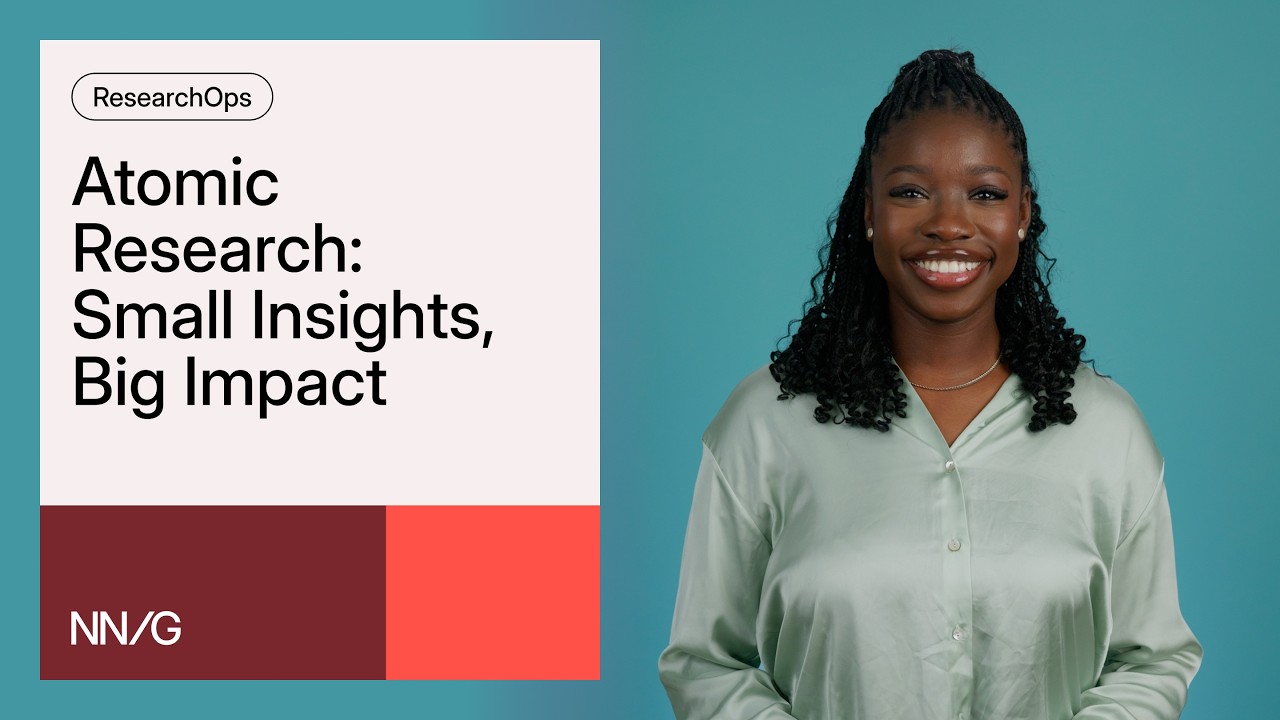
Atomic Research: Small Insights, Big Impact
4:23

Atomic Research: Small Insights, Big Impact

NNgroup 01.06.2026 884 просмотров 34 лайков

Machine-readable: Markdown · JSON API · Site index

Поделиться Telegram VK Бот
Транскрипт Скачать .md
Анализ с AI
Описание видео
Atomic research breaks user research into small, evidence-backed units to improve analysis, repository organization, and cross-team collaboration. Read More: https://www.nngroup.com/articles/data-findings-insights-differences/ Watch Next: https://www.youtube.com/watch?v=JLdQeE4I5YM&t=1s Enroll in live training: https://www.nngroup.com/courses/research-with-ai/ Subscribe to our weekly newsletter: https://link.nngroup.com/yt-newsletter Follow us and stay connected: Linkedin: https://www.linkedin.com/company/nielsen-norman-group Instagram: https://www.instagram.com/nngux/ Threads: https://www.threads.com/@nngux X: https://x.com/NNgroup Bluesky: https://bsky.app/profile/nngroupux.bsky.social _______________________________________________________ Chapters: 00:00 What is Atomic Research? 00:33 How & Why to Use 00:55 Example 02:21 When to Use 02:37 Starting Guidance 03:10 Conclusion

Оглавление (6 сегментов)

What is Atomic Research?

Is your research stuck inside slide decks and final reports, useful in one moment but forgotten soon after? Atomic Research challenges this reality. It organizes insights so they're easy to reference, reuse, and share across teams. The idea is simple. Instead of storing findings by project, we store them by what we actually learned. Each atom is a small, standalone insight backed by evidence. On its own, it's meaningful, but connected with others, it tells a bigger story and gives a team a modular way to manage knowledge.

How & Why to Use

So, how does Atomic Research work? Let's take a look at what goes into an atom. Each atom includes a clear insight, supporting evidence like a quote or statistic, tags or metadata to make it findable, and optional context such as the confidence level or the study method used. These elements give the insight structure and make it easier to share and act on. Let's look at a quick

Example

example. Imagine a team runs a study on their checkout experience, and they want to apply the concepts of Atomic Research. Based on their insights, they might create multiple atoms. One of these might have an insight saying, "Users hesitate at the payment screen when total costs aren't visible upfront. " The evidence of this is that six of eight participants asked if additional fees would appear later during a usability test. And they include searchable tags of checkout, pricing, and trust. The researcher included that their confidence in this insight is medium and links to a usability test and analytics on cart abandonment that were previously done. Now, that atom lives in a searchable database. Months later, a product manager working on subscriptions searches checkout and finds it along with other related findings. Instead of repeating work, they can build on what's already been learned, knowing there's a validated pain point with evidence and other teams addressing a similar issue. Compare that to the traditional model, where the same insight might sit on slide 19 of a 40-page deck, hard to find and rarely reused. This matters because it makes research accessible and helps clarify decisions. Because each atom includes evidence and context, it's easier to understand not just what was learned, but also why it matters. And over time, this approach builds a more evidence-informed culture. When insights are easier to find and trust, they're more likely to be used.

When to Use

Atomic research works best when insights need to be shared regularly across multiple teams. It's especially helpful if you have multiple researchers contributing insights. Your work spans different products, markets, or customer types, or you need smooth knowledge transfer because of high team turnover. If you

Starting Guidance

now consider implementing atomic research for your team, here's a short list to get you started. First, choose a tool. You can use anything that supports linking information, filters, and search. A spreadsheet, Notion, or Airtable could work. Next, start small. Start with a recent project that you've completed and pull out a few key insights. Are there other projects and research that support these insights? Connect them. Any that disagreed? Consider how this adds to the knowledge in your organization. You'll quickly see how much easier it becomes to build on what you already know. That said, atomic research is not

Conclusion

one-size-fits-all. It's not a replacement for analysis. Atomic insights are representations of a bigger story, not the story itself. Your team still needs to analyze your qualitative and quantitative research, and then you can use atomic research as a way to present the information you've analyzed in a highly usable and connected format. It also requires structure and ongoing maintenance, often with research ops support. And for very small teams doing limited research, it might not be economical. For many teams, though, it can be the difference between forgotten and implemented insights. Thanks for watching. If you'd like to see more UX videos, check out these over here. And consider subscribing to our channel. You can find even more resources on our website, including a free library of over 2,000 UX articles. And if you're ready to dive deeper, we offer both live hands-on UX training and self-paced courses you can take anytime and at your own pace. Explore our full course library at nngroup. com.

Другие видео автора — NNgroup

Ctrl+V

Экстракт Знаний в Telegram

Экстракты и дистилляты из лучших YouTube-каналов — сразу после публикации.

Подписаться

Дайджест Экстрактов

Лучшие методички за неделю — каждый понедельник