Watch the Anatomy of the Nokia 3310: https://nebula.tv/videos/realengineering-the-anatomy-of-the-nokia-3310?ref=stewarthicks
Get Nebula using my link for 50% off an annual subscription: https://go.nebula.tv/stewarthicks
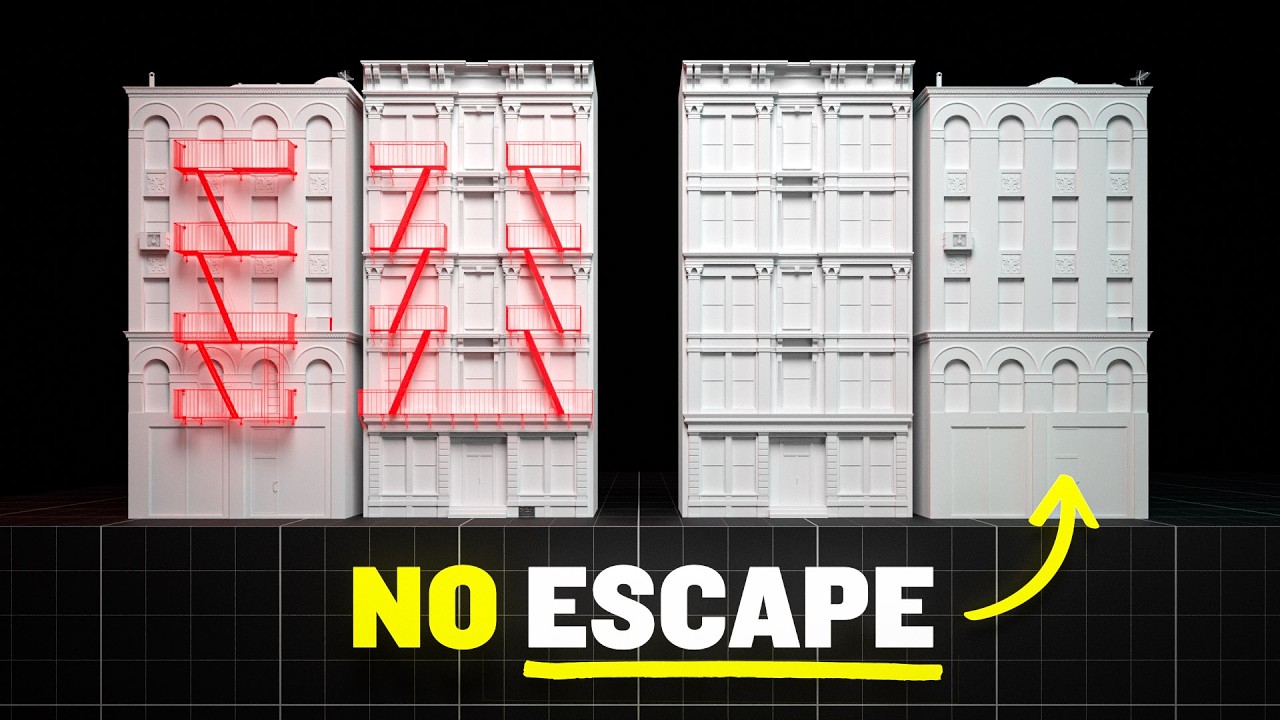
Why is New York covered in fire escapes, while Chicago — a city practically synonymous with burning down — has so few of them?
It turns out these two cities learned very different lessons from fire. New York grew upward and inward, packing people into dense tenements where the nightmare was being trapped inside. Chicago grew outward, building quickly and cheaply with wood, where the bigger fear was fire racing from building to building.
So New York often dealt with the problem by attaching escape routes to the outside. Chicago, under pressure from insurers and new building laws, pushed more of its fire safety into the construction of the building itself.
This video looks at how density, alleys, wood framing, tenement reform, insurance companies, the Great Chicago Fire, the Iroquois Theater fire, and the Triangle Shirtwaist Factory fire all helped shape the buildings we still recognize today.
__Special Thanks__
Evan Montgomery: Producer
Daniela Osorio Sanudo: Graphics
__Sources__
Christine Meisner Rosen, The Limits of Power: Great Fires and the Process of City Growth in America.
Richard Plunz, A History of Housing in New York City.
Elizabeth Mary André, Fire Escapes in Urban America: History and Preservation.”
Sara E. Wermiel, The Fireproof Building: Technology and Public Safety in the Nineteenth-Century American City.
Carl Smith, Urban Disorder and the Shape of Belief: The Great Chicago Fire, the Haymarket Bomb, and the Model Town of Pullman.
Lawrence Veiller, The Tenement House Problem, edited with Robert W. De Forest.
New York State Tenement House Commission, Report of the Tenement House Commission of 1900.
NYC Department of Records and Information Services, “Building Escapes.” Good archival overview of New York fire escape regulation and inspection history.
Village Preservation, “The Birth of the Tenement Fire Escape.” Useful for the 142 Elm Street fire and early fire escape history.
Encyclopedia of Chicago, “Fire Limits.” Useful for Chicago’s post-fire regulatory geography and the logic of limiting wood construction.
Chicago Public Library, “Fire Limits: Technology That Changed Chicago.” Helpful for connecting fire limits to Chicago’s built form.
National Weather Service, “The Great Midwest Wildfires of 1871.” Useful for Great Chicago Fire figures and regional fire context.
NYC Fire Code, Chapter 10 / Section 1027, Means of Egress. Useful for current fire escape access rules, including restrictions on air conditioners in fire escape windows.
__Membership__
Join this channel to get access to perks:
https://www.youtube.com/channel/UCYAm24PkejQR2xMgJgn7xwg/join
__About the Channel__
Architecture with Stewart is a YouTube journey exploring architecture’s deep and enduring stories in all their bewildering glory. Weekly videos and occasional live events breakdown a wide range of topics related to the built environment in order to increase their general understanding and advocate their importance in shaping the world we inhabit.
__About Me__
Stewart Hicks is an architectural design educator that leads studios and lecture courses as an Associate Professor in the School of Architecture at the University of Illinois at Chicago. He also serves as an Associate Dean in the College of Architecture, Design, and the Arts and is the co-founder of the practice Design With Company. His work has earned awards such as the Architecture Record Design Vanguard Award or the Young Architect’s Forum Award and has been featured in exhibitions such as the Chicago Architecture Biennial and Design Miami, as well as at the V&A Museum and Tate Modern in London. His writings can be found in the co-authored book Misguided Tactics for Propriety Calibration, published with the Graham Foundation, as well as essays in MONU magazine, the AIA Journal Manifest, Log, bracket, and the guest-edited issue of MAS Context on the topic of character architecture.
__Contact__
FOLLOW me on instagram: @stewart_hicks & @designwithco
Design With Company: https://designwith.co
University of Illinois at Chicago School of Architecture: https://arch.uic.edu/
__Attributions__
Stock video and imagery provided by Getty Images, Storyblocks, and Shutterstock.
Music provided by Epidemic Sound and includes music from Chromatic by Tom Fox
https://www.youtube.com/@chromaticbytomfox"
#architecture #urbandesign
Оглавление (3 сегментов)
Segment 1 (00:00 - 05:00)
Watching a street scene like this, the fire escape is a dead giveaway that you're in New York. And I do mean dead, because some say as many as 75% of those rusty contraptions don't meet the modern code. Meanwhile, over here in Chicago, we only have a few fire escapes that are left on display. That's despite building our entire brand around our city's combustibility. That difference is strange because both cities were shaped by a series disasters, which in turn became fuel for serious fire codes. So, why do they look so different today? At one point, they were two of the most dangerous fire-prone cities in America, just for different reasons. And those differences had everything to do with how each city grew in the first place. Chicago had room to spread. It had easy access to lumber. Trees cleared in states around the Great Lakes came across Lake Michigan on a barge, and wood became the city's default building material. Chicago became a site for experimenting with how to create bigger buildings with smaller pieces of wood. And eventually, the technique became balloon framing, and it allowed construction crews to easily carry raw materials to almost any site and erect new buildings quickly and cheaply. The city's layout helped in this, too. The block planning module fits neatly inside of the grid used by the US government to divide up land into sellable parcels. — Settlements around the area followed the exact same predetermined structure, so the city could expand and connect pre-existing areas seamlessly, all within the same common matrix. And because there was room, the block usually included alleys inside of the middle of it. The alleys took up space, but they also kept things moving by separating the service corridors from street traffic. But over in New York, they didn't follow the same plan. New York is on a long, narrow island that's rotated to an angle that doesn't cooperate very nicely with a clean, rational grid. Its early settlements each followed their own local logics. So, stitching them together into one coherent system ended up in a mess. On top of that, the rivers created hard boundaries that limited how far the city could grow outward. So, rather than spreading, development in New York focused inward with more density. Alleys would have just taken up too much valuable space. So, developers just accepted that parcels would only have one side with any exposure to the street, the only side with guaranteed access to light and air. So, while Chicago was refining the wood construction system that would help build the rest of America, New York was refining the tenement, five- and six-story buildings that housed one half of the city's population. Many of those had inadequate plumbing, terrible light and ventilation, and one single stair near the street serving far too many people. So, the big difference between the two cities is that Chicago grew outward and New York grew inward. Not only did these approaches eventually lead to dangerous conditions, they also set the stage for their residents' deep-seated fears for what was coming for them. New York's flashpoint came first in 1860. Firefighters arrived at 142 Elm Street when the basement bakery burst into flames. 24 families lived above it. The stair quickly filled up with smoke and flames, and the firefighters' ladders could reach up to the fourth-floor windows, but the building, it was six stories tall. 10 people on the top floors couldn't get out. And the newspaper reports narrated the event with survivor testimony from the inside. One gruesome version described how a man saved his children one by one after his wife fell victim to the smoke. While there were big fires before that, this kind of reporting turned the fire into a major political problem. So, everyone acted really quickly. New York soon required that buildings with only one stair either be made of noncombustible materials or to provide fireproof balconies and exterior stairs. — On its way to becoming a thriving metropolis, the inward growth of New York, when taken too far, produces the conditions for entrapment. But, it wasn't the wealthy or the decision-makers in the city that were in danger of being trapped. It was the dispossessed and the poorest. The law, as written, gave landlords a choice in how to proceed. It really only pointed toward one single obvious answer. For most owners, the cheaper and more practical path wasn't to be rebuild the building, it was to bolt an escape route to the outside and to continue charging rent. — This solution became so reassuring to New Yorkers that in 1867, the Tenement House Act required fire escapes on all tenements regardless of the construction type. But the actual effectiveness of the fire escapes was questionable from the start. The fire escape became like a badge where the building safety features were worn right out on the facade. This outward display calmed the fears of potential residents, but also worked on code officials because even 30 years after the law was put into place, 650 tenement buildings across the city had fire escapes that didn't even reach all of the floors in the building and 100 tenement buildings still didn't have any fire escapes at all. And these early versions weren't even as effective as the kinds of fire escapes that we picture today. They were often just vertical metal ladders running up the building. The more familiar versions, those platforms with the zigzagging stairs, came later through a series of late 19th century improvements including Anna Connelly's
Segment 2 (05:00 - 10:00)
patented version in 1887. By 1901, those designs became much more standardized under a new Tenement House Act that closed many of the loopholes that were in the earlier laws. — But even with this checkered past, the idea that a building could be augmented with a device to make it safe alleviated many of New Yorkers' fears being trapped inside the density that they created. Chicago though, if you remember, grew another way. It spread and its fire is famous for spreading, too. In 1871, 17,000 buildings spread over 3 square miles killing 300 people. With all those wooden structures, people weren't necessarily trapped inside the buildings. The problem was that the wood construction allowed the fire to jump between buildings too easily and too fast for the fighting infrastructure to be able to contain it. So, just as New York's growth became its greatest fear, the same became true for Chicago. So, they needed to regulate the spread of fire. And it did so by publishing this enormous 700-page book of regulations. Among other things, it demanded walls between buildings that wouldn't burn. It also claimed the power to establish fire limits at the scale of the city and to prohibit the erection of wooden buildings inside of these limits. In a city all about how easy it is to move and spread, — the biggest pieces of fire legislation were about establishing limits and boundaries. This first version of the fire code was actually a compromise, though, because officials first tried to ban wood construction across the entire city, but many residents pushed back and they won. Wood construction remained essential for people with fewer resources, so the fire limits became a negotiated line where different kinds of rebuilding would be allowed. So, many areas, especially working-class neighborhoods, were initially rebuilt in the same wood construction as before. Then, only a year after those laws were published, 800 buildings over 60 acres caught fire. This one is not as well remembered, but it's during the aftermath of this fire where rebuilding really hit the snag, because building owners tried cashing in their insurance policies, which were supposed to protect them from bearing the full cost of reconstruction. And the National Board of Underwriters effectively pushed insurers to stop doing business in Chicago until the city made major changes. They're not going to fund just another round of rebuilding until the city fundamentally changed how it built. And they threatened to cancel every single policy in the city. That's actually what it took to change our approach here. No amount of moral outrage was enough, and only when the insurers acted did Chicago's laws fully shift. That's when masonry construction expanded, fire limits were widened, wood frame construction was really constrained. The emphasis moved toward brick, stone, iron, terracotta, thicker walls, and building rules aimed at stopping fires from spreading in the first place. Chicago did eventually require fire escapes on some of its multi-story buildings, — but there's a distinction. In Chicago, the fire escape is secondary. It was added to buildings that were already required to be conceived as less combustible structures to begin with. Of course, today the fire codes between the two cities are much more similar. Chicago began worrying more about entrapment when a supposedly fireproof building caught fire and no one could get out. That's what happened at the Iroquois Theater. On the flip side, New York lost trust in its fire escapes when workers at the Triangle Shirtwaist Factory couldn't safely use them. — Managers locked the exit doors to control theft and worker movement, killing 146 people when the ways out failed all at once. The Iroquois Theater, too, had the same kind of fire escapes, — which proved ineffective for saving lives. That still leaves the question of why these two cities look so different today. Well, without the pressure from the insurance companies to holistically reconsider their construction, New York continued just accepting their piecemeal strategy, even as new construction veered toward internal exits. — Many of the New York's fire escapes are still critical safety equipment and provide a secondary means for egress. And they require regular inspections periodically in order to stay certified. Even when the fire escapes aren't functionally necessary, the facades of these older buildings have become so permanently associated with the look of their iconic accessory, so sometimes building owners are required to keep the fire escape by preservation standards instead of any modern fire code. — Over here in Chicago, it's also not quite as free of fire escapes as you might think. With less dense blocks and mid-block alley systems, buildings here can sport things like fire escapes on all sides that face away from the street. — The same slice that separates the building lots to allow light and air on the back side can also become the site for later amendments and attachments. The alley system also gives houses their backyards, and that's where all the old brick and stone two- and three flats were what locals call the Chicago porch. That's the nickname for the wooden deck constructions and stairs that line the backyards. But the key difference though is that these were more integrated into the everyday egress logic of the buildings rather than becoming some big front-facing urban symbol like the New York fire escape. Chicago's buildings were driven by concerns about fire very early on. Their safety features are more
Segment 3 (10:00 - 11:00)
often internalized and intrinsic to their design. These buildings aren't showing you how safe they are. They're just celebrating their architectural makeup instead. Interestingly though, the legacy of the early obsessions of each city it still shows up if you know where to look for it. Chicago for instance still organizes many of its fire spread provisions around stopping lateral spread. It also has prescriptive geometric rules for balconies where no more than 50% of the exterior perimeter of a floor can have combustible projections. That's a direct attempt to prevent fire from jumping too easily across exterior conditions. — New York too has an inordinate number of rules governing the interior layout of apartments to keep fire escapes accessible. Can't put an air conditioner unit in the same required access window for instance because it would block the exit. These unique histories of each place can be read on and in the buildings. If you could see right through it like an x-ray, you'd see that it's all just made up of the same set of parts but the magic is really in how they come together. But it wouldn't just stop at those buildings. You need to see inside of all the little objects inside of it too. And for that I recommend a show called the Anatomy of produced by our friends at Real Engineering. I absolutely love it. They take you on deep dives into things like the Nokia 3310. Like did you know that it's built kind of like a building with an internal frame that's protected by this hard removable shell? That's why it's so indestructible. The Anatomy of is an original show that you'll only find at Nebula, the streaming platform built and owned by creators. It's like this prestigious clubhouse where your favorite 200 creators or so are hanging out making exclusive content and make their regular content available before anywhere else. So follow the link on the screen or in the description to watch Anatomy of and to join Nebula. It's only $2. 50 per month when you sign up for a year if you're using my link. That's 50% off the regular price. If you really love what you see, you can pay just once, get access to everything for the rest of your life. And if you're already signed up and want to share with a friend or a loved one, you can gift a subscription. Either way, you'll be supporting us while unlocking the best thoughtful content out there right now. See you over there.