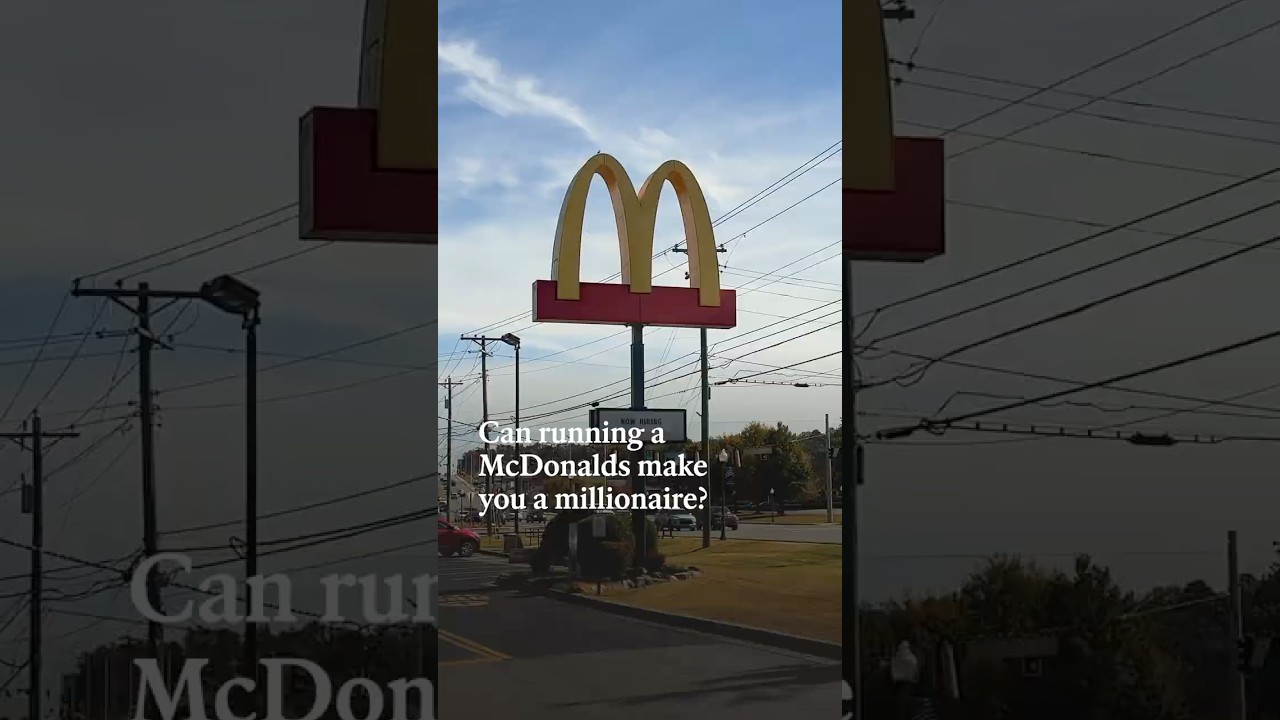
Can running a McDonald’s make you a millionaire? | The Economist
2:29

Can running a McDonald’s make you a millionaire? | The Economist

The Economist 06.06.2026 19 519 просмотров 751 лайков

Machine-readable: Markdown · JSON API · Site index

Поделиться Telegram VK Бот
Транскрипт Скачать .md
Анализ с AI
Описание видео
Can running a McDonald’s make you a millionaire? The Economist’s US business editor, Alice Fulwood, explains why running a local franchise may be the best way to get rich, especially in the age of artificial intelligence. #business #finance #mcdonalds #franchise Read more: https://econ.st/4vpUubX Subscribe to The Economist: https://econ.st/3Mia0pz Download The Economist app: https://econ.st/4qdVVaA Follow us on X: https://x.com/TheEconomist Follow us on Instagram: https://www.instagram.com/theeconomist Follow us on Facebook: https://www.facebook.com/TheEconomist
Оглавление (1 сегментов)

Segment 1 (00:00 - 02:00)

Can running a McDonald's make you a  millionaire? Campaigning politicians   love to tell you about their experience  flipping burgers. I'm going for a job   right now at McDonald's. I worked in McDonald's.   But to really sell voters on the American dream,   perhaps they should focus more on the  people who are running the joints. 95% of American McDonald's restaurants are  franchises where a company licenses its brand   to an independent owner operator, usually  for an upfront fee and a share of revenue.    The model began spreading across America in the  1950s. In the 1970s and 80s, it was overlooked   by economists who considered it little more than a  cheap growth tactic. But the model worked through   its franchises. McDonald's has plausibly created  more millionaires than any firm in history. And   it's not just the Golden Arches. There are close  to 850,000 franchise establishments in America,   run by around 250,000 owners. They employ  around 9m people and generate about 3% of   GDP. The reasons for their success lie in  the particularities of American capitalism.    Franchises work because they align incentives  and divide labor. The franchisor saves money   on monitoring staff and gains local knowledge.   The franchisee benefits from brand recognition   and nationwide marketing. And in America, strong  intellectual property rights protect franchise   brands, while deep capital markets make it easy  for franchises to borrow to acquire the initial   investment, which can be around a million dollars.   Franchises have long appealed to immigrants in   particular. Around 2/3 of American motel are  owned by Indian-Americans, many descended from   Gujaratis who bought Super 8 and Travel Lodge  franchises in the 1980s. For young people today,   the model looks even more attractive. Rising  tuition fees and the emergence of artificial   intelligence have prompted renewed interest  in people focused ways of making a living.    Franchises are even expanding into new areas  like pilates and childcare. In the age of AI,   keeping customers happy in McDonald's could  just be the smartest way to make a million.

Другие видео автора — The Economist

Ctrl+V

Экстракт Знаний в Telegram

Экстракты и дистилляты из лучших YouTube-каналов — сразу после публикации.

Подписаться

Дайджест Экстрактов

Лучшие методички за неделю — каждый понедельник