Consider joining our memberships to support our channel and for early access to future videos!
Business Inquiries: howfarmswork@gmail.com
*CURRENT SCHEDULE*
Sundays @ 11 Central
How Farms Work by Ryan Kuster is a YouTube channel based in rural Potosi, Wisconsin. Our mission is to teach those who didn't grow up on a farm what the farming life is like. These videos show the Kuster family working together raising cattle and crops. We believe everyone who wants to know more about farming should be able to share the farming experience with us and we look to educate the world on many essential agriculture topics.
How Farms Work takes place on ~1,100 acres with around 200 cow-calf pairs. Four John Deere tractors are currently used on the farm, which are a 4020, 4640, 7600, and 8235R.
Оглавление (4 сегментов)
Segment 1 (00:00 - 05:00)
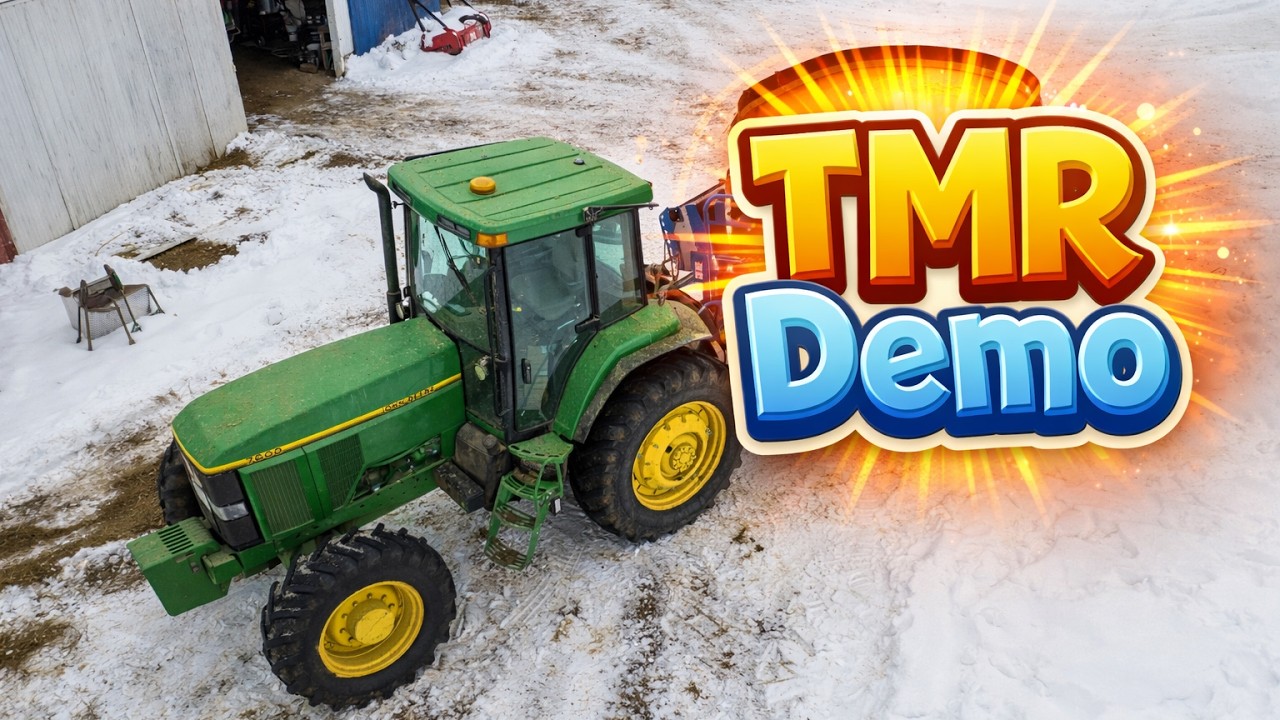
Hey, is this thing on? Hey everybody, it's Ryan. Welcome back to How Farms Work. So, it's been a good few months since I have posted to my YouTube channel. And there's a lot of reasons for that. Um, one of the probably biggest reasons is because Hannah and I welcomed our first son, our first child, uh, into the family. And, uh, I've been busy spending time with him and, uh, really just kind of taking things slow. Um, that's just one of the many reasons. Uh, really too many to count to why I haven't been posting. What we're doing today is a little special. So, I figured I'd whip out the camera and, uh, talk to you guys a little bit about what I'm doing. Now, the big thing, the big reason that I'm here today is because we finally got our hands on a TMR. So, uh, there's so many reasons to want a TMR that I'm not going to be able to touch on in this video. Um, but essentially what a TMR will do is help you feed your cattle more with more consistency. Um, it allows you to blend different mixes of feeds. And although we're not completely set up for it yet, um, we were offered this just for a short demo. And I'm like, well, heck, if you know, if there's no obligation, I'm not even obligated to make a video on it. It's strictly just a, you know, a farm demo. Um, but me being me, it's like, well, I got to talk about it, um, and show you guys, you know, I'm excited to share this. So, uh, I have very little experience with TMRS. Done a lot of research over the last year or two. Um, and trying to see whether or not they'd be a good fit for our operation. I believe they would. Um, we're not totally set up for them yet. So, one of the things we're going to be doing is I would like to have a bunk space to be able to dump into. That's actually what that feed line was down there. Me not thinking that, you know, it'll be a couple years before we can afford a TMR. I bought those feed bins to set up and play around with. Uh, well, there was some storms coming and I was in a hurry to get those bins set up so that they didn't blow away. And I put them on the con the hog house foundation that I had taken down earlier this year. There wasn't a video on that either. And um, I've set them up on the cement. Well, the original intention was is to be able to drive a TMR around where the bin is and be able to just dump directly into the bunk, which would work great except I put those two bins on there and, you know, they're serving their purpose, but I had no idea we were going to be, you know, running a TMR this soon or testing one out. Um, but, you know, so what we're going to be doing with this is we're just going to be dumping it on the ground. Um, not ideal by any means. I wish, you know, we had a bunk set up um if we had some old tires, we could use those um to dump the feet into, but I'm going to just dump it into a line. Um I've seen guys do it. I know that people do it. Uh it's not ideal, but for the short time that we're going to have this, it's perfectly fine. So, um this TMR is a penta and this is out thanks to Kevin Ree. He brought this demo unit over. It was at another farm. Um he brought it straight over from there just for us to try out. Um we had bought some other equipment from him and he's like, "Have you ever tried one? " You know, I had talked to somebody else who had bought one from him um who told him that we were interested in it and he didn't know it at the time that we had made videos. Um but now we're just testing one out. So, uh, the TMR has a scale, and the big reason you want a scale is so that you know you're hitting your targets for what you're trying to feed your cattle. So, one of the other big things that I've been trying to do is to spend more time running the number numbers on the cattle, trying to get everything straightened out. Um, it's really complicated. farming in general is all the numbers is really hard to pin down, but I've been doing as best I can to estimate those numbers and the closer you can get to exact numbers, the easier it is to figure out, you know, what um you should be feeding. So, uh the scale is going to help us know exactly what we're putting out for the cattle so that we are hitting their targets. Um, if you're blending different kinds of feeds, typically you'll talk with a nutritionist or set up your own uh diet for your cattle. Um, we're not going to be getting that fancy with it today. However, in one of my feed bins down there, um, I have been dumping corn in for the cows. The TMR allows us to mix the corn directly in with the feed and then dump it out for the cattle. So, um, like I said it earlier, it helps with consistency, helps you get more of a even blend of the feed so that your heaviest cows aren't pushing into the feed bin um, every time it dumps and hogging all the corn. So, I did that
Segment 2 (05:00 - 10:00)
because that's well, it's super cheap um, if you got the feed bins to do. Um, but otherwise, I mean, if you got a TMR, heck yeah, use this thing. So, uh, instead of running the feed bin, I shut it down and I'm going to be mixing the corn directly into the TMR. Um, I'm going to drive down there with the skid loader and dump into the bucket and just dump it right in. And that's where the scale comes in handy because you know exactly how much of each product you're putting in. Again, going to be very straightforward. Um, this is just going to be balage and a little bit of corn. I'm not blending anything else in. If we were blending or using one of these and we had planned it, um, honestly, I would probably try to do some kind of silage and get some silage bags going and then that'll help me be able to take scoops of silage versus bales. Um, another thing guys will do is they'll actually have a bail processor and they'll grind up uh the hay and then they can just take scoopfuls out of it. But we're not set up for uh grinding anything here quite yet. Um got a lot of infrastructure to deal with before we get to a point like that. But uh typically when you're using the TMR, they say that you can have up to 10 to 15% in hay savings. And uh when you're feeding a lot of cattle, um that adds up really quick. Uh there's been guys that say that, you know, just the savings in hay on even 60 head of cattle is enough to make the payment on the TMR. And if it lasts for many years, then well, you just made your uh TMR payment off. So, um we're going to go ahead fire this up. Uh I've got the hydraulics hooked up and everything. Um typically when you get demos like this, you just need to go through and make sure that everything's hooked up. Um, we had steers break into the hay part of the pole shed when he was dropping this off. So, unfortunately, he wasn't able to set it up for me. Um, but one of the things I had to do was, uh, lower the hitch, actually raise the hitch up because the 76's, uh, draw bar is flipped upside down, so it's very high. Uh, it had a very low clearance uh to the PTO. So, just to protect the PTO, I moved it up. Um, that helped it get more level, too. Uh, one of the things you want to do is make sure that you're running it as level as you can so that you aren't spilling over the side. So, I'm kind of interested to see how many bales this will hold. Um, I was told in the past that typically one bail per screw. Uh, this is a 4540 and it has a one single very large screw in it. Let's hop up and actually show you that right now. So, here's the conveyor. It's got a door on the front. Um, for those of you that aren't familiar, like me with, uh, TMRS, um, it's got the door on the front. When you raise it, that's when it starts dumping the feed out. So, here's the single screw. Uh, it's actually much larger than it looks like in the camera, believe it or not. When I got up here and looked at this thing, I was kind of surprised um, at how large it is. So, it's got those blades. What we're trying to do is we're trying to cut the material up to get it down uh to be shorter so that the cows aren't picking through it. It reduces how much they reject and um helps them really utilizes all the feed that's there. So, it's got those notches on the side. That's to help catch the feed so it's just not stuck in here spinning. We're going to load it up with the balage first. Uh see how much it fluffs up. Um, I should have a couple bales that are roughly 50% down there we're going to drop in. So, granted this is a long going to be a long video, but uh it's been a hot minute. So, let's go ahead crank this up, get her turning, and uh go get us some bales. Heat.
Segment 3 (10:00 - 15:00)
So, that was about 7 minutes. You can probably hear the 7600 grunting. Well, just a little bit. We're running at about 17,800 RPM. And it took seven or eight minutes for it to blend the bail up completely. So when you drop the bail in, it fluffs up. And it threw a little bit over the sides, but we haven't lost much in the way of poundage since dropping the bail in. I mean, there's a little bit when it went over the top at the beginning. So, but again, it's not very much at all. about 2160 weight of the bail. That boy that bail should have been about 50% moisture but it's just over,50 lb,70 80 lb. Not what I expected, honestly, cuz uh the Bobcat really can't pick them up when pointed downhill. Heat. Look, I'm not too happy about the placement of that pin either. All right. Supposed to be temporary. It's temporary. Heat.
Segment 4 (15:00 - 18:00)
Heat. I almost got stuck down there, but thankfully we didn't. the 76 was able to pull us through, but the snow built up in front of that back tire I saw when I was looking at the footage. And uh it wasn't turning, which isn't great, but uh that's why you'd want to get set up so that you wouldn't have to feed like this. Um I have a plan for this lot. Uh right now it looks like there's going to be what the plan would be is there'd be a lot straight down the middle and there'd be feed lanes on each side and then there'd be a place to turn around on the ends and come back up and then I would split each side into probably at least two lots. But that requires getting water down here somewhere. And um to run it that far, it's going to be a pretty penny. I just finished mixing feed and I'm pretty happy with the job that it did. Uh grinding up the feed is definitely ideal um to get those shorter lengths that the cows reject less. But overall, I mean, the quality of the feed, seeing it ground up, very happy with it. Uh it only took 7 minutes to grind that first bail that I dropped in. And I would say that was pretty quick. But otherwise, I just want to send out a thank you to Kevin Ree for sending this over. If we had one of these here full-time, I would definitely want to get some corn silage uh ground up so that we would have something to top it off with and to throw into the mix uh for pretty much everybody. Um I really think that would really help with the cow's diets. And um yeah, I'm pretty happy with it so far. So I just want to say thanks for watching this video, guys. And I'll see you next time.