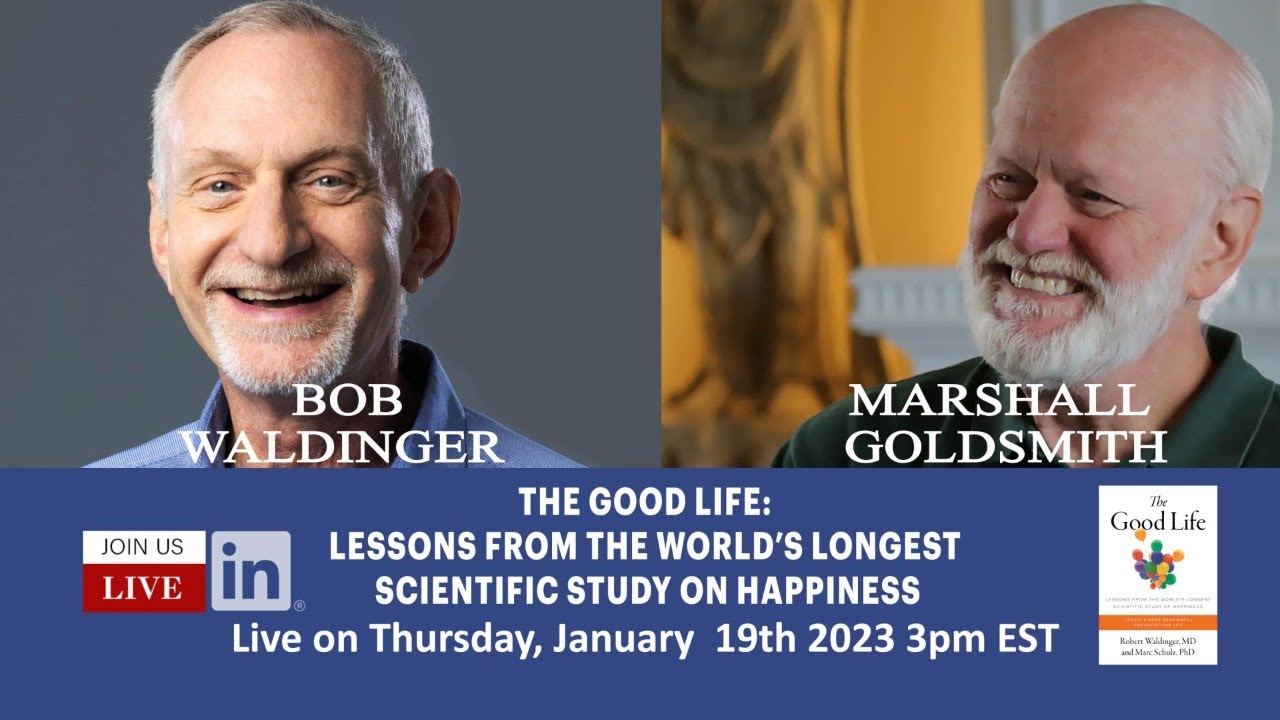
The Good Life: The World’s Longest Scientific Study on Happiness
30:17

The Good Life: The World’s Longest Scientific Study on Happiness

Marshall Goldsmith 20.01.2023 5 537 просмотров 105 лайков

Machine-readable: Markdown · JSON API · Site index

Поделиться Telegram VK Бот
Транскрипт Скачать .md
Анализ с AI
Описание видео
Join me and Robert Waldinger a professor of psychiatry at Harvard Medical School, director of the Harvard Study of Adult Development at Massachusetts General Hospital, and cofounder of the Lifespan Research Foundation as we discuss his new book, The Good Life: Lessons From the World’s Longest Scientific Study on Happiness Dr. Waldinger received his AB from Harvard College and his MD from Harvard Medical School. He is a practicing psychiatrist and psychoanalyst, and he directs a psychotherapy teaching program for Harvard psychiatry residents. He is also a Zen master (Roshi) and teaches meditation in New England and around the world. Robert is the co-author of the book The Good Life: Lessons From the World’s Longest Scientific Study on Happiness (Simon and Schuster; January 10, 2023). I look forward to seeing you there!


Оглавление (23 сегментов)

Introduction

foreign Goldsmith I am an author and um author of 51 books I've done four New York Times bestsellers one of them called what got you here won't get you there was just ranked in chief executive magazine as one of the 10 best books ever written as judged by CEOs in America I was very proud of that my new book is called the earned life and I've got a documentary movie about that just came out on Amazon also I am I'm a coach I've been the coach of the CEOs of Ford and Pfizer and Glock so all kinds of people I love coaching because I learned so much from it and then I travel around the world speaking and teaching I've been to 102 countries and on American Airlines I have 11 million frequent flyer miles well I'm here today I am so excited I'm here to talk about a great new book and a

Guest introduction

fascinating long-term study I'm here with Dr Bob waldinger Dr Bob is a wonderful guy friendly nice kind person he's a member of our 100 coach group and he has a new book out summarizing the results of some amazing research called The Good Life so I'm going to ask him to give us some of the highlights of his research of what he's learned and most importantly what can we do to help you in this call what can he do he's really got some great knowledge how can his knowledge be translated to help you have a good life Dr Bob so happy to be talking to you can you just take a couple minutes and introduce yourselves and give us a

Guest introductions

little of the background sure and I'm so glad to be here Marshall um so I'm Bob waldinger I am a psychiatrist I'm professor of Psychiatry at Harvard Medical School I'm the director of the longest study of adult life that's ever been done and that's what we wrote the book about it's we're in our 85th year I'm also a psychotherapist I'm also a zen teacher and Zen priest and that's a very important part of my life as well uh Marshall would you like me to say some about the study now yeah just give

Background on the study

a little bit of background about the study itself okay so the study uh started in 1938 and it's the longest study of the same people going through their entire adult lives that's ever been done unheard of to have a study that lasts this long covers three generations 724 families started out in 1938 with a group of Harvard college sophomores 19 year olds and a group of boys from Boston's poorest neighborhoods and most troubled families and both of those separate groups were studied to see what helps people thrive as they start out on their adult lives and what was unusual about it was that it was a study about thriving so much of our research up till that point had been on what goes wrong in life so we can try to help but this study of thriving was really trying to determine what are the key predictors of who's going to do well as they go through life

Essential ingredient

you know I love what you've done if you had to say what was the essential ingredient I'm sure there were more than one but I had to pick one what was the essential ingredient that came out as a positive indicator for having a great life sure well I'll actually I'll pick two because I don't want to miss one is taking care of your health and that's not a surprise the surprise was this huge factor that we began to find which is that the quality of our connections with each other our relationships predict having a healthier happier life so that the people who had warmer connections with other people weren't just happier but the surprise was they stayed healthier and lived longer they were less likely to get heart disease type 2 diabetes if they had better relationships with other people and it wasn't just our study that found this it was many other research studies

Factors in early childhood

you know a lot of people listening are perhaps parents or perhaps teachers and they deal they may not be you know really young people themselves but they deal with people in early child or like me a grandparent who deal with people in early childhood what are some of the factors in early childhood that impact Mental Health well what we know from a lot of research now is actually best said by Michael Rutter who's a developmental scientist and he said every child needs at least one adult who's crazy about them and what that boils down to is that each child needs one consistent caring adult in their life and if they have that they can weather a lot of storms a lot of problems but that sing at least one consistent caring adult is what we all need to set us up to have a good life

Happiness is not something you achieve

you know I love that and that's something we can all strive for as parents grandparents teachers mentors whatever so I think that was wonderful now I love this next one because the next question is related to a book I just did the earn life and it's this how come happiness is not something that you achieve yeah well happiness as you know Marshall as a Buddhist is a feeling that comes and goes moment to moment I'm having a good time talking with you now and I'm happy but you know an hour from now something really upsetting might happen I won't be happy right but what we can strive for and build is well-being is that Foundation of things in our life that help us feel that life is good enough that it's meaningful and the foundation of good relationships of purposeful work that's a foundation that can help us weather all the storms that come our way and they come into every life

Happiness and achievement are independent variables

you know you've met many of the people on 100 coach groups and some of the people in our LPR groups who are just amazing people one of the people that's in our group of safibocall Safi is a brilliant scientist he wrote a book called loon shots and I asked him what does he learn being around all these great people he said he learned a great lesson which is connected to your book he used to believe if I achieved more I would be happy now Safi is a brilliant guy who talks like a scientist he said I finally realized happiness and achievement are independent variables yes you can achieve and be happy and miserable you know and he said there are people in our group who've achieved tons who are happy and they're miserable I mean he knows people achieve nothing are happy and nothing are miserable so they're independent variables and I said you know Safi I'm glad you finally realized that because you already have a PhD in physics from Stanford you've already written a newer Town's best-selling book called loon shots you've already made millions and millions of dollars you've successfully started four businesses and you've consulted to presidents I said if that's not enough achievement to make you happy you really think a little more making difference exactly you know Marshall you've described this perfectly in terms of what our study shows as well and when we when our original people got to be 80. we asked them look back on your life and tell us what you're proudest of you regret the most and the most common was regret was I spent too much time at work and not enough time with the people I care about and the most common thing that people were proud of had everything to do with relationships it wasn't I made a lot of money I was the CEO it was I was a good boss Mentor I was a good parent grandparent spouse that that's what everybody said meant the most when they looked across the entirety of their lives

Why do we overlook the most important characteristics

okay question why do we overlook some of the most important characteristics that will make us happy why do we Overlook the success factors that may matter the most I think it's because we sell each other a lot of myths you know so if you think about all the messages we get all day long you know you look at any advertisement and the message at least subliminally is if you buy this you'll be happy this right this brand of pasta whatever it might be and the other thing we do is we look at each other's social media feeds we look at the beautiful photos we post of our wonderful lives and those are curated lives I don't post the photos of myself waking up in the morning unhappy or befuddled right I don't do that so we look at these curated lives on social media and we say oh my gosh everybody has it figured out except me right and that's just the not the truth so we end up saying gee it can't be my messy complicated relationships it has to be this other thing that that the media is holding out to me as the key to happiness

I cant get no satisfaction

happiness you know a great poet talked about this and um I think it really captures what happens when we try to find happiness out there the poem goes something like this I can't get no satisfaction yep thank you Mick Jagger yes a Great Sage it's so true because we don't get it I mean that's what you know look I'm at Harvard and I've seen all these high achieving people my whole life and what happens often is that when you finally reach your big goal it could be being Harvard Professor it could be winning the Nobel Prize many people turn around and they say oh my gosh that didn't make me happy I might be proud of my achievement but it didn't really make me happy and that's just what you were saying before Marshall that happiness and achievement are separate

IIT

you know I just uh had an interesting experience I taught a class that the Indian Institute of Technology IIT now to put in context Harvard is hard to get in but IIT is probably 10 times as hard to get in yeah I'm surprised it's difficult to get in school in the world wow I'm thinking Chinese young guys so like you I'm an old Buddhist right so I'm sitting here and my book is basically a Buddhist philosophy book that earned life yeah I'm sitting there thinking ah number one there's a bunch of techy kids A friend of mine want me to do this I'll do it probably nobody will show up okay I get there if the place is full that surprised me no more then I'm saying well they're Engineers I can pay attention to this nonsense I was wrong I started talking about some of the things you talk about in the book connection of our aspiration our achievements and then our love of day-to-day life our enjoyment of the process and I look up 10 of these kids are crying yeah they are just sitting there crying and they had this belief if I ever get into IIT I will be happy they never had a childhood when they were kids their life their whole life has been like this then they get into IIT they think they got it made guess what happens it gets worse I know the level of

What am I doing

competition just gets bigger and they realize wait a minute what am I doing this for exactly and you know the other thing that Buddhist philosophy reminds us of is that you know a hundred years from now I'm gonna be dead no one's going to remember anything I do what's gonna be remembered maybe and paid forward is if I'm warm and giving in my relationships with other people and then they become warm and giving toward other people still that that's really what we pay forward and that our achievements all fade away

Social Fitness

you know one thing you talk about we all know about physical fitness in the book you talk about social Fitness well what does that mean well we coined that phrase just to make it analogous to physical fitness so the idea is like with physical fitness if I go work out today I don't come home and say good I'm done I never have to do that again but with so with our social relationships we can imagine that well I made my friends in my 20s and earlier and I don't have to take care of them now what we want to emphasize is that the way the people in our study kept their relationships alive and vibrant was just to keep paying attention to them to keep reaching out to keep connecting that it's an ongoing practice like social like physical fitness like taking care of your body

Daily Questions

you know we talked about this I have someone call me on the phone every day to remind me to do things every day I love the daily question process every day I make a series of questions and represent what's most important in my life and every day people call me one of the questions did I do my best to be happy build great relationships now somebody asked me why do I have somebody call me every day don't I know the theory about how to change I wrote that's why somebody call me every day that's right my name is Marshall Will Smith I'm too cowardly and undisciplined to do any of this stuff by myself and I need help well I think a big step forward going back to this concept of social Fitness is like physical fitness it takes work yeah it takes work you've got some great examples of keeping in touch with people we need reminders and I don't think people are bad or evil we just get so busy in the day-to-day process of life we literally forget we forget to try to be happy yes you know what let me offer a challenge to the people who've been kind enough to tune in today right here's our challenge okay think of somebody you miss or somebody you haven't connected with in a while and you'd like to connect with now when either when you're done listening to this or even right now take out your phone send them a little text or an email saying I was just thinking of you and wanted to say hi that's all you have to do it'll take you 10 seconds and then see what comes back to you and you will be amazed at how much positive comes back when you do these little tiny actions you know it's interesting that's the last sentence in your book and I have to say that's the favorite sentence for me oh I think that is so deep because it really transcends the intellectual up here stuff and puts it in the heart it really Transit because now you're talking about something real telling a person you know you've meant so much to me thank you I just wanted to send you a note and connect with you you're important to me thank you and what does that hurt nothing mean to the other person because so much now another thing you talk about is loneliness and I think it's a huge topic today you know first let's talk a little bit about work but then get into more existential just a broader concept loneliness why does it impact productivity at work people who are lonely are not engaged what you know what you just pointed out Marshall is that when we have other people to engage with when that person calls you every morning you're engaged in a process and it's self-reflective but you're engaged if you're all by yourself you kind of lose energy often you lose steam um and that what we find is that the people who have a friend at work who have someone they can talk to about their lives those people are more engaged workers they're less likely to leave their jobs and they're more productive workers you know it's interesting because the

Its Lonely at the Top

people that I coach many of whom you've seen before are amazing people and many of them are very visible people I mean some of the people in our group in the El para Pau Gasol the basketball player Carter Martin the football star you've heard him before an amazing guy and head of the Olympic Committee World Bank it's Lonely at the Top there's no saying it's lonely it's up it used to be Lonely at the Top today it is much lonely ER at the top and one of the things I think is very important and I love this about our hunter coach group is building a group of people that you can act like a human being one guy said I get to hour a week you know and and accountability without being judged what are some of your thoughts yes well to your point the Gallup organization did a survey of loneliness at work and half of all CEOs report that they are lonely so it is Lonely at the Top um and these connections do so much to nourish Us in the workplace you know one of the problems is that we make this artificial distinction between our work and our life and you know work life occupies more of our waking time than almost anything for many of us so really what we want to do and we try to do this in the book is to ask people pay attention to what's happening in your workplace and really try to build more connections there make it a place you want to show up because you care about the people who you're working with you know this business of work and life

If You Love What You Do

one of my old mentors told me if you love what you do you're not really working now I I'm sure this isn't evidence to our viewers but it is possible both of you and I are over 65 years old I'm shocked to hear you don't look like it of course but it's theoretically possible yet neither of us seem to have quote be retired and kissed and given it up yet why all right why am I working because I love what I do why are you working why because I love it and you know sometimes Marshall like we're lucky because we love what we do sometimes people are in jobs and they need to be in jobs where they don't love the work but what we can do is start loving some of the people we're with right so we can start making work a place where the relationships are good and that does a lot to give us a sense of meaning in going to work every day even if we don't love the particular thing we're doing in the workplace

Casual Relationships

you know one thing you talk about I've never heard this said before but it was very interesting about casual relationships and you talk about the importance of casual relationships can you elaborate on that a little bit yeah we were surprised so there's been some good research now we used to think well it's your nearest and dearest who give you these benefits who make you happier and keep you healthier but it turns out that means casual ties give us little hits of well-being if we let it so who am I talking about I'm talking about the Barista who gives you your coffee at the coffee shop every morning uh the cashier in the grocery store who checks you out you know the person who delivers your mail if you can have a friendly exchange with that person you can literally feel your body glow a little bit and that what we find is that those small interactions mean a lot in terms of supporting our well-being

Gerund Iing Words

well-being and you know one thing that we talked about and that I'm working on a new article that was the concept of a gerund I in ing words and it really helps us focus on what are we doing and you know let's take the grocery store and I mentioned the idea of a CEO listening to a presentation maybe they've heard it 100 before they already know it they don't really need to learn anything or if they're not carefully come off as bored and indifferent and what they're actually doing is demoralizing the person who's making the presentation as opposed to saying what's my ing word I should be caring I'm supporting I'm caring Now give me a good word like this you're in the grocery store yeah somebody's checking you out all right obviously you're going through a transactional activity yet what's a word you can use in terms of that relationship with that real human being who's checking you out at the grocery store I love this Marshall and my word would be seeing I'm seeing you so you know if you're if you are in the checkout line and the cashier has a name tag it's you know hi Susie how's your day going uh it's use it's making eye contact it's using a name if you have a name available to you it's seeing somebody and then being seen in return because it's that process of seeing and being seen that makes us feel so good and even with your CEO listening to of the young person gave a presentation it's like seeing what if the CEO could find something really unique in this person's slides you know in a presentation that otherwise he knows backwards and forwards what if the CEO could make that young person feel seen in that way

Social Media

I think that's wonderful now you know one thing you talk about that I've written about is social media I made a prediction in a book called The Community of the future maybe 20 25 years ago and I said within 20 years it'll be something I didn't mention the word internet back then that you know we'll have will provide instant quality TV quality audio visual um in content it instantly now so when this happens media addiction will far surpass drug addiction and alcohol addiction combined is a social problem well my mind we're already there that was unfortunately accurate prediction you mentioned a 11 hours which was an amazing statistic first talk about what can go off the rails with social media and two how can we use it in a positive way because after all we can't criticize it too much we're doing it right now well exactly and right I'm so glad you asked this so there's some research that says that how we use social media makes all the difference that if we use social media actively to reach out to other people to connect with other people that actually can enhance our well-being so for example during covet during the lockdown one of my friends reconnected on Facebook with all of his old elementary school buddies and now they have coffee every Sunday morning on zoom and they are just thrilled getting to talk about their childhoods and their current lives and okay so that's an active connection the counter weight is what if you passively scroll through other people's Instagram feeds right or Facebook pages if you do that what we know is that lower self-esteem because what it does is it pulls for us to compare ourselves to what we see online and that lowers self-esteem it increases depression adolescents are particularly vulnerable to this but we're all vulnerable so it's the difference between active use of social media to connect versus passive consumption yeah and one of the things you're

vicarious living

talking about I think is very important correct me if you think I'm wrong his vicarious living yeah if you want to live a good life one of the things I got out of what you've written is live your own life yeah don't live Kim Kardashian's life or the boxer's life or The Athlete's life or the rock star's life it's your life live your own life there's a quote I love from Joseph Campbell who wrote The Power of myth he Joseph Campbell once wrote If the path before you is clear you're probably on somebody else's path and that's exactly what you're saying Marshall two final thoughts final thought number

surprising finding

one what is your most surprising finding after reviewing pages in years and people's lives and research well I would say this surprised me the most what was surprising was how far-reaching our social Fitness was how much it affected every aspect of our lives right that was surprising that it didn't just affect happiness that it affected Health it affected the Legacy we leave after we're gone it affects how people remember us so that it's it sort of reaches everywhere in your life and in your universe that was the surprise thank you

my mission

now finally as I've grown older my mission in life has gotten kind of simpler and simpler and kind of that aspiration in some ways going down and down yet the impact is going up and up why quit worrying about what I'm not going to change just try to focus on what I am going to change so you know my life my mission is pretty simple just help people have a little better life anybody listen to our call has a little bit better life hey it's a great call I'm not going to have a little better life tell you one thing I got out of this is just the importance of that day-to-day interaction with the real human being in front of me and how easy it is to forget the person at the grocery store yeah to take them for granted to not treat them like humans to have something be transactional as opposed to relationship oriented that was really helpful to me if you had to have one final suggestion for all our wonderful viewers think this is one thing that might help you have a little better life what would it be it would be don't assume that it's ever too late to make this better that what we find and you know we following these lives over 85 years is that people who thought they were terrible at relationships people who thought it was never going to happen for them found friends in their 60s and 70s Found Love in their 80s that these things can happen even if you think you already know how your life story is going to turn out you don't know I love it well I am very proud to know

conclusion

you I love your new book The Good Life I recommend it to everybody I think that along with doing academic research which is fascinating you really are focused on helping the world be a better place and even more important at the micro level helping each human being have a little bit better life so it's been my honor to talk with you I hope the people listening got something out of this and maybe help them have a little better life so thank you so much thank you and I'm always grateful to get to talk with you Marshall thank you thank you

Другие видео автора — Marshall Goldsmith

Ctrl+V

Экстракт Знаний в Telegram

Экстракты и дистилляты из лучших YouTube-каналов — сразу после публикации.

Подписаться

Дайджест Экстрактов

Лучшие методички за неделю — каждый понедельник