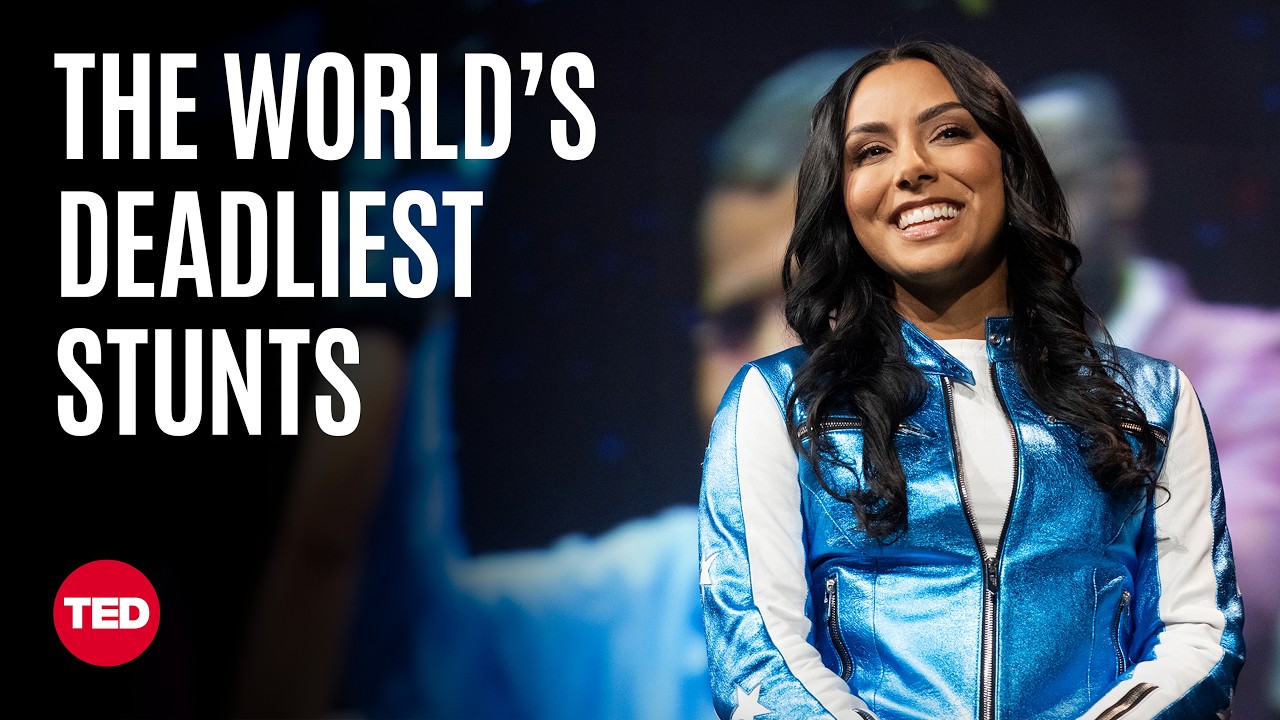
Why I Attempt the World’s Most Dangerous Stunts | Michelle Khare | TED
12:34

Why I Attempt the World’s Most Dangerous Stunts | Michelle Khare | TED

TED 11.12.2025 47 530 просмотров 2 045 лайков обн. 18.02.2026
Поделиться Telegram VK Бот
Транскрипт Скачать .md
Анализ с AI
Описание видео
Daredevil Michelle Khare has trained with Olympians, run seven marathons on seven continents in a single week, and even escaped Harry Houdini's deadliest stunt. She shares how embracing fear, failure and an "amateur’s mindset" transformed her from a cautious child into someone who proves that daredevils aren't born — they're developed. (Recorded at TEDNext 2025 on November 10, 2025) Join us in person at a TED conference: https://tedtalks.social/events Become a TED Member to support our mission: https://ted.com/membership Subscribe to a TED newsletter: https://ted.com/newsletters Follow TED! X: https://www.twitter.com/TEDTalks Instagram: https://www.instagram.com/ted Facebook: https://facebook.com/TED LinkedIn: https://www.linkedin.com/company/ted-conferences TikTok: https://www.tiktok.com/@tedtoks The TED Talks channel features talks, performances and original series from the world's leading thinkers and doers. Subscribe to our channel for videos on Technology, Entertainment and Design — plus science, business, global issues, the arts and more. Visit https://TED.com to get our entire library of TED Talks, transcripts, translations, personalized talk recommendations and more. Watch more: https://go.ted.com/michellekhare https://youtu.be/vE2_KZH8fDQ TED's videos may be used for non-commercial purposes under a Creative Commons License, Attribution–Non Commercial–No Derivatives (or the CC BY – NC – ND 4.0 International) and in accordance with our TED Talks Usage Policy: https://www.ted.com/about/our-organization/our-policies-terms/ted-talks-usage-policy. For more information on using TED for commercial purposes (e.g. employee learning, in a film or online course), please submit a Media Request at https://media-requests.ted.com #TED #TEDTalks #PersonalGrowth
Оглавление (3 сегментов)

  1. 0:00 Segment 1 (00:00 - 05:00) 709 сл.
  2. 5:00 Segment 2 (05:00 - 10:00) 651 сл.
  3. 10:00 Segment 3 (10:00 - 12:00) 252 сл.
0:00

Segment 1 (00:00 - 05:00)

This is me about to perform one of the most dangerous stunts in cinematic history: hanging on the side of a C-130 as it's taking off. No goggles, no helmet, no parachute. This stunt has only ever been performed by one other person on the planet. Tom Cruise. (Laughter) So I think it's fair to say that this is the first time this stunt has ever been attempted by a mere mortal. My name is Michelle Khare, and I created a show on YouTube called "Challenge Accepted," where I attempt the world's toughest stunts and professions. But despite my job title, I was not born a daredevil. I was born a child of immigrants who sacrificed everything to give me a safe, secure, and a chance at a successful life. They gave up so much for me just to exist. So why would I ever risk that? So growing up, I only saw fear as a stop sign. In seventh grade, I was the kid who quit the cheer team when someone else got hurt. And my biggest rebellion in high school was choosing to use the font Gill Sans instead of Times New Roman at the International Science and Engineering Fair. (Laughter) And while this mindset definitely set me up for success, it also left me incredibly lonely as an adult. So I decided to take my first big risk and sign up for something that had absolutely nothing to do with my career: a cycling club. And I was terrible. But I kept coming back because I had something I had never had before: the freedom to fail without consequence. Now most of our learning journeys look something like this. In the beginning, learning something new is really, really fun. And our brain floods with dopamine at any sign of progress. Some people call this beginner's luck, but I think it's much more than that. Amateurs often see progress faster than professionals in this rapid adaptation phase. We have the willingness to ask questions, to look silly trying, to take risks. So it's not luck. I think it's an amateur's mindset. Knowing there's only room for improvement. And this feels great until we hit a plateau. Learning starts to feel like work, we have a little bit of experience, so we start self-judging as we try, and many of us give up here. But if we could find a way to stay in that amateur's mindset, how much further could we go? With cycling, I had somehow found a way to stay in that headspace even as I got better. And if you fast forward two years later, I decided to go to nationals on a whim for fun as an average-ranked racer. During the final event, I decided to take a big risk and sprint ahead of the group. But because nobody was threatened by me, they assumed I would burn out and fall back in with everyone else. But 20 minutes later, to everyone's surprise, including my own, I ended up winning. (Laughter) And it was the first time I had seen success or won something by genuinely just having fun. So I thought to myself: How much of life had I been missing out on because of fear? Could a daredevil be developed? So I wrote out all of my fears on a whiteboard and connected each to a unique circumstance that would force me to address it. I started posting my adventures online as a way to hold myself accountable. To face my fear of being perceived as unintelligent, I studied with chess masters until I hit 1,000 ELO. It took me 10 months. To face my fear of confrontation, I trained with an Olympian to box in front of 12,000 screaming fans. I bloodied my teeth, I broke my nose, but I won the match. (Laughter) And to face my fear of being perceived as unfunny, I joined a professional clowning troupe. And, I'll be honest, there's nothing scarier than standing in front of a group of strangers trying to make them laugh while looking like this. (Laughter) And people really responded. The show has amassed 850 million views. Now fear exists for a good reason. It's to protect us from danger.
5:00

Segment 2 (05:00 - 10:00)

Sometimes fear means, hey, if you do this, you will die. But oftentimes I have found we take that way too far. Fear doesn't always mean stop. Sometimes it means go. Here's an example. A couple of years ago, I became obsessed with Harry Houdini and his deadliest trick: the water torture cell. Bound in chains, locked upside down in a glass box filled to the brim with water, Houdini would escape with a single breath. How could anyone be this brave? So it became my mission to attempt this act, to confront my fear of drowning. Now the average person can hold their breath for 30 to 60 seconds. But for this stunt, I needed a breath hold of three minutes. It may sound crazy, but under the right training and supervision it is possible. But to get there, you have to push through the struggle phase. This is when, as carbon dioxide builds in your bloodstream, your brain thinks you're suffocating and sends signals to your diaphragm to cause violent contractions to force you to breathe. Now for weeks I failed at this edge, and my breath hold times were progressively getting worse. Until my coach told me, "Hey, you can't muscle through. You have to surrender." And when I finally surrendered to the pain, I started noticing all these details I hadn't before. I noticed I was shivering, which meant I was burning valuable oxygen, just trying to stay warm. My wetsuit felt a little too tight, so I actually wasn't able to get a full inhale before I went in. I started noticing all of these little changes that we began to make and address, and it made all the difference. Stripped of the emotional component, fear is simply information. It tells us exactly what we need to know in order to progress. And when we addressed all of these things, everything changed. Six weeks later, I escaped Houdini's trick in two minutes and 40 seconds. (Applause and cheers) This is me in front of a panel of 20 martial arts legends about to fail spectacularly in front of all of them. A black belt in taekwondo typically takes three to five years to earn, but I wanted to see if it would be possible in only 90 days. Everybody thought it was crazy, and many people rightfully questioned if it was even appropriate to do something like this. So I knew I could only progress with the blessing of a respected master. Enter the legendary Grandmaster Simon Rhee. To call this man the best of the best actually is not an exaggeration, because he literally starred in the movie "The Best of the Best" (Laughter) And together, we did what nobody thought was possible. In just 90 days, Master Rhee coached me to pass every single belt test. Yellow, green, blue, red. And I was granted permission to test for the black belt. Now Master Rhee’s belt test is a multi-hour gauntlet. You have to perform hundreds of forms. You have to spar three black belts at once. But for the final step, you have to break a brick with your hand. And after many hours of sweat, I made it here to this final step, the final inch to the finish line for the black belt. And this is what happened. (Video) Permission to break, sir. Master Rhee: Permission granted. So nothing happened. Like not even a crack. And I failed the entire belt test because of it. But Master Rhee had taken a chance on me. He put his reputation on the line to see if this would be possible. And I realized that giving up on this challenge would be worse than giving up on myself. It would be giving up on him. So I kept training for months after this video released on YouTube. And on day 264, this happened. (Screams) (Applause)
10:00

Segment 3 (10:00 - 12:00)

Failure is, as painful as it is, a necessary part of the process. And when we feel disappointment and failure, it's a privilege because it means we care. Which brings us back here. Moments before I attempted the most dangerous stunt of my career. A 10-minute flight pattern with me tethered to the side of this military aircraft. This was the greatest logistical challenge our team had ever faced, and an amateur's mindset was crucial. We had to be unafraid to ask questions, to make mistakes along the way, and be willing to ask for help. On set, we had a "fear is welcome" policy. This meant that at any moment, anyone on the crew could raise a concern and it would be addressed in front of the whole group. This strategy allowed us to fine-tune every single detail, from the custom contact lenses I wore to protect my eyes, to the tightness of the harness, to even the FAA approval paperwork. It was the only way we could ensure, without a doubt, we were ready for the impossible. And with the support of this team, weeks later, it happened. When I set out to make "Challenge Accepted" I assumed there would be a magical moment where I'd finally feel like a daredevil, a woman without fear. But that moment, for better or for worse, actually has never come. But that is exactly why I do these things. Not because I'm unafraid. But actually because I am. Thank you. (Cheers and applause)

Ещё от TED

Ctrl+V

Экстракт Знаний в Telegram

Транскрипты, идеи, методички — всё самое полезное из лучших YouTube-каналов.

Подписаться