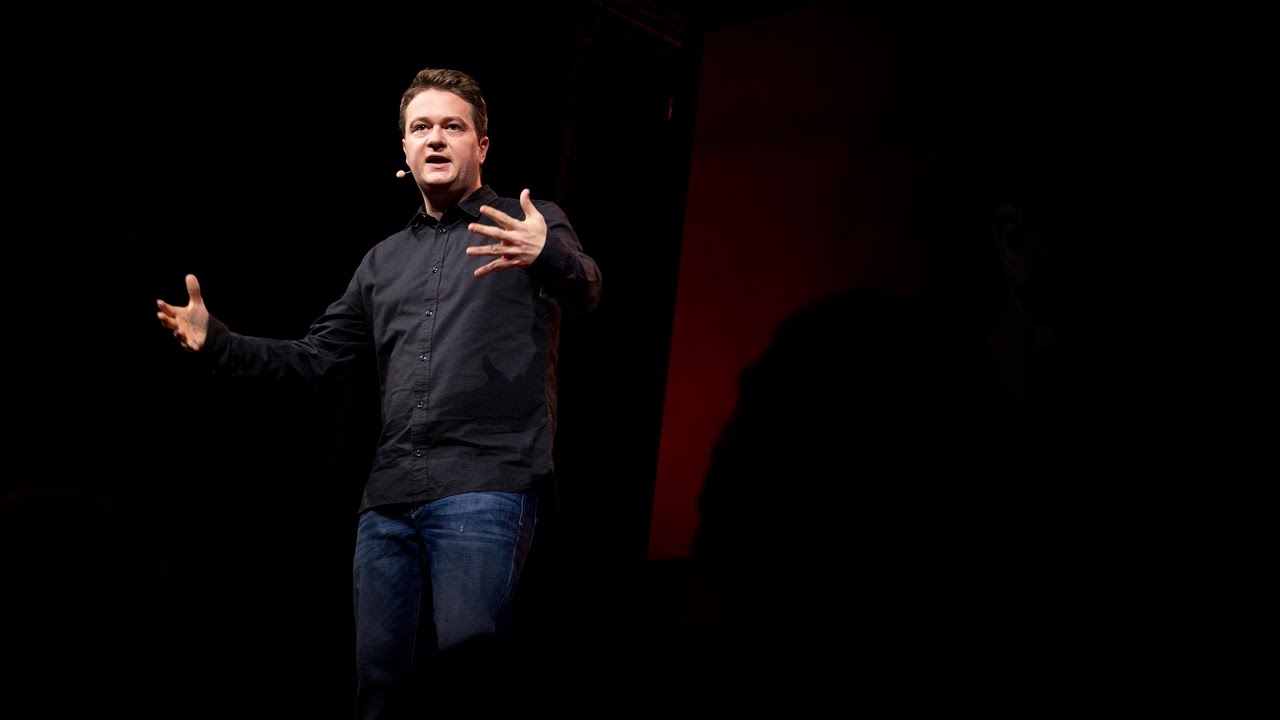
How We Could Solve the Dark Matter Mystery | Chanda Prescod-Weinstein | TED
14:56

How We Could Solve the Dark Matter Mystery | Chanda Prescod-Weinstein | TED

TED 13.07.2022 85 685 просмотров 2 158 лайков обн. 18.02.2026
Поделиться Telegram VK Бот
Транскрипт Скачать .md
Анализ с AI
Описание видео
The universe that we know, with its luminous stars and orbiting planets, is largely made up of elements we can't actually see -- like dark energy and dark matter -- and therefore don't fully understand. Theoretical physicist Chanda Prescod-Weinstein takes us inside the search for this cosmos-shaping invisible matter and explains how, with the help of a new generation of telescopes, we could be closer to demystifying it than ever before. "The universe is more queer and fantastical than it looks to the naked eye," she says. (If you want to hear more from Prescod-Weinstein, check out her episode on "The TED Interview" podcast.) If you love watching TED Talks like this one, become a TED Member to support our mission of spreading ideas: http://ted.com/membership Follow TED! Twitter: http://twitter.com/TEDTalks Instagram: https://www.instagram.com/ted Facebook: http://facebook.com/TED LinkedIn: https://www.linkedin.com/company/ted-conferences TikTok: https://www.tiktok.com/@tedtoks The TED Talks channel features talks, performances and original series from the world's leading thinkers and doers. Subscribe to our channel for videos on Technology, Entertainment and Design — plus science, business, global issues, the arts and more. Visit http://TED.com to get our entire library of TED Talks, transcripts, translations, personalized talk recommendations and more. Watch more: https://go.ted.com/chandaprescodweinstein https://youtu.be/h6pHoIT-CkM TED's videos may be used for non-commercial purposes under a Creative Commons License, Attribution–Non Commercial–No Derivatives (or the CC BY – NC – ND 4.0 International) and in accordance with our TED Talks Usage Policy (https://www.ted.com/about/our-organization/our-policies-terms/ted-talks-usage-policy). For more information on using TED for commercial purposes (e.g. employee learning, in a film or online course), please submit a Media Request at https://media-requests.ted.com #TED #TEDTalks

Оглавление (10 сегментов)

  1. 0:00 Intro 304 сл.
  2. 2:09 How did the universe get this way 269 сл.
  3. 4:09 Cosmic accounting 232 сл.
  4. 5:45 What is dark matter 189 сл.
  5. 7:04 Dark matter in galaxy clusters 95 сл.
  6. 7:43 The Venn diagram 361 сл.
  7. 10:00 Visualizing dark matter 123 сл.
  8. 10:50 Quantum classification 154 сл.
  9. 11:53 Axion condensate 164 сл.
  10. 12:59 Conclusion 260 сл.
0:00

Intro

When we look at the night sky, we see a vast cosmos filled with stars and galaxies and dust, a cosmos teeming with luminous phenomena. So we've all heard some version of that famous Carl Sagan line, "We are made of star stuff." And it's true, we are. And that makes it easy to believe that what matters is what's visible -- us, the trees, the stars -- because it helps us feel connected to everything that we can see. Today, we know that everything visible in the universe is composed from a basic set of building blocks known as elementary particles. We call this incredibly elegant picture the standard model of particle physics, and we understand it in great mathematical detail. Comprehending the standard model is an enormous achievement. But we are now certain that it describes very little of what's out there. It turns out that most of the stuff which fills our universe is completely invisible to us. In other words, visible matter, the kind that we and the stars are made from, the kind that radiates light, is not what's normal. And we, the luminous matter, we are the cosmic weirdos. So how do we know? Well, consider this invisible nonbinary person, who's hiding in plain sight inside of their suit. We can't exactly see a person, but we know that they're there, because the suit is filled out. So the presence of the invisible enby is governing how the suit hangs in space-time. So we can see a similar effect with visible matter. We can see that stars and galaxies are affected by the presence of something more, something completely invisible to us. So we now know that the universe is more queer and fantastical than it looks to the naked eye. (Cheers) (Laughter) That's right. (Laughter and applause)
2:09

How did the universe get this way

So how did the universe get this way, and what exactly is inside? So I'm a theoretical physicist with expertise in particle cosmology. And it's my job to use math to study the origin and evolution of space-time and every single thing that's inside of it. I connect the very small -- elementary particles -- with the extremely large -- galaxies and galaxy clusters, and I'm a griot of the universe. I develop creative mathematical narratives that may just be our cosmic origin story. Now as a theoretical physicist, I really love doing math and coming up with different ideas that may describe our mostly invisible universe. But it's important to be accountable to data too, the real stuff. So after mathematics, my second favorite tool for addressing these large cosmological questions is the biggest laboratory we know, the universe itself. Observatories with capabilities from visible light to high-energy X-ray and gamma-ray photons are still some of the best ways to gain insight into what's going on in space-time, with the invisible stuff. So what you're looking at here is the Vera C. Rubin Observatory, an exciting new facility that's about to see its first light over the next two years. It's a leading example of a new generation of telescopes that are going to change the way we see this mostly invisible universe. Now it's also the case that swarms of satellites threaten images from ground-based facilities like this one. But the Vera C. Rubin Observatory can help us understand where the invisible stuff is and what it's doing, which will help us determine what exactly it is.
4:09

Cosmic accounting

So when it comes to the cosmic accounting, here is what we know so far. We're in the midst of a great cosmic drama, where space-time is curved and it’s expanding. And the history and future of that curvature and expansion is determined by what's inside, which is mostly not visible stuff like us -- that's only about five percent. The majority of the energy-matter content in the universe is something that we call dark energy. So empty space seems to have an energy associated with it. And that's increasingly affecting how space-time expands. After dark energy, the second-largest ingredient is something that we call dark matter. So here's the funky thing about dark matter. Unlike dark energy, it gravitates exactly like visible matter. But it's completely unlike us in every other way. So you might be thinking, "OK, dark matter. It clearly has a color associated with it." It's dark, like my pants. Right? But the first thing you should know about dark matter is that it doesn't have a color, and at least at first approximation, light seems to go right through it, so we can't see it. It's invisible, maybe transparent, maybe clear. So if you put out your hands and think about the weight of having a clump of dark matter in your hands -- that's how it would feel, but your hands would look exactly the same.
5:45

What is dark matter

Today, we believe that 80 percent of the normally gravitating matter in the universe is dark matter. Dark matter is dominant on the outskirts of galaxies, and it affects stellar motions on the edges. This effect is actually how Vera C. Rubin and Kent Ford found the first substantive evidence for the existence of dark matter. What you're looking at here is an artist's rendering of our own galaxy, the Milky Way, and it's enveloped in a halo of dark matter, represented here by a blue gas. We believe that every single galaxy, or almost every single galaxy, lives inside of a dark matter halo. And we think that they're not alone. The Milky Way itself has around 60 gravitationally bound satellite galaxies that are in its orbit. Some of these, you may have seen when observing the night sky, or you may have heard of, like the Large Magellanic Cloud and the Small Magellanic Cloud. Each of these satellites lives inside of its own dark matter subhalo. So, like the invisible enby in their suit, the presence of dark matter is affecting how galaxies are distributed throughout space-time.
7:04

Dark matter in galaxy clusters

So we can also reverse-engineer where dark matter is -- it's represented here by the bluish purple. We can look at how images of galaxy clusters are distorted, which tells us something about how dark matter is distorting space-time. So we know something about how much dark matter there is, and even how the dark matter is distributed, but what kind of particle is it? So all that we know is that it's beyond standard-model physics. It's not like any of the particles that we have ever seen or had any kind of contact with.
7:43

The Venn diagram

Alright, so this seems like a potentially terrifying, intractable problem, because we're talking about something that we can't see, something that we can't touch. You might be thinking, "OK, they haven't had many ideas about that over the years, because that just seems really hard." Right? So here's the Venn diagram to end all Venn diagrams. (Laughter) [Theories of Dark Matter] So I'll bet y'all a hundred dollars that you can't find a better one. At least according to me. (Laughter) So Tim Tait created this diagram to help us visualize just some of the hypotheses that physicists have had over the years to explain the dark matter problem and how these ideas overlap with each other. So as you all can see, there's a lot happening here, right? And hopefully, it's becoming increasingly clear that this isn't just an astrophysics problem of galaxies and galaxy clusters, but this is also a particle physics problem. In order to understand what's happening on the largest scales, we need to understand something very small, like a new particle, or maybe primordial black holes. So you've been looking at this for a moment, and you know what you're all really thinking is, "What's Chanda's favorite dark matter candidate?" Right? This is what you're dying to know? So, I'll end the suspense by telling you... that my favorite candidate is something called the axion. This is the hypothetical particle. And the first thing that I want to tell you about the axion is that it was almost called the higglet... (Laughter) And whoever chose "the axion" just completely blew it, OK? I'm pretty bummed about that. But the axion is a compelling particle, because it's a twofer: it addresses a problem that we already had, a conflict between theory and experiment in the realm of quark physics. "OK," you say, "but, like, how can I visualize it?" At this point in the talk, you should know better, right? Because to first approximation, dark matter is invisible. (Laughter) But I know you really want a visual, so I'm going to give you one. Here's what it looks like to me, in my everyday work. (Laughter) (Applause)
10:00

Visualizing dark matter

Which is to say, it's OK if this is unintuitive. (Laughter) The universe is a wonderfully strange and fantastical place, and that's why humans as a species have always wanted to study it. And this is why we have so much fun, trying to understand it. So how are we going to go looking for the axion or any other dark matter particle? You might think that we have to use traditional particle physics approaches, like colliders, where we smash particles together and see what comes out. But astrophysical signals have something to say. Telescopes from across the electromagnetic spectrum -- for example, the proposed NASA facility, the STROBE-X X-ray space telescope -- can help us potentially determine what exactly dark matter is.
10:50

Quantum classification

But telescopes look at the very large. How can we use the extremely large to understand something so small? Well, in the case of the axion, it helps to pay attention to its quantum classification. So all particles come in one of two quantum categories, fermions and bosons. So fermions, even when things get cold, like to keep their distance from each other. They're antisocial. That's how it is. Bosons, on the other hand, when they get below a critical temperature, they're like five-year-olds on a soccer field, so they don't have a concept of formation, they just bunch up together. So in technical terms, we call this the formation of a Bose-Einstein condensate, where all the particles come together and act like one superparticle. So importantly, axions are bosons, and so now you have a sense of why I like working with them. I'm completely enamored with the idea of axion Bose-Einstein condensates.
11:53

Axion condensate

So usually, we talk about creating these quantum states in the lab, using atoms, but now, we're talking about the possibility of new, maybe galaxy-scale Bose-Einstein condensates made out of dark matter. So what you're looking at here is a simulation developed by a team that I lead. It's an axion condensate orbiting a central mass. So it's like a subhalo orbiting its host galaxy. Maybe the Large Magellanic Cloud orbiting the Milky Way. As you can see, over the age of the universe, the subhalo starts to get torn apart, and what my team's work shows is that the way that this happens with axions is different than with other dark matter candidates, because it goes into this special condensate state. Now imagine the possibility that there's more than one type of dark matter candidate. Maybe there's more than one type of dark matter particle? How much richer this picture can be. There's no cosmic rule that says there can only be one.
12:59

Conclusion

So in the end, I expect the universe to force us to reevaluate what we thought we knew. [Making the invisible visible.] When we honor the land and the sky... as our galactic relations... and their Indigenous stewards, it becomes possible for us to imagine new ways of being in good relations with each other. That's why I, as a Black queer person, am so proud to follow in the footsteps of my ancestors, who studied and dreamed with the night sky, sometimes of freedom. Astronomers like Harriet Tubman, for whom the recently launched James Webb Space Telescope should be renamed. (Applause) I honor the gay NASA employees who were persecuted under the leadership of JWST's namesake, even as I share in the tremendous community-wide excitement for what that facility is going to teach us about dark matter. And I honor the memory of Vera C. Rubin, the astronomer who first asked me, as a young, terrified graduate student, "How do you think we should solve the dark matter problem?" We live in an amazing time to be doing dark matter research. Over the next decade, we're going to see the universe with incredible accuracy and clarity thanks to these new telescopes on the ground and in the sky. We'll probably get some answers, but we're going to get a host of new questions. And my team? We're going to be ready. So the search for dark matter is on. What's your favorite candidate? (Laughter) If it's not an axion, you better fix that. (Laughter) Thank you. (Cheers and applause)

Ещё от TED

Ctrl+V

Экстракт Знаний в Telegram

Транскрипты, идеи, методички — всё самое полезное из лучших YouTube-каналов.

Подписаться