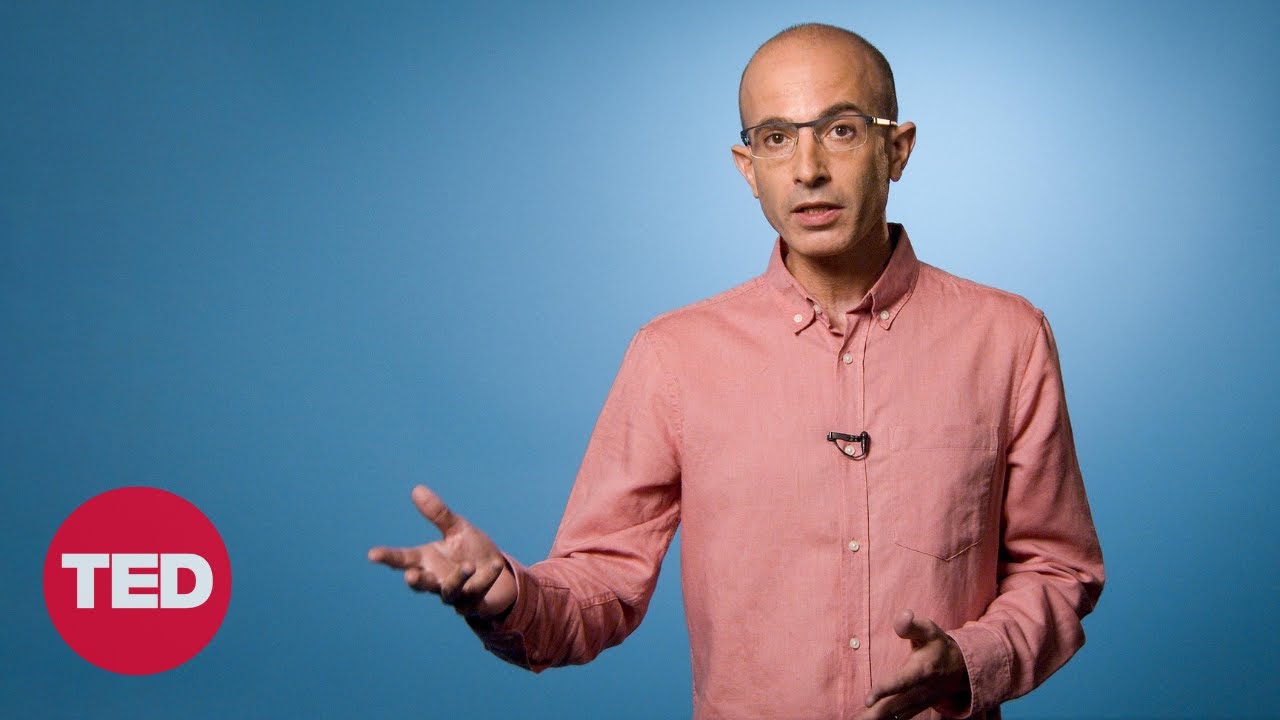
Yuval Noah Harari: The Actual Cost of Preventing Climate Breakdown | TED
10:26

Yuval Noah Harari: The Actual Cost of Preventing Climate Breakdown | TED

TED 17.06.2022 218 403 просмотров 8 202 лайков обн. 18.02.2026
Поделиться Telegram VK Бот
Транскрипт Скачать .md
Анализ с AI
Описание видео
Nobody really knows how much it would cost to avoid the worst impacts of climate change. Yet historian Yuval Noah Harari's analysis, based on the work of scientists and economists, indicates that humanity might avert catastrophe by investing the equivalent of just two percent of global GDP into climate solutions. He makes the case that preventing ecological cataclysm will not require the major global disruptions many fear and explains that we already have the resources we need -- it's just a matter of shifting our priorities. Countdown is TED's global initiative to accelerate solutions to the climate crisis. The goal: to build a better future by cutting greenhouse gas emissions in half by 2030, in the race to a zero-carbon world. Get involved at https://countdown.ted.com/sign-up Learn more about #TEDCountdown: Twitter: https://twitter.com/TEDCountdown Instagram: https://www.instagram.com/tedcountdown Facebook: https://www.facebook.com/TED Website: https://countdown.ted.com Watch the full 2021 TED Countdown Global livestream here: https://youtu.be/SG_vqlb1pOQ If you love watching TED Talks like this one, become a TED Member to support our mission of spreading ideas: http://ted.com/membership Follow TED! Twitter: http://twitter.com/TEDTalks Instagram: https://www.instagram.com/ted/ Facebook: http://facebook.com/TED LinkedIn: https://www.linkedin.com/company/ted-conferences/ TikTok: https://www.tiktok.com/@tedtoks The TED Talks channel features talks, performances and original series from the world's leading thinkers and doers. Subscribe to our channel for videos on Technology, Entertainment and Design — plus science, business, global issues, the arts and more. Visit http://TED.com to get our entire library of TED Talks, transcripts, translations, personalized talk recommendations and more. Watch more: https://go.ted.com/yuvalnoahharari2022 https://youtu.be/SiCvGQnweAg TED's videos may be used for non-commercial purposes under a Creative Commons License, Attribution–Non Commercial–No Derivatives (or the CC BY – NC – ND 4.0 International) and in accordance with our TED Talks Usage Policy (https://www.ted.com/about/our-organization/our-policies-terms/ted-talks-usage-policy). For more information on using TED for commercial purposes (e.g. employee learning, in a film or online course), please submit a Media Request at https://media-requests.ted.com #TED #YuvalNoahHarari
Оглавление (10 сегментов)

  1. 0:00 Intro 39 сл.
  2. 0:24 Lets talk numbers 106 сл.
  3. 1:16 The bottom line 102 сл.
  4. 2:04 Investments 117 сл.
  5. 3:02 Plan of Action 159 сл.
  6. 4:25 Priorities 253 сл.
  7. 6:25 Thought Experiment 88 сл.
  8. 7:12 Stimulus 45 сл.
  9. 7:36 Where does the money go 135 сл.
  10. 8:45 Tax evasion 196 сл.
0:00

Intro

As the climate crisis worsens, too many people are swinging from denial straight to despair. But we should not lose hope. Humanity has enormous resources under its command, and by applying them wisely, we can still prevent ecological cataclysm.
0:24

Lets talk numbers

Let's talk numbers. What would it cost to prevent catastrophic climate change? Would we have to commit 50 percent of our total budget? Thirty percent? Ten percent? Naturally enough, no one knows for sure. My team and I have spent weeks poring over various reports and academic papers living in a cloud of numbers. But while the models behind the numbers are dizzyingly complex, the bottom line should cheer us up. Most experts converge on the number two percent. If humanity increases our annual investment in clean technologies and infrastructure by around two percent of global GDP, that should be enough to prevent catastrophic climate change.
1:16

The bottom line

If you want to see how experts got to that number, you're welcome to visit the Sapienship website. We can, of course, argue endlessly about the exact number, tweaking the models this way and that way. But we should look at the big picture. The crucial news is that the price tag of preventing the apocalypse is in the low single digits of annual global GDP. Even the more pessimistic models generally estimate it at below five percent. And most models say it requires investing only an additional two percent of global GDP in the right places. And note the word investing.
2:04

Investments

We are not talking about burning piles of banknotes in some huge sacrifice to the spirits of the Earth. We are talking about making investments in new technologies and infrastructure, such as advanced batteries or other technologies to store solar energy and updated power grids to distribute it. These investments will create lots of new jobs and economic opportunities and are likely to be economically profitable in the long run, in part by reducing health care expenditures and saving millions of people from sickness caused by air pollution. In addition, since oil and gas often prop up autocratic and militaristic regimes, reducing our dependence on fossil fuels will be a huge boon to democracy and to peace.
3:02

Plan of Action

All this can be translated into a concrete political plan of action. We have learned in recent years to define our goal in terms of one number: 1.5 degrees Celsius. We can define the means to do this with another number: two percent. Increased investment in clean technologies and infrastructure by two percentage points of global GDP, above 2020 levels. Of course, unlike the 1.5 Celsius figure, which is a scientifically robust threshold, the two-percent figure represents only a rough guesstimate. It should be understood as a ballpark figure that can help to frame the kind of political project humanity requires. It tells us that preventing catastrophic climate change is a totally feasible project, even though it would obviously cost a lot of money. Since global GDP in 2020 was about 85 trillion US dollars, we are talking about a number around 1.7 trillion US dollars. But that's still just two percent. This means that to save the environment
4:25

Priorities

we don't need to completely derail the economy or to abandon the achievements of modern civilization. We just need to get our priorities right. Committing two percent of annual global GDP is far from the whole story, of course. It won't solve all our ecological problems, such as oceans brimming with plastic or the continued loss of biodiversity. And even to prevent catastrophic climate change we'll need to make sure that the funds are invested in the right places and that the new investments don't cause their own negative ecological or social fallout. We will also need to change some of our behaviors and ways of thinking from what we eat to how we travel. None of that will be easy. But that's exactly why we have politicians. Their job is to deal with the hard stuff. And politicians are actually very skilled at shifting two percent of resources from here to there. It's what they do all the time. The difference between the policies of right wing and left wing parties often amounts to a few percentage points of GDP. When faced by a major crisis, politicians swiftly shift far more resources to fight it. For example, in 1945, the US spent about 36 percent of its GDP on winning the Second World War. During the 2008-2009 financial crisis, the US government spent about 3.5 percent of GDP to save financial institutions that were deemed "too big to fail." Maybe humankind should also treat the Amazon rainforest as too big to fail.
6:25

Thought Experiment

Let's try a thought experiment. Given the current price of cleared rainforest land in South America and the size of the Amazon rainforest, buying the [whole] of it in order to protect local forests, biodiversity and human communities from destructive business interests would cost about 800 billion dollars, or a one-off payment of less than one percent of global GDP. In just the first nine months of 2020, governments around the world announced stimulus measures worth nearly 14 percent of global GDP to deal with the COVID-19 pandemic.
7:12

Stimulus

If citizens pressed them hard enough, politicians can do the same to deal with the ecological crisis. So can investment banks and pension funds. Pension funds hold over 56 trillion US dollars. What's the point of having a pension if you don't have a future?
7:36

Where does the money go

At present, most businesses and governments are unwilling to make the additional two-percent investment necessary to prevent catastrophic climate change. Where does that money go instead? Well, every two years, approximately 2.4 percent of global GDP is spent on food that goes to waste. Governments also spend about 500 billion US dollars annually on -- wait for it -- direct subsidies for fossil fuels. That means that every 3.5 years governments write a nice fat check for an amount equivalent to two percent of annual global GDP and gift it to the fossil fuel industry. And it gets worse when you factor in the social and environmental costs that the fossil fuel industry causes but isn't asked to pay for, the value of these subsidies actually reaches a staggering seven percent of annual global GDP.
8:45

Tax evasion

Now consider tax evasion. It's estimated that the money hidden by the wealthy in tax havens is worth around 10 percent of global GDP. Every year, another 1.4 trillion dollars in profits is stashed offshore by corporations, which is equal to 1.6 percent of global GDP. To prevent the apocalypse, we'll probably need to impose some new taxes. But why not start with collecting the old ones? Such examples can be multiplied. But you get the picture. The money is there. Of course, collecting taxes, stopping food wastage and slashing subsidies is easier said than done, especially when faced by some of the most powerful lobbies in the world. But it doesn't require a miracle. It just requires determined organization. So we shouldn't succumb to defeatism. Whenever someone says, "It's too late, the apocalypse is here," reply, "Nah, we can stop it with just two percent." And when COP 27 convenes in Egypt in November 2022, we should tell the attending leaders that it's not enough to make vague future pledges about 1.5 degrees Celsius. We want them to take out their pens and sign a check for two percent of annual global GDP. Thank you.

Ещё от TED

Ctrl+V

Экстракт Знаний в Telegram

Транскрипты, идеи, методички — всё самое полезное из лучших YouTube-каналов.

Подписаться