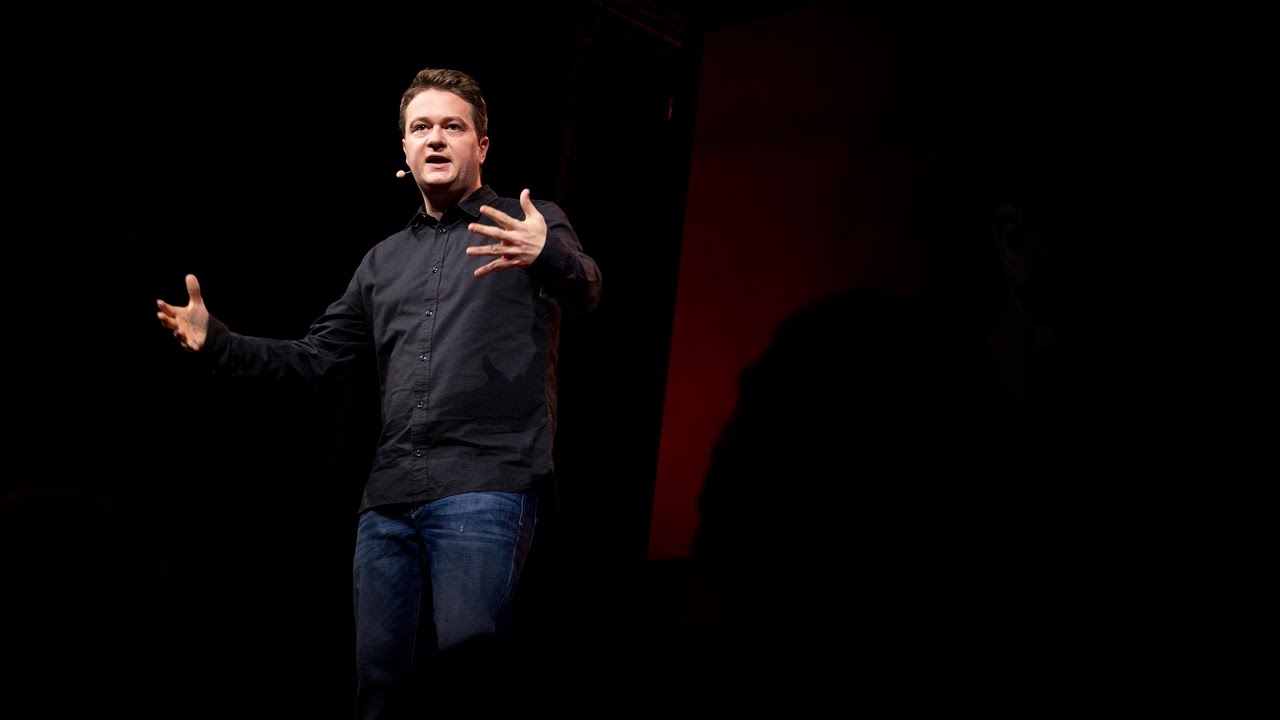
A Brain Implant That Turns Your Thoughts Into Text | Tom Oxley | TED
12:42

A Brain Implant That Turns Your Thoughts Into Text | Tom Oxley | TED

TED 02.06.2022 210 344 просмотров 6 062 лайков обн. 18.02.2026
Поделиться Telegram VK Бот
Транскрипт Скачать .md
Анализ с AI
Описание видео
What if you could control digital devices using just the power of thought? That's the incredible promise behind the Stentrode -- an implantable brain-computer interface that collects and wirelessly transmits information directly from the brain, without the need for open surgery. Neurotech entrepreneur Tom Oxley describes the intricacies of this breakthrough technology, which is currently enrolling participants in human trials, as well as how it could help restore dignity to those with disabilities -- and transform the future of communication. If you love watching TED Talks like this one, become a TED Member to support our mission of spreading ideas: http://ted.com/membership Follow TED! Twitter: http://twitter.com/TEDTalks Instagram: https://www.instagram.com/ted Facebook: http://facebook.com/TED LinkedIn: https://www.linkedin.com/company/ted-conferences TikTok: https://www.tiktok.com/@tedtoks The TED Talks channel features talks, performances and original series from the world's leading thinkers and doers. Subscribe to our channel for videos on Technology, Entertainment and Design — plus science, business, global issues, the arts and more. Visit http://TED.com to get our entire library of TED Talks, transcripts, translations, personalized talk recommendations and more. Watch more: https://go.ted.com/tomoxley https://youtu.be/7Fiaew7nDmE TED's videos may be used for non-commercial purposes under a Creative Commons License, Attribution–Non Commercial–No Derivatives (or the CC BY – NC – ND 4.0 International) and in accordance with our TED Talks Usage Policy (https://www.ted.com/about/our-organization/our-policies-terms/ted-talks-usage-policy). For more information on using TED for commercial purposes (e.g. employee learning, in a film or online course), please submit a Media Request at https://media-requests.ted.com
Оглавление (14 сегментов)

  1. 0:00 Intro 249 сл.
  2. 1:45 Group Chat 80 сл.
  3. 2:20 The Dream 75 сл.
  4. 2:51 Locked In Syndrome 72 сл.
  5. 3:23 Connection 88 сл.
  6. 4:02 Utah Array 78 сл.
  7. 4:33 Brain Surgery 310 сл.
  8. 6:33 Clinical trials 126 сл.
  9. 7:34 The centroid 153 сл.
  10. 8:34 How it works 179 сл.
  11. 9:43 Building Blocks 111 сл.
  12. 10:32 Scalable 88 сл.
  13. 11:02 The future of communication 122 сл.
  14. 11:56 What if 76 сл.
0:00

Intro

A few months ago, I surrendered the password to my Twitter account to let a person with paralysis tweet out their thoughts. But I mean that literally. Philip O'Keefe can't use his fingers to type like you or I, but thanks to a tiny brain implant, he was able to send the following tweets. "Hello world! Short tweet. Monumental progress." "No need for keystrokes or voices. I created this tweet just by thinking it." "My hope is that I pave the way for people to be able to tweet through thoughts. Phil." Now you might be thinking there are some people out there who should not be allowed to tweet directly from their brain. (Laughter) I agree. But for people with paralysis and disability, this technology can be life-changing. I’m very excited to introduce you to Philip and Rodney. They both have a neurodegenerative disease called ALS, means they can't move their hands or speak clearly, but they can now text thanks to a brain-computer interface or BCI. There were Philip’s brain signals up on the screen. They’re connected to their computers via Bluetooth. The device is fully internalized, invisible to the outside world, and they learn to control the keyboard with clicks directly coming from their brain. Now BCIs conjure up images of science fiction like "The Matrix" with a cable jacked up into your brain through a hole in your skull. But I'm here to show you that the future can be much more elegant than that.
1:45

Group Chat

So we got this group chat going, which I thought was a great idea, until they started roasting me about the TED Talk -- (Laughter) Which they found hilarious. Thanks for the vote of confidence, guys, bloody Australians. (Laughter) Now you can see it's still quite slow for them to type this way, but this is like dial up speeds at the beginning of the Internet. This is a new Moore's Law. We're just getting started. (Laughter) (Applause) That's Philip.
2:20

The Dream

This has been the dream of patients and caregivers, doctors and scientists, for decades, and for good reason. You may know someone who's lost the ability to use their hands, maybe from a stroke or a spinal cord injury or multiple sclerosis, paralysis. It comes in all shapes and sizes, from minor inconvenience to life-threatening. During my neurology residency, I cared for a man in his 40s. He had a stroke and developed locked-in syndrome.
2:51

Locked In Syndrome

Meant he couldn't move his body, except for his eyes, left or right. His brain still worked like yours. He could see and hear and think and feel just like normal, but he couldn't move or speak ever again. And in what were horrific circumstances, we supported his wish to be taken off life support. And so I've been wondering ever since, was there not anything else that could have been done?
3:23

Connection

Connection is a fundamental human need. So many of our patients have lost the ability to speak, let alone type, for years, and they so desperately want to reconnect with their family, with their loved ones. You know what the main request we get is? Text messaging. And then email. Control over their smartphone. And shock horror, social media. We've been speaking so much lately about the flaws of these technologies, but for people with paralysis, this is a return to life. BCIs make all of this possible.
4:02

Utah Array

Now, part of the problem has been that BCIs typically require invasive surgery. This is the Utah Array. This is designed similarly to all other BCIs currently under development, which require drilling needles directly into the brain. Now, this has been the basis of critical fundamental research over the last 20 years and the early proof that this technology really can perform. But for patients, it means open-brain surgery, which involves cutting through the skull with a saw.
4:33

Brain Surgery

And there are only about 150 functional neurosurgeons in the US that can perform this procedure. Apart from the fact that the recovery is tricky, the brain doesn't really like having needles put into it. It develops this foreign-body tissue rejection immune reaction over time. So I've been wondering, is there any other way into the brain? And there is, a secret back door. The blood vessels are the natural highways into the brain. These are hollow tubes that connect every corner of the brain. The largest vein at the top there is right next to the motor cortex. The exact part of the brain that we want to connect to restore control to the outside world. How cool is that? Now we already know how to travel through the blood vessels. We've been doing it for 40 years, mostly going to the heart. If anyone here today has had a heart attack, there's a pretty good chance you've had a stent. A stent is a metal scaffold delivered through a catheter, which opens up like a flower into the blood vessel. Millions of stents are delivered each year, not in the OR, but in the cath lab or catheter laboratory. It's now common in the cath lab to navigate up into the brain through the blood vessels. And there are 2,500 physicians who can now navigate their way up into the brain. But what's really amazing about this is that for BCIs we already know that devices can be left inside a blood vessel, cells grow over it, incorporate it into the wall like a tattoo under the skin, and we're protected from that immune reaction. This is part of the reason why our team became the first in the world to receive a green light from the FDA to conduct clinical trials of a permanently implanted BCI. (Applause)
6:33

Clinical trials

So what we had to do was figure out a way to put a sensor, connected to this crosslinks of the stent that could record that brain activity. To do that, we had to do a complete overhaul of stent manufacturing. This is the end result. I think it's very beautiful. Then connect it to a cable which brings the information out of the brain and do it all in a way that it can be delivered in the cath lab. This way we can make BCI accessible not to the thousands of people, but to the millions of people who need this technology. So it wasn't easy, took us ten years, but I'm very excited to show you guys. We called this the Stentrode. (Applause)
7:34

The centroid

Graham Felstead, an incredible human being suffering with ALS, became the first person in the world to receive and use one of these brain-computer interfaces. And he has very generously offered you, the world, a chance to see what it looks like inside his brain. Would you like to see? Audience: Yes! TO: Seeing this video for the first time was one of the most incredible moments of my life. I was standing in the cath lab, Dr. Peter Mitchell had just completed the surgery and you can see the device, the outline of device, sitting inside the blood vessel there. So this popped up on the screen and it just felt like we were witnessing something new in the world. I had tingles down my spine, I've got them now thinking about it again. I turned to my colleague Pete, and I said something poetic and profound like, "Pete, holy shit!" (Laughter)
8:34

How it works

And then two hours later, something even more amazing happened. Graham woke up, and he asked, “Am I alive?” And our nurse Kristine broke out in tears of relief. It was a phenomenal moment. Once it's in place, it's connected to this tiny antenna that sits under the skin in the chest. This collects the raw brain data and sends it out of the body wirelessly to then connect with external devices. It's always on and ready to go. Kind of like how your brain is meant to work. So here's how it works. Our engineers work with our patients to decode specific movements. So we tell the patient, “Press down your foot.” So they'll repeatedly press down their foot. You won't see the foot moving because they're paralyzed, but we've been able to determine which brain signals are generally linked to “Press down your foot.” The black dotted line is the moment of pressing down the foot, and you can see the brain signal is different before to after, which means we can turn that into a switch.
9:43

Building Blocks

Now we repeat this for several different types of movements, say, open/close your hand or pincer-grip your finger. Now, that may not seem like much, but these become the building blocks for every single interaction on a digital device that is needed for control. Converted to click, up, down, left, right, menu, back, etc. But what's really amazing is that to some degree, this process, our brain signals, are universal. So the brain signal for “Press down your foot” for me is the same as it is for you. Now this means that we're creating a dictionary of the brain across all humans. This is going to make BCI truly scalable.
10:32

Scalable

As Philip once said to me, "It's kind of like learning how to ride a bike. It takes a bit of practice, but once you're rolling, it becomes natural. Now I just look on the screen where I want to click and I'm texting, messaging the world via Twitter." But Graham, he said, as his ALS was progressing, that it gave him immense comfort to know that even if his body was failing, he was always going to be able to tell his wife that he loved her.
11:02

The future of communication

In the future, I'm really excited about the breakthroughs BCI could deliver to other conditions like epilepsy, depression and dementia. But beyond that, what is this going to mean for humanity? What's really got me thinking is the future of communication. Take emotion. Have you ever considered how hard it is to express how you feel? You have to self-reflect, package the emotion into words and then use the muscles of your mouth to speak those words. But you really just want someone to know how you feel. For some people with certain conditions, that's impossible. So what if, rather than using your words, you could throw your emotion just for a few seconds? And have them really feel how you feel.
11:56

What if

At that moment, we would have realized that the necessary use of words to express our current state of being was always going to fall short. The full potential of the brain would then be unlocked. But for right now, BCI is about restoring the lives of millions of people with paralysis. After years of feeling trapped, this technology promises the return of autonomy and independence. But what I really mean is dignity. Thank you. (Applause)

Ещё от TED

Ctrl+V

Экстракт Знаний в Telegram

Транскрипты, идеи, методички — всё самое полезное из лучших YouTube-каналов.

Подписаться