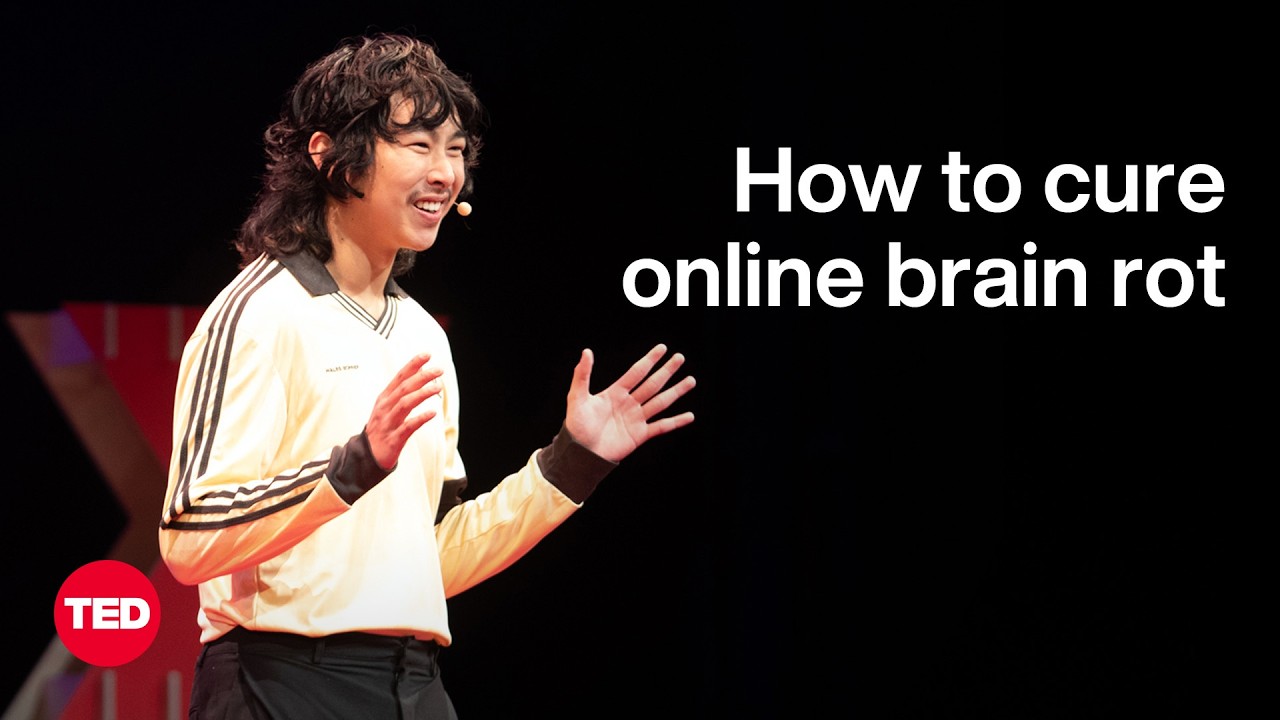
Before algorithms ruled our feeds, the internet was a mess — glitchy, chaotic and full of unexpected magic. Internet culture writer Michael Sun reflects on the wild digital world of the 2000s — and makes a funny, wry case for why we need to reclaim its spontaneity, weirdness and genuine connection. From niche Facebook groups to loading music onto your iPod, it might be time to borrow from the past. (Recorded at TEDxYouth@Sydneyon May 24, 2023)
Join us in person at a TED conference: https://tedtalks.social/events
Become a TED Member to support our mission: https://ted.com/membership
Subscribe to a TED newsletter: https://ted.com/newsletters
Follow TED!
X: https://www.twitter.com/TEDTalks
Instagram: https://www.instagram.com/ted
Facebook: https://facebook.com/TED
LinkedIn: https://www.linkedin.com/company/ted-conferences
TikTok: https://www.tiktok.com/@tedtoks
The TED Talks channel features talks, performances and original series from the world's leading thinkers and doers. Subscribe to our channel for videos on Technology, Entertainment and Design — plus science, business, global issues, the arts and more. Visit https://TED.com to get our entire library of TED Talks, transcripts, translations, personalized talk recommendations and more.
Watch more: https://go.ted.com/michaelsun
https://youtu.be/1o7znNK19Pk
TED's videos may be used for non-commercial purposes under a Creative Commons License, Attribution–Non Commercial–No Derivatives (or the CC BY – NC – ND 4.0 International) and in accordance with our TED Talks Usage Policy: https://www.ted.com/about/our-organization/our-policies-terms/ted-talks-usage-policy. For more information on using TED for commercial purposes (e.g. employee learning, in a film or online course), please submit a Media Request at https://media-requests.ted.com
#TED #TEDTalks #Technology
Оглавление (3 сегментов)
Segment 1 (00:00 - 05:00)
Let me tell you a story. This story begins in the summer of 2008. It's one of those scorching summers where everything stops and time itself seems suspended. I'm 11 and sitting in front of the computer for days on end, melting into my chair. Somehow my dad has found this website that he claims is this cool, new virtual-reality experience. And I'm 11, which means I still trust my dad. So I hop on this site, right? It's called ExitReality, which is exactly what I want to do, because it's 42 degrees outside and there's no air con in our apartment. If you know what Second Life is, it's kind of like that. You can make your own avatars in the most rudimentary 3D graphics I have ever seen in my life. And then supposedly you can meet with and talk to other avatars in this endless expanse of digital landscape engulfed in a permanent sunset. But because it is 2008, everything freaks out when you press any button, and the lag is enough to give anyone anxiety. I mean, I already had anxiety as an 11-year-old, so it made me want to literally die. But I persevered even though there's nary a soul in sight. I key-smashed my way through pixelated deserts and abandoned streets. And then, in the corner of my screen, something appears. Someone appears. Their avatar is wearing a leather jacket and a mohawk. So I approached them and I'm like, "Hey, nice mohawk. " Once again, I'm 11, so please withhold your judgment, I'm begging you. We start chatting and he tells me his name is Tommy, and then he asks "ASL? " Which, of course, means age, sex, location. And obviously I'm like, "17, male, Canada," even though I'm an 11-year-old boy living in northwest Sydney. (Laughter) We added each other on MSN, and we start talking for hours a day. I'm talking hours since both of us are horny teens or tweens, in my case, with absolutely nothing better to do. He tells me his favorite band is Death Cab for Cutie, and I'm like, "Oh my God! Same! " Even though the only thing on my iPod is Coldplay. (Laughter) And then suddenly, we fall out of contact. I'm not sure how it happened, but it was devastating. Pulverizing. One day we were talking for hours and the next we just weren't? My first real heartbreak, though certainly not my last online boyfriend. Now you might be wondering why I’m telling you this story. And it's not just because I love embarrassing myself on stage. Tommy, if you're listening, please DM me, I'm desperate. No, I'm just kidding. I'm telling you this story because I know you have a similar one. Especially if you also grew up in the days of the early internet, right? Maybe you also got your heart broken by some guy you'd never met. Or maybe you were less dramatic than I was and just made a friend on Club Penguin. Or God forbid, Habbo Hotel. What I'm saying is this: we should return to the days of the early internet, the Wild West of the internet, where everything felt a little looser, a little jankier, a little more spontaneous, where you, too, could meet the love of your life and get ghosted as an 11-year-old. (Laughter) Where discovery still felt possible. Here's the thing. The internet, as it is right now, is more restricted than ever, right? More corporate, more buttoned up, more difficult to find things outside of what we actually want to see and what's fed to us algorithmically. I'm an internet culture writer, and my screen time is 12 hours a day, which means I'm clinically insane. But even if you use the internet like, a normal amount, I'm sure you'll have noticed that the internet today is a very different place to what it was five, 10, 15 years ago. The internet, as it is right now, is both vaster and harder than it ever has been. If you're on TikTok, which I think most of you are, you'll know that micro trends pop up at the speed of light, then disappear into the ether, never to be spoken of again. As an experiment, I wrote down a list of things that were going viral on TikTok about a month ago while I was writing this talk, right? Here's that list now. "The Hunger Games," OK. Vodka pasta sauce. Flavored water, "WaterTok" and unicorn syrup. Being a "la la girl" versus being an "OK, OK, OK girl. " I mean, none of these words are in the Bible, right? If you cast your mind back even further, the trends become even more meaningless. I'm talking "coastal grandma aesthetic. " I'm talking "frazzled English woman. " I’m talking the return of twee, pasta chips, whimsy goth
Segment 2 (05:00 - 10:00)
dark academia, Barbiecore. What do these words even mean? (Laughter) We are cycling through content at such a velocity that things become old news the second they hit the feed. Even me standing here right now, telling you that things are happening faster. You guessed it, that's old news too. To quote one famous meme, “Everything happens so much. ” All of this means that it's harder to see the things that we actually want to see. We're losing control, this is not new. But what if there was a solution? What if we could turn back time? bring back some of the features that made the early internet so utopian, so lawless, so full of spontaneous connection and random experimental zeal? Well, we can. So the first solution is the galaxy brain solution, of course. It's to repurpose our existing platforms into spaces that feel like the early internet again. For the past couple of years, I've been turning to niche Facebook groups as replacements for the early internet forums of the 2000s. I know I’m going to sound like the world’s oldest zoomer right now. But back in my day, we had these forums with message boards where you could message people about your specific interests, things like Fall Out Boy and other emo bands, countercultures and various subcultures, PlayStation games, etc, etc. For the past decade or so, a smorgasbord of Facebook groups have popped up kind of in their place. They act very similarly to these forums. There are groups for public transport stans. architecture heads who just really love stairs. There are groups for sharing disgusting photos of terrible food. I mean, there is a group for everyone, OK? called Subtle Asian Traits that many of you might have heard of, and it's literally just a group about being Asian. And it has two million members, making it one of the biggest Facebook groups, right? Now is the peak time of absolute chaos. We are living in a time when everyone, even your aunt's friend who keeps sending you minion memes, has left Facebook. Which means the only people left in these groups are truly the most desperate, the most committed, the most insane, the people who have thrown all caution to the wind and said, "Who cares," to any given conventions of social media. These spaces are completely shielded from the frenetic, demanding nature of online life today. You can choose whether to post or not, whether to engage take things further or not. You most likely won't know anyone else in these groups. There are hardly any celebrities either, in these groups, no one's in it to be seen. Being in these groups is truly like experiencing the last, almost, utopia online. Now there is also an easier solution, but you need to bear with me, OK, because I know it sounds super dumb. The solution is to talk to your friends. And I promise I don't mean this in a kind of "get off your phones, we live in a society" kind of way, OK? Promise. I mean, talking to your friends and asking them what they're listening to, what they're consuming, what they've come across on their feeds. The worst thing about the algorithm is that it's so tailored to us that it can feel inescapable. But the best thing about the algorithm is that it's so tailored to us that no two feeds are the same. Your friend is listening to a song that you would have never encountered. Your parents are on a side of YouTube that you didn't even know existed. Your aunt's friend is still sending you minion memes, OK? I want every person in this room to try one thing after this. Open up your phones, you have permission, open any app and show the person next to you the first thing on your feed. You might be surprised at how strangely vulnerable the experience is and also how surprising the results are. I mean, this is how I found out that my partner's TikTok feed was 90 percent musical theater content, which made me question all of my life choices. But ignoring that, looking at your phone and looking at someone else's feed can help us bring back the randomness of the early internet. Think back to me and Tommy, for example. What we shared was a random, fleeting encounter which couldn't have happened anywhere else but online or at any other time but the early internet. That phase might be long gone, but we can still bring back the emotional high
Segment 3 (10:00 - 10:00)
of spontaneity, of discovery. So go forth and be crazy again. Go and have your heart broken by some guy who lives three continents away from you. Go and discover a corner of the internet previously hidden from you. Go and be a tween online again, and go and turn the clock back to 2008. (Applause)