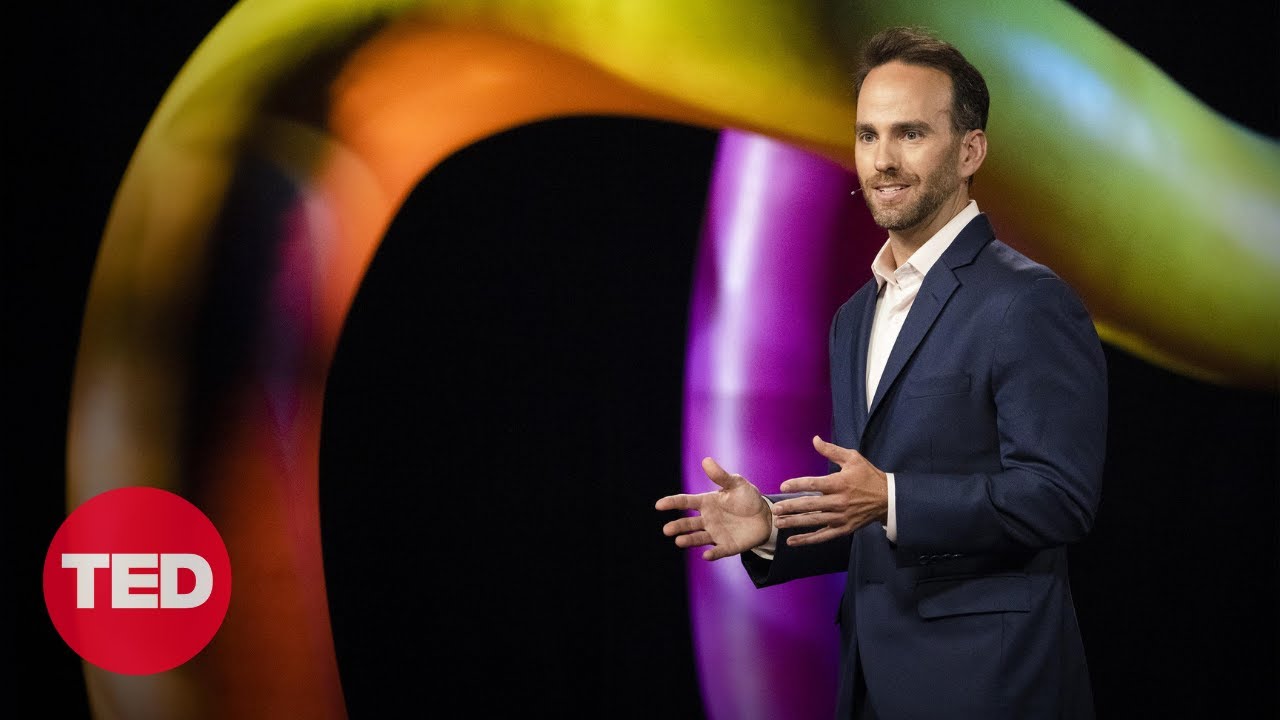
Josh Giegel: Super speed, magnetic levitation and the vision behind the hyperloop | TED
8:37

Josh Giegel: Super speed, magnetic levitation and the vision behind the hyperloop | TED

TED 27.01.2022 43 605 просмотров 1 096 лайков обн. 18.02.2026
Поделиться Telegram VK Бот
Транскрипт Скачать .md
Анализ с AI
Описание видео
What if your hour-long commute was reduced to just minutes? That's the promise of the hyperloop: a transit system designed around a pod that zooms through a vacuum-sealed space (roughly the size of a subway tunnel) at hyper-speed, powered by next-generation batteries and state-of-the-art magnetic levitation. In the visionary talk, Josh Giegel, the hyperloop's very first passenger, shares how this zipping innovation could launch us into a faster, cleaner future of transportation. Visit http://TED.com to get our entire library of TED Talks, transcripts, translations, personalized talk recommendations and more. The TED Talks channel features the best talks and performances from the TED Conference, where the world's leading thinkers and doers give the talk of their lives in 18 minutes (or less). Look for talks on Technology, Entertainment and Design -- plus science, business, global issues, the arts and more. You're welcome to link to or embed these videos, forward them to others and share these ideas with people you know. Become a TED Member: http://ted.com/membership Follow TED on Twitter: http://twitter.com/TEDTalks Like TED on Facebook: http://facebook.com/TED Subscribe to our channel: http://youtube.com/TED TED's videos may be used for non-commercial purposes under a Creative Commons License, Attribution–Non Commercial–No Derivatives (or the CC BY – NC – ND 4.0 International) and in accordance with our TED Talks Usage Policy (https://www.ted.com/about/our-organization/our-policies-terms/ted-talks-usage-policy). For more information on using TED for commercial purposes (e.g. employee learning, in a film or online course), please submit a Media Request at https://media-requests.ted.com

Оглавление (6 сегментов)

  1. 0:00 Intro 121 сл.
  2. 0:50 What is a Hyperloop 162 сл.
  3. 1:43 The problem 226 сл.
  4. 3:13 The prototype 273 сл.
  5. 4:53 The mission 236 сл.
  6. 6:31 The first attempt 330 сл.
0:00

Intro

Imagine you're planning a trip up the coast, but instead of driving, you decide to hop into a vehicle shaped like a giant aluminum can. Your heart pounds as you strap yourself in. The air is stagnant. Beads of sweat are pooling on your brow as you prepare to launch. The vehicle starts to move. Before you know it, you're going 500 miles per hour. You hope that the people in control know what they're doing. Turns out that's just your average airplane experience. And 118 years ago, before the Wright brothers' first flight, the thought of humans flying was inconceivable -- crazy, even. Yet today, we get into a plane, 30,000 feet above the ground, and think nothing of it.
0:50

What is a Hyperloop

A year after the Wright brothers' historic first flight, another inventor, an American physicist called Robert Goddard, proposed an entirely new form of transportation: the vactrain. He envisioned a high-speed mass transit system where people would travel on the ground, with little to no air resistance, inside of a tube. And today, these are some of the earliest renderings of what we call a hyperloop. So for those of you unfamiliar with the hyperloop, this is the chance we get to geek out together a bit. So hyperloop is a transit system that has a vehicle called a pod inside of a tube about the same size as a subway tunnel, where we suck most, but not all of the air out of it, making it the equivalent of flying at about 200,000 feet of altitude. This allows us to glide at airline speeds, without turbulence, for a fraction of the energy consumption, about one tenth, to be precise, of an aircraft.
1:43

The problem

And that's important, because we, as humans, have an innate need for speed. But this obsession with speed and volume is destroying the planet around us. In fact, in the United States, the transportation industry is the single largest contributor to greenhouse gas emissions. A hyperloop system can begin to change this trend before the end of the decade, by transforming short-haul journeys and commutes from hours to minutes. Our system is inspiring a new category of companies dedicated to bringing this to life. But it's going to take more than just vision. History's full of ideas that have flopped and flourished, and this one’s just too important for us not to get right. So I am an engineer, and I am insatiably curious and always love a good problem. So in 2013, when Elon Musk released the "Hyperloop Alpha" white paper, of course, I was going to give it a read. It sketched out an idea with an open invitation for anyone to take it from a concept and design it to reality. We decided to not only make it tangible but make it safe, sustainable and economically viable. And we were so convinced that we could make it work that I quit my job to build it. I thought I was being optimistic. My wife, on the other hand, thought I was completely delusional.
3:13

The prototype

Either way, we heard over and over that building a functional hyperloop was unrealistic. But for each "no" we heard, we dove deeper and deeper into the science and the engineering and showed that it was in fact possible, but it was going to be no easy feat for us to build something that had never existed. So our early prototypes started with the traditional concept that maglev uses, that is, where the track controls the vehicle. But something about that just wasn't quite right for a hyperloop system. So for months, I had been noodling on how to make our system future-proof. And while I was on a bike ride in the mountains above Los Angeles, I came around a bend. A 1933 Ford Roadster followed by a Tesla Model S passed me. Those two cars are light-years different in technology, yet they drive on the same passive road. And there it was. Smart vehicle, dumb road. Or in the case of a hyperloop, smart pod, dumb tube. So technology has made it possible that a car can be modular, upgradeable and future-proof, while the road stays pretty much the same. So for a hyperloop, our tube is passive and simple, like the road, but our modular pods can evolve as technology advances, just like the automobile. So we now had our vision. The next thing we had to do is assemble the team. So we've all seen a "Mission Impossible" movie in this room, and there's always a scene in those movies where someone lays out a task or plan calmly. But what they lay out is completely and totally insane.
4:53

The mission

So for a hyperloop, our mission that we've chosen to accept is to build the world's largest vacuum structures, devise new passive magnetic guideways, create pods capable of withstanding a space environment, powered by next-generation batteries while levitating using state-of-the-art magnetic levitation, while quietly accelerating, using the world's most efficient linear electric motor. (Laughter) Everyone turns to the engineer. I have to make that possible, or we have to make that possible. Luckily for us, we have more than just one of those engineers, we have a few hundred that have designed reusable rockets, spaceships, autonomous aircraft, electric vehicles, AI systems and loads of other cool things. And after building that system, we created a test track in the desert outside of Las Vegas. We've operated the system over 500 times and had countless other tests on our subsystems. But there was one test that was going to be the defining moment for hyperloop technology: the first passengers in the vehicle. And we were going to do it with regular people that didn't need years of training and experience to set foot inside of a space capsule. So by October of 2020, we had run hundreds of tests, some with these extremely handsome mannequins that you see here. We had an independent safety auditor give us the green light, but still, it was nerve-racking. We were boldly going where only these handsome mannequins had gone before.
6:31

The first attempt

And on November 8th, 2020, we made our first attempt. So at our test site, my colleague Sara and I climbed into that can-like vehicle suspended by magnetic levitation at a near-vacuum environment, and the countdown began. In those 15 seconds, we showed the world that what was deemed ludicrous over 100 years ago was in fact possible. That brief moment has opened so many doors for us. We've had conversations in the US, Europe, India, the Middle East, about building hyperloop systems in the next 10 years. This is the start of a systemic change in the way we travel. Simply put, society has moved forward, as we've moved faster. The railroad ushered in the industrial revolution, the airplane forever changed the way we move. But today, we’re at an inflection point. Nations around the world are looking for ways to reduce carbon emissions, but at the same time, we need to get where we're going in minutes, not hours. We also need to invest in infrastructure that can meet the needs of the 21st century, and beyond. And so my hope for a hyperloop system is that it can transform the way that we live -- we can live where we want to live, work where we want to work, we can create a world in which your daughter, who lives in Los Angeles, can go surfing in Santa Cruz and be home in time for lunch. A world in which 150 million people can live in Mumbai and travel to Pune, the equivalent distance of Philadelphia to New York, in 30 minutes, not four hours, while saving 1.1 million tons of pollution each and every year. The last century started with two people riding on a plane, and it ended with millions of people flying all over the world. This decade started with two people riding on a hyperloop system, and my hope is that by the end of it, you'll ride one too. Thank you. (Applause)

Ещё от TED

Ctrl+V

Экстракт Знаний в Telegram

Транскрипты, идеи, методички — всё самое полезное из лучших YouTube-каналов.

Подписаться