Climate Action Tracker: The state of the climate crisis in 2021 | TED
5:33

Climate Action Tracker: The state of the climate crisis in 2021 | TED

TED 01.10.2021 159 243 просмотров 4 035 лайков обн. 18.02.2026
Поделиться Telegram VK Бот
Транскрипт Скачать .md
Анализ с AI
Описание видео
Take action on climate change at http://countdown.ted.com. 2021 is a critical year for climate change. According to the Paris Climate Agreement, governments must decide now on how to reduce the amount of carbon they pump into the atmosphere in order to avoid the most devastating consequences of global warming. So, are we on track to limit global warming to only 1.5 degrees Celsius? The Climate Action Tracker explains the good news and the bad news for the planet. (Updated June 2021) This talk was part of the Countdown Global Launch on 10.10.2020. (Watch the full event here: https://youtu.be/5dVcn8NjbwY.) Countdown is TED's global initiative to accelerate solutions to the climate crisis. The goal: to build a better future by cutting greenhouse gas emissions in half by 2030, in the race to a zero-carbon world. Get involved at https://countdown.ted.com/sign-up Become a TED Member: http://ted.com/membership Follow Countdown on Twitter: http://twitter.com/tedcountdown Follow Countdown on Instagram: http://instagram.com/tedcountdown Subscribe to our channel: http://youtube.com/TED TED's videos may be used for non-commercial purposes under a Creative Commons License, Attribution–Non Commercial–No Derivatives (or the CC BY – NC – ND 4.0 International) and in accordance with our TED Talks Usage Policy (https://www.ted.com/about/our-organization/our-policies-terms/ted-talks-usage-policy). For more information on using TED for commercial purposes (e.g. employee learning, in a film or online course), please submit a Media Request at https://media-requests.ted.com
Оглавление (5 сегментов)

  1. 0:00 Introduction 62 сл.
  2. 0:28 Paris Agreement 102 сл.
  3. 1:09 Net Zero 319 сл.
  4. 3:05 The next 9 years 86 сл.
  5. 3:37 Conclusion 307 сл.
0:00

Introduction

2021 is a crucial year in the fight against climate change. According to the Paris Agreement timetable, this year, governments must make key decisions on updating their climate action plans. Are we on track to meet the goal of limiting global warming to 1.5 degrees Celsius? There is good news and bad news, and the details matter, so let's explore the data.
0:28

Paris Agreement

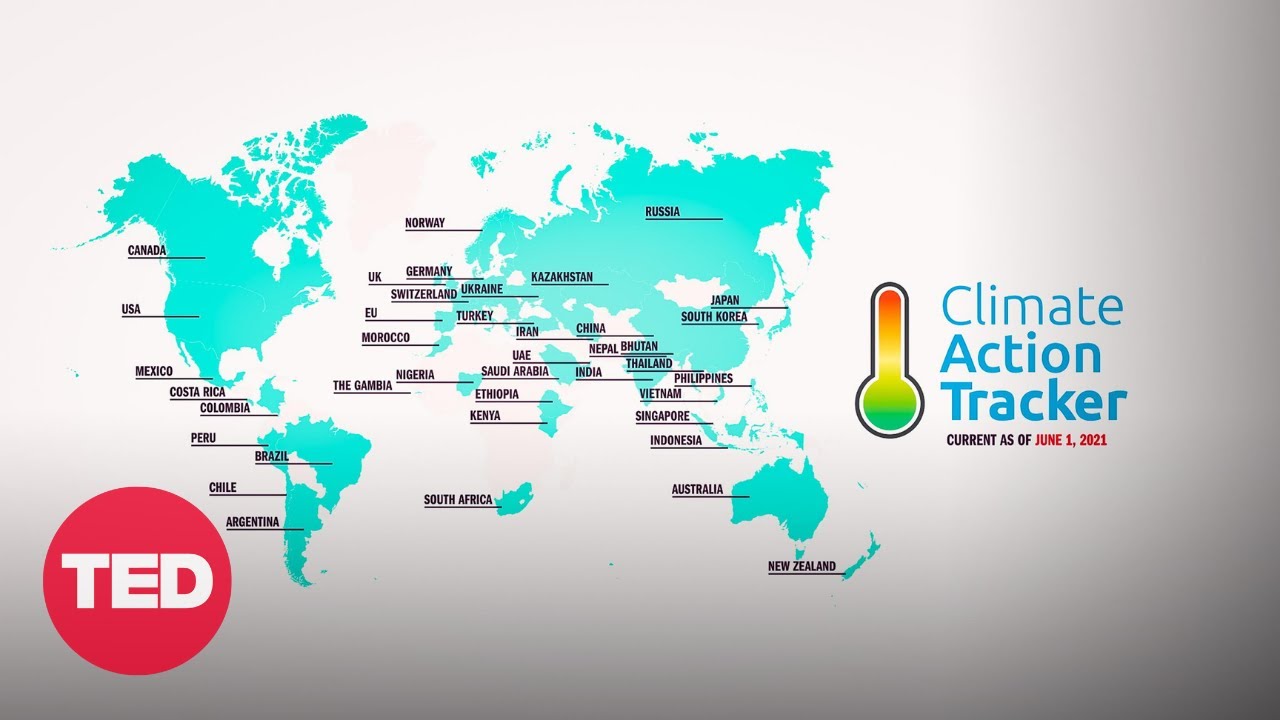
Under the 2015 Paris Agreement, all countries agreed to hold the global average temperature increase well below 2 degrees Celsius, and to pursue efforts to limit it to 1.5 degrees Celsius. Scientists, including the IPCC, tell us that to meet this 1.5-degree warming limit, global greenhouse gas emissions need to be cut in half by 2030, and carbon dioxide emissions need to reach net zero by around 2050 -- an enormous but achievable challenge. The information presented here is from the Climate Action Tracker, a project that monitors national commitments and actions and is current as of the 1st of June, 2021.
1:09

Net Zero

The good news has to do with 30 years from now. Increasingly, governments are pledging to reduce emissions to net zero by the middle of the century, which would be in line with the Paris Agreement's goals. There are already 131 national governments that have adopted net zero targets or are discussing them. Those targets would cover 73 percent of current global greenhouse gas emissions. They include the European Union, which has enshrined this goal into law, the UK, South Africa, Japan, South Korea, Canada, China and the United States, as well as several small island nations. However, the currently implemented actions of all countries will do little more than stop an increase in future emissions. That will put us on a trajectory for an estimated warming of 2.9 degrees Celsius by 2100, and lead to catastrophic climate change. Under the Paris Agreement, countries have to put forward formal, updated commitments to achieve the global target. In the last few months, the EU, the US, China and others have done so, and we estimate that their full implementation could bring us on a path to the warming of 2.4 degrees Celsius by 2100. Already better, but still far from 1.5. There is a more optimistic case. Let's assume all the commitments and stated intentions become policies, and are followed by actions, including the net zero targets under discussion or not yet officially submitted under the Paris Agreement. This would put the world on a trajectory to keep global warming to 2 degrees Celsius by 2100. Additional increases in ambition could bring the 1.5-degree Celsius target, theoretically, within reach. But that's in theory. The actual short-term actions and plans don't yet match the long-term intentions, and that's the bad news. No one will be surprised by the fact that short-term actions, which may determine electoral outcomes, are more timid than long-term commitments that will fall on future governments to execute.
3:05

The next 9 years

But it is the next nine years that will determine if we can achieve the target of net zero by mid-century. The first milestone is 2030. By then, emissions will need to be halved for the world to be brought onto a 1.5-degree Celsius pathway. If we miss the 2030 milestone, making up for it later will be increasingly expensive or even impossible. But with currently proposed actions, even the targets announced in recent months, global emissions would barely stabilize until 2030, leaving an enormous gap.
3:37

Conclusion

It is not in the spirit of the Paris Agreement for countries to simply resubmit the same target as five years prior, or to offer different targets that don't actually lead to lower emissions. This is, unfortunately, the case so far for Australia, Mexico, Russia, Singapore, Switzerland and Vietnam. South Korea and New Zealand say they will come up with new targets before the end of the year. Perhaps the worst case is Brazil, whose new stated target would lead to emissions increasing from its earlier promise. These countries need to reconsider their decisions. And finally, there are still dozens of countries that have not made a new announcement for 2030, such as Indonesia and India, though they do still have some time before the COP26 Conference to formalize their proposals. So in summary, the picture is more hopeful than ever, if we look at the stated 2050 goals, but the actual short-term climate actions won't get us there. There is good news elsewhere. We can sometimes be surprised by the speed at which an entire sector can flip. For example, renewable energy is the new normal for new power production capacity worldwide, because it's cheaper. Many major automakers are transitioning to electric cars, and the financial sector seems to have started the movement out of investing in fossil fuels. Also, the first countries have announced they will stop extracting fossil fuels entirely. The world needs to find that kind of serious, bold leadership to bring us onto a safer path. And keep in mind that if we don't reach 1.5 degrees Celsius, then the next target isn't two degrees, but 1.6 degrees Celsius. The impacts of global warming already being felt will hit in a nonlinear, exponential way. So when it comes to climate change, every year, every action and every tenth of a degree matters.

Ещё от TED

Ctrl+V

Экстракт Знаний в Telegram

Транскрипты, идеи, методички — всё самое полезное из лучших YouTube-каналов.

Подписаться