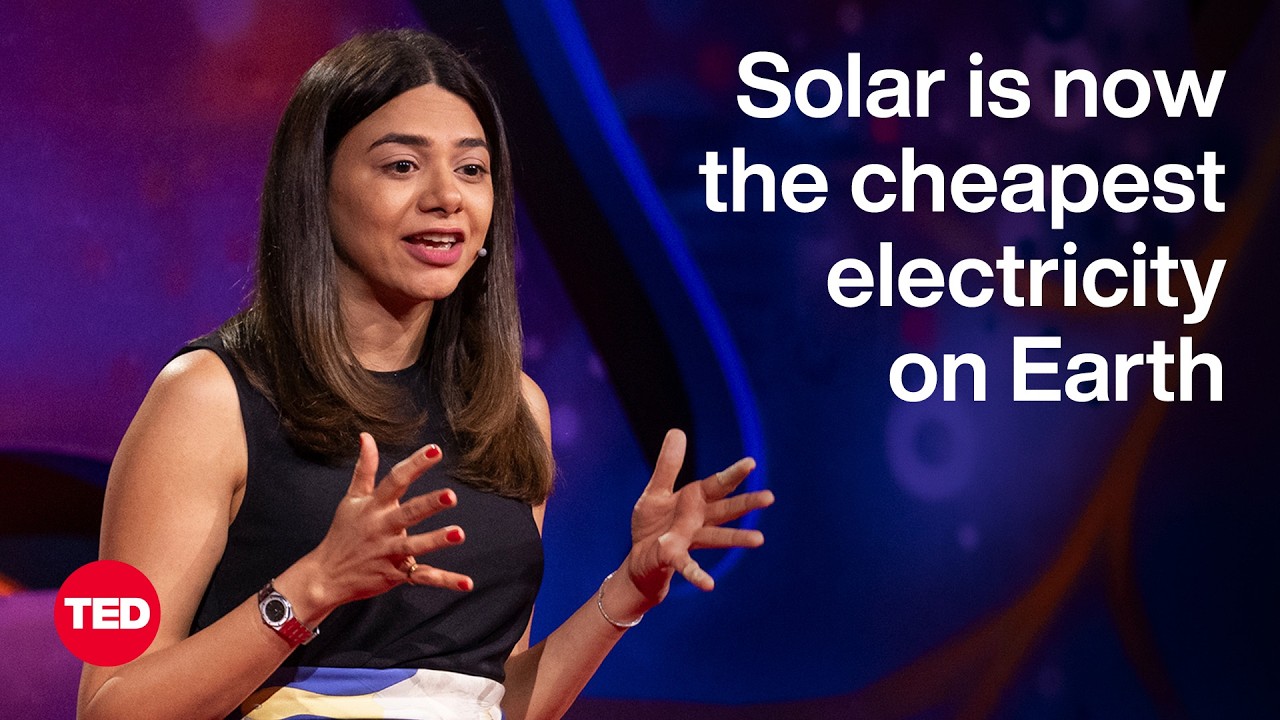
Inside India’s Astonishing Solar Revolution | Kanika Chawla | TED
9:05

Inside India’s Astonishing Solar Revolution | Kanika Chawla | TED

TED 23.10.2025 122 234 просмотров 2 888 лайков обн. 18.02.2026
Поделиться Telegram VK Бот
Транскрипт Скачать .md
Анализ с AI
Описание видео
In 2014, the world’s second largest coal consumer made a bold promise: to increase its solar capacity from three gigawatts to 100 gigawatts in just eight years. Many people called it overly ambitious, but energy expert Kanika Chawla saw the opportunity of a lifetime. She tells the story of how India became a solar powerhouse, turning an expensive dream into an economic reality — and creating a model for other countries to follow suit. (Recorded at TED Countdown Summit 2025 on June 17, 2025) Join us in person at a TED conference: https://tedtalks.social/events Become a TED Member to support our mission: https://ted.com/membership Subscribe to a TED newsletter: https://ted.com/newsletters Follow TED! X: https://www.twitter.com/TEDTalks Instagram: https://www.instagram.com/ted Facebook: https://facebook.com/TED LinkedIn: https://www.linkedin.com/company/ted-conferences TikTok: https://www.tiktok.com/@tedtoks The TED Talks channel features talks, performances and original series from the world's leading thinkers and doers. Subscribe to our channel for videos on Technology, Entertainment and Design — plus science, business, global issues, the arts and more. Visit https://TED.com to get our entire library of TED Talks, transcripts, translations, personalized talk recommendations and more. Watch more: https://go.ted.com/kanikachawla https://youtu.be/DxFZ3ojl9yo TED's videos may be used for non-commercial purposes under a Creative Commons License, Attribution–Non Commercial–No Derivatives (or the CC BY – NC – ND 4.0 International) and in accordance with our TED Talks Usage Policy: https://www.ted.com/about/our-organization/our-policies-terms/ted-talks-usage-policy. For more information on using TED for commercial purposes (e.g. employee learning, in a film or online course), please submit a Media Request at https://media-requests.ted.com #TED #TEDTalks #ClimateChange

Оглавление (2 сегментов)

  1. 0:00 Segment 1 (00:00 - 05:00) 707 сл.
  2. 5:00 Segment 2 (05:00 - 09:00) 550 сл.
0:00

Segment 1 (00:00 - 05:00)

In 2014, India made a commitment to install 100 gigawatts of solar power by 2022. At the time that it made this commitment, it had an installed capacity of three gigawatts of solar power, so it was basically committing to doubling its solar capacity every 18 months. The audacity of this commitment left the world divided. The world's third-largest energy consumer and second-largest coal consumer was betting on solar. And while many thought that this goal was unrealistic and overly ambitious, others, like me, thought it was all very exciting and potentially the opportunity of a lifetime. As it turns out, I was right. And India reached this milestone in February 2025, becoming one of the first few countries in the world to do so, and simultaneously unlocking 90 billion dollars in investment and creating 300,000 new solar jobs. (Applause) For India, the solar revolution has become something of a gift that keeps on giving. It has catapulted India into a global climate leader, while boosting power supply in the country to end blackouts and brownouts for local communities. This is why it is committed to keep going. It is now working on a goal of 500 gigawatts of clean power by 2030, which basically means that in 2030, every second electron used in India, be it in a household, in industry or in transport, would come from a clean power source. (Applause) To meet this solar revolution has been a beacon of hope, not just for the scale of the ambition, but for the motivation behind it. India did not bet on solar for ideological reasons. It bet on solar for economic ones. It was early to see what most of the world can see clearly today. That the transition to renewable energy is good economics. This has been my primary takeaway from the work that I've done with a range of countries over the last 15 years. I've spent much of that time trying to answer a question that many of you may be thinking about right now, which is: The commitments are all well and good, but how are we going to pay for it? Especially in developing countries where the cost of finance continues to be high, where as much as 70 percent of the cost of a single solar electron could be from the cost of capital. And unsurprisingly, the answer is through innovation. And while technology innovation has rapidly brought down the price of solar energy, making it the cheapest source of electricity in every single market in the world, technology innovation alone is not getting it done. India's solar story is as much a story about business models and market design as it is about technology. For instance, when India first made this commitment, the private sector responded with eagerness. Developers and manufacturers came readily to India's solar party, but capital remained elusive. Much of this power that India wanted to deploy would have to be bought by its electricity utilities. And these electricity utilities have chronically been in very bad financial health. So adding large shares of variable solar, which at the time was still a bit more expensive, into their mix, was not going to make their life any easier. And so they delayed payments to solar developers, putting many of them out of business and spooking investors. This was not a great look for a country that was trying to raise 100 billion dollars of solar investment. But the government experimented. It worked with state governments around the country to get them to demand solar power from their electricity utilities. It worked with other large consumers, like the railways, to get them to act as anchor customers for the development of new solar parks. And finally, it worked with development partners to make sure that the energy infrastructure was fortified so that more solar energy could be integrated into the grid. This did not solve all of the problems of India's electricity utilities, but it did make sure that these utilities paid their solar bills on time. And that was enough to get capital to also come to India's solar party. So this very exciting revolution was really built on the back of some quite boring things.
5:00

Segment 2 (05:00 - 09:00)

Things like plans and policies and business models. But this is not unique to India. A lot of examples from around the world of countries using some of these same boring tools to unlock large solar gains has given me this belief that the road from ambition to action can be distilled down into three distinct levels. To me, these are planning, innovation and localization. Plans are really what make commitments real. A really good example of this is the work that we at Sustainable Energy For All have done with the government of Ghana. Ghana already had a net-zero commitment to get to net zero by 2070. But it was in the making of this plan that they were able to look at the evidence, as well as look at the trade offs and not just develop a how-to guide, but actually plan to get to this net zero now by 2060. But plans have to be put into motion. And this is where innovation comes in. And developing countries are hotbeds for innovation. For instance, in sub-Saharan Africa, where the scaling of small solar solutions is curtailed not just by their financial viability, but also by quality concerns, an innovative results-based financing mechanism that structures the payment partly at the start of a project and partly at the end of a project, once quality checks have been made, addresses both these risks. One such facility leveraged 13.5 million dollars to unlock 55,000 new connections across five countries. And finally, the energy transition is a story about creating value and prosperity. And this is where localization becomes really important. For example, here in Kenya, a renewable energy powerhouse, where 90 percent of its power already comes from clean energy sources, putting it well on its way to reach its goal of 100 percent clean power by 2030. But in this pursuit, Kenya imported 50 million dollars' worth of solar panels in a single year alone. This is money it sent out of the country, but the government is having none of it anymore. It is now developing special manufacturing zones that will not just keep this money in the country, but also create jobs for local Kenyans. (Applause) These are not isolated examples. These are evidence that the energy transition is already underway. That the energy transition is irreversible, and that it's being driven by developing countries. Eighty-four percent of the world's population lives in a developing country. That is four out of every five people in this world live in a developing country. These are countries in motion. They need more energy to meet unmet demand, to power their economies and to create jobs for their youth. The choices that they make to meet this demand, the fuels that they decide to use, will determine what the emissions of the future look like. But they're already choosing renewable energy. And they're choosing renewables because renewables is good economics. And they now know that it offers them opportunities for growth, development and prosperity. It is now up to all of us to enable these countries at scale, using the seemingly boring tools of planning, of market design and of capacity building to keep this momentum up. Because the time is right and we can't stop now. Thank you. (Applause)

Ещё от TED

Ctrl+V

Экстракт Знаний в Telegram

Транскрипты, идеи, методички — всё самое полезное из лучших YouTube-каналов.

Подписаться