Why Indian Startups Are Unprofitable
38:43

Why Indian Startups Are Unprofitable

Varun Mayya 09.03.2026 93 186 просмотров 3 845 лайков

Machine-readable: Markdown · JSON API · Site index

Поделиться Telegram VK Бот
Транскрипт Скачать .md
Анализ с AI
Описание видео
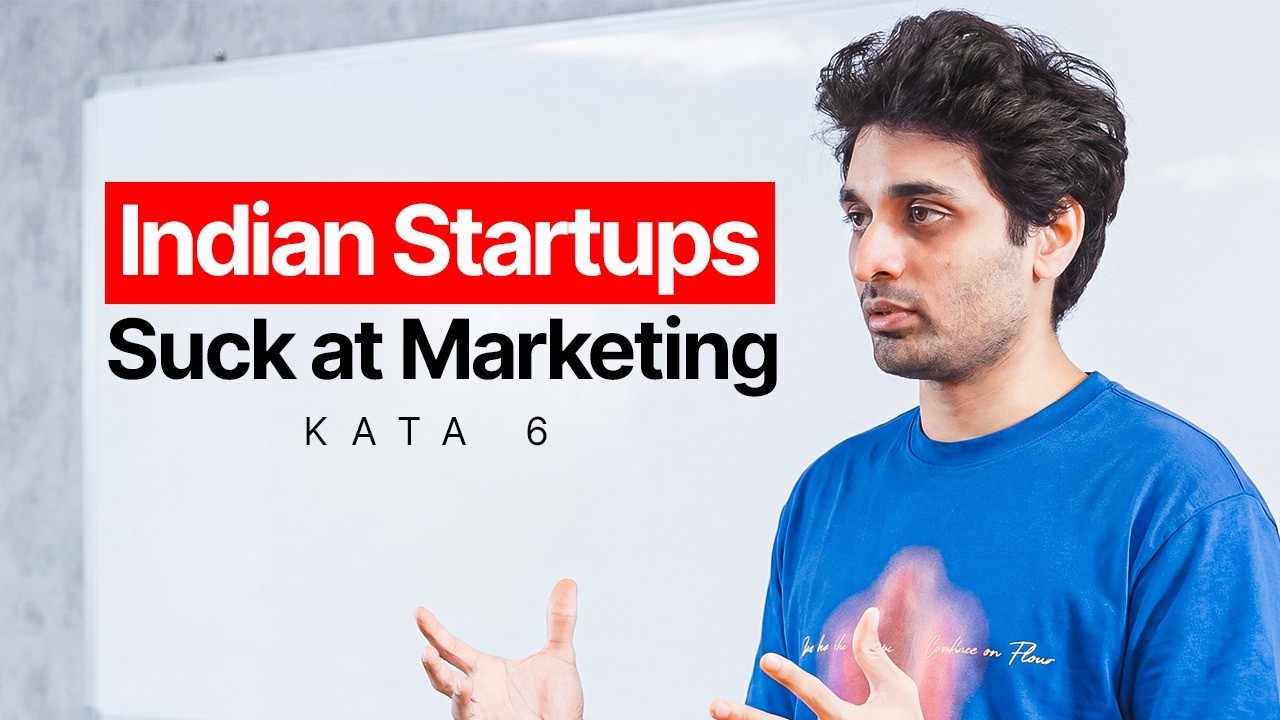
Welcome to the sixth session of the 16-Kata series. This one takes on one of the most quietly destructive problems in business and life: attribution. Figuring out what's actually responsible for your success or failure, and why most people get it completely wrong. The session walks through how Nike lost $25 billion by chasing what was easy to measure over what actually built the brand, why Indian startups stay unprofitable by overdosing on performance marketing, and why tools like coupon codes, ROAS, and "how did you hear about us" forms give you garbage data. It also applies the same lens to life, challenging ideas like "hard work leads to success" and "the best product wins" as textbook poor attribution, and asking a room spending 10 lakhs on degrees whether those degrees had anything to do with where they are today. Whether you're in marketing, building a company, or just trying to figure out why certain decisions aren't paying off the way you expected, learning how to attribute correctly changes how you spend your money, your time, and your energy. If you're optimizing the wrong inputs in your business or your life, this one's for you. 00:00 - Highlights 00:59 - What Is Attribution? 03:40 - Creators Who Steal Credit 05:06 - ROAS Is Killing Your Brand 07:50 - How Nike Lost $25 Billion 09:52 - The Performance Marketing Death Spiral 13:20 - Your Survey Data Is Lying to You 16:50 - The Proxy Attribution Hack 18:31 - Shares Are the Only Metric That Matters 20:48 - How People Actually Buy Things 24:00 - Bad Products Advertise for Competitors 25:08 - The Only Attribution Method That Works 26:36 - Did Your Degree Even Matter? 29:00 - There's No Single Path to Success 34:32 - Hard Work Is Not Enough 36:00 - The Actual Formula for Business Success 37:43 - Closing Thoughts
Оглавление (17 сегментов)

Highlights

So what is the average cost of the degree? 5 10 lakhs. So you're telling me that 300 people here 300 into 10 lakhs. 30 crores has been wasted in this room alone. Nike lost $25 billion in one day just by trying to make everything data driven. Sometimes if you have a bad product you're just running random marketing. You are starting the user on a journey to go end up buying your competitor product. How many of you think hard work leads to success? Sometimes your parents say right if you work very hard you'll become very successful. I don't think that's true. Most marketing managers just because they want to protect the reputation of their boss. They want to get a raise, this that. They want to make it measurable. They do the measurable thing. There are lots of people who are successful and don't know why they're successful. And I think knowing why you're successful is a way to make it repeatable. Otherwise, it's like random luck. You run a YouTube channel and you do 300 videos a year. You don't know which of those videos is getting you sales. You can get like absolutely crap 10 million views. But is that going to change anything? sell tickets? I don't think so.

What Is Attribution?

Today I want to take on an important topic and it's very important if you're in the field of marketing, distribution, content, etc. We'll get a little bit tactical today. And this is a video I've been meaning to make for a long time because a lot of there is especially some of the best marketeers that I've met in specific companies, they always understand this topic at a very different level than most people who just get into marketing, which is how do you attribute things? It's also a very useful life skill. Attribution means what was the thing that was responsible for your success, right? If you let's say made a sale if you made a sale of let's say diet coke which exact ad did someone see or which exact you know uh you know celebrities because of which celebrity or because of which specific creative like which converted you into buying a diet coke. We all know that actually it's a lot more complicated right it's not just you look at a diet coke and you look at an ad and you say today I'm going to order a diet coke because I saw this ad. It's a bunch of different factors, right? And I think because we work in the arena of YouTube, attribution is very important. And I want to tell you everything I know about attribution, all the problems, all the common pitfalls. And this also very useful for life because it's the same rules through and through. Anyway, so we're going to learn today how to attribute things correctly and why I think attribution is a secret success, secret key to success, right? Because there are lots of people who are successful and don't know why they're successful. And I think knowing why you're successful is a way to make it repeatable. Otherwise, it's like random luck, right? Next slide. Again, if you are successful, why are you successful? If you're a failure, why are you a failure? And I think people get this very wrong. I was speaking to a company. We were looking at acquiring a company recently. I was speaking to the founder and the founder said, "Well, we made some whatever 10 crores of sales based on, you know, thousand leads. " And I asked him, "Okay, so why are you shutting down or letting it go? " And his idea, his thing was that well actually you know market size is this or market doesn't care about this. I mean there are a lot of things that the founder told me but I asked him a simple question. He of thousand leads what if you had 10,000 leads? Would you make 10x the revenue? He was like yeah. I said what if you had 100 times that how much would you make? And he kind of he saw it. He saw the math. He's like, "Yeah, it could be very large if I had more leads. " But then again went back to okay but actually you know market size is this that whatever. Now sometimes that's true but I think in that specific business because I understand that space well I think it was just a function of the person doesn't have enough leads but in their head they've attributed to the wrong things and I see this in a lot of

Creators Who Steal Credit

people's lives as well right like I see this a lot of creators for example if a creator is involved with a project any project even if the creator has done nothing for the project let's say they own some equity in some company and they've done nothing for it if the project becomes successful somehow they start believing that they were the ones that made it successful me I was the differentiator. I made the thing happen. So I've seen the opposite side of this as well and I just want to go into how you should think about it and also like another pattern you'll see with a lot of marketing companies is there'll be you know marketing in companies especially is done by groups of teams right like for example when you guys work on Yas and you work with a client and you have whatever let's say seven eight people in the pod everyone at the end of the day when the channel does well put the hand up some guy will be like motion graphics I wrote the script. So it's like who do you really attribute this to? And I've seen in marketing departments there are some people who you know some projects where you know some big campaign where there'll be hundreds of people involved like in VFX you'll see this right like a film will give the project to like five different VFX films and all of them will claim they did all the VFX for the film. So attribution is very tough and even when hiring people knowing like when you see people's CVs when they contributed to something if you don't know how to pick out what did this person really do and how were they actually how critical were they in the project I don't think you'll do very well next slide like I

ROAS Is Killing Your Brand

said marketing managers have a big attribution problem and the problem is this you all know Dyson the brand vacuum cleaners anyone owns a Dyson vacuum cleaner okay very few people Actually, Diet Coke is a good example of this. Everyone's drank a Diet Coke or a Coke. Which ad converted you? Which ad, which YouTube video, which video made you buy this? Okay, someone says Elon Musk. Okay, — just random. — Just a random reel. You saw the reel and then ordered a Diet Coke. — A guy was promoting it to like he was just obsessed with it and kind of made him want to try it. — Okay. Somebody says he was obsessed with it, so he made it try it. But I'll tell you the best brands in the world. The worst brands in the world sell on something called ROAS. You know what ROS is? Is return on ad spend. I spent 10 rupees on an ad, guy bought my product, I made 20 rupees, difference is 10 rupees. And that's how they scale the business. These are like motorless businesses, right? Because that ad cost will go up over time. And it just becomes harder and harder to get a new audience to buy because they don't know enough about your brand. Yeah. If you've seen Dyson or you've seen uh A16Z, you don't know which piece of content made you a fan. You don't know whether it's that billboard, whether it was the store like with Apple products, right? Like which is the exact ad you it's not like you saw one billboard and said buy it right now. You don't do that. So they have a big problem and they don't know how to attribute. And I think it's the root of all evils in marketing. content and I think misattributing things gets you in a lot of trouble. Next slide. And I think one problem with a lot of marketing managers in India and this is mostly because a lot of marketing managers especially in startup in India come from tech. So they are more data science and measure driven measurable driven and also it's easy to report measurable stuff right if you do a YouTube video if you run a YouTube channel and you do 300 videos a year you don't know which of those videos is getting you sales if you're selling a product on that. You don't know which of the 300 videos would sell something for you. But if you run an ad, you can clearly say, "I spent this, I got this. " Believe it or not, most marketing managers just because they want to protect the reputation of their boss, they want to get a raise, this that, they want to make it measurable, they do the measurable thing. But I'm trying to tell you and what we have learned from 100 years of, you know, just everything from TV ads where it's very hard to measure to the advertising world that we live in today. I think this kind of marketing will get you in trouble. ROS marketing over the long run, performance marketing will get you in trouble. Right? Next

How Nike Lost $25 Billion

slide. And a good example of this is Nike. You all know Nike. Do you know that Nike lost $25 billion in one day in market valuation just by trying to make everything data driven? Nike invested billions into something that was less effective but easier to measure versus something that was more effective but less easy to measure. Do you know Nike changed as a brand earlier they used to do these you know they used to get the best athletes and make them you know show they used to celebrate running sports but they switched and they said no we'll go very tactical we'll go very measured and obviously it became a less aspirational brand the minute you make everything measurable and you're trying to sell one specific shoa unit audiences can see that unit it becomes there's no story there's no connect and half the things we buy is because of story and act. So, you lose that and then they did that because it's easier to measure and they lost so much money. And I'll tell you one of the Nike uh I think one of the uh you know leadership team members put this on out on LinkedIn. What happened in 2020? Well, the brand team shifted from brand marketing to digital marketing and from brand enhancing to sales activation. Okay. Because of that, the CM of the time made few epic moves. shift from create demand to serve and retain demand. That meant most of the investment were directed to those who are already Nike consumers or members because you'll realize over time if you set a pixel if anyone's familiar on your website and you know a person has come and abandoned cart or done some engagement with your website shoa I can click yeah you can track that now on Facebook and Google I hope you know this and they're like we'll only go after these people they've shown some intent right they've already gone put one shoe in their cart maybe they're not converted let's go target these people it's very measurable way to do this it's you can actually very cleanly say okay if I spend this much I'll make this much it's very easy to do this Nike started doing that and they started doing a lot of programmatic advertisement investment right um

The Performance Marketing Death Spiral

so anyway because of that Nike invested a material amount of dollars billions into something that was less effective but easier to be measured versus something that was more effective but less easy to be measured it's an impressive waste of money and I'll tell you one thing it's a cat-and- mouse game right you're running more and more ads that RO is today you spent 10 rupees made 20 rupees tomorrow that ad cost because everyone's running ads. It's the easy thing to do. You're going from 10 rupees now it's gone to 15 rupees then it's gone to 16 rupees suddenly it's 22 rupees and you're still making only 20 rupees as a unit. Then you say we're not making enough money let's increase the price of the unit. So the unit price of whatever you're selling goes from 20 rupees to 25 rupees to make up for this and over time your unit costs keep going up. You become a worse and worse objectively worse business. And then your ad costs are constantly going up and just to maintain the ad cost you're increasing unit cost. That's how things become expensive and it's been happening in India for a very long period of time right and then for a while we start getting don and the reanir Singsh in the ads saying that you know if you get a dhoni or a ranir singh the cost goes down from you know 10 rupees to maybe slightly lesser right even though technically celebrity advertising is still this brand awareness come still comes into brand awareness camp right but people are using it like ros they were like we'll spend one rupee make two rupees back and it is like in my opinion This is the reason why a lot of startups in India are unprofitable, right? And are continuing to be unprofitable because you're going after the absolutely measurable thing and the only solution there because the costs keep climbing up is to keep increasing the cost of goods and over time you can't increase the cost of goods beyond a certain amount because a customer will not pay in a country like India. You get stuck at 25 rupees as the sale price. Your cost of advertising goes to 30 35. You become a fundamentally unprofitable company. But the best companies in India and there's a podcast I did with Nitan Kamat. I don't know if any of you have watched it. There's a podcast I did maybe a year ago or two years ago with Nitan Kamat. And in the ending he says something very profound. He says that actually Zeroda has had no cost of acquisition for a very long time and they don't run ads. And he's like our entire margin is exactly the cost of our advertising. the cost of advertising and the cost of whatever they would have spent if they didn't have organic reach they would have had to spend that in acquiring customers they would have m made zero profit physics walla it's entirely YouTube-driven cost of acquisition there's no cost of you know uh buying a customer so the YouTube strategy and a lot of companies realize this right like a lot of cool companies in India first they do a lot of YouTube they get very big and then they said they raise money and they're like I'm professional and a lot of ed techs have done professional company celebrity. We'll only do celebrity ads and then they do celebrity ads. They forget their YouTube roots and then of course celebrity ads and running it as performance advertising just keeps increasing in cost over time. It's senseless. It's an exercise in stupidity but they do it and it's a very good short-term thing and don't get me wrong, right? Like you need to sell units in the short term while you build brand awareness. And there's another tweet I saw by you know someone who runs I think appsumo CEO once said this right he's like I think or Jason Lmin one of these people said this which is that in the early days all marketing needs to be performance marketing but as you get to a certain scale all marketing needs to be top of the funnel brand marketing. How do I build awareness about my brand and let customers come to you?

Your Survey Data Is Lying to You

Anyway, next slide. Have you seen this on websites? How do you hear about us? This is how people track. Most marketers still track where you came from. I have a quick question to everyone. How many of you fill this inaccurately? don't fill this inaccurately? Put your hands up. How many of you just click on the first thing and just be like, "Next. " Do you know one thing I've learned about YouTube or Instagram? Most people are running very low context. You know, the right way to model your user is not, oh, the person is like, you know, sitting and watching your reel and then like paying attention. That that's not that. They're sitting on the toilet, one hand's on the spray, other hand is, you know, on the phone, their mom is calling them. They're distracted and busy. And if you show them something like this during this period because most of the time they're in the metro, they're like doing like five things at once, they are going to press the wrong thing. And this error, it's not like one or two% error. It is like it meaningfully changes, you know, your error. and you're attributing you're assuming this is the source of truth. If let's say everyone clicks on television or like random things you'll actually believe that oh our TV ads are working or this is working or that is working. This is not the way you track people right and if people are using this especially in this era where everyone's busy maybe 5 years ago they were paying more attention to what they're clicking on. they were clicking on but today they're absolutely not paying attention and whatever data you're getting from this is wrong. Right? And I'm not even kidding. Like I've sat with so many brand managers and we have dug through their data and we're like and they know it's wrong. Some of them the best ones are like I don't believe this and more importantly the best companies don't do this. Next slide. I'll give you another example of this which is ref and affiliate programs right and I think I'll give you good example of zerodha and I remember this because somebody from zeroda once told me this right which is that earlier when they used to run affiliate programs which is hey go open a zeroda account and you would give that person who referred another person to the to open a zeroda account some percentage of earnings of the next guy right when they did that sometimes what would happen is a person would watch one video of an affiliate driving traffic and then the same day they'd watch a different affiliate. They'd watch two different personal finance videos and both the videos would have zero links. But maybe the person clicked on the second video. first video, came to the website, didn't convert and then they'd go back, watch another video, see the second person talk about it, and click and convert. Now, I want to ask you a question. Isn't it unfair for the first person who made that video to send you to the website in the first place which gave you the first look at the Zerodha platform? Isn't it unfair to that person if that was part of the conversion? convincing that you should start up you know using this platform to save your money and invest wisely. Right? If I've watched three ads but all three were important my dec but trust me all when you watch like five 10 different pieces of content all are important in your decision making would you only calculate the last one that converted you or the other eight ones that also helped you make a decision and this is the fundamental problem behind all affiliate and zero has a you know at least from what I've heard has a complicated way to solve this so there's no easy

The Proxy Attribution Hack

way to solve this anyway next slide and that's where we get into the idea of proxy attribution which is what like good brand managers do is but it's still wrong which is that I will try to use some proxy some other way of figuring out okay and it could be as manual as meeting people in an event like something with more accuracy right maybe you know I've seen that uh like on Netflix does this very well right like do you know how they commission new shows does anyone know how Netflix commissions new shows or new TVs new uh movies they'll buy a movie And they need to make sure on their mathematics that if I buy this movie for 10 crores, am I able to at least make 10 crores of new subscriptions? It's that right is the movie interesting enough and attract every movie for them is a marketing campaign. Believe it or not, every movie they can if they're like if I put a little bit of advertising on it in catalog, will it get a person to convert? But they also know that sometimes it's just not one movie that makes you convert. It's multiple of these that make that's having that library. Netflix has this and this. That makes you convert. Another example of this is, have you seen consoles? Have you heard of something called console exclusives? Specific games made for specific consoles. Okay, PlayStation has God of War and Spider-Man. And believe it or not, all those console exclusive, the reason Sony themselves spends money making those happen is they know it requires a certain catalog of games to get players in. Sometimes people buy the PlayStation just to play Spider-Man. In the past, now it's changed. Now you can get Spider-Man on the PC as well. But this really mattered during a specific era. And I think what we need to really learn is something called proxy attribution. Next slide. I'll give you a

Shares Are the Only Metric That Matters

very good example of this. Right? I did two ads last year on my channel. Right? Um I did one for Mumbai Tech Week which is an event and the other one was for Nvidia's GTC. Okay? And as you can see Instagram has no way to do to attribution. You can just get views right views video. And let's say the first one would have done some 300,000 views. The second one did 274,000 views. But to me, what is important proxy attribution and I think something we have learned on Instagram, the measure of intent is sharing. Sharing is a far better proxy attribute of Instagram on is this interesting than views. Here's an example. On the Nvidia video, we got 14,000 likes. That doesn't matter at all. People like sometimes they brain dead, they like, they'll move on to the next thing. It's got 7. 6K shares. Why does somebody share an event with another person? — Cuz they want to go. — Exactly. It's in the DMs, right? Hey, you should go to this event or chal event chal. I don't know what they're typing in the DMs. I just can see one value which is shares. Okay. And this one has 3. 1K. So, a little less interesting as an event, but still a significant number. So, these are what we call proxy metrics. And therefore, I feel like when brand managers go out there and just say, "Hey, we got a million views on this campaign or 10 million views on the campaign," you can get like absolutely crap 10 million views. Today, if you want like if you just want to get 10 million views on Instagram and I target like literally the worst audience, the lowest CPM audience, you can get 10 million views. But is that going to change anything? sell tickets? I don't think so. And I'll tell you how I found out this, whether we're useful or not. I actually went to Mumbai Tech Week. I was there and the entire audience was mine. I was like, "Oh, a big chunk of this audience. " Because you could feel it, right? You go there and they're like, "Hey, I came because I saw your real or hey, Vun, I know you blah blah. " You I saw them in the event and they're like, "Okay, this works. " Actually, before this, I was not fully convinced on influencer marketing. I was like, "Does it really work? " But then the minute you meet them in person, you're like, "This is real. These are real people who came from online offline. Then it changed my mind on it. Next

How People Actually Buy Things

slide. Do you also know that on Instagram and YouTube clicking links is not normal behavior? Like have you ever clicked on a link on Instagram? Do you even see links? Story sometimes. But even on story you know if you click the link it'll open in a you know that Instagram browser. It doesn't open in a normal browser right? Links are deboosted on Twitter. If you put a link in the first post on Twitter, it gets deboosted. Okay. So, how do you attribute campaign link? it? Nobody has a very good answer to this. And I'll tell you how some brand manager, have you heard of coupon code system? Hey Vun, I'll give you a coupon code, Vun 1000. Go click on the link. Tell your followers, okay? They can't click on a link. So tell your followers to go to the platform and type in vun 1000. I think it's absolute rubbish and I don't think it's the way people buy at all. I'll tell you how people really buy and you have all done this. Okay, let's say you're buying a new phone. All of you have bought a a phone. I'll tell you exactly what the process is. Let's say you saw an influencer talk about a phone. Some new phone that came out. He's put it out there and he said, "Look, this is an amazing phone. " Now you're interested. You're like, "I need a new phone. This looks interesting. It's zoom whatever some five features you like you're like okay this celebrity is talking you you're interested but are you the kind of person who will go buy it the very next day I'm asking that probably 300 people in this room how many of you have snap bought a phone zero what you have instead done is you'll open YouTube and you'll be like blah blah phone reviews correct step one you'll watch reviews then you'll see what are the alternatives possible you'll be like I know about this one brand. Let's say brand A. Let me go see brand Bphone and you'll check the reviews of that also. You'll check the specs of that. Then you see brand C. You'll see reviews. Correct? You'll compare all three. You'll watch YouTube videos of an MKBHD video of 1, two, and three. Then ultimately you'll forget about it. Next month. So 30 days you're holding on to it. You're just like I'm not going to buy. Then after 30 days your paycheck comes in you're like hm now I'll buy okay which of these three should I buy now a fourth competitor has come in you'll watch their video also then you'll be like which of these four should I buy then finally that decision you make is a gut decision correct no matter how much you say have you every single time when you bought something have you bought something with the best specs that's not true otherwise Apple wouldn't be selling the kind of units in India that it does right Apple never has the best specs except for maybe compute in there you know there are better alternatives right now for at cheaper prices. Ultimately, you buy on status, satisfaction, how you'll feel, etc., right? But this is the buyer's journey. It's not a snap by journey. Unless you're buying a 200 rupees, you know, nail cutter or nail polish or something like that. Every journey, every buyers journey is a long journey of being convinced. Correct? Why the hell do people run ads? Right?

Bad Products Advertise for Competitors

Sometimes I will see someone advertising and I'll just be like you know you are making your competitor like if weak competitors advertise against stronger competitors unless they have very strong positioning and their marketing is really well thought through you are just feeding the bigger competitor because people will compare services or products they will always go and be like okay this guy's given me this quote or this whether it's a services company or if I'm buying this product this guy's given me this is the price of the product let me check the other three products. Sometimes if you have a bad product and you're marketing you're just running random marketing you are help you are starting the user on a journey to go end up buying your competitor product. I hope you realize that. I hope brands also realize that anyway and that's why the coupon code system doesn't work right because if you do coupon code system no one's going to snap by and a month later they will anyway go to coupon duna or one of those platforms check for 15 coupons they'll lose honey people are sophisticated especially the people who have the money to buy a phone or 5,000 8,000 shoe I'll tell you how we

The Only Attribution Method That Works

a 5,000 8,000 shoe I'll tell you how we really attribute okay before we get into this right which is I think the only way to attribute is something like I like to call qualitative attribution and it requires a really honest person. It's so hard to tell which of your things worked, which of your activities work. It requires a very honest, unbiased person to go in and be like, hm, I'm listening to the users and from what I hear, this is what worked. That's the only way. I've not found a better way. I'm sorry. But that's the only way and maybe at massive scale some data will emerge that's useful but usually most companies are not at that like crazy Apple level scale where they can extract information from just the data right it has to be this get on the phone call and call some buyers people who also saw the campaign whatever you did ask them why or why not they purchased or engaged we're getting to old school surveys and my opinion is companies need to do this in-house this is the main task of a company selling a product. You need to know why are people buying your product? service? You absolutely need to know to the tea why it happens and you have to use your eyes, ears and brains. It's very easy to be driven into random narratives. Next slide. Now, why is this useful?

Did Your Degree Even Matter?

This also this attribution problem exists in life also. How many of you think your degrees got you here? Can we turn one of the cameras to the people? Zero. They're all making money. Then why did you do the degree? So you're telling me what is the average cost of the degree guys in this room? 510 lakhs peranom roughly. Give me some numbers. Huh? 10 to 12 — 10 to 12 lakhs. How much are your degrees? — 15 10 or below. So you're telling me that 300 people here 300 into 10 lakhs 30 crores has been wasted in this room alone. Right. Right. Yes or no? Now outside of this room, how much has been wasted? Which is why I think and of course I can't blame you as a kid your parents put pressure on you to go do a degree. get all of that but in general I think attribution is so important because just like the degree decision what if I told you there are decisions you're making in life right now that have nothing to do with your success in the future but you are thinking it might motion graphics is a very good example right whenever an editor comes and says motion graphics I'm like you know it has no correlation to how much more money you'll make in the next few years zero correlation but yet you do it you're attributing the wrong thing you're like if I get better at Maybe this is the handle that increases money. It doesn't. It's important to know which of those things it is, which of the handles it is that increases the amount of money you make. And I think we do this a lot, right? We do poor attribution to medications. Okay? Sometimes people will eat some ancient thing and they'll be like, but maybe at the same time they just got into adulthood and puberty hit and the hormones changed and they just they outgrew whatever. poor attribution to foods. If you have a food allergy, it's so hard to tell which food because anything you buy, they'll there'll be some extra additive. Like the worst thing that can happen to you in a country like India is some addit you're allergic to some additive, one of those small like flavorings or something. You'll spend years trying to find out what you're allergic to. It's a it's very difficult.

There's No Single Path to Success

Okay. And lastly, I think it's also poor attribution to why or why not something worked. In reality, we all know this. Ultimately, the reason something works is the multiffactorial reason. Nobody likes hearing this, but there's no one single thing you did in your life that might make you very successful. Sometimes there are and we'll talk about that, but it's about finding this cluster of things like Charlie Manga calls. I've spoken about this before, right? Lula pula effects. Can you find four or five things going in the same direction that you want to go and have them incorporate them all in your life? Next slide. The reason you need to understand attribution is attribution allows you to appreciate risk better right actually let's talk about the riskreward trade trade-off of having a degree that 30 crores wasted in this room I just we just calculated together what is the risk you took it's 10 lakhs or 12 lakhs or whatever it is what is the reward you got because of the degree zero right but if you wrongly attribute and say my degree got me this job either then for you the riskreward ratio make might make sense cuz you'll make that money in some amount of time this is the reason attribution really matters what is the thing I'm doing right now like I'll give you a very good example of this in my last company we overbuilt technology we software as a service company we said if we add one more feature users will come if we do if we add this specific tipping feature users will come if we build you know uh web RTC based live calling then if you know somebody's acquiring us tomorrow they'll value this at a higher amount because we customuilt our technology all the wrong attributions we're making in our head in India that's not why acquirers buy companies acquirers buy revenue most acquirers buy revenue I think more than anything it allows you to set up correct proxies you can't easily measure these things but you can at least set up a proxy you can avoid skipping the hard work because sometimes when you do wrong attribution look for shortcuts and not miss out on good opportunities. It allows you to promote better talent and credit the right people. You know the thing I hate the most and it's like I just don't know how as a company we solve this which is man sometimes talent will do something in a team and they'll be part of like a team okay there'll be like five six people in the team but the guy will come and be like mania I and it's so difficult because I'm always like so are you saying the editor didn't edit the video maybe it's a writer right so are you saying the editor I didn't edit the video yeah but that's not the important part my writing is the important Sometimes it might the person might come and be like it might be a DP and be like no actually my camera angles you know my camera angles or the shots made the video good. But I'll tell you something we all know this about the best videos we've watched. I'm just talking about video because everyone here understands it. The best videos we've ever seen or we've made, they're all team efforts. Yes or no? The best projects I've worked on my life, the game for example, they're all excellent team projects. Everyone's pulling their weight. There is no one hero superstar. Right or wrong? — Right. And that's why I think it allows you to promote better talent credit the right people because otherwise what happens is the loudest people get the best most credit. And I think lastly it surfaces reliable repeatable formulas which allow you to scale a business. There are some things that like for example the argument I have with a lot of people is YouTube works. YouTube is a great acquisition mechanism and you know a brand probably will do YouTube for a while they'll get to 4 500k they like you say ROI my point is always do you know now when I hire people I just put up a story I mean we use LinkedIn as a company but for me I just put up a story I'll get like 2,000 applicants best applicants possible if I need to get sales I just put up a story saying hey this is a product we're doing or this is a service we're doing anyone wants to try any pilot anyone wants to pilot it we'll get 10 20 customers so it's very clear that me having followers and a very specific type of follower gives me a lot of these rewards that makes running a company easier allows me to save money because I don't need to have you know too many people in hiring I don't need to I can I can do everything at much cheaper but brands will be like but you know I'm only thinking about sales or they'll be like you know right so these things I think are very important because you have to tease out reliable repeatable formulas which allow you to scale a business. Next slide. And I think in general better attribution recognizing proxies help you lead a better life. And if all of you sat down and be like what is the number one problem in life? Maybe some of you maybe one of you just you write down and you're like okay what's my biggest problem in life? actually my biggest problem is there's a guy who's in my roommate or whatever who's constantly negative whatever and because of that you know that negativity is coming in my head or someone one of you might be like my biggest problem in life is ABCD and I bet you haven't done this or you're attributing wrongly I think in general it's very useful to do attribution well right it's a marketing problem but it's also a life problem next slide how many of you think hard work leads to success?

Hard Work Is Not Enough

It's an attribution thing, right? Like we've heard it so much. Hard work leads to success, right? Here's what I think. I think it's one of the factors, but definitely not the only factor. Otherwise, laborers will be very wealthy. Anyone doing manual effort, the oil rigging people, there's so many people doing hard work in the world. Clearly, hard work is not that correlated with financially financial success. But if you look at actual people who are successful, a lot of them also work hard. So it might be one of the factors definitely not the only factor. So whenever somebody sometimes your parents say right if you work very hard you'll become very successful. I don't think that's true. And I think it's bad advice to give people. It should be like hard work is one of the conditions but there's other things that you're missing that other things you need to attribute to that is responsible for your success. Next slide. Some other things if you build it they will come right. Poor attribution. The best product wins. Poor attribution. Talent is everything. Poor attribution. Follow your passion and the money will follow. Poor attribution. Capital scales any business. Poor attribution. Next slide. And I see this in the comments a lot, right? People think money is the end all be all of everything. If you have money, you'll be able to build a big thing. That's not true at all. Money has one of the factors, but definitely if money is the only thing that ended up helping you build big businesses, AOS wouldn't exist because we started with zero. And more than that, there are so many businesses that have raised hundreds of millions of dollars and gone to zero. And I think

The Actual Formula for Business Success

the biggest set of problem makers here are business case study people. Okay, business case study are sensational. You've seen business case study creators on the internet. We used to create business case studies many years ago. I think their job is to be sensational, right? Which is successful. Correct? You've seen this. It's always very sensationalized. Do you know what the true secret behind all businesses is? I'll tell you what the true attribution is. It's just these three things. Find an untapped market. Hire good talent and execute well. Stick around long enough to reap the benefits. just don't die. That's it. These are three things that matter most in a business. Any trick, any move you do, your competitors can easily copy. So in general, I think that it's important to simplify your life because it allows you to compress all the noise and be like this happened at the same time this happened. But correlation is not causation. But this is not the only reason that this company became successful. Every founder I've met is these three. There are exceptions of course, but it's mostly this. Next slide. What are some hidden things in your life you should attribute your life state to? If you're succeeding, what are the reasons you are succeeding? If you're failing, what are the reasons you're failing? Write it down. It's a brilliant, you know, way to think about life. Trust me on this. So, I want to quickly

Closing Thoughts

summarize. I think people on the internet attribute things wrongly. And I think people don't make from the marketing perspective, people don't make buying decisions very, you know, in the way of I saw this ad, therefore I'll convert. I saw this YouTube video, therefore I'll convert. It's all slow. Takes months. Sometimes somebody would have seen me do a video like from 5 years ago and then be like, "Oh yeah, this guy also does AI services or YouTube services. Let me go to him. " It's like very long term, right? And YouTube, things like YouTube, it's very hard to clearly define why they help, but they definitely help otherwise this business wouldn't exist. So I hope you guys learned something. This also applies to your life. Do the right attribution. Bye.

Другие видео автора — Varun Mayya

Ctrl+V

Экстракт Знаний в Telegram

Экстракты и дистилляты из лучших YouTube-каналов — сразу после публикации.

Подписаться

Дайджест Экстрактов

Лучшие методички за неделю — каждый понедельник