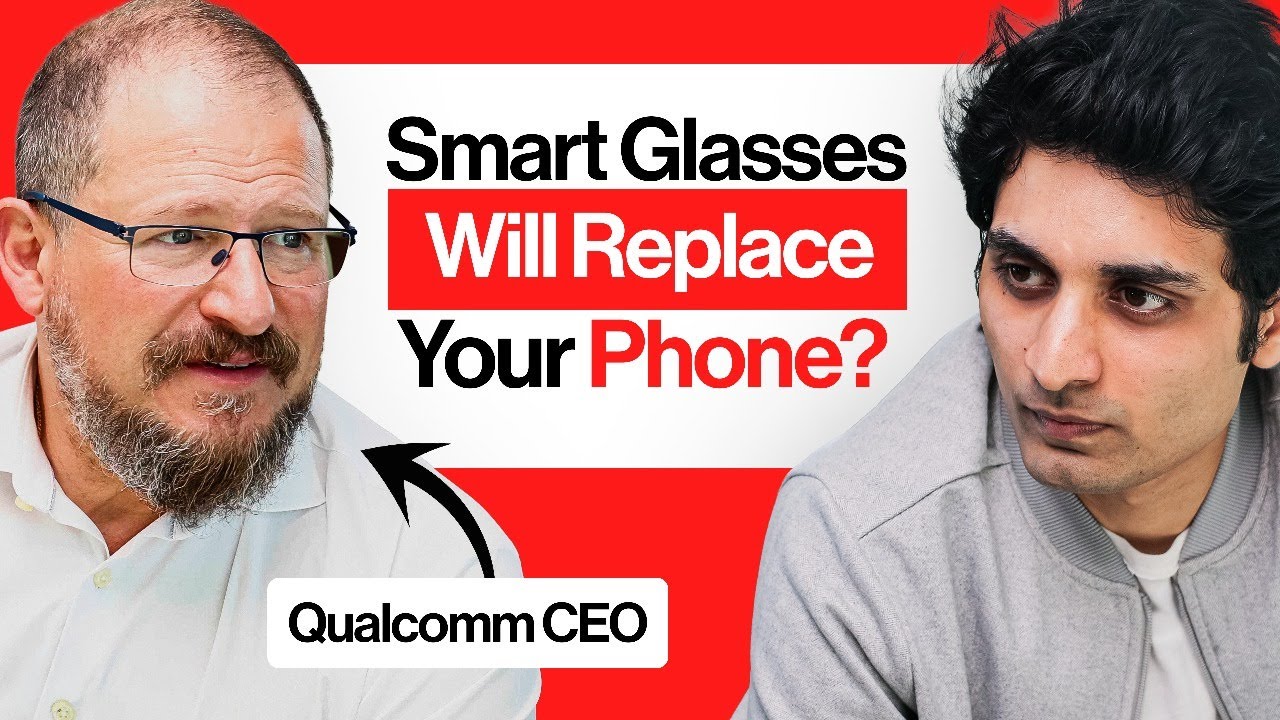
Qualcomm CEO on Self-Driving in Indian Traffic, Smart Glasses Potential in India and More!
26:11

Qualcomm CEO on Self-Driving in Indian Traffic, Smart Glasses Potential in India and More!

Varun Mayya 11.11.2025 15 819 просмотров 574 лайков

Machine-readable: Markdown · JSON API · Site index

Поделиться Telegram VK Бот
Транскрипт Скачать .md
Анализ с AI
Описание видео
In this conversation, Cristiano opens up about Qualcomm’s evolution beyond smartphones. From building AI-powered PCs with multi-day battery life to partnering with Meta on the Ray-Ban smart glasses that merge the digital and physical world. He breaks down why mobile and PC are converging into a single computing ecosystem, how gaming will be transformed by AI, and why the next wave of connected devices will emerge from markets like India, not Silicon Valley. Cristiano also shares Qualcomm’s next big bet: disrupting the data center with energy-efficient AI inference chips, and bringing intelligence to cars, glasses, and everything in between. From autonomous driving and AI copilots to redefining how humans interact with technology, this is a rare look into the mind of the man rearchitecting the future of computing. 00:00 - Introduction 01:15 - Gaming Evolution & AI Integration 07:07 - Meta Ray-Ban & Smart Glasses Future 12:34 - Data Center Plans & AI Inference 14:54 - Connected Cars & AI Integration 20:02 - Self-Driving Technology in India 22:02 - CEO Challenges & Market Timing 25:36 - Closing Thoughts
Оглавление (8 сегментов)

Introduction

We all got to test out meta rayband displays. A question popped up in my head. When does this get commoditized and what role does Qualcomm play in the entire — When the internet first started, mobile internet developed faster in markets that were not traditionally internet markets. And I think we're going to see the same thing with those new classes of devices of AI. — One of the most influential figures in global tech and the semiconductor industry, Cristiano Ammon, is the president and CEO of Qualcomm, the company secretly powering the entire world. From his early days as an engineer in Brazil to leading one of the most critical tech firms on the planet, Cristiano has been at the center of every major shift in mobile and wireless technology. Under his leadership, Qualcomm has gone beyond just smartphone chips, pushing innovation in AI, automotive XR and the future of connected devices. — Every time I go to India, people riding their motorcycles and they get their phone and they put it between the helmet that tells you that why aren't I using your smart glass? — What's the top challenge for you right now? What's a call you've taken recently in the last 6 months or the last year that you got it wrong? Ladies and gentlemen, I am with the CEO of Qualcomm and uh you know I loved your keynote. — Thank you. — Thank you very much. — And you know I'm also really glad you took the time to look at our trailer. Uh I want to know like as you know we do a

Gaming Evolution & AI Integration

bunch of things but from the game dev side right the excelates they've constantly kept getting better. uh you are sort of gunning for a serious laptop, a serious computing device that everybody can have. What's the vision there so far? How have sales been? How has response been? — We're incredibly happy because we entered this market. It was already established market because we thought we could do something unique and we always believe in the mobile PC conversions and we believe we could do something that will change a little bit your PC experience and uh we're delivering on that. I think if you look at some of those devices with X Elite, they're very fast. They look very cool. The form factor small and then tons of battery life, multiple days of battery life where people didn't expect to have that on a PC. But uh the other part is we knew that this was going to change. I think if you hear what Google saying, if you look what Sach is saying about the agentic experience coming to PCs, that's the disruption. That's the entry point. And I think that's great an opportunity for us. Having said that, we just started uh we like uh we launch in the first retail of the United States in the top five European markets. We're expanding to other markets right now including India. Um and we expect uh that we're going to go to enterprise commercial next. So right now we're tracking about 9% share for somebody that started from zero. I think we're very happy. We look at other players in the PC. Took them seven years uh to get to about uh that market share. So it's going great. Uh what you're going to see here is we're investing on it. We have new chips. We want to be disruptive. We want to again change the performance. And one of the things you will see probably as we announce new products is Nept Summit and how much gaming is going to improve. [snorts] And I want to talk a little bit about gaming because we need to be thinking about gaming a little different. By the way, super excited about uh the gaming you show me. I can't wait to see it running on Snapdragon XLE. But gaming is an area that I am incredibly excited about AI because we have all this gaming experience. We talk about building great graphics and that's what we're doing. One of the biggest improvements you see from one generation to the other will be graphics. But AI also changes the game. You have AI for known player characters. You have uh AI for you to interact with the game. And every interaction is going to be different. And I think we're going to even see AIs changing the game play as you move into the game. So exciting time for gaming. — Yeah. So I have a question, right? I tried the 1X Sugar product. Have you tried this console that uses the Snapdragon inside it? It's from China. It's this handheld gaming device. I have a technical question for you, right? And I'm asking you to predict the future here, which is you saw the game that I showed you. That's a PC console game, right? Do you think do you have a timeline in mind for that to eventually be able to be played on a mobile phone? — That is a great question. This And I think um when you think about the future of gaming and I want to come from I'm going to answer your question from different angles. Okay. First I am going to talk a little bit about console games. You know I know we talk about PCs and phones but I want talk console games. So we have a product that we did with Sony. It is incredibly successful. When we launched it I think it was sold out which is the PlayStation Portal. And the PlayStation Portal is it's a Snapdragon chipset on a PlayStation that you extend the game frame, the game play from the console to the portal. And the user experience at the time was I'm starting playing the game in the console. I want to go play in my room. uh sitting in the sofa in the my bed. I'm going to continue game playing everywhere. And I think we're about to see this happening now, which is the whole experience of gaming, especially Triple A games. They're going to be developing a way that you're going to start playing on your PC, on your console, and then you finish on your phone and then you go back to your PC. And there's so many titles thinking about this. We're seeing the full convergence of mobile and PC. We see AI uh making devices uh in enabling u major games with things like super resolution as an example. — Yeah. — And then you're going to have the whole gaming experience changing into a different experience now enabled uh by AI. So I expect that we're going to see more and more especially as you saw in the conversation with the keynote with Google as they also going into the personal computing devices you're going to see the entire Android mobile ecosystem now running on PCs and laptops that's going to be on Windows Android I think Microsoft is enabling that as well we're also going to see the PC ecosystem running on mobile devices and the whole sort of merging — yes the whole interaction with gaming will be different and we're serious conversion of mobile and PC is inevitable. So you think there'll be one platform mobile? — There will be multiple platforms, but I think you're going to have gaming are going to be designed for you to play and multiple devices. As I talk in the keynote, I think we're going to a future that is not going to be about one device. It's going to be multiple devices working together. And I think that's going to be true for the use cases. And gaming is going to be one of the use cases. — Interesting. I want to shift slightly

Meta Ray-Ban & Smart Glasses Future

right? Um, last week I was with, you know, a bunch of creators and Mark Zuckerberg. We all got to test out the Meta Ray-B band displays. — We're super proud of that uh product with them. — It is phenomenal, right? Especially, you know, everything the glasses, the the waveguides, the EMGs. It's just it's a piece of the future, right? So, thank you so much for being a part of the future in that way. Uh, which is now the present. So, I shouldn't even be calling it the future. But the minute I used it, the a question popped up in my head which is how much of a lead time does Meta have on all the other companies is how long do you think it will take for you know 10 different companies to do this? When does this get commoditized this new technology and what role does Qualcomm play in the entire — Okay, there's a lot of questions in there. — Yeah. — So why don't we break that down and question that just I'm going to go maybe talk about the first component. — Yeah. about companies lead on new technology. If I go back in history, there's a lot we can learn for the history of technology transition. And I think I will say even within Qualcomm, we learned a lot. We have been fortunate enough that we have always reinvented ourselves. So we didn't miss any technology transition. For example, in the mobile industry, many companies missed technology transitions. in the mobile industry. You look at Blackberry, you look at Nokia as an example, right? So I think what happened is when new platforms arrive, usually the company that has no legacy — uh is very quick uh to embrace the new technology and innovate it. For example, what I like about what meta is doing, they saw early on that you're going to have devices that you can wear like glasses because of the simple concept of which started as a conversation about the metaverse which is can I merge the physical and the digital world. can I superimpose you know is that going to be important for the future social for example and the future how people communicate and uh with each other and call and messages like you can think about WhatsApp as an example but then also about this agent that where you see uh the device and there's no legacy there's nothing to worry about you can start with the new and I think that's where we see the excitement and the focus of meta uh how they started with glasses and the rayan meta is an overwhelming success. uh you know I think exceed everybody expectations and I think show what's possible for companies to continue to be in the lead you have to keep going like you have to keep pushing the use cases the experience and I think you start to see now it's about adding the display and information on the display every technology if you just develop something good and you stop there are a lot of companies doing that uh right now uh if you just up and you just uh thinking you're just going to monetize your success for a long time. That's very risky. So I think uh I am incredibly motivated about how our partners keep keeping adding and and inventing new capabilities. It's always a race. Success today does not mean success tomorrow unless you keep invent reinventing and building new products. And I think that's what's happening. And the last part of your answer is I think that technology is going to get democratized. It's interesting. I'm going to give you an example. India example. Uh, every time I go to India, we're very proud of our teams there. We have over 10,000 people across multiple sites. And I always notice one thing. People riding their motorcycles and they get their phone and they put between the helmet and in right here. They stuck it right here. That tells you that why not using our smart glass. Incredible potential for navigation, for everything. So you can see as the technology becomes available the potential is huge. So I think this technology is going to come uh from different companies at different capabilities from different markets. It's going to be tailor to every market. It's very personal. It's very regional and I think the role of Qualcomm is to build a platform that is open and work with everybody. So actually we can bring uh that technology and innovation. I'm incredibly excited about uh those new devices and I'm going to use one last comment. I know I'm giving a long answer, but this is important. When the internet first started, uh it was interesting to see that the mobile internet uh developed first developed faster and more complete in markets that were not traditionally internet markets. So the mobile internet developed faster in Brazil, in India, in China because people start experiencing the internet to a mobile device. And I think we're going to see the same thing with those new classes of devices of AI. — You think it's going to be slower adoption from America? — I don't think it's going to be slower adoption, but I think we're going to see the internet like the mobile internet reshape the internet. And now the mobile internet is bigger than how the internet started with PCs. IC is going to be like that with those new devices and now actually the opposite. I think the speed of adoption uh of those technologies globally is going to be much faster.

Data Center Plans & AI Inference

— Wow. Hey, I have a question on AI because I saw is a very important part of your keynote, right? Do you have data center plans? Do you want to get into data centers? — Yes, we had uh recently announced that we are uh building products for the data center. We also did announce an acquisition. We're waiting for the approval of a wave. We believe there are two reasons that we can be incredibly disruptive on the data center. And how I feel about the data center, it's a massive opportunity. It will continue to expand. The edge will continue to expand of AI, but the data center will continue to evolve. And what's happening with the data center is as AI gets scale, you're starting to move the center of mass of the compute from training to inference and inference is becoming bigger and bigger. You see those inference clusters and once you build that is because you're not talking about creating an AI, but AI is going to production. And if it's going to production, there's going to be competition. So then we believe we can build something because of our mobile DNA, something that is incredibly power efficient uh and changes the equation of tokens per dollar, tokens per watt. So we're building — specifically on inference. We're building inference accelerators uh both at the chip level as well as the rack level and we also have a very good CPU asset that I think we prove it how our CPU is working on phones and PC nows in cars and we extend that CPU uh to the data center whether is uh what we call uh the head node controlling several GPUs or NPUs or general purpose CPU And the reason we're doing this is because power matters. So we build products. We had said in our earnings call we are in a very dense uh negotiations with an significant hyperscalers and you should see and expect welcomecom being a player in the data center. — Interesting. Can't wait uh can't wait to see who you end up partnering with who ends up doing you. — Crossing my fingers we can uh — it feels like you want to give me an answer but you're like hey — I can't give you right now but shortly. — Shortly. Interesting. Um, you know, I

Connected Cars & AI Integration

have a question on you. You mentioned cars, right? So, I have a specific question on cars, which is I use an old car, right? So, not connected to anything. It's got a little bit of, you know, music and it's got a, you know, even the maps thing doesn't work. I've been hearing a lot about the connected car, right? And having more computer in a car makes sense because a car can do a lot of things, but I haven't found or I haven't seen interesting use cases yet. So question to you is with everything that's going on with auto right and everything that you've been powering at auto what are some use cases you've seen that are that customers really like and does that factor into their buying decision of that car? — Yes. First 100%. Uh especially new uh new car customers uh one of the key decision criteria is actually the digital capabilities of the car. We have seen it. I think the car really became a computing surface. People they drive the car, they go from A to B, but they get entertained from the car, they get connected productive on the car. And I think this is a fast evolving. So we're enabling the digital cockpit of the majority of the car brands in the world. I think we're designed when we're virtually every car company and we're at the beginning to see some of the use cases. So I'm going to tell about some of the use cases that I find incredibly exciting right now and I'm going to tell where this is going with AI. First, right now you could started to see things that kind of significantly enhance navigation. Uh some of our customers right now when you're doing navigation and it has an the unique thing about the car system, the car is not a phone, it's not a PC, it's a car. So the car works a little bit different. So you can integrate like Google maps for example with other inputs from the car and uh you can you're following a route you have to make a turn you can see in some of the our customers it show in the digital cockpit it show the actual image from the front camera on the car with an overlay exactly where you need to take a turn. Those are some example how navigation gets significantly enhanced. You can see this like today we can see how it changes the whole experience for you to use voice uh to control. We have some of our customers right now they using the cameras they're looking to you inside the car. um a kid on the back say can just point the finger say can you open this window and the camera will know it pointed to that window open that window how you change any settings and this is becoming better better it's changing navigation it's changing your driving experience of course the popular use case of uh of assisted driving um and uh and navigation on autopilot we just launched this for BMW I drove the new BMW EX-3 uh with our stack last week in Germany for 45 minutes. Never had driven in Germany before. I was 130 kilometers per hour handsfree on the autobond and you have even the camera in the car is looking at you and knows whether you're going to pay you pay attention or not to the road. So you have all of those use case already happen right now. Where does this going? Now you think about all of the cameras of the car see what you see. uh and you think about the ability to run a lot of AI in the car. So some examples of what's possible, we actually demonstrated a last CS with one of our customers, we trained, we trained the model on the entire service database of the car. So you want to know something about the car, this button or something. You just ask the car, the car tell you, but then something happens with the car. the car say this happened and you know the saver's database you know what it is and you say this happened you're gonna have to replace this it's okay you can continue to drive and then you can go in and say look I your dealership is so and so uh there's an availability you're in the car want me set up an appointment for you you're going to go from I am going to go drive from this city to the next city if you see anything interesting along the way just let me know I'm interested in historical Thanks. Or you can chat like we have this thing that we did with Mercedes-Benz on our platform uh with this company for wheel which foi radio. You're listening to radio and then all of a sudden you can sit chat with the car and you have your agent and you have conversations. You can do search and endless. And what I like about the car is what I told about the glass. There's no legacy. So and voice is natural. So the gentic thing is going to develop super fast and I think you're going to go pretty soon to this future that you're going to have an expectation start things on your phone, PC, continue on your car, — seamlessly move over. — Yes. — I have a slightly predictive question

Self-Driving Technology in India

from you. Right. Do you think self-driving would work in India with the roads that we have and you know slightly clogged roads a little bit of uh you know the road structure isn't great. Do you think it'll work in India? — Look I think it will. Uh the question when you think about self-drive is where's most useful and where to get scale? Like for example, one of the things I like about level two plus for example, which is um you can have highway autopilot and when you're in a highway, the car is driving, the car stops, the car change lanes, the car does everything. You don't have to do anything. And and especially if you have congestion, uh it's at a lower speeds, it's even safer. the car will keep doing and will stop or change lanes. So, — so it's safer when it's slow. — That's going to be Well, we designed those things to be safe like the ones we launch a BMW to safe as low and safe 130 km/h. That's not the issue. I think those things are designed to be safe. But even if you have congestion, you're going to find it useful. So, the way I think about autonomous driving and assisted driving, I like to look at those things combined, right? When is most useful to every driver assisted driving so if something happens the car can prevent an accident incredibly helpful and I think that's true everywhere and I think you can continue to enhance those assisted driving systems uh for safety and then you going to have a range of scenarios depending on the market depending on the car and depending what the desire the driver Do you really want full self-driv to drive with you? And I think when I look at the India market, all of those things are possibilities in their market for all of them. — Interesting. I have two more questions for you. These are slightly more personal questions, right? Questions for

CEO Challenges & Market Timing

you as a CEO. What's the top challenge for you right now? — Look, the top challenge, and it's okay. It's a it's uh I like the challenge. I think uh I think as Qualcomm we always like be the underdog since the beginning of our company when we started with CDMA nobody believe it. Uh so the interesting thing is we're incredibly proud of the technology we create and I think we're one of the few companies that we decide to go to a whole new market that we need to understand the market. We have to prove ourselves. We have to develop the core competence and every new market we chose to enter, we actually build the leading platform from a technology and sometimes it's a challenge for people to be able to see that Qualcomm is a lot more than handsets. There's we love handsets. We always going to be the company doing everything possible to set the pace of innovation in uh in mobile. That's that's Snapdragon Summit. But our technology become relevant to automotive to the future of industrial to robotics to the data center as we talk about it and I think there's so many investors who still wanted to pay qual this is the handset company but eventually we'll just we're just going to get recognition. We just need to continue executing and it's going to come in time. — Interesting. That's a very good challenge to have like having people not fully believe in you till you prove things out. I love it. — The world would be very boring if you put out stuff and you didn't have critics, right? Like it's just it's part of the game. Last question for you, right? Uh what's a call you've taken recently in the last 6 months or the last year that you got wrong? — It's not that we got wrong. I think you know sometimes uh what I like about the company and I think we have a track record in mobile. We were able to imagine the future. Like for example, I'll give an example. Uh we're the first company, we're the first company that actually understood and created the concept of the smartphone. I think most people don't know we have most of the patents for app stores for example. We got at the time we got a Palm Pilot connected with a modem and said like this should be your phone, right? and uh and we actually created the very first concept with Kiosera of a smartphone and we realized when you're going to get a computer and a phone together we had this idea because when we created mobile broadband we realized why if you have broadband you need to have a computer and the computer is fit in your hand and when we talk about those things was way before the launch of Android like we're well early on it on its time the tech we need to go do our part develop the technology but the rest of the ecosystem takes time to develop so I'll say I it's not that we got the call wrong it's very clear and if you like the keynote you probably see how AI is going to develop it's going to go to the edge and we've been preparing we've been waiting for it but sometimes the market doesn't move as fast like them to move so I'll say we wish the timing on the AI transition as it was a little faster but it's okay. Uh it's going to happen and uh and I think we're starting to see the beginning of that transition right now.

Closing Thoughts

— This was a fantastic conversation. I feel like I just we went on a journey from everywhere from games we went to self-driving in India and then finally ended it you know uh put the past of what you guys did with mobile phones. Um you know the plan that you had ready but you know execution timing is matters as well. I thought it was a great sort of journey that we went through. Thank you for your time. I know it's super valuable. Uh and I know that um you know having you for 30 minutes is a big deal. So, thank you so much for doing this. — No, thank you for taking your time to talk to me. Appreciate it. I enjoy our conversation.

Другие видео автора — Varun Mayya

Ctrl+V

Экстракт Знаний в Telegram

Экстракты и дистилляты из лучших YouTube-каналов — сразу после публикации.

Подписаться

Дайджест Экстрактов

Лучшие методички за неделю — каждый понедельник