How To Master NotebookLM in 2026 (Free Course)
34:40

How To Master NotebookLM in 2026 (Free Course)

Paul J Lipsky 04.01.2026 196 116 просмотров 6 347 лайков обн. 18.02.2026
Поделиться Telegram VK Бот
Транскрипт Скачать .md
Анализ с AI
Описание видео
🤯 Join i10x (Access ChatGPT, Claude, Gemini, Grok, for $8): https://i10x.ai?fpr=paul53 Most people are using NotebookLM completely wrong—here's my 3-step system that will unlock results you didn't think were possible with this free AI tool. 0:00 Introduction 0:30 Accessing NotebookLM 1:02 Why It's Unique 1:58 Step 1: Curate 2:53 Common Mistakes 4:13 Adding Sources 5:32 Voice Files 6:08 Google Drive 6:22 Copied Text 7:09 Web Search 8:52 Step 2: Learn 9:12 Configure Settings 10:07 Using Chat 10:46 Citations 11:40 Save Notes 12:27 Source Selection 13:27 Gemini Integration 14:15 Limitations 14:52 I10X Sponsor 17:47 Studio Panel 18:25 Audio Overviews 20:23 Podcast Comparison 21:21 Interactive Mode 22:26 Download Podcasts 23:06 Video Overviews 24:52 Mindmaps 26:05 Reports 27:14 Flashcards 27:51 Quizzes 28:35 Infographics 29:24 Slide Decks 31:16 Data Tables 31:38 Step 3: Act 32:30 Sharing Options 33:12 Layout Customization 33:42 Changing Icons 34:08 Conclusion 🔗 This video is sponsored. Some product links are affiliate links which means if you buy something we'll receive a small commission.


Оглавление (37 сегментов)

  1. 0:00 Introduction 100 сл.
  2. 0:30 Accessing NotebookLM 106 сл.
  3. 1:02 Why It's Unique 166 сл.
  4. 1:58 Step 1: Curate 177 сл.
  5. 2:53 Common Mistakes 255 сл.
  6. 4:13 Adding Sources 282 сл.
  7. 5:32 Voice Files 129 сл.
  8. 6:08 Google Drive 52 сл.
  9. 6:22 Copied Text 162 сл.
  10. 7:09 Web Search 337 сл.
  11. 8:52 Step 2: Learn 67 сл.
  12. 9:12 Configure Settings 166 сл.
  13. 10:07 Using Chat 137 сл.
  14. 10:46 Citations 171 сл.
  15. 11:40 Save Notes 157 сл.
  16. 12:27 Source Selection 199 сл.
  17. 13:27 Gemini Integration 152 сл.
  18. 14:15 Limitations 125 сл.
  19. 14:52 I10X Sponsor 524 сл.
  20. 17:47 Studio Panel 122 сл.
  21. 18:25 Audio Overviews 385 сл.
  22. 20:23 Podcast Comparison 186 сл.
  23. 21:21 Interactive Mode 223 сл.
  24. 22:26 Download Podcasts 124 сл.
  25. 23:06 Video Overviews 366 сл.
  26. 24:52 Mindmaps 229 сл.
  27. 26:05 Reports 224 сл.
  28. 27:14 Flashcards 122 сл.
  29. 27:51 Quizzes 138 сл.
  30. 28:35 Infographics 165 сл.
  31. 29:24 Slide Decks 384 сл.
  32. 31:16 Data Tables 53 сл.
  33. 31:38 Step 3: Act 168 сл.
  34. 32:30 Sharing Options 151 сл.
  35. 33:12 Layout Customization 115 сл.
  36. 33:42 Changing Icons 68 сл.
  37. 34:08 Conclusion 111 сл.
0:00

Introduction

So, Notebook LM is without a doubt one of the most powerful free AI tools that has ever been created. But I just figured out why some people are getting incredible results with Notebook LM and others are just left disappointed. It really comes down to how you understand and use it. Today, I'm going to give you a full walkthrough of Notebook LM, and I'm going to show you my three-step system for mastering it that is going to completely change how you learn and work with information. This video is sponsored by I 10X. So, Notebook LM is
0:30

Accessing NotebookLM

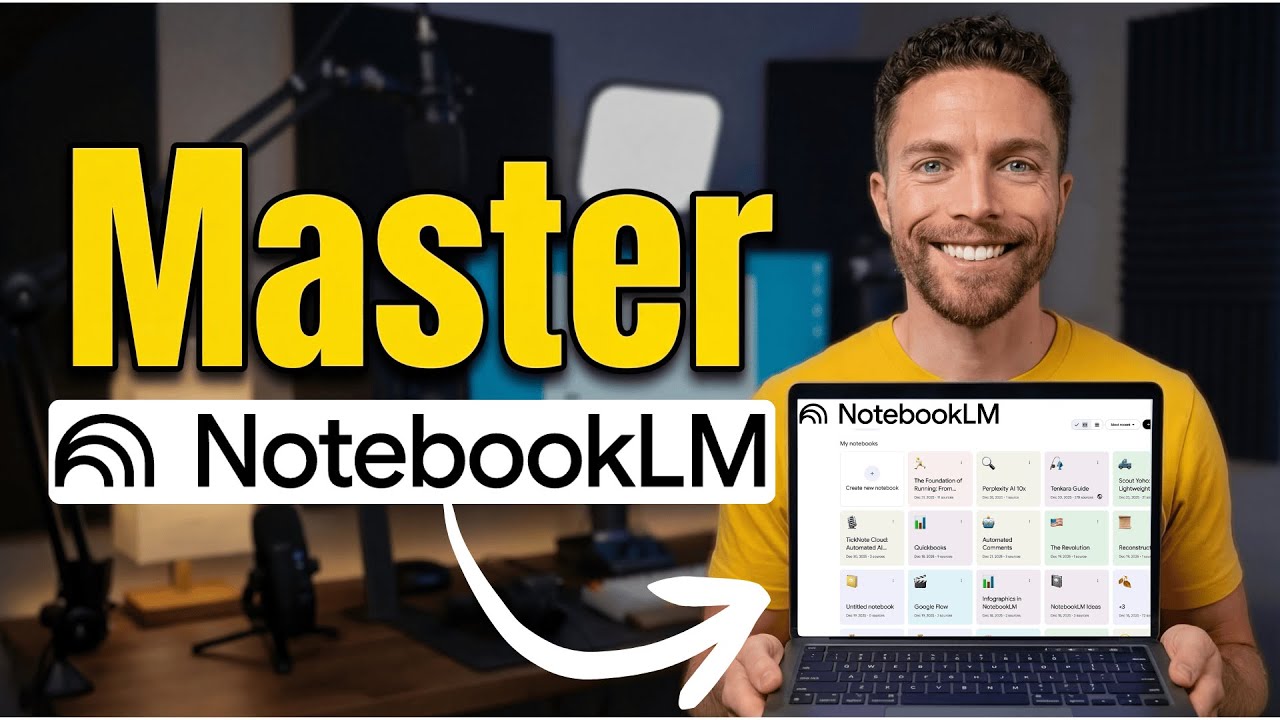
best accessed from the web. Just come to notebookm. google and then you can click on this big button right here that says try notebook LM. And here you can see all of the notebooks that I have already created. But if you're on a new account, you won't have any notebooks in here yet. Now, if you open any of these up, you'll notice that right here in the middle is this chat. And that actually allows you to chat with all of the knowledge that's inside this notebook. And even though this may look like something like chat GBT, it's actually very different for
1:02

Why It's Unique

two different reasons. First, this chat inside this notebook is grounded only in the sources that you give it. So when you chat with chat GBT, it's pulling information from the sources that OpenAI trained it on. They chose the sources. But here inside this notebook, I chose the sources. You can see all those here on the left. So, this allows you to get very hyper specific about the information that you want to be used for this chat. And as a result of that, I often find that it hallucinates or makes stuff up a lot less often than chat GBT does. And the second thing that makes Notebook LM very unique is that it has a massive context window, which basically means that you can upload a ton of information inside of this. So, now that you understand what makes Notebook LM so special, let's jump into my three-step framework that will walk you through how to use Notebook LM. Starting with the
1:58

Step 1: Curate

first step, which is curate. So, to get started with your first notebook, just come on over to Notebook LM and click right here where it says create new notebook. Now, the first thing it's going to have you do is upload your sources. And these are what's going to make up the knowledge base for this notebook. And you can upload files, you can add links to websites or YouTube videos, add things from Google Drive, or even copied text. So, for instance, let's say we want to start learning how to run and maybe even how to train for a marathon. So, you can come on over to YouTube. Let's say I see this video right here about running. I'll go ahead and copy down the link to it. Return back to Notebook LM. Click right here. Paste in that link and click on insert. and then that video will become part of the knowledge base for that notebook. Now, this is where I see people making the number one mistake when it comes to
2:53

Common Mistakes

Notebook LM. The way that most people use Notebook LM is they'll come over to YouTube and they'll search for how to start running. They'll see all these videos and they'll just start grabbing all these links like rightclick, copy link, rightclick, copy link. This one right here, rightclick, copy link, and then return back to Notebook LM. paste all of them in and click on insert. And if you're doing that, I'm telling you right now, you are using Notebook LM wrong. The first step in my process is called curate. And curate means that we're just not uploading random sources. We are being very particular about the sources that we're putting in here. After all, what did I say is one of the benefits of Notebook LM is that it's grounded in only the information that you're giving it. If you're just picking random sources and dumping them all in here, it's really no different than using Gemini or Chat GBT. So, every source that you upload into here really should be vetted. So, for instance, I know that for myself, I started looking at running and I keep coming back to the same videos. I watch this one, I like this one, I watch this one. There's a few videos here. There's even a blog that I really like and I keep coming back to these as a resource. they really work for me and for my type of training, these are perfect. So, I know that these are vetted sources that
4:13

Adding Sources

I want in my notebook. So, what am I going to do now is I'm going to copy down the links for all these sources that I already know are great and begin pasting them into Notebook LM. So, here I have a blog post article. I'll copy that. Go ahead and click right here where it says links and YouTube videos and paste that in. And one tip here is you can paste multiple links in here as long as they are separated by a space or new line. So I'll click on space and then switch back to find my next source which is this YouTube video. And I'll do that for every single one here by just pasting in the next one. Space and then I'll do the other ones. Once I have all the website links or YouTube videos linked up in here, go ahead and click on insert. And then you'll notice here on the left, it is actually becoming part of your knowledge base. You can see all of your sources right here on the left. Now, at any time, you can always add more sources by clicking up here where it says add sources. And now, this time, I'm going to go ahead and upload a file because I actually have a PDF on my MacBook that goes over marathon training. So, I'm going to go ahead and upload that. And you can see that down here is now being uploaded as well. So, here it is right here. Just know that there are a ton of different files that are supported. You can even upload images as well and even voice files. So, uploading
5:32

Voice Files

voice files is super easy. What you want to do is pull out the voice memo app on your phone. Go ahead and record something. Then go ahead and select it. And you want to make sure, of course, you have the Notebook LM app downloaded to your phone. Then go ahead and share this. So, I can do that on an iPhone by clicking on these three dots and clicking on share. You'll then find Notebook LM. Click on that. And then you'll choose which notebook you actually want to share it with. So if I wanted to share with this one, I can click on that. And you see it's now being uploaded right there for you. Let me show you a couple other ones. So we
6:08

Google Drive

can also use Google Drive. So if you have anything in Google Drive, you can add that. So I'm going to do that right now. Here's a marathon training guide right here. And then finally, if you click on add sources, you can also paste in copied text. So let's say someone
6:22

Copied Text

sends you an email with some really helpful information. Just copy down the text of that email, paste it in here, and click on insert. This is also super helpful because sometimes you'll notice that certain websites aren't able to be uploaded into a notebook. So, you can see that right here, Forbes. com is behind a payw wall, so you're not able to upload it. What you can do instead is if you have access to Forbes and to this article, you can just copy down the text, click on add source, paste it in, and that can then become part of your notebook. You'll notice this happens a few times where these sources aren't able to be uploaded. The best way to clear it out is just to click on more, click on remove all failed sources, and that will then clear it out for you. Now, there's one additional way you can add sources into Notebook LM that they
7:09

Web Search

just added. So, if you click right here where it says add sources, you'll notice right here that you can actually search the web for new sources. So, I can type in here, for instance, how to start marathon training. You can say that you want to search the web. You can change it from fast research to deep research and then click on submit. And then it's actually going to go out and find websites for you that are all about marathon training in this case. And here we can see all those results right here. Now, this is handy for sure, especially if you switch it to let's go ahead and confirm this deletion. If you switch it to deep research, you actually get a report as well. So, it is super handy. However, you're running into that number one problem that I see people making, which is that these are all unvetted sources. So, if you just ran it again and click on import, that will then take all seven sources that I found and make them part of your notebook, but you don't know if they're good sources. from trainers that you actually respect and whose training philosophy you actually agree with. So, I'm not a fan of this at all. If you want to use this, you got to be very careful. you want to go ahead and run the search and then click on view and actually look at every website independently to make sure it's one that you like and let's say it is then you can go ahead and import that specific resource but I would not just blanket import all of them without first vetting them because that violates the first step which is curate okay once you've curated all your sources you'll see all of them here on the left and at any point in the future you can of course add more by clicking right here where it says add sources. But for now, let's say
8:52

Step 2: Learn

you're happy with that and you're ready to move on to step number two, which is learn. And that's when you can take all this information and begin to digest it yourself. And that all starts right here in the middle with the chat. Now, before we begin chatting with our new knowledge base, it really helps to customize your settings. So, click up here where it
9:12

Configure Settings

says configure notebook. And there are two settings that we can configure. So, first is the conversational goal style or role for this notebook. So, there's a default setting, there's a learning guide, but I really suggest you turn on custom and give it a custom set of instructions for what you're looking to accomplish using this notebook. So, I'm going to tell it that I wanted to act as an elite marathon training coach with over 20 years of experience coaching Boston qualifying athletes and firsttime marathoners. And so this is really going to be able to tailored uh be tailored to exactly what I want, which is to have a coach who's helping me prepare for a marathon. Down here, you can also choose the response length. So either default, longer, or shorter. Personally, I leave it on default. And then click on save. And now you're ready to go. So let's start asking it some questions and chatting with this knowledge. So I'm
10:07

Using Chat

going to ask it a question like, should I bring food with me when I run a marathon? And I'll go ahead and submit that. And here's the answer. It says, "Yes, absolutely, you need to bring food with you when you run a marathon. " And actually gives a breakdown of how often you should be eating. And what I love about this is that if I were to put the same question into Chat EBT or into Google, the answers I'm going to get are going to vary widely. But here, I'm getting answers from sources that I actually trust, from trainers who I actually respect. So, I know that this answer is going to work for me and my training style. And what I also love about this is that it always gives you
10:46

Citations

citations. So right here they reference this golden rule of race day, which is that you shouldn't do anything new on race day. And I can hover over this right here and actually see where this information came from. So this actually came from the PDF that I uploaded. And it gives me the exact quote from that guide as well. So I can see exactly where that information is being pulled from. so I can verify it myself. And you can, of course, continue to chat with it and really get like a lot more specific with this. So, I can say something like, "Help me put together a 12week training guide for a marathon. " And here it not only gives me that guide, but also says, you know, that's actually super aggressive. You might need to give yourself more time than that to train. But anyway, here's the exact outline of the 12-week training guide. So, at any point if you get an answer that you love and
11:40

Save Notes

you want to save, you can click right here where it says save to note and you'll see it now appear here on the right. To take this one step further, if you click on these three dots, you can actually convert this to a source. And by doing this, it's now going to appear over here on the left. So now using Notebook LM, I have put together a 12week marathon training guide for myself and I've incorporated it into my knowledge base so that when I chat with this in the future, it's going to know exactly what my 12week training guide looks like and it's going to be able to use that information to give me very specific answers to what questions I'm asking it. And while we're over here on the left, I want to show you one other thing. You'll notice that all of these sources here have check marks next to
12:27

Source Selection

them. And that means that all of these sources are being used when you actually chat with this notebook. But at any point, you can turn these off and you can only chat with certain information if you want. So let's say there is one video I know that gave a very particular tip and I just can't find it in that video or I don't want to open up that video. Well, I could just check off that one video right here. And over here, you can see it's now just using one source. And I can say something like, what was that tip he gave about food? And then here's the answer I'm looking for. The guy in the video said, "You want to eat before you run so you don't arrive at your workout feeling flat or low energy. " And again, I can hover over this and see the exact quote from the transcript of the YouTube video. So again, you can choose whatever sources you want to chat with inside the chat or just leave them all on. And then finally, as an advanced tip, you can come over to Google Gemini, which is
13:27

Gemini Integration

connected to your Notebook LM account. It's all the same Google account. Click on this plus icon right here. Choose Notebook LM, and you can actually chat with your notebook directly inside of Gemini. Now, one warning about this is that when you do this, it's probably also going to pull in information from its own training and from the web as well. So, it's not going to be as curated as chatting with the information directly inside of Notebook LM. However, it can be pretty handy when you're on the go just to be able to jump into Gemini and choose whatever notebook you want. And I do find that Gemini can be a little bit more creative as well. So, just understand how to use it. But nine times out of 10, if you set up a notebook, you're going to be chatting with it directly inside of Notebook LM.
14:15

Limitations

Now, before we continue, I think it's also important to understand the limitations of Notebook LM. Because even though this is great for chatting with specific sources, it's not great as a general use chatbot. For something like that, you'd want to use Gemini or Chat GBT or something. But of course, the problem there is that there are so many different chat bots these days, and they all have their different strengths and weaknesses. And of course, you want to use the best one for the job. So, in the past, this meant you had to frequently switch between different tabs, finding the best chatbot for the task that you want to do, and it gets very cluttered and annoying and confusing. But not
14:52

I10X Sponsor

anymore, thanks to today's sponsor, I 10X. I 10X is an all-in-one platform that gives you access to all the major AI chat models in one place. So for instance here when I'm chatting with it, I can click on this dropdown and select between chat GBT's models like GBT 5. 2, Gemini's models like 3 Pro, we have Gro 4 in here, Claude 4. 5 Sonnet, DeepSeek 5 Mini. So all the major models are right here ready for me to switch between and choose exactly which one I want to use for my particular task. And they even break it down for you to make it super organized. So you can see which ones are best for research, coding and which ones are best for long context, etc., etc. Now, my favorite feature inside of here is here on the left is called chat arena. And this enables you to put the prompt in once, such as, "How do I start marathon training and you can actually get a response from two different AI models at once. " So I can choose, for instance, GPT 5. 2 for this one. And for this one, I'll go ahead and choose Gemini 3 Pro. And then when I submit this, I'll get an answer from both different models. And I can see which answer I like the best. And so going forward, if I like the one from chat GBT better, I'll just start using that one more. Or I could just continue to use both here inside of chat arena and then always pick whichever answer I like best. There's also a ton of other features this comes with. So if I come back over to AI chat, you notice that they do have memory in here as well, just like chat GBT does. You can enable web search, you can add attachments. Here on the left you can click on AI image and you're able to generate images with this as well with all the top models like Imagin 1. 5 by ChatGBT. We have nano banana by Google even nano banana pro in here. Flux pro we have deep research which is powered by perplexity my favorite AI research model. You can even upload PDFs and documents and then chat with those documents. There's AI video generation. There's a whole discover tab and they even have agents in here as well, which is very similar to gems on Gemini or GBTs on chat GBT. So really everything you could ever want out of an AI chatbot and more because they have access to all the models in one place. And the best thing about this is this starts at just $8 a month if you go with the yearly subscription or if you prefer to pay monthtomonth. It starts at just $10 a month. So, if you want to try I 10X out for yourself, I'll leave a link for it in the description down below. And thank you 10X for sponsoring this video. So, I think we've covered everything you need to know about how to use the chat inside
17:47

Studio Panel

of Notebook LM. Let's move over to my favorite section, the one that gets everyone so excited. Definitely the coolest part about Notebook LM. That's over here on the right. This panel, it's called Studio. Now, if this isn't showing up for you, just click right here. This will collapse it and expand it. So, just make sure that's expanded so you can see all of them inside of here. And this studio allows you to take all the knowledge inside of your notebook and to transform it. And there's several different ways you can do that and they're always adding more. So, let's just jump in and we'll start with the first one, which are audio overviews. Okay, so audio overviews
18:25

Audio Overviews

basically will generate an AI podcast based on all the information in your sources. Now, the biggest mistake that I see people making, this is probably the second biggest mistake that I see people making with Notebook LM is that to generate one of these audio overviews, they just click on this button right here. And you'll notice right here, it starts generating that podcast. That is a mistake. The better way to do this is to click on this pencil icon. and that will open up the settings so you can tell notebook LM exactly what podcast you are looking for it to generate. So there's several different formats here and these are all fun to play with. So in my case I know that at least a few of my sources don't quite agree on the best way to train for a marathon. So in that case, I would go ahead and select the debate one because that will pit two of the competing viewpoints about marathon training against each other. There are some other options in here as well though. So we have critique. So this will actually generate a podcast where the host is actually critiquing all the information inside of your notebook. We have brief, which is basically a short podcast. And we have deep dive, which is just like a general overview of the information, but a lot longer than brief. So again, by default, it's going to be on deep dive, but definitely come in here and get exactly what you're looking for. In this case, I want to go ahead and go with debate. You can then choose the default language. I'm going to go ahead and go with English. And you can choose between short or default. And then you can actually ask the hosts to focus on anything specific that you want. So in this case, I want to ask them to focus on the differences in how to approach marathon training and whether it's better to do more long runs or shorter but faster runs. So I'll click on generate on that. And then once those are finished, we're going to go ahead and listen to both of them and you'll see how different they are. Okay. So both our podcasts are now complete.
20:23

Podcast Comparison

Let's go ahead and listen to the first one, which was the generic one that we just generated just by clicking on it without going into the pencil. — Welcome to the deep dive. Today we're diving into the, let's be honest, overwhelming world of running advice. We're talking biomechanics, training plans, marathon prep, — all of it. — And we're going to try and turn — So, you'll see what it's doing is it's taking all that information and made a podcast about it, but it's making a podcast about all of that information. Now, if we listen to this one instead, you're going to hear how different it is — of stressing the speedwork. We are simply training to tolerate our existing limits, not expand them. — I see the desire to increase that capacity. I do. But you risk undermining the base required to even approach the starting line healthy. So you see very different approach because we and really more fine-tuned to what I needed, which I was able to get by using that pencil icon. Now, one other thing I want
21:21

Interactive Mode

to point out about this is that one of the benefits though of using the generic one, which again you just get by clicking it without clicking on the pencil, is you get this really cool ability to actually interact with the podcast. So, you notice this one right here has this interactive mode. I'm going to go ahead and click on that. Let's go ahead and play the audio. — Welcome to the deep dive. Today, we're diving into the, let's be honest, overwhelming world. Now, if I'm going to click right here where it says join and I'll actually be able to chat with the podcast host. — Oh, wait. Someone wants to join. Hey, go for it. — What's the best food that you should eat while you're running a marathon? — That is a fantastic and honestly a critical question. — We love that you jumped in with that. — Okay, let's unpack this right now — because fueling is non-negotiable for long-distance running. — We were just about to talk about this. — You hear about so cool. It's so wild that you're able to do that. not only generate the podcast, but then actually be able to interact with the hosts. It's pretty wild. So, pro tip, if you download the Notebook LM app and open up
22:26

Download Podcasts

any of the notebooks that you've generated a podcast for, click on the bottom right here where it says studio and then go ahead and choose any of those podcasts that you've generated. Then up here, you'll see this icon. Just go ahead and click on that. This is now downloading onto my phone. So, even if I'm offline or don't have great service, I'll still be able to listen to this podcast. And this is one of my favorite ways to learn information inside of my notebooks, I just download these podcasts onto my phone and listen to them while I'm working out or while I'm driving to be able to learn even while I'm on the go. Next, let's look at video
23:06

Video Overviews

overviews. And these will literally generate for you an explainer video presented by AI. It is super cool. So once again, we're not going to click on this. We're the pencil icon. And we have two different formats. We have the longer, more structured one and then the briefer one. I'm going to choose brief on this. You'll notice that anytime you make these shorter, it's going to be able to generate faster. So for purposes of this, I'm just going to leave it on brief. And then this is the really fun place because you can actually choose which visual style you want. There are several pre-selected or templates for you already in here. You can go with classic or you can actually customize it if you want. But I'm going to go ahead and choose anime style. And then again, you can tell it what you want the AI host to focus on. So in this case, I'm going to say focus on running form. That's going to go ahead and start generating. And because these are videos, these usually take a little bit longer. Okay, so our video is finished. You'll see it here on the right. And by the way, as you're generating these things inside of Studio, they're all going to stay here on the right. You can leave and come back and they're still going to be here. Same thing with the chat as well, everything in the chat will be persistent. You can leave and come back and it will stay here. If at any point you want to delete the chat, you can click on these three dots and click on delete chat history. But coming over here to the explainer video, let's go ahead and watch this together. — All right, let's talk running form. We're going to break down exactly what you need to know — and you will see a huge difference. But look, running slow isn't weak. It's smart. Rest isn't quitting. It's getting stronger. So, what's your first step going to be? — Yeah. So, those are the video overviews. Super handy, especially if you are a more visual learner. Okay. So, we've
24:52

Mindmaps

barely scratched the surface of what you can do inside of Studio here. Next up, we have mindmap. So, there's no pencil icon for this. Go ahead and click on it. This one's usually really fast. And you'll see it's generating right here. And by the way, just like before, if you only want to use some of these sources when actually generating the different things inside of Studio, you can just choose those. So if I just chose this one and clicked on mind map, you'll see it's generating that mind map just based on that one source. Let's go ahead and look at the one that used all the sources. These are super helpful for learning all the knowledge inside your notebook. So here we see this starts with marathon training and let's go ahead and click on get started. Then it breaks that down like medical clearance. I can click on this and then it'll actually start or actually puts in a prompt into the chat asking about the medical clearance that's needed for a marathon. We could do the same thing for base mileage of 20 to 30 miles per week and it's going to ask a question about that. Uh, I think these are just super helpful for kind of seeing visually how all the different knowledge connects. Next up, let's go ahead and
26:05

Reports

close the mind map view. And this time we'll click on reports. Again, no pencil icon. And that's because when you click on it, it will automatically bring up the menu right here. And you can choose which type of report that you want. And what's cool about this one is that they not only have the generic formats up here at the top that are available inside of all your notebooks, but they also have suggested formats that are specific for this notebook based on what the notebook's about. So, you can play around with all of these, but for this one, I'm going to click right here where it says training philosophy. And again, you can click on the pencil icon and really tailor this exactly the way that you want. I found that this is really good at suggesting the prompt for the report. So, usually by default it's very good and I could just click right here without having to actually change up the prompt. And you can see it's now generating on the right. So, here is the report right here. So, you see it's a very textbased explanation, extremely long but very wellthought out. So, it's not a brief answer. This takes a long time for it to generate specifically. So that gives you a very detailed, helpful
27:14

Flashcards

answer. Next up are flashc cards. So again, clicking on the pencil icon, you can change how many cards you want, fewer or more, and the level of difficulty. So if you're new, you can start with easy ones and then create another set that's medium, and then another set that's hard. And then you can choose again exactly what the prompt is for this topic, like maybe running phrases. And then here are the flash cards right here. So you can read the question and click on see answer and then go through all of them and kind of quiz yourself. And speaking of quizzing yourself, if we go back to the studio, there's also a quiz option in here as
27:51

Quizzes

well. So these last two, flashc cards and quiz are really great for students. This is something I really wish I had when I was in law school. Notebook LM would be incredible for students. You can create a separate notebook for every single subject and then actually quiz yourself on the material in there and create flashcards for it. You could even record your professor's lectures and then upload that recording into the notebook as well. I think it's brilliant for students. And then just to show you what the quizzes look like, this is what it looks like. You can even see a little hint here you can choose and it'll tell you why you're wrong and what the right answer is. And it'll actually grade you on it as well. So, moving on now, let's
28:35

Infographics

go ahead and look at infographics. This is one of my favorites as well, just because these turn out usually beautiful. If I go ahead and click the pencil icon again, you can choose the language. You can choose if you want it to be in landscape orientation, portrait, or square. I usually go with landscape, so it's able to fit a lot more into it. And then we have level of detail, concise, standard, and detailed. Now, if you do detailed, I find that it usually packs a ton of information into the one infographic and sometimes it can be hard to read. I suggest you leave it on standard. And then again, you can describe what you want here. So, I can say something like create a map of a marathon route and at which mile marker you should be eating food, drinking water, etc. So, now that's going to get to work actually generating that infographic. We also have slide decks in
29:24

Slide Decks

here as well. And you get to choose between a detailed deck or a presenter deck. Basically, the difference is that a detailed deck will have all of the information on it. This is really useful if you're learning something. However, if you're actually giving a presentation, you want to choose presenter slide. That will put minimal information on the slide, just a lot of graphics and you're actually going to be doing the talking and the presenting and telling everyone what the slides about. I'm going to go ahead and choose detail deck for this one. I'm going to keep it at shorter just to make it generate faster. And I'm going to tell it to create a slide deck about the best clothes to wear for the New York City Marathon. So here we can see our infographic is now complete. So let's go ahead and open that up. And here you can see it actually put together this map. So it says pre-race about 2 to four hours before. Have a simple high carb breakfast uh that you've tasted during training. Here's a start line. Mile three, drink water. Mile five have like a nice energy gel. Mile 9 drink water. I mean look how cool this looks. Like this took a couple of minutes. This is so great looking. You can kind of save this into your documents and just have this as sort of a visual representation of when you should be fueling during your race. It looks super cool and even have the post-race recovery in here as well. I always love the infographics. They always turn out so nice looking. So our presentation is ready. If we go ahead and click on it and then click on expand this viewer, we can see a little bit bigger. So here is the entire presentation. This is another place where I think Notebook LM really excels. Their presentations always look exceptional. They created all these charts. Here's another chart like where you basically bunk during a run. Here's another one about where you should be drinking water during your run. So, always well done. And here are all the close as well. So, super well done. There's one final thing inside of Studio which are data tables. And these
31:16

Data Tables

basically create for you Excel documents that pull data from all your sources. Now, this isn't a very dataheavy type of notebook. However, it still generated for us something really cool here. This actually put together an entire training plan for us inside of a table that's really neatly organized. So, we've now
31:38

Step 3: Act

completed step number two, which was learn. And that brings us to the third and most overlooked step, which is act. Because here's the thing, knowledge is completely wasted unless you actually use it. You need to build something, create something, just do something with this new knowledge. That might mean building a business, using this to create content, or even just sharing this knowledge. So, I know for myself, I create a new notebook anytime I'm working on a video. I use that notebook to organize all of my ideas. I throw my voice notes in there. I upload links to blog post articles, to other YouTube videos, or just write out all of my different ideas. And then I can use that to actually create a outline of all the videos that I create and actually script out parts of it as well. In addition to that, I know people who have created entire businesses using Notebook LM. And then finally, you can of course share
32:30

Sharing Options

this information. So the easiest way to do that is by clicking on the top right here where it says share. Here you can share it with whoever you want. And you have the choice of limiting what they have access to. I think this is only available on the paid plan, but you can either share with them the full notebook, meaning they'll be able to see all of your sources, the notes, and the chat as well, or you can share just the chat. So, they won't even be able to see what sources you use to create this notebook. In addition to that, you can come to a lot of the different things you created inside of Studio, like this infographic right here, and actually download it and share it with people that way. And finally, just to wrap this up, I'm going to return back to the
33:12

Layout Customization

Notebook LM homepage where you can see all of your notebooks. Couple of quick things I want to show you in here. So, first of all, you can change the layout. So, we have this grid layout, but you can change it to these lists. Personally, I think the grid looks a lot better. You can also change the sorting. So you can sort by title or most recent. Now for any of these notebooks, you can change the title by clicking right here and click on edit title or you can delete it or you can open up the notebook and change the title up here. So I'm going to rename this one marathon
33:42

Changing Icons

training. And in addition to that, if you scroll all the way up on the chat and click on this emoji right here, you can actually change the emoji that appears right here. So, let's go ahead and change that to maybe this one. And now, if we refresh this right here, you'll see it is now that sneaker and we have the updated title. So, there you
34:08

Conclusion

have it. That's my three-step framework for mastering Notebook LM. If you follow these three steps, curate, learn, and act, you're going to get so much more value out of this tool than just throwing sources in and just asking random questions. And now that you've mastered Notebook LM, you may want to check out the video I made recently on how to master perplexity. It's my go-to AI tool when it comes to curating knowledge that I can then feed into Notebook LM. So, if that interests you, make sure to click on this video right here and I'll see you over there in just one second. Bye for now.

Ещё от Paul J Lipsky

Ctrl+V

Экстракт Знаний в Telegram

Транскрипты, идеи, методички — всё самое полезное из лучших YouTube-каналов.

Подписаться