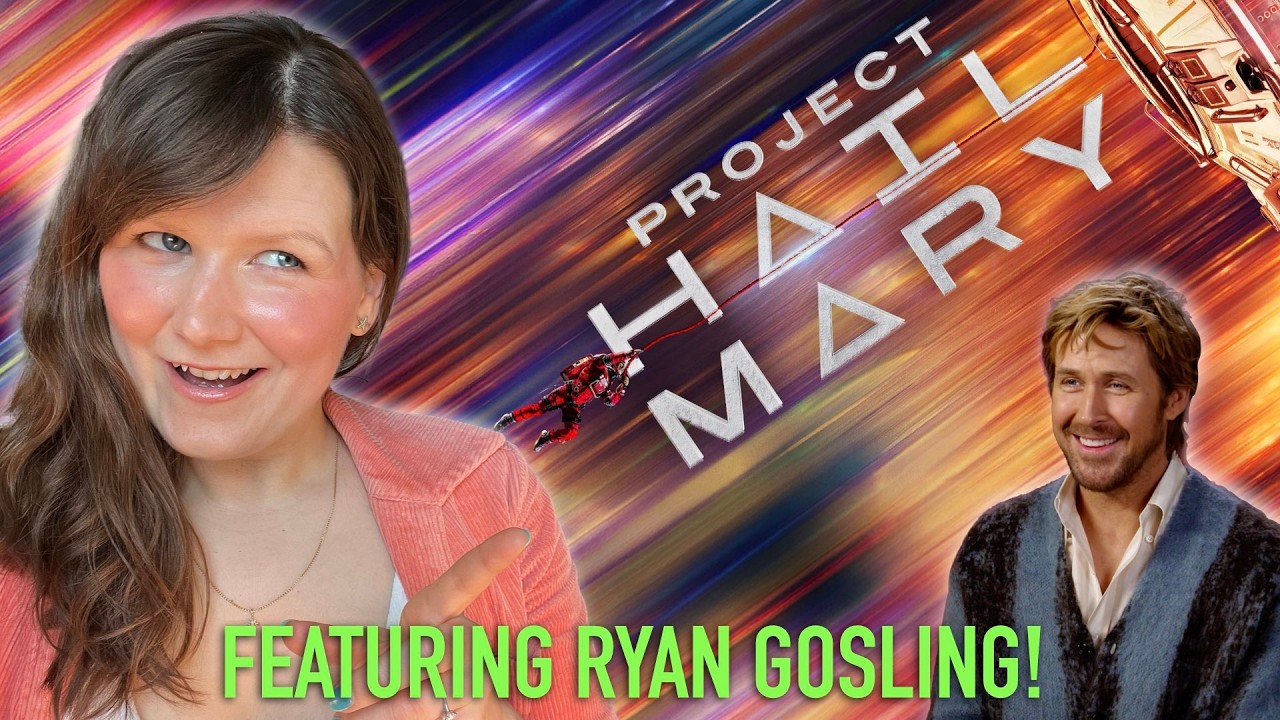
How much of the science in Project Hail Mary is actually possible? Because this story is packed with real science! I got to sit down with Ryan Gosling to chat about how the science in Project Hail Mary (one of the most scientifically ambitious sci-fi stories ever written) was translated from the book to the big screen. I also sat down with author Andy Weir, and directors Phil Lord and Christopher Miller to chat about how you visually communicate difficult concepts like relativity on screen, whilst keeping the human story at the heart. There will be mild spoilers ahead... #projecthailmary #andyweir @SonyPicsUK @AmazonMGMStudios @sonypictures
Full video breaking down the science of Project Hail Mary - https://youtu.be/lYHCTEnYOr4
Video edited by Dr Becky Smethurst
---
👩🏽💻 I'm Dr. Becky Smethurst, an astrophysicist at the University of Oxford (Christ Church). I love making videos about black holes, cosmology, dark matter, the early universe, the James Webb Space Telescope, and the biggest unsolved mysteries in astrophysics. I like to focus on how we know things, not just what we know. And especially, the things we still don't know. If you've ever wondered about something in space and couldn't find an answer online - you can ask me! My day job is to do research into how supermassive black holes can affect the galaxies that they live in. In particular, I look at whether the energy output from the disk of material orbiting around a growing supermassive black hole can stop a galaxy from forming stars.
http://drbecky.uk.com
---
📚 My book, "A Brief History of Black Holes", out NOW in hardback, paperback, e-book and audiobook (which I narrated myself!): http://lnk.to/DrBecky
---
👕 My merch, including JWST designs, are available here (with worldwide shipping!): https://dr-becky.teemill.com/
---
🎧 The Supermassive Podcast that I co-host: podfollow.com/supermassive
---
🔔 Don't forget to subscribe and click the little bell icon to be notified when I post a new video!
Оглавление (3 сегментов)
Segment 1 (00:00 - 05:00)
As part of my video breaking down the science in Project Hail Mary, I got to speak to the author Andy Wear. Here's that chat in full. You are famously known for incorporating a lot of the science into your sci-fi. So, when you're starting a book, I'm really curious. Do you start with the science or plot characters first? — Uh, I start with the science. I usually start with some There's usually something that interests me in science that I like, oo, this is neat or what if this or what if that. And then I start to build a plot around it. And then I grudgingly acknowledge that there have to be characters in the story. — You have a computer science and a software development background. So um coding is famously a lot of problem solving like solo and using a lot of your initiative. Do you think that background is what leads to your main characters embodying that attitude as well? — I'm not sure. Um, possibly, but I honestly I don't think so because coding um isn't very solitary when you're doing it professionally, which I did for 25 years. I worked for, you know, I was a software engineer for various companies and you are it's you're always on a team. you're one of many engineers on a project and you're working with QA engineers who are testing it and you're working with you know um production people who are deciding what the feature sets are. So it's a big team effort. You're part of a big group. So I would say no in that sense. However, my experience as a software engineer um translated well very it translated very well over into the business of being a writer. So the idea of then I am told that I'm a pretty easy writer to work with um in terms of editing and feedback and stuff because like I give a manuscript to my editor, he gives it back to me with like six tons of red ink on it and I'm like, "Okay, I'll fix that. " Because to me it's like getting bug reports about my software. It's just like I'm used to that system of like I make a thing then somebody tells me a thousand places where it sucks, I fix those, send it back and I'm used to that iterative process. I'm not like I'm an artist. How you're not seeing my genius, you know? I just kind of accept that it's an iterative process. And so that translated really well over — nice. — Not the question you asked, but that's the one I — No, I love it. Yeah, it's like version control. Vision control. Um, now I'm curious when you're doing like the maths that a lot of us scientists love to read when we read your when you read your novels, when especially when you're like actively writing and in that writing phase of a story, are you back of the envelope like calculating this math or have you made a spreadsheet? Have you got a code that's outputting like you know Lorent transformations for you so you can keep flow and writing? It's all I have spreadsheets upon spreadsheets, pages and pages of um just more spreadsheets than you can shake a stick at. I love it. And that's my favorite part, by the way. The um the yeah, the math and science of it is all um — let's see. I'm going to uh here we go. I'm going to do screen share here. So here, this is just the spreadsheet for things related to Hail Mary, fuel insulation, fuel volume, how the centrifuge works, uh how the engines work, the how spin drives work, um and so on. It just keeps going on. And that's just one page. Here's a bunch of stuff about astrophase, like you know, it's biological mass, it's propellant rate. Oops, I did something bad there. Okay. Yeah. And so on. And these are constants like and that just keeps going on. Um this is uh well that's not as pretty but yeah there we are. Um this is information about the taeti system. forierani system and uh this is how iridian muscles work. — This is amazing. — Yeah. — I have to ask while I'm here like are you doing like this is a really nerdy question but I think you'll enjoy it. So, doctor, I think you can go ahead now. What? What are you a doctor of, by the way? — Uh, astrophysics. — Astrophysics. There we go. — I study super massive black holes. So, I'm waiting for your black hole story at some point. — Super massive. Well, you got interstellar, you know. — Sure. — You had interstellar. — Oo, I saw that. Um, I'm curious with Project Hail Mary, like were you doing simple Lorent like transformations or were you doing like full second order GR acceleration calculations to throw in there as well? — F full general relativity relativistic rocket equations. I did not derive them. You know, I found them online and then used them, you know. — It's so cool that you can, you know
Segment 2 (05:00 - 10:00)
flesh together a story like that with so much science. And I think that's what people really appreciate it. And especially the fact that you picked real stars, Taeti and 40 Arerodania included in the story. How did you choose those two stars specifically? Was it convenience of distance or was there other scientific aspects involved? — Um, well, first off, convenience of distance was very important because I didn't want any faster than light travel or any nonsense like that. So, I wanted everything to stay like if I'm going to have somebody go to another star and they're not going to go faster than light, it's got to be pretty close. I mean, unless I have a magical power source that's even better than mass conversion, and then you can get, I think, anywhere in the universe in 28 years of your own time, I think, is what it works out to be roughly — if you're accelerating at 1g. So, I wanted them to be close together. — And then, um, I wanted we find out at the end, it's actually just speculated by Grace and Rocky, but I can tell you as the author, it's true. um that all life on all three of those worlds was from a panspermia event that emanated from Adrian or Taletti emanated from the Talcetti system 4 and a half billion years ago and that would be the um I call it primordial astrophase some ancestor of astrophase seeded all these planets that's why so that's why it's all planets that are close to talcetti — and the And that's why like we're all related. You and me, Rocky, Astrophase, Taliba, we're all we all come from the same single genesis of life because it rubbed me the wrong way the idea of three different genes of life in such close proximity. So I wanted a panspermia event. Having gone with that then I got to say like oh now I don't need to invent a bunch of different cellular mechanisms or anything like that. I could just say yeah yeah astrophase has mitochondria — you know why not now I don't need to reinvent that and then I swear I am getting to the answer of your question which is why did I chose those stars is because they're solar analoges — um so um those are stars that are similar to those so it's not so much taetti as soul and forodani are similar enough to taetti that taetti based life was able to seed to those systems. — It gives us an insight into sort of what becomes science and what becomes the sci-fi when you talk about you didn't have to reinvent mitochondria. So, that's great. — Right. I don't want to reinvent my aritochondria. — No, — I already had to violate. You have to dig down to the quantum level to find where I have my madeup physics. So, I'm proud of that. — I think I know what you're talking about as well, right? New — super cross-sectionality of I I came up with that term and I like it. — I like it, too. It's a good one. good one. — Super cross-sectionality. And it is — watch people start using it in the literature now. — Yeah. I watch. Yeah. It's nothing can quantum tunnel through astrophase uh cell membrane — because I said so. — Yeah. — You play guard when you write. It's great. — Yeah. It's awesome. — So you produced the new film adaptation of the book as well. Were you involved in decisions on what science was left in and also the scientific accuracy of the visuals which obviously convey so much information in the film? For example, like I loved the visuals of the planet Adrian. They were beautiful. But was like the color choice motivated by say like the fictional atmospheric composition of like carbon dioxide and methane that's like so crucial for the story, — right? Um I think uh I it's been a while. I think in the book I said it was mostly methane. I I'm not sure. Um and I never even defined I'm not sure if I ever even defined it if it was a gas giant or just a dense atmosphere. But anyway, um I think it was supposed to be a mini gas giant. Um I was a producer, but anything visual and anything visual on screen and stuff like that, that's all the directors, Bailey Wick. They'd ask me things like, well, you know, what color is Adrian? And I said, it's green. And in my mind, I imagined something like Uranus, but green, right? And they came up with this beautiful tableau of greens and purples and stuff like that. I'm like, that's that looks really cool. I don't know if it's realistic, but who cares? It looks really cool. And then um but I would come in on the little things like um I'd be like, "Okay, when he's thrusting backward, it should be ionizing the atmosphere behind it because we're talking about an unbelievable amount of infrared light like hitting the upper atmosphere. " And so I love that when you can see it going back and you can see the kind of like the thing. And it also took me a while like there were several revs of the screenplay and kind of storyboards and stuff like that where they thought it was ionizing like the whole atmosphere. Like they thought like the
Segment 3 (10:00 - 14:00)
entire planet was a glow. And I'm like no planets are big. Planets are big. So just the part right behind the hill Mary is — you talked before about um scientific discoveries that made like plot points in the Martian moot like curiosity discovering water on Mars. Like if you were a betting man what would you say would be the thing that in the project hail Mary plot line is going to be you know disproven by my astrophysics colleagues or myself in the future? — It has already happened. your colleagues have already uh proven that uh 40 Aerodani AB doesn't exist. — Yeah, — it was believed to exist when I wrote the book. It has since been disproven. It it aligns almost perfectly with like stellar flare activity. And so they're like, "Yeah, we thought there was a planet there, but there isn't. " But — yeah, — I I'm that stuff doesn't bother me because — yeah, my books are a product of their time and I'm not gonna what am I going to do a re-release every time like something happens that invalidates it. It's like no, it's a it's I wrote The Martian uh with our understanding of what Mars was like as of 2015 or actually 20 2009. Um, and I wrote Project Hail Mary with our understanding of what those stars and planets and were like as of 2019 or thereabouts. — And you know, when when you're doing speculative science fiction, that's that's the one you take. We may later find out that I in fact probably certainly within my lifetime we will probably learn more about Talcetti E that will invalidate aspects of that as well. Yeah. Like — I think they also struggled to find it with one of the big instruments on the VT last year. There was a paper came out. So yeah, it' be really interesting to see what happens if they manage to — Yeah. But it' be really cool if we find out it's a carbon dioxide kind of like three worlds around Taeti anyway is carbon dioxide. be a neat coincidence. That's cool. But, you know, like I said, it's a product of its time. Another fun one was uh was um you know, so I described the in The Martian, I described pretty frequently the Aries 3 landing site, right? Where he was, what things looked like in the distance, what he was dealing with, and stuff like that. And then so after The Martian came out, JPL turned the High Mars satellite down to look at that exact location because I specified it in the book, the exact latitude and longitude using Mars coordinates of where Aries 3 was. And they took like highresolution photos where each pixel is a 30 by 30 cm square of Mars — and of the Aries 3 landing site. And they're like, "Well, that doesn't look anything like he said it. " I'm like, — that's just cuz we're all just a big bunch of nerds who love sci-fi. — I know. But it's — it's kind of funny that it's like, okay, they they've showed it. You can see pictures online of like this is where The Martian took place roughly. And here's where the HAB would have been. — That leads me to my very last question for you. Um like many astrophysics colleagues, like I grew up reading and watching sci-fi and was so inspired into the field because of that. Do you hope your work leaves the same legacy in that way or have you heard that it already has? — Uh, I've definitely heard people say they went into scientific fields because of my books, but I believe those people were probably destined for science anyway. I don't I think people have their interests. Um, you can foster those interests, but you're not going to change them. And so, if it makes somebody more enthusiastic about something they already loved, then great. Um, but I don't think I'm out there changing the world. I'm just an entertainer. Um, so I'm I I love to hear when somebody says like, "Hey, I you know, I read your book and now I'm an astrophysicist or something like that. " Um, that makes me feel good, but deep down I'm like, you probably would have been an astrophysicist anyway, but I'm glad I helped cl I helped I'm glad my book helped give you some clarity. — A big thanks to Andy Wear. I hope you all enjoyed that. Check out the book. Check out the film. They're both fantastic.