JWST discovers “platypus galaxies” in the distant Universe | Night Sky News January 2026
18:41

JWST discovers “platypus galaxies” in the distant Universe | Night Sky News January 2026

Dr. Becky 23.01.2026 103 474 просмотров 7 998 лайков

Machine-readable: Markdown · JSON API · Site index

Поделиться Telegram VK Бот
Транскрипт Скачать .md
Анализ с AI
Описание видео
Hello! And welcome to this episode of Night Sky News for January 2026 with me, astrophysicist Dr Becky Smethurst. This is the show where we chat about what you should look out for in the night sky in the next month, and what’s been happening in space news in the past month. In this episode we’re chatting about the preparations for the launch of Artemis II (NASA’s mission to loop astronauts around the moon), plus JWST’s discovery of some distant “platypus galaxies” that we can’t yet explain, and the discovery of a starless gas cloud that is yet another piece of evidence towards the existence of dark matter in our Universe. This is astronomy and astrophysics direct from an astrophysicist. Anand et al. (2026) - https://arxiv.org/pdf/2508.20157 Greenstreet et al. (2026) - https://iopscience.iop.org/article/10.3847/2041-8213/ae2a30 Yan, Sun & Shive (2026) - https://arxiv.org/pdf/2509.12177 My previous video on Rubin's first light images - https://youtu.be/QPVcG8TZ8Wg My previous video on Trump's cuts to NASA budget - https://youtu.be/si6paqM2_ug 00:00 Introduction 00:54 - Saturn, Moon & Neptune 23rd-15th 02:23 - Moon & Pleiades 27th 02:46 - Supermoon, Winter Hexagon & Jupiter 29th & 30th 04:28 - Mercury, Moon & Saturn 19th 05:25 - More detail on Rubin's asteroid discoveries 09:15 - Starless gas cloud discovery 11:10 - JWST's "platypus galaxies" discovery 14:05 - Artemis II mission closer to launch Video filmed on a Sony ⍺7 IV Video edited by Martino Gasparrini: https://www.fiverr.com/mgs_editing --- 📚 My book, "A Brief History of Black Holes", out NOW in hardback, paperback, e-book and audiobook (which I narrated myself!): http://lnk.to/DrBecky --- 👕 My merch, including JWST designs, are available here (with worldwide shipping!): https://dr-becky.teemill.com/ --- 🎧 Royal Astronomical Society Podcast that I co-host: podfollow.com/supermassive --- 🔔 Don't forget to subscribe and click the little bell icon to be notified when I post a new video! --- 👩🏽‍💻 I'm Dr. Becky Smethurst, an astrophysicist at the University of Oxford (Christ Church). I love making videos about science with an unnatural level of enthusiasm. I like to focus on how we know things, not just what we know. And especially, the things we still don't know. If you've ever wondered about something in space and couldn't find an answer online - you can ask me! My day job is to do research into how supermassive black holes can affect the galaxies that they live in. In particular, I look at whether the energy output from the disk of material orbiting around a growing supermassive black hole can stop a galaxy from forming stars. http://drbecky.uk.com
Оглавление (9 сегментов)

Introduction

Hello and welcome to Night Sky News for January 2026 with me, astrophysicist Dr. Becky Smithhurst. This is the show where we chat about what you should look out for in the night sky in the next few weeks and then we chat about what's been happening in space news in the past few weeks. In this episode, we're chatting all about the preparations for the launch of Arteimus 2, NASA's mission to loop astronauts around the moon. Plus, JBST's discovery of some distant galaxies that we can't yet explain, and the discovery of a starless gas cloud that is yet another piece of evidence towards the existence of dark matter in our universe. There's chapter markers down here if you want to skip ahead to any specific news story. Plus, any scientific research papers I mentioned are all going to be linked in the description down below, free to read. So, without any further ado, let's kick things off and start by looking up.

Saturn, Moon & Neptune 23rd-15th

We are still being treated to the joys of the winter sky with its long nights up here in the northern hemisphere. But wherever you are in the world, if you have clear skies on Friday, the 23rd of January, see if you can spot the cresant moon and Saturn in the west just after sunset. Now, the moon is a nice signpost for where to look for the fainter Saturn, which can tend to blend a little bit with the background stars, especially if you don't know what you're looking for. The only clue that you have is just that slightly yellowish glow that Saturn has. Now, the fun thing this month is that Saturn is also acting as a signpost to find Neptune, which is not visible with the naked eye. It's too faint. But with good binoculars, at least about 10 times magnification, something like a 10 by 50 would do. It'll appear as a slightly bluish faint star. Now, usually Neptune would be really hard to find cuz it's so faint. But because it's so close to Saturn at the minute, it should be in the same field of view of your binoculars as you look towards Saturn, making Neptune a lot easier to find. Now, if you don't manage to spot Saturn and Neptune on the 23rd, don't worry. They're in the same part of the sky right through January and February with Neptune getting ever closer to Saturn from our perspective as they move around their orbits. They get to just half a degree apart or the about the width of a full moon apart on the 15th of February before they'll start to move away from each other again. So, if you can at least find Saturn, if not both of them, when the moon is close to them on the 23rd, you'll know which direction to look in. Just keep an eye on them over the next few weeks. From

Moon & Pleiades 27th

the 23rd of January though, the moon then sweeps across the sky as it gets closer towards being full. So on the 27th of January, it will be a half moon right next to the star cluster Plightes or Messier 45. Another great target for binoculars or astrophotographers to get both the moon and the star cluster in the same shot, but also something that you can see with your naked eye as well.

Supermoon, Winter Hexagon & Jupiter 29th & 30th

By the 29th, the moon is then smack bang in the middle of the winter hexagon made up of six of the brightest stars in the winter sky that all ring the constellation of Orion. So if you start in Orion with his left foot of Riel and go down to the brightest star Sirius up to Prooion up again to the twins Caster and Pock in Gemini up to Capella right at the tippy top and then go down this time to the red star Alderan the eye of the bull in the constellation of Taurus before rejoining with Riel in Orion. These are so bright that these six stand out more than the constellations themselves, right? It's really obvious, especially in cities with light pollution. And if you do have clear skies on the 29th of January when the moon is in the middle of the winter hexagon, that just adds a little bit of fun to the whole affair because the moon will then be at perigee, the closest it gets to Earth in its slightly squashed oval-shaped orbit. Plus, Jupiter is also in the middle of the hexagon at the minute as well. It's the brightest thing after the moon, and Jupiter is especially bright at the moment because it's just past what's known as opposition, where it's going to be in the opposite part of the sky to the sun. So, it is also at the closest it gets to Earth. The moon will then swing past Jupiter on the 30th and 31st. Again, sign posting where to look for Jupiter if you're not sure before the moon then reaches its full moon phase on the 1st of February, which because the moon is at perigee, the full moon will then class as a super moon. When it is brighter and bigger in the sky, but remember, our puny human eyes can't pick out those changes, especially because we don't have a normal moon to compare it to. And if the moon does look big on the horizon to you near, you know, trees and buildings in the foreground, that is just the moon illusion. The moon will

Mercury, Moon & Saturn 19th

then continue to loop around the sky to come back to the evening skies near Neptune and Saturn on the 19th of February. This time with Mercury joining them as well. So if you've got a really clear horizon on the 19th of February, look for Mercury because it's reaching its greatest eastern elongation. So, the furthest it gets from the sun on the sky from our perspective, meaning it reaches its highest on the sky after sunset. But even that, it's still not that high. So, if you've got any buildings, trees, mountains around you, you're just not going to be able to spot it, especially in the glow of the sunset, which makes it harder to spot faint Mercury even on the 19th when it's at its greatest elongation. Later on in February, Venus will also rise higher in the sky. So, you'll hear a lot of hype about the planet parade coming up at the end of February, but more on that in next month's episode. For now, that's enough of looking up at the night sky. Let's come back down to Earth and chat about what's been happening in space news in the past month.

More detail on Rubin's asteroid discoveries

January can only mean one thing in the astrophysics world and that is double as the American Astronomical Society meeting which is the largest astronomy and astrophysics conference in the world which happens every year in the first week of January. This year was the 247th meeting which was held in Phoenix, Arizona. And as usual, there was a flurry of new discoveries and results announced at the meeting. Far too many to talk about here, but I'll try and pick out a few to highlight and I'll link the rest below. So, first up, we had more detail on the 2,13 new asteroids that were discovered by the Reuben Observatory in its first look images when it first came online that were released back in July of 2025. I covered this on my channel at the time, but now Green Street and collaborators have released their work studying how the brightness of these 2,000 or so asteroids changes with time. what's known as a light curve. And these light curves tell us a lot about the individual asteroid. So first, any repeat variations can tell us how fast the asteroid is rotating as different areas of the asteroid surface reflect different amounts of light. Secondly, the amplitude of any variation you have tells you how round an object is. So small amplitudes with very little change suggest a rounder asteroid, but a huge swing between different brightnesses suggests an elongated object. Third, how fast the rotation is actually gives us an idea of the density of the asteroid as well. So, if you've just got like a rough jumble of rocks held together loosely by gravity, it can't rotate very fast. Otherwise, all those rocks would fly apart due to centrifugal force, the force you feel on a roundabout or when you hold hands with a friend and spin around. Now, most asteroids are just a jumble of rocks. So, any asteroid that rotates faster than say every 2 hours or so are much more likely to be solid rock for that reason. Then finally, you've got the color of the asteroid. So, how much light at different wavelengths the asteroid reflects can give you an idea of what materials the asteroid is made of. So, here's an example from Green Street and collaborators showing the period, so the repeat in the variation of this asteroid's light curve, which tells us that this specific asteroid rotates every 1. 1 hours. Its average brightness tells us how much light the asteroid overall reflects, and that gives us a rough size. So, for this one, it's about 200 m or so. This asteroid's light curve has also got quite a large amplitude, suggesting this asteroid is about twice as wide as it is long, so it's not very round. Then you can also see the difference in color from the brightness detected in a filter only letting through reddish, greenish, and bluish wavelengths of light. That difference in brightness through each of these filters tells us that the asteroid is most likely rich in carbon. So, Green Street and collaborators have these light curves for over 2,000 asteroids, but we're only able to determine reliable rotation periods for about 75 of them. And from that found that 19 of those asteroids are rotating faster than that 2hour limit of a jumble of rocks held together, suggesting that these asteroids have to be made of solid rock. Especially the three they found rotating faster than once every 5 minutes. the fastest taking less than two minutes despite being 700 meters in size. So to explain this asteroid, Green Street and collaborators suggest this could actually be a fragment of a big collision in the early solar system which actually heated the rock so much so that it melted and became a solid object. And what's exciting about this is that this is just the beginning of asteroid science with Reuben, right? This was the discoveries in about 10 days worth of observations rather than the 10 years of observations that Reuben is going to give us. So we have all of that to look forward to which will help us learn so much more about our solar system and how it came to be. The next discovery announced at DAS to catch my eye was this discovery of an apparent

Starless gas cloud discovery

starless gas cloud. Essentially a failed galaxy in the universe. Now, these objects are actually predicted to exist by the simulations that we run of the entire universe evolving, specifically ones that contain dark matter that clumps together under gravity, which then pulls in the hydrogen gas from around it to give us these islands or galaxies in the universe. Now, usually there's enough hydrogen gas there that the gas will keep cooling and clump together to where eventually it gets dense enough for stars to form. But if there's too much dark matter and not enough hydrogen gas, then you'll end up with a failed galaxy with no stars. However, finding and observing these things to provide evidence for this prediction of our best model of the universe is very difficult. No stars means no visible or infrared light that we can detect. And dark matter famously doesn't give out light. We can only see its effects to gravity. So instead what we look for is emission from the hydrogen gas which gives out a faint glow of radio light. So what Anand and collaborators have reported this month is the discovery of a cloud of hydrogen gas a million times heavier than the sun which was spotted with the massive 500 meter wide fast radio telescope in China. And this cloud of gas is in a region of sky that when you observe it with the Hubble Space Telescope there just doesn't seem to be anything there. And given the distance to this cloud of gas, you should expect to be able to see a dwarf galaxy of at least a thousand times heavier than the sun. So this suggests that if this cloud did ever form stars, it was less than this amount. So, not only does this provide the strongest evidence yet for this specific prediction of our dark matter models of the universe, but also gives us an idea of that threshold of how much hydrogen gas versus dark matter that you need to have a failed versus a successful galaxy form. Now, the

JWST's "platypus galaxies" discovery

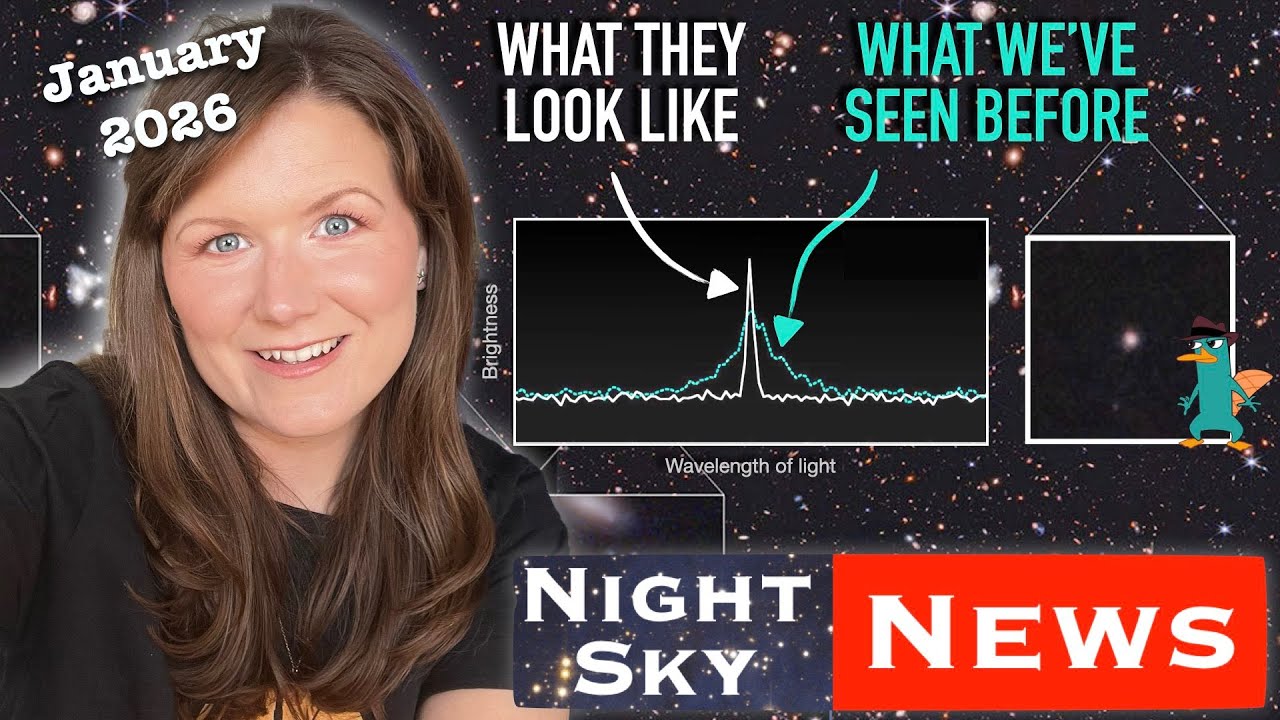
discovery announced at that intrigued me the most was what's been dubbed the platypus galaxies found in data from the James Webb Space Telescope JWST by Yan Sun and Shive. These are galaxies that just they look like little points of light in the images and we've seen things that look like that before, but then they don't look like what we'd expect them to in their spectrum of light where we get a graph of how much light of each wavelength or color of light these objects are giving out. So they look like one thing in their image but another thing in their spectra. This is why they've been dubbed platypus galaxies because like how a platypus shares some features with ducks. So, webbed feet, a bill, and it lays eggs and shares some features with mammals. It has fur and a tail and a beaver-like body. None of which would be weird on their own, right? But put them together and you get the incredibly oddlooking platypus. It's the same here with these galaxies. They've got features that we're used to seeing but not together. So, usually point sources of light like this are either stars that are close by to us or very distant objects called quazars. So growing super massive black holes in very distant galaxies, the gas around which shines so bright it outshines the entire galaxy of stars and you just see a pin prick of light. So when we see objects that just look like this single point of light in an image, we can then look at their spectra to tell them apart because stars give out a different spread of colors than the gas does around a growing super massive black hole. But these Platypus galaxies don't look like either of those things. They look most like quazars with bright spikes of light coming from specific elements like hydrogen that are glowing with a very specific color of light. But those bright spikes of light are sort of skinny spikes. They're not smeared out. The smearing out of those spikes for quazars is because the gas is moving at huge speeds around the black hole. So the light gets doppler shifted like the sound from a siren on an ambulance when it races past. But we also see skinny spikes of light like that in nearby star forming galaxies that we can fully resolve the shape of and see the stars. So either these are growing super massive black holes the likes of which we haven't seen before perhaps growing differently in the early universe to what we're used to. Or if they are in fact normal star forming galaxies like they look in their spectra then from the brightness and sizes that they appear in the images that means they are incredibly young. only a 100 million years or so old compared to the 13. 7 billion years old that the universe is. And also they appear to be forming from the inside out very calmly rather than a chaotic merger of two galaxies like we might expect from simulations. So further study of these platypus galaxies is definitely going to reveal something about the early universe that we didn't know before. We just don't know what

Artemis II mission closer to launch

yet. And finally, let's talk about the upcoming Arteimus 2 mission so that we're all up to speed with what is going on when we hear about it in the news in the next couple of weeks and months. So, if you didn't know, NASA wants to send humans back to the moon. So, like with the Apollo missions in the 60s and 70s, — that's one small step for man, one giant leap for mankind. — Now, we have the Arteimus missions. Arteimus 1 launched back in November 2022 and it was an uncrrewed mission, so no astronauts on board, which took 10 days to loop around the moon and come back to Earth. It was the first test of the Orion spacecraft and the SLS rocket, which were specifically developed for the RMS missions. And there were a fair few problems and issues that were flagged during that mission that had to be sorted out, including some hydrogen fuel leaks on the launchpad or electrical faults on board the spacecraft and also more damage to the heat shield on re-entry in the Earth's atmosphere than was expected. All of which had to be addressed before the launch of Arteimus 2, which will soon make the exact same journey as Arteimus one, but this time with four astronauts on board. So Reed Wiseman, Victor Glover, and Christina Ko, all from NASA, and Jeremy Hansen from the Canadian Space Agency, CSA. All of who will see that which few humans have seen with their own eyes, the far side of the moon, which always faces away from Earth. And so we are very close now to the launch of the Aremis 2 mission. So this month, we saw the SLS rocket with the Orion spacecraft attached roll out of NASA's assembly building at the Kennedy Space Center and take the fourmile journey to the launchpad. But don't get too excited just yet because it will most likely sit there for a few weeks to months yet depending on how all of the pre-flight checks go and whether they time well with the launch windows at the beginning of February, beginning of March, and beginning of April that are decided by the position of the moon in its orbit. The earliest Arteimus 2 will launch is Friday the 6th of February. But bear in mind, Arteimus 1 spent three months on the launch pad with two failed launch attempts that were scrapped either due to a fault or these infamous hydrogen fuel leaks from one of the tanks. My guess is that because there's not just expensive equipment at stake this time, but also four astronauts lives, they're going to be extra cautious. So, we could see a similar time frame before launch here as well, putting us somewhere in early April for the launch, maybe, but you never know. The lessons learned from Artimus one might help speed up that time frame for the launch. And we should know more by the end of January after what's known as the wet dress rehearsal. Wet meaning the fuel will actually be loaded into the rocket. And if things go well, then Arteimus might launch earlier. But if they don't go so well, then more dress rehearsals will be needed, which will delay the launch. In terms of science learned from the Arteimus missions, you'll know that if you've been subscribed to this channel for a while now that I don't particularly think the cost of this mission justifies the new science that we will learn. This is definitely a politically motivated mission and unfortunately that means a lot of other science missions have had their funding cut or removed entirely to further fund the space exploration efforts beyond Arteimus. So the science on Artemis 2 will be focused mostly on human health like in deep space environments with lots of samples shall we say collected from the astronauts all with the goal of preparing for either like a moon base in the future or even sending humans to Mars. Similarly, the lunar science that's set to be done during Arteimus 2, either by the Orion spacecraft itself or the cube sats that are launched alongside it are all focused on understanding the moon and its surface better in the context of landing on the lunar surface and building perhaps a moon base on it, which I'm sure will be very interesting from an engineering perspective, but I'm secretly hoping there'll be an unexpected astrophysics discovery that we might get out of one of these Arteimis missions as well. This is why I'm not going to be covering the Aretimus missions much on my channel beyond this highle overview. Rocket Science and Astrophysics are two very different disciplines. So, I'd recommend subscribing to either Scott Manley's channel or Tim Dodd's Everyday Astronaut channel just to keep up with everything Arteimus. All right, that's it for night sky news for this month. As always, if you snap any pictures of the night sky or you see any space news stories on your travels around the internet that you want me to explain in a future night sky news video, then send them away over on social media. But until next time everybody, happy stargazing.

Другие видео автора — Dr. Becky

Ctrl+V

Экстракт Знаний в Telegram

Экстракты и дистилляты из лучших YouTube-каналов — сразу после публикации.

Подписаться

Дайджест Экстрактов

Лучшие методички за неделю — каждый понедельник