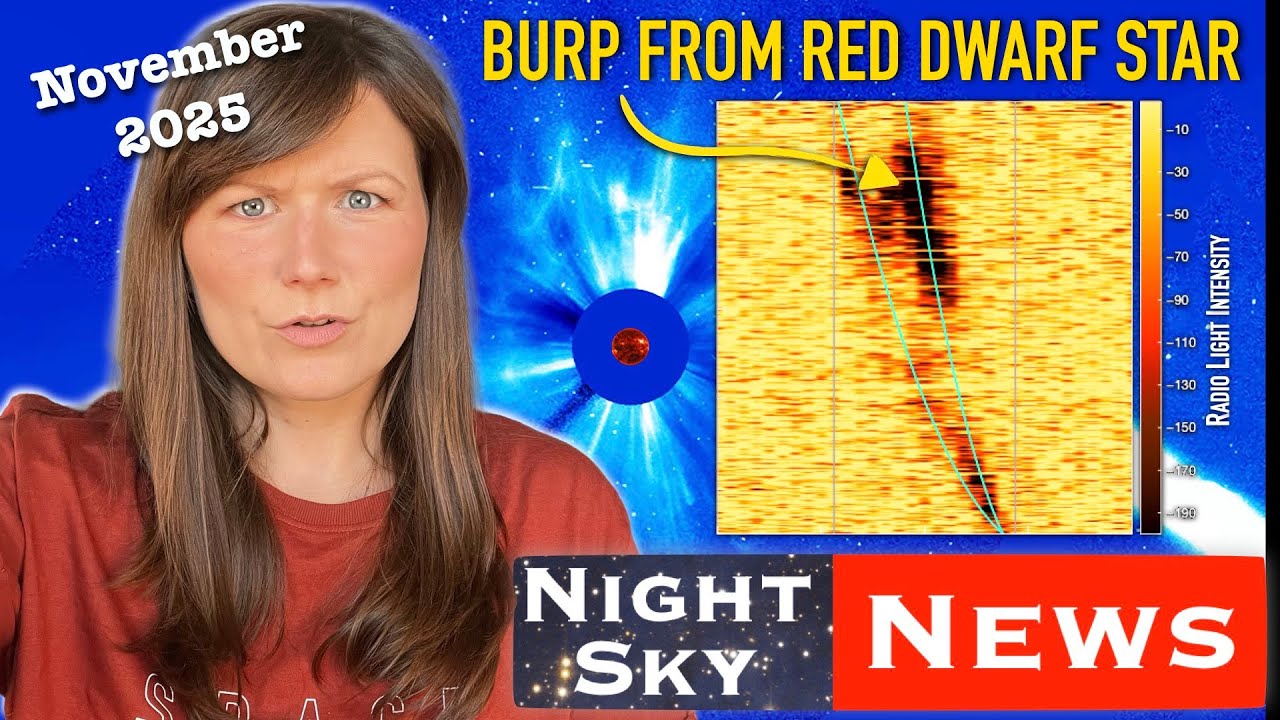
Hello and welcome to this episode of Night Sky News for November 2025 with me, astrophysicist Dr. Becky Smith. This is the show where we chat about what you should look out for in the night sky in the next few weeks and then we chat about what's been happening in space news in the past few weeks. In this episode, we're chatting about the burp of high energy radiation that's been spotted coming from a star other than the sun for the first time. Plus, how astrophysicists have once again smashed the observing proposals record for the James Web Space Telescope. And finally, whether the interstellar comet visiting our solar system, ThreeI Atlas, has been bombarded by galactic cosmic rays. There's chapter markers down here if you want to skip ahead to any specific news story. Plus, any scientific research papers I mention are all going to be linked in the description down below, free to read. So, without any further ado, let's kick things off and start by looking up. All right, as we approach the end of November with its darker evenings here in the northern hemisphere, we've got Jupiter and Saturn bracketing the famous winter hexagon of stars. Now, this is not a constellation. It's what's known as an asterism. So, it's six of the brightest stars in the winter sky and they all ring the constellation of Orion. So if we start in Orion with his left foot, the star of Riel, and we go down to the brightest star, Sirius. We then go up from there to Prosion. Up again to the twins Caster and Pollocks in Gemini. Up to Capella, right at the tippity top, and then go down this time to the red star Alderan, the eye of the bull in the constellation of Taurus, before rejoining again with Riel to complete the hexagon. These six stars are so bright that they stand out more than the constellations themselves. They're really obvious in cities especially where you do have a lot of light pollution and all you can see are the brightest of stars. So why don't you see if you can see it in the night sky. It is much bigger than you expect. But once you've seen it, you really can't unsee it. It will be the only thing you'll be able to spot when you look towards that part of the night sky. It really is a herald of winter coming for any astronomer. — Winter is coming — and so it will be around in our sky for a few months yet. So, if you've got a couple of weeks of bad weather coming your way, do not worry. At the moment, you've got Jupiter just sitting to the left of the winter hexagon or the east of it. And that will be the brightest thing in the night sky at the time. So, it should be really easy for you to spot and also give you a little bit of signpost of where to look for the hexagon in the first place. Whereas, Saturn is going to be out to the right or out to the west of the hexagon. And that will set around about midnight. Saturn will look slightly yellowish and brighter than the background stars around it. But if you're not sure where to look, the half moon does swing past Saturn on the 29th of November before it makes its way to the middle of the winter hexkin as a full moon on the 5th of December and then swings past Jupiter on the 6th and the 7th. But the astronomical highlight of this next month is the peak of the Geminids meteor shower on the night of Saturday the 13th into the morning of Sunday the 14th of December which is objectively one of if not the best meteor showers of the year and it's visible from wherever you are in the world. To give you an idea in a typical year on the peak in the darkest of skies you can see anywhere from 100 to 150 meteors per hour. That is like one to two shooting stars per minute. Although note that number will drop the closer you are to the bright lights of a city. Now, meteor showers are caused by tiny lumps of rock burning up in the Earth's atmosphere, which come from clouds of debris left behind by a comet, for example, on its orbit around the sun, which Earth then passes into each year on its orbit. Now, this year is a particularly good year to watch for the Geminids. Not only because it's perfect timing with the peak falling on a Saturday night, but also because the moon is only half full. So, it won't rise until after midnight, meaning the evening night sky will be nice and dark with no moon to wash out any of the fainter shooting stars. So, you've got a chance of seeing even more meteors at, you know, a reasonable hour. Now, the Geminids are known to be slightly slower moving meteors. So their bright streak tends to last for longer, which makes them such a joy to watch. You might see a few shooting stars in the nights before from around the 7th of December when the moon is full with the number then ramping up as we get to the peak on the 13th of the 14th. If you do want to try and make an occasion of this and head out to try and spot some meteors, the best viewing time is technically closer to midnight when the radiant in the constellation of Gemini, so the part of the sky that all the meteors will appear to shoot away from, that radiant will be higher in the sky the closer you get to midnight. So you'll lose less shooting stars over the horizon. And what you should do is lie as flat as you can. And so either on the ground or on a sun lounger or something and that will give you the best look at the entire sky to try and spot them as they shoot away. If you do that though and you're in the northern hemisphere, please wrap up warm because we are after all heading towards the start of winter with the winter solstice on the 21st of December. So it can get very cold, especially with clear skies. Now the other natural phenomenon to keep an eye out for at the minute are the aurora or the northern lights. These are caused by big solar storms where the sun burps up more radiation, so high energy particles than normal. They then get funneled by the Earth's magnetic field down to the poles where it causes gases in our atmosphere to glow with these beautiful green, pink, and purple colors. Now, the sun is around the peak of its activity right now before it starts to drop off in 2026, which means you might see a lot more coverage in the news this week about the more pronounced aurora. And with any story like this, there's sure to be a lot of clickbait and even misleading headlines out there, like this one calling the solar storms cannibal storms with no additional context. Or this headline saying that these storms raise the risk for ground level radiation. Now, if these were the only headlines you saw, you might think the end is near, but the reality is that the majority of these storms are just completely harmless. And unfortunately, this type of coverage isn't just limited to this story. It happens with multiple stories each and every day. And coming through all of these articles to find the truth is an impossible task. That's where Ground News comes in. The sponsor I've been working with for a few years now. They're a website and an app designed to make reading the news easier and more datadriven. So every day they pull in thousands of articles and arrange them by story. And each story comes with all the information you need to cut through the noise. So, with ground news, I can see straight away that more than 120 different news sources covered this story with 96% of those sources having high factuality ratings. So, within a few quick glances, I can tell that this story is genuine. And I can then get excited about maybe seeing the Aurora for myself. And not only can you directly compare headlines to see how the framing differs, I can even see what's being left out or frame specific ways using their bias comparison feature. It's datadriven tools like this from Ground News that make understanding and staying informed with the news so much easier, like their blind spot feed, which shows which stories had little to no reporting on either side of the political spectrum. So, if you head to the link in the video description below at ground. news/dbecky, or you scan the QR code, you'll save 40% on their Vantage plan to get unlimited access to all their features, which comes out at around about $5 a month. Those subscriptions help keep Ground News adree and therefore free of any bias that comes with paid advertising. So, a big thanks again to Ground News for continuing to sponsor this channel. And now, let's come back down to Earth and chat about what's been happening in space news in the past month. So, first up, speaking of radiation burps from the sun, which cause our aurora, this phenomenon has now been convincingly spotted on another star in our galaxy for the first time, thanks to this research by Callingham and collaborators. This is what's known as a coronal mass ejection and it's all caused by the tangling of the sun's magnetic field. The sun is made of plasma where atoms have separated into the charged positive and negative particles that make them up. And as they move around in the sun, rising and falling as heat circulates, then you've got moving charged particles, which sets up their own magnetic fields. They then get tangled with the sun's magnetic field. And as those tangles get more and more intense, eventually the pressure snaps as the magnetic field lines reconnect. And that ejects a bubble of the sun's plasma with it into space, i. e. a whole bunch of charged particles that have been accelerated by that snapping to huge speeds. Now, we see those bursts from the sun all the time. We have dedicated observatories recording them, and they're visible as these big chunks of atmosphere that very clearly blow off the sun. But such a thing is too faint to see on other stars at great distances. So, previous research has only been able to hint that they exist from other observations, but haven't actually confirmed that material has definitely escaped from the star out into space. So, how do we confirm that other stars also burp up material like this? And ideally, could we then figure out at what rate do different types of stars have these eruptions? And how would that affect any planets in orbit around them and any evolving life on those planets? So what this new research paper from Callingam and collaborators did was observe a star using a radio telescope. A telescope sensitive to long wavelengths of light, i. e. radio waves. Now because you've got charged particles, specifically in this case, negative electrons moving around in a magnetic field that is going to generate radio waves, these light with a very long wavelength. Now, it's not for lack of trying that this hasn't been detected before, but given how quickly these coronal mass ejections occur and how faint the light is, we either didn't have telescopes sensitive enough or we just weren't pointing in the right direction at the right time to catch one of these coronal mass ejections cuz we can't predict when they will occur. Thankfully, we now have Loar, the Low Frequency Array, a radio telescope made up of over 10,000 antenna spread across Europe, giving you effectively a telescope the size of Europe. One of those things that Loar is doing is a survey of the sky, which Callingam and collaborators searched through the existing data for any star that was variable and found a burst of radio light lasting just 2 minutes that matched the signature of what we'd expect from a coronal mass ejection. And this was coming from a red dwarf star known as STKM1-1262 from data taken back in 2016. Now, red dwarfs are much fainter, cooler, and smaller than the sun. Thanks to observations that Callingham and collaborators then got using the X-ray space telescope XM Newton, we know that this red dwarf is about half the mass of the sun, rotates 20 times faster, and has a magnetic field 300 times more powerful. So, this is really key when you bear in mind that half of the planets that we know of in our Milky Way galaxy that are orbiting other stars in the sun are orbiting red dwarf stars. And so, this is why it's so important that we understand how often and how violent the coronal mass ejections are from red dwarfs. And so from the data they collected, Callingham and collaborators worked out that the plasma in the coronal mass ejection that they detected was moving at 2,400 km a second, a speed only seen in one of every 2,000 coronal mass ejections thrown off by the sun. That means that the ejection would be both fast enough and dense enough to completely strip away the atmospheres of any planets orbiting close enough into the star to be in the habitable zone. This is what we think happened to a very early Mars in our own solar system. So if this coronal mass ejection from this red dwarf star that Calamian collaborators had observed had actually been from the Trappist one system for example which has seven rocky earthlike planets. This would have wiped out the atmospheres of the majority of those planets. So this result from Calingham and collaborators makes those results we've been seeing from the James Webb Space Telescope on the Trappist one system sadly unsurprising. JD West has revealed very little evidence for atmosphere on any of these planets so far, no matter how much we all hoped otherwise. All right, next up, you may have seen the incredible footage of Kilawea, the volcano on the big island of Hawaii, erupting with lava reaching 1,000 ft in the air in the past few weeks. And a couple of you have reached out to me asking whether this eruption was actually affecting observations at the worldclass telescopes on the summit of the big island Mount Vanaya because those who've been subscribed to my channel for a while will know that volcanic eruptions and scientific observations do not mix. The ash that's thrown into the air makes seeing a clear picture of the light from stars and galaxies very difficult. And the ash is incredibly abrasive as well. So if it gets on the mirrors of the telescope on the instruments, it can be very damaging. Thankfully, although this eruption from Kilawa, which has been ongoing since December 2024, has produced some spectacular lava flows, the observatories are still operating as normal. Thankfully, the winds have been mostly out of the northeast recently, taking any ash that's been released with those big lava fountains southwards away from the observatories. So, we've nothing to worry about for now. I've just personally been enjoying the time-lapses from the Mountaaya Summit webcams which show the glow from the eruption in the distance. And speaking of observatories, the numbers from the latest call for observing proposals for the James Web Space Telescope were just released and they are record-breaking once again with 2,900 proposals submitted. So every year astrophysicists from around the globe have to write an application for time on JWT and lots of other telescopes as well. Essentially they write a proposal for why JWST should be used to do their really cool science over anyone else's really cool science. And all those proposals are then reviewed anonymously by a panel of 550 volunteer reviewers of astrophysicists. They're then ranked in terms of scientific importance and impact. And only the top ones are then awarded time on the telescope. So, as you can imagine, it's a very competitive process. And as the community starts to better understand what JWT is capable of, now we've had it in operations for four or five years or so, those numbers have only grown. So, in the first year of observing, what's known as cycle 1, there were 1,173 proposals. In cycle 2, there were 1,601 proposals. In cycle 3, 1,931 proposals. And in cycle 4, last year there were 2,377 proposals. And now for this year, in cycle 5, 2,900 proposals. The largest response to any call for proposals on any astronomical observatory in history. Now, those were split across many different areas of research, from nearby in our own solar system to stars in the Milky Way to distant galaxies and black holes. And the soul crushing part of all of this is that only 8% of those submitted proposals will actually be successful just because of physically how many hours there are in a year to actually observe with JWST. And also anyone who's put in a proposal will also have to be patient now as the results of this whole process won't be announced until March 2026. As in previous years on my channel, I'll try and go through which proposals have been successful and what science we have to look forward to from the fifth year of JWST's observations. And finally, let's talk about this research from Maggiolo and collaborators, which is the latest on comet 3i Atlas, the interstellar comet visiting the solar system that was discovered back in July 2025. So, this is a lump of rock, an asteroid or comet-like object that instead of orbiting the sun as part of our solar system, it's just passing through. has actually formed around another star in our galaxy before it's been ejected from its orbit around that star and has been traveling through the space between stars, interstellar space ever since until it's just happened upon the solar system. There's been two of these found in the past. The first one, one eye, was dubbed Amua Mua and that was found back in 2017. And the second one, twoey Borisov, was detected back in 2019. Now, we know these are interstellar objects because their movements through the sky allow us to work out what their orbits are and show that they are not bound to the sun. They do not loop back around. So, by studying these objects once we find them, we can learn so much about what they're made of and are the comet-like things in our own solar system made of similar things. All trying to get at the root of this question of how did we all end up here. So, of course, all our telescopes have been set the task of observing comet 3i Atlas since it was discovered, including the Hubble Space Telescope, Gemini on Mount Aaya, the very large telescope in Chile, and even some of the missions in orbit around Mars and on their way to Jupiter as we spoke about last month. But of course, the James Web Space Telescope has also done its part to observe three eye atlas as well. And we heard about that research back in September's Night Sky News episode. Specifically, this paper from Coordinate and Collaborators described how the data from JWST revealed how the ratio of carbon dioxide to water, CO2 to H2O, was much higher for this comet than for your typical solar system comet. It was actually one of the highest ratios ever measured for a comet. And so Cordner and collaborators discussed many possible explanations for this, including that the comet may have originally formed around its star close to what's known as the frost line or ice line, where it gets cold enough for carbon dioxide to condense from a gas into solid ice, i. e. dry ice. Or maybe the high ratio isn't that there's more carbon dioxide, but less water outgassing from this comet than normal. But the latest interpretation of that high CO2 to H2O ratio comes from Maggiolo and collaborators who claimed that it can be explained by the comet's exposure to what's known as galactic cosmic rays whilst it was in interstellar space. Now galactic cosmic rays are protons that have been accelerated to huge speeds by extreme events like supernova when a star dies and runs out of fuel and its outer layers are thrown outwards. It's in this process that these protons are accelerated. They're kind of like interstellar radioactive particles, which we are thankfully mostly shielded from by the sun's own bubble of charged particles, which create a magnetic field around the solar system that deflects all but the highest energy galactic cosmic rays. That means that comets in the solar system won't have been exposed to many galactic cosmic rays and so the material on their surface hasn't been changed by that exposure. Whereas an interstellar comet exposed for millions, maybe even billions of years to any and all galactic cosmic rays is going to show signs of that exposure. And Maggiolo and collaborators point out that lab experiments have shown that if you bombard carbon monoxide CO with high energy protons, it underos a chemical reaction and forms carbon dioxide CO2 and a whole host of other molecules. Now, Magiolo and collaborators even ran a simulation showing how the ratio of CO2 and CO to H2O changes with depth under the surface of the comet after exposure to galactic cosmic rays over a billion years. And so, what you can see here in this graph is that deep in the comet where the material is protected from cosmic rays, you have a very high carbon monoxide to water ratio, CO to H2O, what's shown in the black line there. But as you get closer to the surface of the comet, moving left on this graph, the carbon monoxide starts to get converted into carbon dioxide, CO2, which is what's shown in the red curve. So much so that in that top 10 m of the comet surface, you've just got that really high ratio of CO2 to H2O. So that does unfortunately seem to neatly explain the JWST observations of three eye atlas. And I say unfortunately there because of the implications for what this means for what we can actually learn from interstellar objects. Ideally, these would be perfect fossils for what comets are like in other star systems and we could work out what are they made of and is it different from solar system objects and that could tell us about how the solar system came to be. But if the outer layers are instead processed this much by exposure to this interstellar radiation of galactic cosmic rays, then that really does limit how much we can learn from these interstellar visitors. at least by using telescopes anyway. Because under that top layer, it still should be that pristine fossil. But to get at it, we'd have to send a spacecraft to one of these interstellar visitors. A mission that would require a very quick turnaround, right? Threei Atlas was discovered back in July. It made its closest past the sun and Earth in October, only a few months later, before it's starting to shoot back out of the solar system again. Now thankfully the Reuben Observatory is coming online imminently and that is set to survey the sky every three nights. So what that means is that it will come back to each section of the sky to take another image every three nights for us to be able to spot all the things that have moved or flickered and changed in that time. And the hope is that around 70 interstellar comets will be spotted by Reuben each year. So, not only will that hopefully help us work out, you know, how common is it for these interstellar objects to have this processing by galactic cosmic rays, but also hopefully give us enough advanced warning to maybe send a future mission to an interstellar visitor to our solar system. All right, that's it for night sky news for this month. As always, if you snap any pictures of the night sky or you see any space news stories that you want me to explain in a future night sky news episode while you're traveling around the internet, then send them my way over on social media. But until next time, everybody, happy stargazing.