SUPERMASSIVE stars: fact or fiction?
12:42

SUPERMASSIVE stars: fact or fiction?

Dr. Becky 21.08.2025 117 214 просмотров 9 270 лайков

Machine-readable: Markdown · JSON API · Site index

Поделиться Telegram VK Бот
Транскрипт Скачать .md
Анализ с AI
Описание видео
Have you ever looked up at the night sky and wondered how massive can stars be? Or what is the biggest star out there? Is there even a limit to how massive they can be? Well we can try and answer this question in two ways - first with theory, with our understanding of how stars fuel themselves with nuclear fusion fusing hydrogen into helium to produce energy which can counteract gravity and how that all contributes. And then secondly by surveying the stars we can see in the sky, counting how many of each mass we see to work out if there is an obvious cut off in mass that we see. And when we do that we get a distribution of that drops off towards 150 times heavier than the Sun, suggesting that is the limit. But is that just for stars forming now, what about stars in the early Universe when conditions were very different? Could they be much heavier? Could they be supermassive stars...? Abbott et al. (1981) - https://articles.adsabs.harvard.edu/pdf/1981ApJ...250..645A Bestenlehner et al. (2020) - https://arxiv.org/pdf/2009.05136 Crowther et al. (2016) - https://arxiv.org/pdf/1603.04994 De Becker et al. (2006) - https://arxiv.org/pdf/astro-ph/0606379 Figer (2005) - https://arxiv.org/pdf/astro-ph/0503193 Hosek et al. (2019) - https://arxiv.org/pdf/1808.02577 Wang et al. (2024) - https://arxiv.org/pdf/2212.04476 Zwick et al. (2025) - https://arxiv.org/pdf/2507.22014 My previous video on the history of figuring out the most massive star limit - https://www.youtube.com/watch?v=TSQS4OGCVD4 Alexander Hager lecture slides on "Stars and Stellar Evolution", Monash University (derivation of Eddington limit) - https://2sn.erc.monash.edu/Class/AST-4001-2008-S2/notes/Lecture_02.pdf 00:00 Introduction 01:34 The science behind the 150 MSun limit 05:03 The nearby stars that break that limit 10:07 The supermassive stars that might exist in the early Universe 12:17 Bloopers --- 📚 My new book, "A Brief History of Black Holes", out NOW in hardback, paperback, e-book and audiobook (which I narrated myself!): http://lnk.to/DrBecky --- 👕 My new merch, including JWST designs, are available here (with worldwide shipping!): https://dr-becky.teemill.com/ --- 🎧 Royal Astronomical Society Podcast that I co-host: podfollow.com/supermassive --- 🔔 Don't forget to subscribe and click the little bell icon to be notified when I post a new video! --- 👩🏽‍💻 I'm Dr. Becky Smethurst, an astrophysicist at the University of Oxford (Christ Church). I love making videos about science with an unnatural level of enthusiasm. I like to focus on how we know things, not just what we know. And especially, the things we still don't know. If you've ever wondered about something in space and couldn't find an answer online - you can ask me! My day job is to do research into how supermassive black holes can affect the galaxies that they live in. In particular, I look at whether the energy output from the disk of material orbiting around a growing supermassive black hole can stop a galaxy from forming stars. http://drbecky.uk.com

Оглавление (5 сегментов)

Introduction

Have you ever looked up at the night sky and wondered how heavy can stars be? Or what is the heaviest star out there? And is there even a limit to how heavy stars can be? We can try and answer this question in two ways. First, with theory, with our understanding of how stars fuel themselves with nuclear fusion, fusing hydrogen into helium to produce energy and heat and light, which can counteract gravity crushing down inwards. And then secondly, by surveying all of the stars that we can see in the sky, counting how many of each mass we see to work out is there like an obvious like cutoff or drop off where we don't see any stars heavier than that. And when we do that, we do see this distribution that does drop off and seems to have an end to it. And when you put both of these things together, we find that there's a limit of around about 150 times the mass of the sun for a star. But is that limit just for stars forming now? What about stars forming in the early universe when conditions were very different? Could they be much heavier? Could they be super massive stars? So, in this video, we're going to dive into first the science behind that 150 times the mass of the sun limit. Second, the stars we found that are heavier than that apparent limit. And then finally, the super massive stars that might exist in the early universe. So, let's start with diving into the

The science behind the 150 MSun limit

science behind that 150 times heavier than the sun limit. One of the most important relationships when it comes to understanding stars is what's known as the mass luminosity relation, which describes how the total amount of light given out by a star is proportional to how heavy that star is. Essentially, the bigger the star, the brighter the star. Roughly speaking, that brightness, the luminosity is the mass to the power of 3. 5. That means a star that big has got to be producing enough energy to shine that much more brightly than the sun. which means it goes through its fuel, its hydrogen, fusing it into helium 3,000 times faster than the sun does as well. But why? Because with that much more mass there, you've got a stronger force of gravity pulling inwards that's trying to crush that star down all the time. The energy producing fusion process in the center of the star is what counteracts that, pushing outwards back on gravity to balance the forces. So even though more massive stars have more hydrogen fuel there in the first place, they go through it at a much faster rate that they don't live as long as the sun. So while our sun is expected to live around 10 billion years in total, a star 10 times heavier than the sun will only live 10 million years. So this could be one reason for the drop off at higher masses that we see when we look out to count how many stars of each mass there are. Because they don't live as long, it's rare that we do catch them when they are there. So, is there even an upper limit? Or is it just that they live such short lifetimes we don't spot them? Well, yes. And it comes back to that balance of gravity and the energy from fusion pushing outwards. When those two things are perfectly balanced, the star happily continues to live its life. But if you keep making an ever heavier and heavier star, and the key word there is star, because you don't want to make this thing so dense that it collapses to become a black hole. So that means you have to keep the material at normal star density. So as you keep adding mass, you also increase the size of the star as well, which means the outer layers of the star are very far away from the center and aren't as tightly bound by gravity. And what happens if you try and create that ever heavier and heavier star is that you end up creating a star where the rate at which it has to fuse hydrogen into helium is so high to counteract gravity pulling inwards that you end up crossing what's known as the Edington luminosity. The point at which the star is so bright that energy pushing outwards is actually greater than the force of gravity pulling it inwards. So the stars outer layers end up being blown away by that intense energy generated by the fusion process. This is what limits how massive a star can become. It's the physical nature of stars themselves. They self-regulate how heavy they can get. We can work out what that limit is through theoretical modeling of the strength of gravity and the energy produced by fusion to work out, okay, what is the heaviest star that you can have before it reaches over the Edington luminosity and you find that it's 150 times heavier than the sun, which is all well and good, but the universe likes to continue surprising us. There have been a number of stars that have actually been found with masses estimated to be over that limit, which brings me to part two. The stars

The nearby stars that break that limit

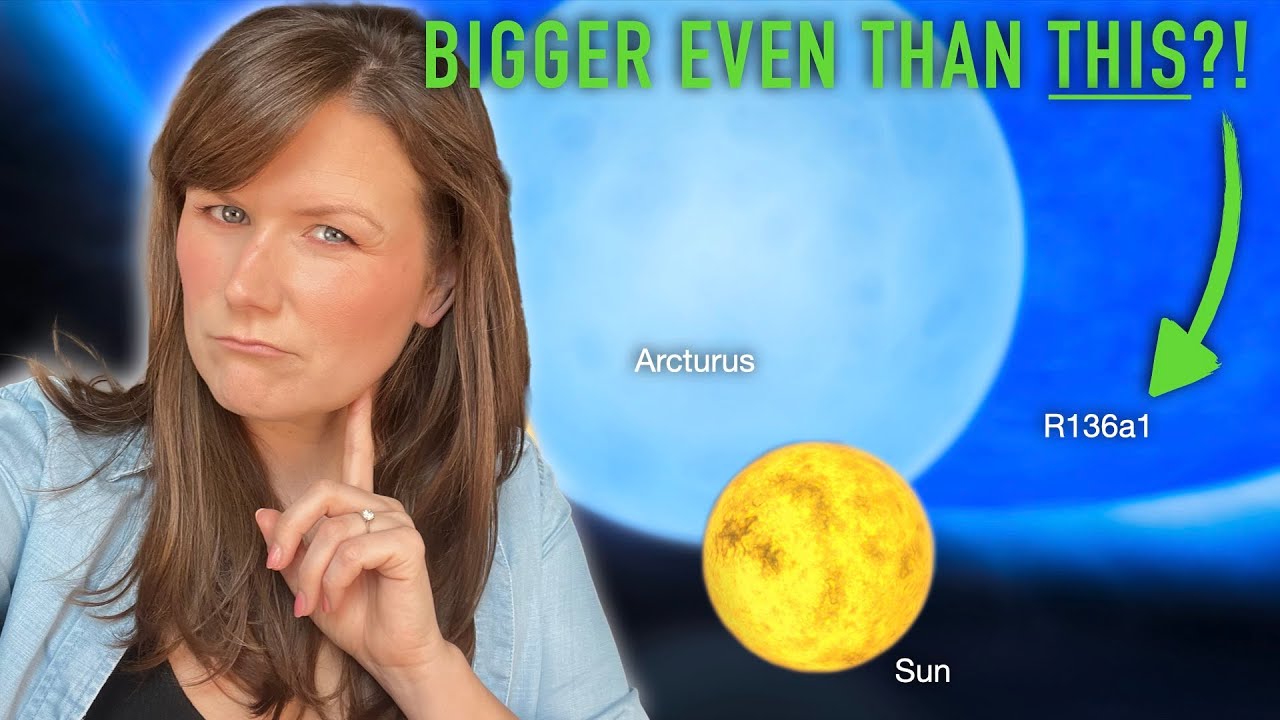
that break this, the most famous of which is R136A1, a star in the tarantula nebula in the large Magelanic cloud dwarf galaxy which is orbiting the Milky Way. You can see it from the southern hemisphere. And this star is estimated to be 291 times heavier than the sun. It radiates more energy in 4 seconds than the sun does in an entire year. Just let that sink in for a minute. It's not alone, though, because a lot of the most massive stars known are actually found in this same tarantula nebula of newly formed stars, including BAT 99-98, which is 226 times the mass of the sun, and also R136 A2 and R136 A3 at 151 and 155 times the mass of the sun, respectively. Now, a quick caveat to the values of those masses of the stars there. Like all newly born stars, they're embedded in big clouds of gas and dust that we call nebula, which means that gas and dust can interfere with our observations of their brightness and their temperature and introduce some error. Because of this, that heaviest known star that I mentioned, R136A1, has a range of masses that have been estimated in different ways with different observations that are anywhere from 215 to 315 times the mass of the sun. And those measurements have been indirectly calculated. So, we measure the brightness in the temperature and the luminosity of this star. And then we compare it to the brightness, temperature, and luminosity of other stars that we've seen before that we have directly measured the masses of. And the only way we can directly measure the mass of stars is if they're in binary systems with another star orbiting them. And we can calculate the mass by studying the gravity of that whole system. And the most massive star in a binary system that we know of. And we've measured its mass is HD15558 in the heart nebula in our own Milky Way galaxy. That has a mass of 152 times the mass of the sun. right on that limit. But crucially, it's also had its mass loss measured at 0. 00 0. 1 sun's worth of matter every year, i. e. its outer layers are also being blown off as you'd expect. And the same is also true for the stars I mentioned before around about that same 150 times the mass of the sun limit that R136 A2 and R136 A3 but also R136A1 and BAT 9998 that push into that 200 times heavier than the sun range. They're also losing mass like we'd expect in like this big wind throwing away its outer layers. But we really can't explain how a star would have formed that heavy in like a traditional formation scenario where you have a collapse of gas down. Instead, one idea that's been knocking around trying to explain this is the idea that actually this these stars could have formed if two stars collided and merged together. So in a star cluster like R136, it's possible that the stars would be close enough together, dense enough so that they could collide and make big superstar that bypass traditional limits on how heavy they can get. Another possibility though is to do with what the stars are made from because that theoretical derivation of the Edington luminosity relies on what's known as the opacity of the star. essentially how much of the light that's produced in the nuclear fusion process in the center actually makes it out to the surface of the star. If the star is more opaque then more of that light is absorbed as energy by the outer layers of the star pushing back on gravity. But if the star is less opaque then the light actually makes it to the surface having little to no impact on the star itself and doesn't push back as much. Now we know stars are mostly made of hydrogen with a few trace heavier elements like carbon, nitrogen and oxygen and all the way up to iron. The heavier elements make a star more opaque whereas hydrogen makes a star less opaque, more transparent. And the exact level of opaqueness is also related to the temperature and the density of whatever element you have as well. So we can model for this given you know the average composition of stars that we see and get that reasonable limit of 150 times heavier than the sun. But if that opacity changes and is dramatically different then you're going to have a dramatically different answer for how heavy a star you can make. And that could also change with time because the heavier elements get more common with time because they're produced by stars in nuclear fusion in runaway nuclear fusion as they die and go supernova and spread those ingredients and pollute the pristine hydrogen gas that we started with. Which brings me to part three. The possibility that super

The supermassive stars that might exist in the early Universe

massive stars might exist in the early universe. The first stars to have formed in the universe would have formed from almost pure hydrogen gas with some helium mixed in. That would have given them a completely different opacity and therefore a completely different Edington luminosity mass limit for how heavy they could get. Meaning that the first stars to have formed in the universe could actually reach a thousand times heavier than the sun, giving them incredibly short lifetimes as well. Meaning they'd only live not even a million years. A blink and you miss it. sort of scenario. These are purely theoretical though. No such star has ever been observed. There's none hanging around still in our Milky Way galaxy because they would have died long before that. And looking for them in more distant galaxies that we see, you know, as they were when the universe was much younger because it takes light time to travel to us is very difficult, right? Because often the galaxies are just a little pixel on our telescope images, never mind like a single star in that galaxy. That could also be very rare because it's at the high mass end of things where it's just not as likely you'll form something that big. But that hasn't stopped people from trying. We thankfully have the James Webb Space Telescope now that's been designed to spot the faint light from distant galaxies. And with it, astronomers have spotted a single star that happens to be lensed by a galaxy much closer to us so that we could see it. I've made a video on that before if you want to check that out. And the hope is that a chance alignment like that will happen again, but with a super massive star, one of these first to maybe have formed in the early universe. Or perhaps even we might be able to detect a big clump of these super massive stars. Maybe the conditions are right to produce loads of them in the early universe. A detection that some have tentatively claimed already. So how heavy can a star actually be? Well, as far as we know, that limit is around about 150 times heavier than the sun. But as always, the universe could very likely surprise us yet.

Bloopers

yet. Faster rate, meaning they also That was loud. Now, a quick caveat to the measurement. Now, a quick g Now, a quick little caveat is breaking in my head. Meaning that the first stars to have formed in the universe could reach massive Reach masses, not reach a massive.

Другие видео автора — Dr. Becky

Ctrl+V

Экстракт Знаний в Telegram

Экстракты и дистилляты из лучших YouTube-каналов — сразу после публикации.

Подписаться

Дайджест Экстрактов

Лучшие методички за неделю — каждый понедельник