Ingredients for LIFE found around newly formed star?! | Night Sky News August 2025
21:54

Ingredients for LIFE found around newly formed star?! | Night Sky News August 2025

Dr. Becky 14.08.2025 76 509 просмотров 8 163 лайков

Machine-readable: Markdown · JSON API · Site index

Поделиться Telegram VK Бот
Транскрипт Скачать .md
Анализ с AI
Описание видео
AD | Go to https://ground.news/drbecky to stay fully informed with the latest Space and Science news. Save 40% off the Vantage plan through my link for unlimited access | Hello and welcome to this episode of Night Sky News for August 2025 with me, astrophysicist Dr Becky Smethurst! This is the show where we chat about what you should look out for in the night sky in the next month, and what’s been happening in space news in the past month. In this episode we’re chatting about the latest dwarf planet discovered at the edge of the solar system which is ruling out the possibility of a 9th planet, plus LIGO has spotted its most massive black hole merger GW231123, and has ALMA has found the ingredients for life in a newly forming planet system around a star?! Lunar eclipse information for your location - https://www.timeanddate.com/eclipse/lunar/2025-september-7 Batygin & Brown (2016) - https://arxiv.org/pdf/1601.05438 Chen et al. (2025) - https://arxiv.org/pdf/2508.02162 Fadul et al. (2025) - https://arxiv.org/pdf/2507.14905 Groth et al. (2025) - https://academic.oup.com/mnras/article/523/2/2876/7176071?login=false Lagrange et al. (2025) - https://arxiv.org/pdf/2502.15081 LIGO collaboration (2025) - https://arxiv.org/pdf/2507.08219 Potiszil et al. (2023) - https://www.nature.com/articles/s41467-023-37107-6 00:00 Introduction 00:52 Perseids Meteor Shower 03:51 Moon meets Jupiter & Venus 04:29 Orion's return! 04:47 Lunar Eclipse for Asia, Oceania, Europe 06:03 JWST goodies 06:37 AD 08:34 ALMA ingredients around V883 Ori 11:03 First woman appointed as Astronomer Royal 11:55 LIGO detects most massive black hole merger GW231123 15:21 Sednoid discovery casts doubt on Planet 9 21:20 Bloopers Video filmed on a Sony ⍺7 IV Video edited by Jonny Hyman --- 📚 My new book, "A Brief History of Black Holes", out NOW in hardback, paperback, e-book and audiobook (which I narrated myself!): http://lnk.to/DrBecky --- 👕 My new merch, including JWST designs, are available here (with worldwide shipping!): https://https://shopdrbecky.com/ --- 🎧 Royal Astronomical Society Podcast that I co-host: podfollow.com/supermassive --- 🔔 Don't forget to subscribe and click the little bell icon to be notified when I post a new video! --- 👩🏽‍💻 I'm Dr. Becky Smethurst, an astrophysicist at the University of Oxford (Christ Church). I love making videos about science with an unnatural level of enthusiasm. I like to focus on how we know things, not just what we know. And especially, the things we still don't know. If you've ever wondered about something in space and couldn't find an answer online - you can ask me! My day job is to do research into how supermassive black holes can affect the galaxies that they live in. In particular, I look at whether the energy output from the disk of material orbiting around a growing supermassive black hole can stop a galaxy from forming stars. http://drbecky.uk.com
Оглавление (12 сегментов)

Introduction

Hello and welcome to this episode of Night Sky News for August 2025 with me, astrophysicist, Dr. Becky Smith. This is a show where we chat about what you should look out for in the night sky in the next few weeks, and then we chat about what's been happening in space news in the past few weeks. In this episode, we're chatting about the latest object discovered at the edge of the solar system, which might be ruling out the possibility of a 9inth planet. Plus, LIGO has spotted its most massive black hole merger yet, and Alma has found the ingredients for life in a newly forming planet system around a star. There's chat markers down here if you want to skip ahead to any of those specific news stories, plus any scientific research papers I mentioned are all going to be linked in the video description down below, free to read. So, without any further ado, let's kick things off and start by looking up.

Perseids Meteor Shower

August can only mean one thing when it comes to the night sky, and that is the best meteor shower of the year, the Percads. Meteor showers happen when the Earth passes through an area of space where there's lots of bits of debris, bits of rock and space dust that burn up through the Earth's atmosphere as a load of shooting stars. Now, the peak of the Perciads this year was earlier this week on the night of Tuesday the 12th into Wednesday the 13th of August, but that was only a few days after the full moon. So, it wasn't the best timing to make the most of this meteor shower. So, if you're grumbling now being like, "Oh, is this video coming out after the peak? I would have liked to have seen it. " Don't worry. I'm heading out this weekend to try and spot some Perciads instead when the moon will only be a half moon. So, it won't be as bright because remember the Perciads, although yes, the peak is on a certain date, there's going to be shooting stars from the Perciads all the way up to the 24th of August. There just won't be as many shooting stars streaking across the sky as during the peak. Just to give you an idea of in previous years when there's been no moon during the peak of the Perciads. There can be anywhere from like 75 meteors an hour. That's more than one shooting star every single minute. Now, we won't hit anywhere near that number this weekend, but if you're outside for half an hour to an hour just looking up and enjoying the sky, you'll more than likely spot a shooting star. If you are in the southern hemisphere, just be aware that half the meteors will also shoot below the horizon for you towards the north. So, you will get even less meteors. You might find this a little bit more difficult than those of us up here in the northern hemisphere. Now, remember, the closer you are to a city, the more light pollution there's going to be just from the street lamps, which will make the sky brighter, meaning all you'll be able to see is the brightest of meteors. The light pollution will drown out all but the faintest of meteors, which means again, you've got a less chance of spotting a shooting star. So if you can get somewhere darker, the better. But the Perciads are known for their really bright meteors that last longer than shooting stars from other meteor showers as well. Percads are caused by debris left behind by the comet Swift total on its 133year orbit around the sun. Remember meteor showers need no fancy equipment to watch. Just let your eyes adjust to the dark over sort of like 10, 15 minutes or so. Pop a blanket down on the ground, lie down, and look up. It's a really fun activity to do with a lot of people, so friends and family, because the more eyes there are on the sky, the more chance it is that you'll spot more meteors. And it's really fun when you know a few of you spot one at the same time, especially because you can see the Perciads at a normal time in the late evening after the sun has set. So, no early getups required, which is great if you want to watch the meteor shower with say kids in the family. Plus, remember the Percy's meteor shower has been building for the past couple of weeks since late July. So if you have seen a shooting star streak across the sky in the past few weeks, then most likely it came from the Percied meteor shower. Now the moon will continue to

Moon meets Jupiter & Venus

wayne over the next week or so before it pairs up with Venus and Jupiter in the early morning sky on the 20th of August in the east towards that glow of the sunrise. Venus and Jupiter are two of the brightest objects in the night sky after the moon. So hopefully you'll have no problem with spotting this. On the 19th, the moon will be closer to Jupiter. On the 20th, it'll be in between them. And by the 21st, it will be closer to Venus. So, if you manage a few clear mornings in a row, you can use this to be able to tell Venus and Jupiter apart, so you know which is which as you keep watching them, getting further apart as August moves into September. You might also noticed how

Orion's return!

close all of this is happening on the sky to the constellation of Orion that's now visible rising in the morning sky. Again, Orion appearing in our skies can only mean one thing to a northern hemisphere astronomer. — Winter is coming.

Lunar Eclipse for Asia, Oceania, Europe

— Sticking on the topic of the moon, there's also a total lunar eclipse coming up on the night of the 7th of September and into the morning of the 8th that's visible for most of Europe, Asia, and Oceanania where the moon will appear to turn red. So, a lunar eclipse occurs when the moon passes into Earth's shadow. It turns red because of light bending through the Earth's atmosphere, which is what gives us red sunsets as well. I like to say that a lunar eclipse is like the moon passing into Earth's sunset shadow. So, if you watch the whole thing, you'll first see the Earth's shadow passing across the face of the full moon before it finally turns red as it passes into the center of the shadow. I'll pop a link in the description below so you can put your location in and work out what you'll be able to see and at what time. So for those of you in Australia and Oceanania, this is all going to be happening on the early morning of the 8th of September. So we'll either need a late night or an early get up if you want to see this. Whereas for those of us in Europe, we'll just catch the end of the eclipse during moonrise on the evening of the 7th of September. But that's enough of looking up at the night sky for this month. Let's come back down to Earth and chat about what's been happening in space news in the past month.

JWST goodies

Well, first up, we've got to talk about how the James Hub Space Telescope, JWT, has been spoiling us again with some incredible images released this month. We had the discovery of this incredible galaxy merger dubbed the Infinity Galaxy, which could be the first ever direct collapse black hole discovered. I talked about that in last week's video if you want to check that out. Plus, we had this image of the first exoplanet that JWST can claim discovery of, TWWA7, which is roughly the same mass as Saturn and orbits its star about 50 times the distance of Earth from the Sun. But when

AD

you see coverage of something like this online, how do you know that what you're seeing is actually legit? Because let's face it, if you search for news on the latest JWST discoveries, it is an absolute minefield. There's so much misinformation and clickbait out there. Thankfully, that's where Ground News comes in, the sponsor of this week's video. For example, I can immediately see that this news story, James Webb Space Telescope, directly images its first exoplanet, has been covered by 91 different sources from around the world, and that 91% of those sources have a high factuality rating. So, immediately, with a few quick glances, I know this is a story that I can trust. What I can then do is compare coverage from different news sources with ground news. So, we can see that the Smithsonian mag went with the headline, "The James Web Space Telescope reveals its first direct image discovery of an exoplanet. " Whereas, the Sun went with eerie hidden worlds spotted by alien hunting. Space Telescope is first of its kind. It's great to have all of that coverage in one place because I can see if some media sources might be sensationalizing this story with clickbait headlines compared just to the main facts in the summary provided by Ground News. The feature of theirs I use the most is their blind spot feed because I also find it so interesting to see which stories have had little to no reporting on either side of the political spectrum. You just get a really well-rounded picture of what's going on. I think these datadriven tools for analyzing the news are so important right now, which is why I'm so thankful that they're continuing to sponsor this channel. So, if you head to the link in the video description down below at ground. news/dbecky or scan the QR code, you'll save 40% on their Vantage plan. get unlimited access to all their features. It comes out at around about $5 a month and your subscriptions help to keep Ground News ad free and therefore free of any of the biases that come with paid advertising. So, a big thanks to Ground News for sponsoring this video. And now, let's

ALMA ingredients around V883 Ori

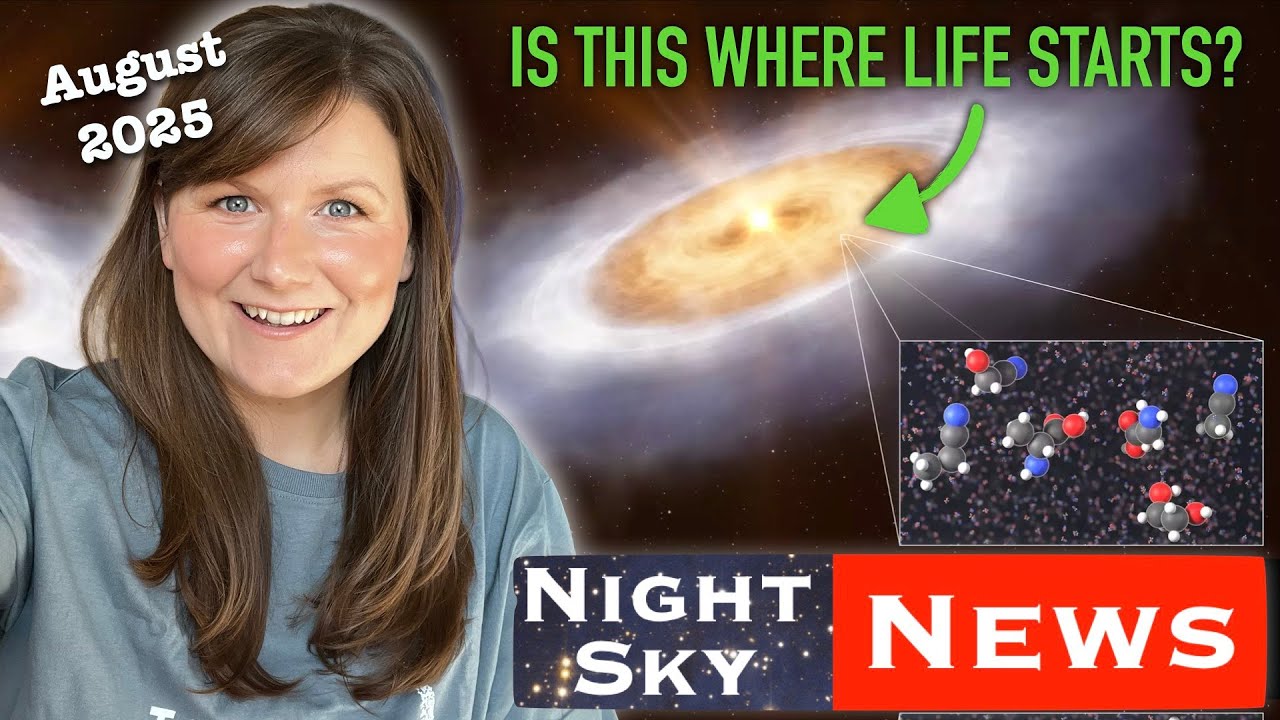
chat about this paper from Fowl and Collaborators reporting on the discovery of the ingredients for life in the disc of debris that's forming planets around a newly formed star. And this is a really big deal because sure there's a lot of places that we found these ingredients, these building blocks that actually build the proteins that power life. From the gas in outer space between stars to the material that makes up comets and asteroids. But there's always been the question of whether those ingredients for life then survive the collapse down of that gas. It's heating up as it forms the star and then this disc of debris around it that the planets then form from. Do those ingredients survive that process or are they destroyed and then do they reform independently on planets and asteroids and comets depending on the conditions. We didn't really know that until now with this study by Fowl and collaborators who have used the ALMA Observatory, a big array of radio telescopes to detect the radial light from the disc of gas and dust around a newly formed star VA83 in the direction of the constellation of Orion. and their observations revealed some tentative detections of both ethylene glycol and glycolo nitrial. Two building blocks of proteins found right in that gas and dust of the disc around the star that is currently forming planets. That suggests that these kind of molecules can actually survive that process of going from cold gas in between stars to collapsing down to form a new protoar and all of the intense radiation and winds that come with that in a very quite violent process. That would mean that planets forming in these debris discs around newly formed stars could actually inherit the ingredients needed for life rather than needing the conditions and the chemistry to form those molecules in situ on the planets. themselves or even needing them delivered later on from comets or asteroids that enhances the potential hability of any planet formed anywhere in the universe. So these tentative detections are a big deal if you care about finding life out there beyond the solar system one day because they just made that prospect a whole lot more

First woman appointed as Astronomer Royal

likely. Next up, some news a bit closer to home. It was great to see the appointment of my colleague Michelle Dockati as the UK's new astronomer royal, making her the first woman appointed to the position in its 350 year history. Michelle was actually the lead on an instrument on board the Cassini mission to Saturn, which had the most incredible impact to the field, and is now the lead on an instrument on board the Juice mission to study Jupiter's moons, which will arrive at Jupiter in 2031. She is an absolute giant of both solar system astrophysics and geoysics. So it was great to see her become the public face of astronomy here in the UK. A role which carries a great deal of social responsibility. So a big congratulations to Michelle and also a big thank you to Martin Ree as he steps down from the position. Now, another big piece of news that was published this month came from the LIGO collaboration

LIGO detects most massive black hole merger GW231123

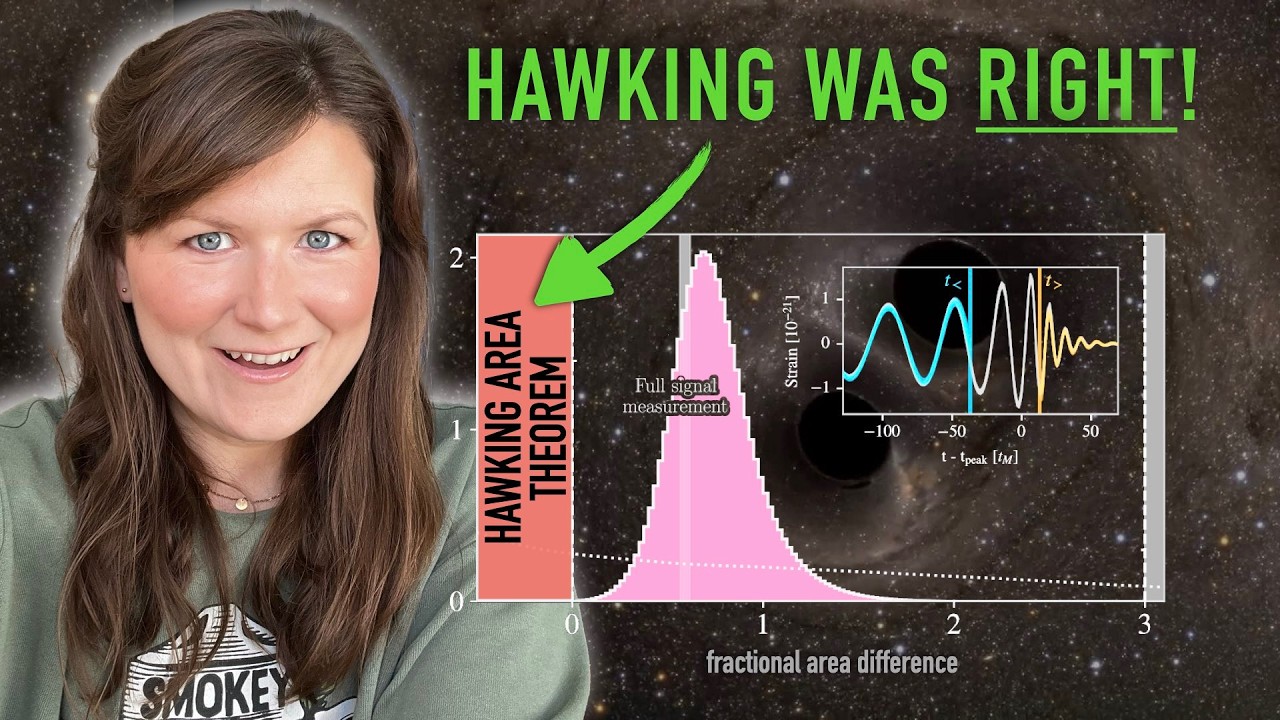
with the announcement of the detection of gravitational wave event GW231123 caused by the ripples through space itself when two black holes merge together. And what's really exciting about GW231123 is that it is the heaviest black hole merger that LIGO have detected to date. So from the gravitational waves they detected they can fit those wave patterns with various different models of black holes merging with different masses using Einstein's theory of general relativity and then they get the best fit model out. When they do that they find that one black hole was around 137 times heavier than the sun and the other one was around 103 times heavier than the sun. That meant that the merger resulted in a black hole that's around about 225 times heavier than the sun. For context on how big this is, as of March 2025, there have been 290 gravitational wave events detected. And only nine of those 290 events detected had a remnant black hole with a mass greater than 100 times heavier than the sun, never mind 200 times heavier. So, this is a big deal for a few reasons. First, that makes it a candidate for an intermediate mass black hole. Those who caught my video on this from a few weeks ago know that we know a lot of stellar mass black holes that form after a star dies and goes supernova and makes a black hole from around 3 to 50ish times the mass of the sun. And we know about lots of super massive black holes at the center of galaxies that are millions to billions of times heavier than the sun. But in between them there is a big mass gap, a knowledge gap where we haven't found any intermediate mass black holes. Since a supernova is the only way that we know of to form a black hole that we have evidence to support, we assume that super massive black holes must grow from these stellar mass black holes from around about you know 10 times the mass of the sun up to a million times mass the sun moving through this regime of intermediate mass black holes. But do they? And if they do, where are those black holes and why can't we find them? So this detection by LIGO that gives us a remnant black hole of 225 times heavier than the sun suggests this happens through merges of smaller black holes. But given how rare these mergers appear to be that make a black hole this big, then is that enough to actually grow all the super massive black holes that we know of to super massive status? And the second reason why this is a big deal is the mass of the two original black holes at 103 and 137 times the mass of the sun. They're already bigger than what we think is possible to make in a typical supernova when a star dies. So have these already formed through multiple mergers of black holes. The best fit model for this data suggests that the spin of these two black holes that merged together were both very high. And we would expect that to be the case if they had indeed gone through previous mergers. So this data does seem to support this idea. But the LIGO team considered many other explanations as well to describe this data. And there have already been other hypotheses published as well from primordial black holes from the early universe to cosmic strings. So I have no doubt that GW231123 will become one of those gravitational wave events that we are going to be debating long into the future. And

Sednoid discovery casts doubt on Planet 9

finally, let's talk about this work from Chen and collaborators that has thrown a spanner in the works when it comes to the infamous planet 9 hypothesis. I've made a few videos in the past on this idea of a ninth planet in the solar system before, including a few on whether it could be a black hole the size of a tennis ball. I'll link those below if you want to check them out. But as a quick recap here, we're not talking about Pluto. Sadly, that is still classed as a dwarf planet. But instead, out on the edge of the solar system, way beyond the orbit of Neptune, is a region filled with icy comets and asteroids that are bits of debris left over from the formation of the solar system. And we call these objects trans neptunian objects, TNOs. And over the past decade, as more and more of these objects have been discovered, astronomers have noticed that the orbits of some of these objects were weirdly aligned and clustered together in a way that shouldn't happen if it was just gravity acting on them randomly. So in 2016, Betigan and Brown proposed the planet 9 hypothesis that this could be explained if there was a massive as yet undiscovered 9inth planet lurking at the outer edge of the solar system. and they estimated it to be five to 10 times the mass of the Earth and orbiting the sun 10 to 20 times further away than Neptune does. Now, despite the popularity of this idea, because it seemed to so nicely explain the observations that had been made, as of yet, no planet 9 has been detected despite many, many searches for it. Although the hope is that as the new Reuben Observatory starts its observations this year, we should spot it in the next 12 months and then we'll actually know where to point our telescopes that you know zoom in a bit more and get us more detail like for example JWST. If we don't find anything then obviously the other option is that there is no planet 9. And that's the way Chennon collaborators are leaning after they made the discovery of this object 2023 KQ14 which they nicknamed Ammonite. And they discovered it using the Subaru telescope on Mount Aaya. It's pretty small. It's only around 380 km or so in diameter, putting it at around about 10% of the size of our moon, which means it doesn't even class as a dwarf planet. Officially, it's what's known as a sedoid as it's very similar to the object Sednner. Another trans neptunian object and both have a very ovalshaped orbit. So, when ammonite was discovered, it was only 70 times the Earth's sun distance away from the sun. But its orbit takes it more than 432 times the Earth's sun distance away. Takes around 4,000 Earth years to make one full loop of the sun. now is the fourth of these sedoid objects that have been discovered with weird elliptical orbits. And it's the sedoids that were the bulk of the objects used for the evidence for the initial planet 9 hypothesis raised by Betigan and Brown in 2016. They were part of these clustered ovalshaped orbits supposedly shephered together by a hypothetical planet 9. But Ammonites's orbit is oriented in the opposite direction. it gets furthest from the sun on the opposite side of the sun to the three other sedites meaning they don't all cluster together. Now Shenon collaborators after their discovery of ammonite have modeled its orbit and have actually found that its orbit has been stable for 4 and a half billion years. The age of the earth and solar system. That's a big blow to the planet 9 hypothesis because when they added a planet 9 object to their simulations, they found that in 47 out of 54 instances, so 87% of the time, ammonite gets ejected from the solar system just because of all the gravitational interactions between these different objects out beyond the orbit of Neptune. So, while there is still a 13% chance that the solar system is in this scenario where Ammonite and Planet 9 coexist, this does cast a lot more doubt on the existence of a planet 9. So, how do we know for sure? Well, finding planet 9 would definitely help, but if not, or in the meantime, then finding more of these saidoids would also help constrain these models of planet 9 even further by once again dropping that percent chance of survival in the model. And while there are lots of sky surveys and telescopes that are dedicated to finding asteroids and TNOs's by looking for anything that moves, the real gamecher in this field is going to be the Reuben Observatory, which as we heard last month, will start survey operations very soon, taking an image of the sky every three nights so we can try and spot all the things that move. So, will Reuben spot more TNOs and more Sednoids, or will it finally spot the infamous planet 9? All right, that's it for night sky news for this month. As always, if you spot any space news stories that you want me to explain in a future video, or if you snap any pictures of the night sky that you want to share, then tag me over on social media, cuz I always love to see those. I just want to say a really big thank you to everyone who shared well-wishes after I shared my news about my breast cancer diagnosis in last month's video. My recovery after surgery has gone really well and I got the fantastic news that there was absolutely no spread to the lymph nodes and the tumor was completely removed. I have had to go in for another surgery sadly though just to ensure good margins around the tumor. So by the time this video comes out I will be in recovery for that. But what it means from here on out is that any treatment I have will all be about reducing the risk of any cancer coming back and not actually treating cancer itself. So a lot of good news there. I'm feeling very positive. So thanks again for all of the well wishes and until next time everybody. Happy stargazing.

Bloopers

Just realized I needed to send an email before I started filming and I didn't. So I'm going to do that. just realized this is the heaviest 231123. And then there was also like was it the first neutron star merger that was discovered and it could be used as the cosmogenic that was like 170817 like with the repetition when all these gravitational wave events have the repetition of the date in the year coming out to after their discovery

Другие видео автора — Dr. Becky

Ctrl+V

Экстракт Знаний в Telegram

Экстракты и дистилляты из лучших YouTube-каналов — сразу после публикации.

Подписаться

Дайджест Экстрактов

Лучшие методички за неделю — каждый понедельник