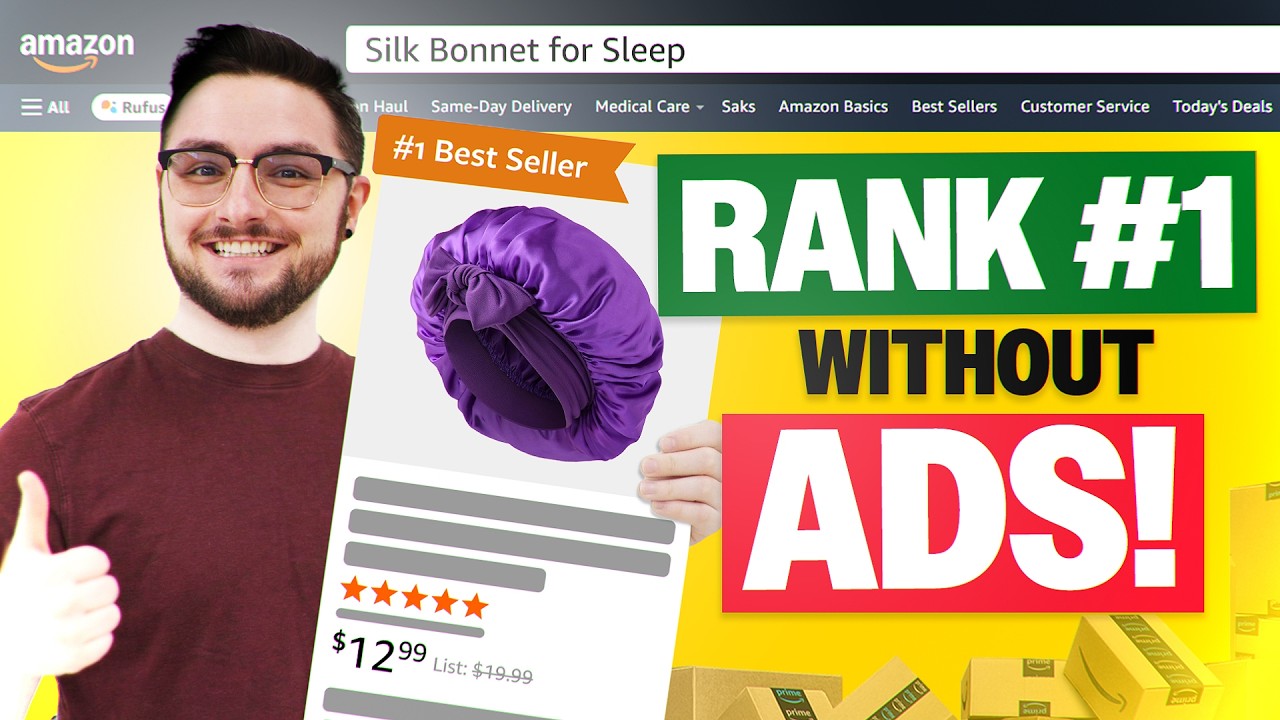
How to rank #1 on Amazon without ads - 2026 SEO Guide
18:47

How to rank #1 on Amazon without ads - 2026 SEO Guide

My Amazon Guy 23.03.2026 513 просмотров 33 лайков

Machine-readable: Markdown · JSON API · Site index

Поделиться Telegram VK Бот
Транскрипт Скачать .md
Анализ с AI
Описание видео
Rank #1 on Amazon without ads using a 2026 SEO guide focused on title optimization, bullet points, and backend keywords. Learn Amazon SEO strategy with keyword research, competitor analysis, and listing structure that improves ranking, impressions, and organic traffic. Step by step Amazon listing optimization using A+ content, alt text, and main image strategy to increase clicks, conversions, and sales organically. If your ads are doing the heavy lifting, it is time to fix the real problem, get expert help to rebuild your listing the right way: https://bit.ly/4jMZtxu #AmazonSEO #AmazonFBA #AmazonListing #amazonsellertips #amazonsellertips Want free resources? Dowload our Free Amazon guides here: Amazon Catalog Spring Cleaning: https://hubs.ly/Q046BVfp0 Growth Email Marketing Strategies: https://hubs.ly/Q04457QF0 Amazon Proft Margin Defense 2026: https://hubs.ly/Q042trRH0 Amazon SEO Toolkit 2026: https://bit.ly/4oC2ClT Amazon Seller Strategy Report 2026: https://bit.ly/3YN1RME 2026 Ecommerce Website & SEO Readiness Checklist: https://hubs.ly/Q040Jg0M0 Amazon 2026 PPC guide: https://bit.ly/4lF0OYX Timestamps 00:00 - Why sales drive more sales on Amazon 00:18 - Ads vs SEO misunderstanding 00:40 - Core areas of Amazon SEO explained 01:08 - How to structure your product title 01:40 - Using high relevancy keywords in titles 02:12 - Adding extra search terms and product details 02:45 - Avoid keyword stuffing in titles 03:29 - How customers actually read listings 04:22 - When to use brand name in titles 05:04 - Bullet points SEO strategy explained 05:48 - Using bullet points for keyword coverage 06:18 - Title vs bullet point ranking impact 07:23 - A+ content and description indexing 08:05 - Alt text and hidden SEO value 09:13 - Keyword research using competitors 10:03 - Using Helium 10 and tools for keywords 11:02 - Filtering high relevancy keywords 12:07 - Finding non-branded keyword opportunities 13:32 - Building a master keyword list 15:23 - Aligning SEO with ad campaigns 16:25 - Competitor strategy and keyword relevance 17:36 - Why main image impacts clicks and sales -------------------------------------------------------------------------- Follow us: LinkedIn: https://www.linkedin.com/company/28605816/ Instagram: https://www.instagram.com/stevenpopemag/ Pinterest: https://www.pinterest.com/myamazonguys/ Twitter: https://twitter.com/myamazonguy Subscribe to the My Amazon Guy podcast: My Amazon Guy podcast: https://podcast.myamazonguy.com Apple Podcast: https://podcasts.apple.com/us/podcast/my-amazon-guy/id1501974229 Spotify: https://open.spotify.com/show/4A5ASHGGfr6s4wWNQIqyVw
Оглавление (22 сегментов)

Why sales drive more sales on Amazon

There's an age-old saying on Amazon that you need sales to get sales. And a lot of people don't actually understand the core of what this means. A lot of times what they think it means is that they need to start funneling money into their ad campaigns to try and get as many sales as possible, but they don't focus on optimizing the core engine behind all of those ads. That would be your Amazon

Ads vs SEO misunderstanding

SEO and optimizations around your back-end search term. Today, I thought I would go over all of the different ways that you can actually utilize organic SEO on Amazon, increase your search volume and your impressions from top ofunnel, which in turn is going to help you gain more traction and more sales and hopefully rank number one within your category. So, the very first thing

Core areas of Amazon SEO explained

to understand with SEO is what are the most impactful areas of SEO as well as how you can you actually optimize for each of those areas. So, the core areas when we're looking at Amazon SEO start off with our title. The title is the number one area for SEO. It is going to have your most impact, most bang for your buck with any form of keywords that you add to it. The very first thing to understand with your title as well is how well you should optimize for it.

How to structure your product title

You'll typically see a lot of much larger brands having something like their brand name and then they'll have a very short maybe 50 to 100 character title and that works really well if you are a well-known brand that people search for all the time. But if you're somebody who's just launching on the platform or you're looking to try and grow, you have to focus on more than just your brand name because you need brand recognition for that to matter within your title. So, one of the biggest things to look at when you're going to optimize your title is the very first part of the title. You'll notice

Using high relevancy keywords in titles

here it says advanced I care. The big aspect of this is that the first three to five words within your title should be specifically your highest relevancy keywords. So, these are in this case advanced eye care on this listing because that's exactly what it is. People are searching for advanced eye care solutions and so that is how they are optimizing their title. The second thing to understand about a title is that you should be adding in any other high relevancy search terms that have to do with specifically your product. This

Adding extra search terms and product details

can be seen in some cases like this one where we're looking specifically at the ingredients list. You can actually see here that they have things such as the goc buckthornne extracts. So this is where you're going to actually add in any other high velocity search volume terms that you want your product to start to rank and list for. On top of that, we'll add in additional layers of optimization for the product around what we're actually seeing the product stand for. So, in this case, it's a 60-day supply, which is something that people frequently look for in a supplement.

Avoid keyword stuffing in titles

Now, the other aspect around titling is that a lot of people have this idea from historical how Amazon work that you should stuff as many of the same keywords into your title as possible. That's not how you should actually utilize a title in this day and age, as Amazon penalizes you for utilizing a search term more than two times within your title. So, you'll actually notice here when we're looking at the title, even something as simple as I, I care, we're only looking at it two different times within the same overall titling. And this is specifically because if you add it three or more times, Amazon's going to ding your title and try and rewrite the title for you on your behalf. And Amazon is not always going to focus very heavily on trying to utilize the best search terms and keywords in the title for ranking.

How customers actually read listings

Instead, they're going to focus heavily on trying to make it look as good as possible for the end consumer. A big misconception a lot of people have when they're making their title is this idea that people are actually going through and reading the entirety of the title, which is not the case. It's actually why we focus the title, the first five keywords on being your most high impact, high relevancy because those are the keywords that when people search a product on Amazon, they actually see. They typically will only show in a title the first five keywords on the SER. And so you want to make sure that if somebody is going to read your title, they know exactly what the product is right out the gate. This brings me back to the point of talking about people who have known brands. The reason they add those at the very beginning of the title is because people know them, people are searching for them, and they want to actually make sure they capture that exact search term and that their search velocity is not being overtaken by any

When to use brand name in titles

competitors. A big aspect with this when you're looking at brands such as this one is that if you have a brand name and has no search velocity towards it, nobody is going to be searching for it and therefore it doesn't make sense to add it into your title. If you do add it to the title, I would recommend adding it closer to the back end of the actual title versus adding it to the front end. It'll have next to the same amount of impact when it comes to SEO ranking and indexing, but you won't have a messy title that doesn't actually focus on the high relevancy search terms within your first couple of words. Now the second part of any SEO strategy is going to come down to the second area on your actual listing PDP that you can focus on and that would be your bullet points.

Bullet points SEO strategy explained

Now your bullet points or in this case Amazon does name them a few different things. For this one is top highlights. You can see this about this item section. Now for most categories you get between five and 10 bullet points. This means that essentially you have all of this different space that you can utilize. What most people do wrong when they are filling out bullet points is that they believe that bullet points should be focused entirely around the idea of very short to the-p point aspects about the item. Whereas in this day and age, bullet points are actually not utilized in a way that people are going to read them. Most people don't actually read the copy on a page. They look at the pictures. An age-old saying we have is for pictures are for people. Reading is for robots. So when we're developing our bullet points, a few key factors here. First and foremost, you'll

Using bullet points for keyword coverage

notice that we have very large bullet points that have lots of information and lots of text. This is purposeful because you want to be able to utilize this to stuff as many different types of search terms and high relevancy terms into your listing as possible. When we're looking at a total search volume and a total ranking perspective of what search terms matter most out of a scale of 100%, you can technically look at the title as 50% of the total volume. then you can look at bullet points as 25%. This means that

Title vs bullet point ranking impact

if we're looking to grow specific terms that are super high relevancy, they should be put into our title. Whereas, if we have other terms that are less relevant, but still somewhat terms that we want to try and show up for, we should focus on having those terms specifically in our bullet points. When you're looking at bullet points as well, you'll notice here that we start out each bullet point with a titling of the bullet. So, nourish, restore, and protect vision. This one right here, proactive long-term eye support. Each one of these is going to be the most impactful part of the bullet points. What actually has the most relevancy? Now, something to understand with bullet points is that typically speaking, Amazon only considers within that 25% of relevancy that I talked about the first 1,000 characters. So, you'll notice towards the end here, they start to make a much smaller one. And this is more of just a directionary. This is very specifically for the aspect of making sure that you're not going over that 1,000 because anything past that 1,00 character limit is going to tend to have a lesser impact on your overall SEO indexing and ranking. Now, once we get

A+ content and description indexing

past the actual bullet points, the other area to focus on is going to be specifically your description and your A+ content. So, a lot of people don't understand this aspect that your product description when you replace it with A+ content does not actually get rid of the back-end description and that back-end description that the A+ content replaced is still there and able to index for keywords that you put into the description. But furthermore, we gain a extra layer of indexable area within our A+ content. You'll see here that I have a extension to view alt text. And when I click that extension, what ends up happening here is you'll see this area right here. So they have a much lesser

Alt text and hidden SEO value

put together alt text on this listing. But alt text at this point in time, especially on premium A+ content like this, is actually indexable and rankable. And so we always want to make sure to fill out the alt text in any area that we have it simply from the aspect that we get 100 total characters in each one of those. A note though, last year Amazon actually made it so that for the products down here in the comparison chart, you'll see empty alt attribute and this happens because Amazon no longer allows us for any type of product like this to add that alt text in. And so this area is no longer indexable for alt text. The other area to focus on within the description area would be this aspect of our brand story. So, our brand story, you can see here, has a lot of different products and a lot images. And again, each one of these different images has the capacity to have that alt text. As you saw, if you have an image that has text though, again, it has to have a short alt text and it will not index. But the brand story is a great area to add crawable text like this that we can add for utilization within our overall SEO

Keyword research using competitors

ranking. Now, the question may remain when we're going through and we're trying to build out the perfect titling, the perfect bullet points, and just the perfect amount of SEO organic rankable terms. How do we actually find those and where do we find those? And the easiest way to go about this is what we're going to consider to be keyword research from our competitor analysis. So, how do we start that? Well, the easiest way to start is to actually find a product within your category, one that is already exceptionally high ranking and understanding what exactly that product is. So, you'll see immediately this is currently the number one ranked overall pick within the category. We can utilize a couple of different tools to start to pull out very specific pieces of uh search terms that we want to have within our titling, within our bullet points, so we can start to rank organically for

Using Helium 10 and tools for keywords

those. The very first thing that I'm always going to do is I'm going to take the asin from this and I'm going to go over to Helium 10 Cerebro. If you haven't used Cerebro or Hel Helium 10, we have a link in the description. I would highly recommend that you go and check it out. It's a great tool for keyword research. If you're not going to use Helium 10, I would also really recommend you use something like data dive. Looking specifically at this, you'll see I put the actual as in here. We can get the keywords from that. And what this will give us is the organic keyword distribution as well as the paid distribution, but we care first and foremost about one thing. So they'll have something like this where it says first page organic. Anything that is first page organic for this type of competitor is going to be likely a very high relevancy search term that we want to put in both our frontend and our backend keywords. When we're going through this, a couple of things to note. We're going to first and foremost go by search volume. So you'll see some irrelevant keywords here such as area, but we're going to go by search volume first and foremost. They have a couple

Filtering high relevancy keywords

of odd ones in here, and you'll typically get this in any type of category that is high relevancy where they have over the years just started adding more and more search terms. So if you get something along these lines want to actually focus very heavily on anything that is relevant to us, a really easy way to do this is to start to add more competitors in. So you'll see we have the Ace in here and we can start to get some of the competitors over here that are very relevant to this specific product. So we'll look through a couple of them so we can find this one. We'll copy that and we can add that in. We can click this one. This one right here. Let's do one of their other ones. And then let's add in just a couple of ones that are not the exact same. So we'll add those in here. And then immediately we can get keywords for all of these. Now, something to note when you add multiple competitors into the actual Cerebro is that you're getting all of these different competitors keywords at once, but you do have to filter through them. So, you'll see here each one of these has their own individual filter that we can go through. What we're going to be doing is focusing again on top keywords or first page keywords. So

Finding non-branded keyword opportunities

we'll do top keywords. So, competitor rank average here is going to be 1 to 40 and ranking competitors is going to be at least three of them. So that means that these products are ranked somewhere between 1 and 40 for these keywords. Again, you can see down here, and we're going to customize our columns to take out some of these click shares as well, just so that we have a little bit nicer of an overall view. But what we can do is again go from our search volume now, our search volume trend, like I clicked there, and see what makes the most sense. So you'll see here that we have a preserve vision aids 2. That's a direct competitor search term which we wouldn't consider to be super high relevancy and we can't actually put into our title and our bullet points. But instead, what we can put into our title and bullet points is something like this eye vitamins. So when we're starting to go through this, we'll actually take some of these and we'll start to click on them when we're looking at them. Going through, we see vision MDI supplement. We see Vision MD. A lot of these are branded keywords. And so instead of branded keywords, we want to look specifically at ones like this one where it's for eye supplements. We have another one here, eye vitamins for macular degeneration. Here's one, vision Alive Max. This is one that I would stay away from cuz this again is still a branded term, but it is one that you could potentially add into your back-end search terms. As we pick out a few of these different ones, you're going to end up exporting out of this

Building a master keyword list

point of exporting this data. and you can export it into a CSV so that we can build something called a master keyword list. This master keyword list is going to give us essentially our overall view of what are the best keywords that we need to be focused on. And we're going to start from a high search volume capacity for each one of those keywords. Now, once you have your master keyword list, you can actually start to make out your title, your bullet points. Each one of these is going to be focused very heavily on adding into each other for the purposes of again ranking and indexing. One of the major things you noticed when we were creating that as well is this aspect that a lot of those were branded terms. If you're looking to try and find very specific high relevancy terms they're not branded for a product like this. They have another filter as well and that is the brand name removal. And all this does is essentially removes any terms they're brand name. Now to get a layer deeper on that I would also look and understand what is the core of your actual product. In this case the core of our actual product is I care specifically I. So we can come over here to phrases containing and we can look for I within that phrases containing as well. So we'll apply that as an additional filter on top of this to find specifically any search terms that may contain the word I that do not contain or do exclude brand names. So immediately we have here again eye drops for dry eyes sty eye treatment allergy eye drops. So a lot of these are going to be semi-relevant but not very relevant. You'll see here again we have eye care we have eye drops eye dropper. So we'll go through again from a secondary layer and try and find these. This is going to be the easiest way to find very high relevancy very specific terms that you're actually going for within your product. Now, the goal of this at the end of the day, as mentioned, is to try and get your product to be rank one within the

Aligning SEO with ad campaigns

category. And to get rank one, you need to have sales. So, whenever we're doing any form of organic SEO optimization, you also want to take that master keyword list and understand that utilizing that for your ad campaigns is not a bad thing. As I talked about at the beginning, people tend to utilize ads to just funnel money into any keywords they think will work and try and get as many sales as possible. But if you're not optimizing your actual front-end copy and back-end search terms specifically for the points of hitting very high relevancy, high search volume terms that you want to rank number one for, then you're not going to make much headway with any form of advertising you do. Super impactful and super important to make sure that your title, your bullet points, your alt text, and your back-end search terms all align very heavily with your actual advertising goals and your advertising campaigns. because if you don't actually end up having them on your product detail page, you're going to end up spending money towards search terms that you can't rank for very well organically. So, at the end of the day

Competitor strategy and keyword relevance

when you're looking at all of this and you are trying to understand what makes sense to add in new keywords, how do you find new impactful keywords? The biggest thing to understand is looking at competitors who have done it before you. Anytime you're looking at a form of competitor or looking through a competitor's listing, understand that there are going to be a lot of keywords in there, they're likely not super relevant, especially for competitors like the one we looked at today that have been around for years. They have tons of different indexable terms that they've built up over years that they likely aren't actually doing all that much with. But the big aspect to understand with that is that you will likely be there at some point, too. But when you first are launching and when you're trying to scale on Amazon, focus first and foremost on anything that is super high relevancy to your product and explains exactly what your product is, how your product works, or what type of ingredients your product contains. This is going to be the easiest way to make sure that you gain customer trust and customer sentiment across the board. On that final note, when you're optimizing for all of these, and when you finally have what you consider to be your highest relevancy, most impactful, important keyword, it's what brings us into a very important area, and that is your main image. At the end of the day

Why main image impacts clicks and sales

we can make all of these optimizations specifically for our title, for our bullet points, for our back-end keywords. We can make a master keyword list that we think is the best in the world, but if no one ever clicks on your listing, it does not matter. So, the biggest thing to think about is you'll notice here immediately we have advanced eye care here, but we also have eye care right on the bottle. And the purpose of having this right on the bottle and making sure that you're actually showcasing it is for what we consider to be a main image click-through rate hack. And that is going to be specifically trying to get as many clicks as possible. Because if you don't get clicks, you'll never get conversions. So, you can have all of the impressions in the world. You can have the best keyword strategy, but if you don't optimize your main image specifically for whatever your highest relevancy search term is, which again is going to be in those first five keywords, you're not typically going to get any clicks. Therefore, you won't get conversions. And at the end of the day, clickthrough rate times conversion rate is your true overall search volume for your product. So, if you like videos like this, feel free to subscribe to the channel and leave a comment down below on something else you'd like to see us make a full in-depth guide on.

Другие видео автора — My Amazon Guy

Ctrl+V

Экстракт Знаний в Telegram

Экстракты и дистилляты из лучших YouTube-каналов — сразу после публикации.

Подписаться

Дайджест Экстрактов

Лучшие методички за неделю — каждый понедельник