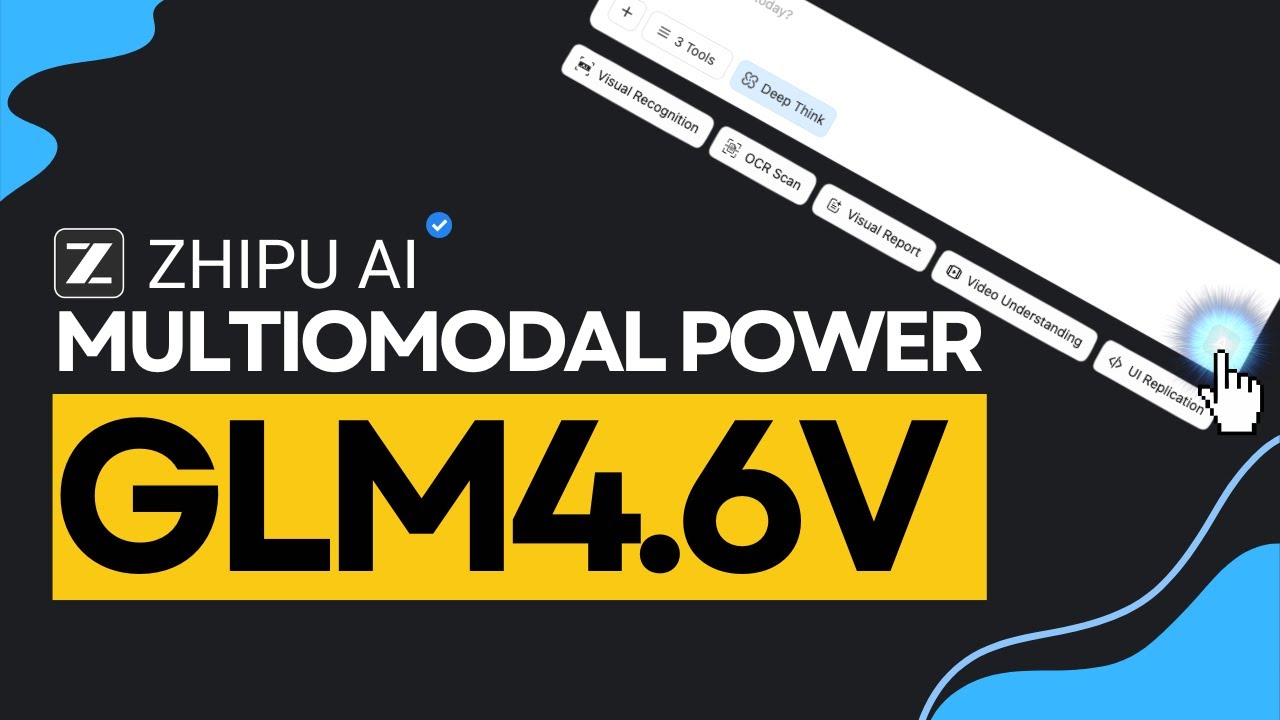
Today I’m testing GLM-4.6V, Zhipu’s newest multimodal model.
Instead of just reading the release notes, we run real demos:
• document understanding
• multimodal reasoning
• video analysis
• UI-to-code generation
• long-context workflows
After that, we break down where the model actually excels based on benchmarks—OCR, chart reasoning, math, agentic tasks, and spatial grounding.
This video is a full, practical look at GLM-4.6V’s real-world strengths
For hands-on demos, tools, workflows, and dev-focused content, check out World of AI, our channel dedicated to building with these models: @intheworldofai
🔗 My Links:
📩 Sponsor a Video or Feature Your Product: intheuniverseofaiz@gmail.com
🔥 Become a Patron (Private Discord): /worldofai
🧠 Follow me on Twitter: /intheworldofai
🌐 Website: https://www.worldzofai.com
🚨 Subscribe To The FREE AI Newsletter For Regular AI Updates: https://intheworldofai.com/
#glmv
#multimodalai
#opensourceai
#Zhipuai
#chatgpt
#gemini3pro
#deepseek
#OCRAI
#AIModelBenchmark
ai news,ai updates,ai revolution,ai,ai,open source ai,glm four point six v,zhipu ai,open source agent,multimodal agents,visual tool calling,long context ai,ultralong memory ai,ui automation ai,frontend generation ai,deepseek,openai,google,gemini,claude,optimus,ai agents,agentic ai,multimodal ai,ai breakthroughs,ai news,tech news,future tech,large language models,open source models,ai revolution,artificial intelligence,machine learning,robotics
Оглавление (2 сегментов)
Segment 1 (00:00 - 05:00)
Today we're talking about GLM 4. 6V, which is an open-source multimmo model when now native tool use. So when this model actually dropped, there were actually two versions of this model that were dropped. GLM 4. 6V, which is a 160 billion parameter model, and GLM 4. 6V flash, which is a 9 billion parameter model. The 4. 6V 6V is actually a foundational model for cloud and high performance cluster scenarios and the flash is for local deployment and low latency applications. 4. 6V actually achieved a state-of-the-art performance in visual understanding and reasoning among many of the models at a similar parameter level. What's really unique about 4. 6V and GLM models are that these are actually designed to be multimodal models first. So traditional models like LLMs often rely on text and require multiple explanations when you give it an image. In simple terms, image, sometimes you have to describe what the image is and what to do with it and then you are able to get an output that is multimodal. However, with GLM 4. 6V, 6V you can also use multimodal inputs like images, screenshots and document pages and they can be directly passed as tool parameters and you don't have to convert them to text and describe what's happening in those images for the model to understand what to do with them. And then you also get multimodal output. The model can actually understand the results returned by the tool such as searching results, statistical charts, rendered web screenshots or even product images that you might give them. and then he's going to incorporate all of that into a final multimodal output. Instead of me just talking about what's new with the model, let me show you its capabilities. The model can take complex multimodal documents like reports, papers, and slides and then turn them into highquality structured image text content. It understands charts, tables, figures, and formulas and even invokes visual tools on its own to crop and extract the key visuals. It performs a visual audit as well to filter noise and then compose a polished article that's ready for social media or downstream workflows. The model supports a full endto-end multimodal search workflow. It identifies the user's intent, triggers the right visual or textbased search tools, analyzes the retrieved images and text and aligns them and then reasons over the combined information to produce a clear structured visually supported answer. The model is also optimized for front-end development. It can turn design files or screenshots directly into accurate HTML, CSS, and JavaScript. It can then replicate layouts at the pixel level and support interactive editing. Users can circle an element, describe a chain in plain language, and the model updates the exact code automatically. The model supports 120K visual context window, allowing it to process hundreds of pages or even an hour-long video in a single pass. It can extract and compare metrics across lengthy financial reports or summarize long- form videos while still identifying fine grained events. Another thing that the model is supposed to be really good at is developing front-end code and designing websites. So it actually has a feature called UI replication. So if you want to select this, what you would do is you can see there's options at the bottom. Visual recognition, OCR scan, visual report, video understanding. So, we're going to try the UI replication feature and I've given it a screenshot of this website which is basically like their store and like everything like that and the shoes show up here. So, I've given it a website and I'm going to tell it to replicate this website. So, let's see what it does. So, as you can see, it's currently coding all this on the side. It's doing this by itself and it understands that it needs to create a single page React app that looks exactly like the screenshot provided. So, it's generating the HTML code at the moment. Okay. Okay, so the model is actually done generating and this actually looks when it comes to UI and UX perspective pretty similar to the website. Obviously the images are not there because like those are different assets and the model might not have good capabilities to generate images like that. But the font looks pretty accurate. Let me put them side by side and let's see. Okay, so these are the models side by side. If we look at it, it's not bad. Like the font looks pretty similar to what we're seeing here. The side on here is pretty much accurate. Obviously, it looks a little bit difference, but it's there. I mean, this is not bad at all. Let's say you have an idea in mind, like a website that you like the design of. You can use this to replicate that website and customize it to your own needs. So, this is pretty good. Another thing that the model is supposed to be really good at is understanding video. So, we're going to click on this feature now, which is the video understanding feature. And I'm going to use probably one of the pre-prompts that it already has. So, we'll do this one, which is shot analysis, decoding shot design, and cinematic language. So, let's click on that. So it's given this video that we can see here which is a advertisement for Coca-Cola. What specific cinematic language was used and what are the highlights of the shot design. Additionally, please summarize the core concepts and narrative structure. So it's thinking about all of that and it has produced a output. So let's see what the output is once it's done generating.
Segment 2 (05:00 - 09:00)
All right. So it recognizes that this is a Coca-Cola advertisement. masterfully employs a variety of cinematic techniques to convey his message of real magic. Here's a detailed breakdown of its language, design, and structure. So, POV shots, dynamic camera movements, match cuts and transitions, special effects and visual magic, uh 2D to 3D animation, scale manipulation. So, it recognizes all of these cinematic shots and what it has done in that video as well. It also pulls out the lighting and color palette. So, the ad starts with a muted almost tone palette reflecting the protagonist boredom. As the magic begins, the colors become more vibrant and saturated. Core concepts are also highlighted. So, this is crazy, guys, cuz like it's able to understand this 1 minute and 52 video, but in there have been examples where people have been able to give it a full soccer match and it's able to understand who scored at what time and everything like that. So, these models are really good and I think this is probably one of the best multimodal models out there. And number one, it's open source. I've given the model the Nike shareholder meeting document which is about a 99page document and is pretty dense. Most of these documents are very hard to read sometimes and has a lot of information. But I want the model to analyze the Nike annual meeting document, produce a clear executive summary, identify key strategic priorities, summarize major financial highlights, extract and restate insights from charts and tables. So, I wanted to read the specific charts and tables and outline any notable operational updates and risk as well. When you're in here, make sure you're selecting the 4. 6V model, which is the new model and not an older model. So, you can see it went through all of that and it came up with a plan. So, this is a thought process of the model. So, you have access to that as well. And what I really liked about this was that it was able to understand what page produces what table and like what to do with that, which shows you it multimodal capabilities. So that's really important for these type of models as well. If we look at it, the executive summary is not bad at all. So it was able to identify the key transition in leadership uh the culture what Nike has mentioned as well like there has been big changes in the board and the governance. So it identified all of that as well and it was able to understand the revenue for the year which was also below target. So good call out by the AI model. So it's pretty good at understanding this thick document which was 99 pages. So it lives up to that long context window. And we also have the ability of the model to recognize specific tables. As we can see it's calling out like page 31, page 29, page 31 here. So we can see that the model is actually understanding and reading these charts and tables which is a good sign. When you look at the benchmarks, GLM 4. 6V has a clear strength profile. It's probably one of the strongest open- source models for OCR, chart reasoning, and structured document analysis, and it consistently extracts numbers, reads the tables, and interprets charts at a level you usually see in much larger models. It also performs extremely well on multimodal reasoning, especially with math and diagram based tasks, and shows high accuracy in spatial grounding, meaning it understands object locations and visual references very reliably compared to other open- source models. And then there's aentic performance on test like design to code. GLM 4. 6V is probably one of the top performing models in it size class which aligns with its UI to code and interactive editing capabilities. Overall, it strengths line up directly with real enterprise workflows, document intelligence, technical reasoning, and toolbased automation. So this is really good for a model like GLM 4. 6V and for open- source models out there. So, if you're looking for a really good multimodal model, this could be the one. If you enjoyed this video, this is what we do here. Fast, clear updates on the biggest moves in AI. If you want to stay ahead of everything happening in this space, make sure you're subscribed. And if you want the hands-on side demos, tools, workflows, and everything developers can actually build, check out the world of AI. We also run a simple no noise newsletter that gives you the most important AI tools and updates in just a couple of minutes. Subscribe here. Follow World of AI. Join the newsletter.